
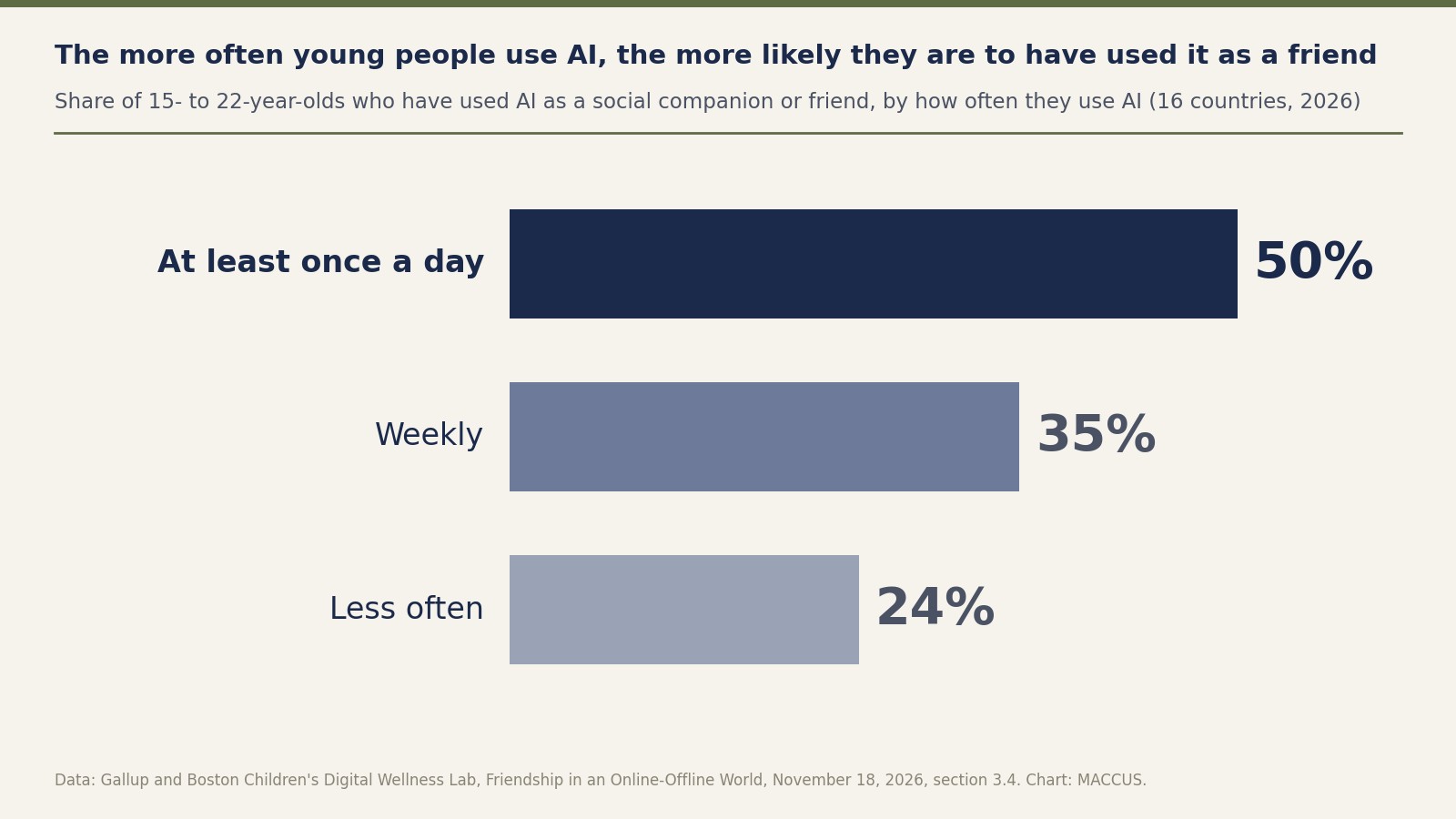
Half of 15- to 22-year-olds who use AI at least once a day say they have used it “as a social companion or friend.” The finding comes from a survey of 15,925 young people in 16 countries. The polling firm Gallup and the Digital Wellness Lab, a nonprofit research center at Boston Children’s Hospital, published the results on November 18, 2026.
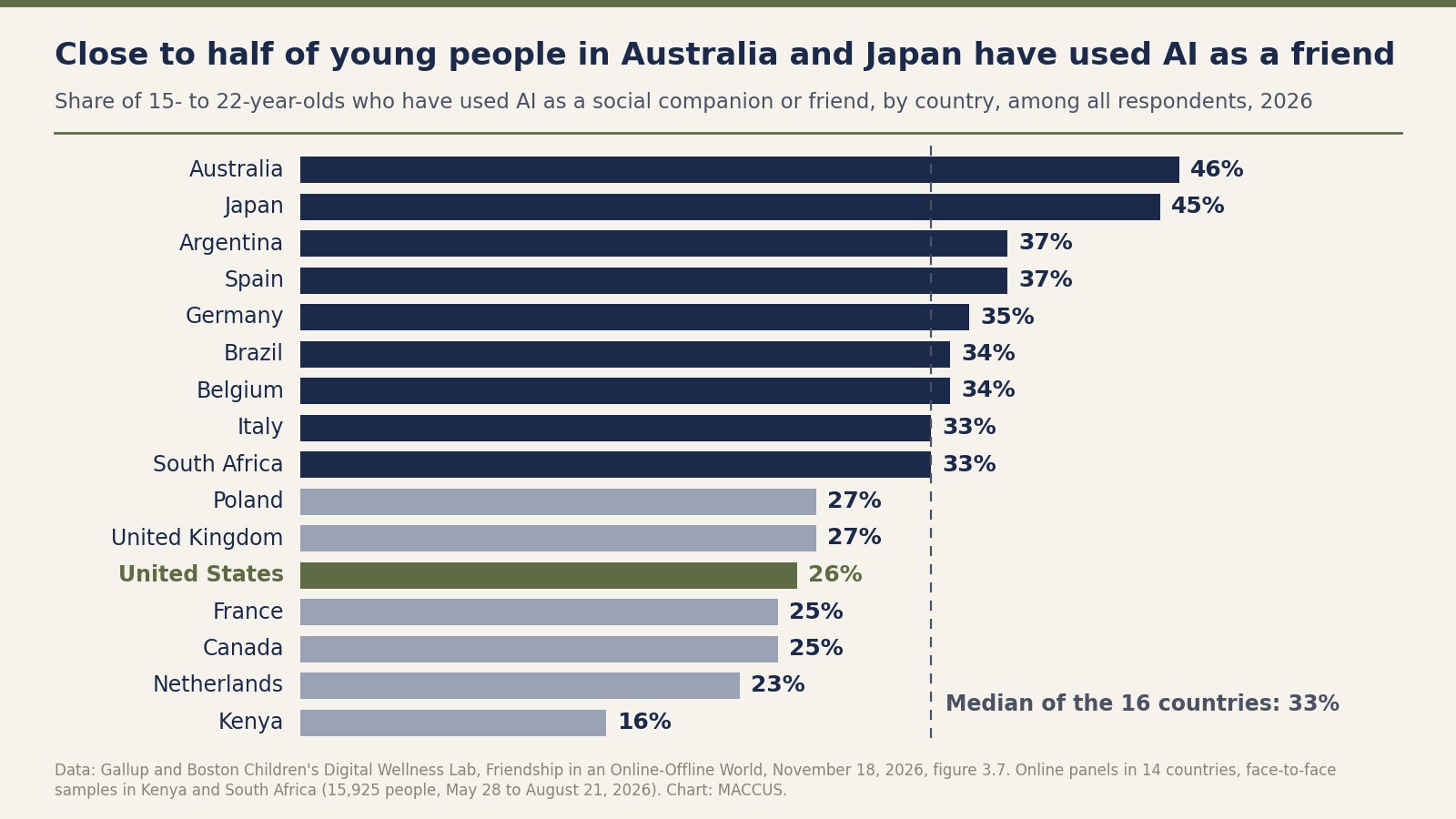
Among all respondents, including those who rarely use AI or did not use it in the past month, the median share who have used it this way is 33%. That is the middle value of the 16 national results. Country results range from 46% in Australia to 16% in Kenya, with Japan at 45%, the United States at 26% and France at 25%.
Young people who have used AI as a companion are more likely to report high loneliness. They have 70% higher adjusted odds of scoring high on a loneliness scale than those who have not. “Adjusted” means the comparison accounts for other factors, such as the quality of their friendships. Gallup says its data cannot show whether loneliness leads to AI companionship or the reverse, or whether other circumstances explain both.
Most young people still have an in-person friend: a median of 93% have one.
A survey of 15,925 people aged 15 to 22
Research teams at Gallup and the Digital Wellness Lab wrote the report, Friendship in an Online-Offline World. The Pinterest Impact Fund, a charitable fund of the social platform Pinterest, supported it. Gallup also posted a summary page.
Most of its 56 pages are about friendship, in person and online. AI gets one section, plus a passage in the chapter on loneliness.
The survey ran from May 28 to August 21, 2026. In 14 countries, about 1,000 young people per country (820 in the Netherlands) answered online, in web samples of volunteers rather than random samples.
In Kenya and South Africa, interviewers met face to face with respondents chosen at random, in samples meant to represent each country. Gallup weights the data within each country. Each national result has a margin of uncertainty of plus or minus 3.1 to 3.8 percentage points. Many cross-country figures in the report are medians, like the 33%, so each country counts the same.
A Gallup News article on the same survey, published on November 17, focused on wellbeing. Young people with a good in-person friendship give their lives higher ratings, and Gallup finds no such link for online friendships. Scrolling through short-form videos is the one online activity linked to lower wellbeing. Among those with regular internet access, 72% do it often or very often.
Companion use is most common among daily users
Most young people in the survey use AI to get information. A median of 82% have asked it a question they did not know the answer to, and 68% have asked it for advice about a specific concern or decision.
Separate data track AI in schoolwork. A UK survey found 94% of undergraduates using AI on graded work. On French-language Wikipedia, pages on the school curriculum have lost much of their back-to-school surge since ChatGPT arrived.
How often young people use AI varies by country. The share who use it at least once a day ranges from 15% in Kenya to 39% in Brazil. It is 36% in Italy, 35% in Japan, and 20% in the United States and the United Kingdom. In the United States, the United Kingdom and Canada, nearly half used AI no more than a few times in the month before the survey, or not at all.
Companion use rises with how often young people use AI. Half of those who use AI at least daily report using it for companionship. The share is 35% among weekly users and 24% among those who use it less often.
From 46% in Australia to 16% in Kenya
Among all young people surveyed, the share who have used AI as a social companion or friend is highest in Australia (46%) and Japan (45%). Argentina and Spain follow at 37%, Germany at 35%, Brazil and Belgium at 34%, and Italy and South Africa at the 33% median. Below it come Poland and the United Kingdom (27%), the United States (26%), France and Canada (25%), the Netherlands (23%) and Kenya (16%).
Other data from Japan show frequent personal use of AI. In February 2026, 22% of Japanese aged 15 to 69 chatted with an AI or asked it for advice at least once a week in their private lives. That figure comes from the Mobile Society Research Institute of NTT Docomo, a Japanese mobile carrier.
Kenya’s 16% counts all young people surveyed there, including the 42% who had no regular access to an internet-connected phone or computer.
Medium is the most common grade young people give their AI companionship: across countries, a median of 54% rate it medium quality, 23% high and 24% low. In Australia, 45% rate it high, compared with 35% in South Africa and Kenya and 12% in Poland. Gallup advises caution in comparing these grades with the ones young people give their friendships, since young people may expect different things from an AI companion and from a human friend.
Who turns to AI for company
AI companionship is more common among young people whose friendships run partly online. Among young people who used AI in the past month, 42% of those with an online-only friend, someone they have never met in person, report AI companionship. The figure is 26% for those without such a friend. The gap is similar for friendships that began in person and moved online: 36% compared with 22%.
Gallup’s press release adds that AI companionship is most common among young people who feel obliged to be available online at all times or who report higher anxiety. It is also most common, the release says, among those who lack a close in-person friend or a strong relationship with a parent or caregiver. That list does not appear in the report itself.
What the survey cannot show
The loneliness finding is an association: the two things go together in the data. Gallup measured loneliness with three questions about feeling left out, feeling isolated and lacking companionship. Young people who report AI companionship have 70% higher adjusted odds of high loneliness than those who do not. The adjustment accounts for friendship quality, satisfaction with in-person social time and other characteristics.
Odds compare the chance of being in the high-loneliness group with the chance of being outside it. The report says these findings “do not establish whether dissatisfaction with social time or AI companionship contributes to loneliness, results from it or reflects other circumstances.”
Some of the report’s own numbers fit poorly with the idea of AI replacing friends. Among young people who used AI in the past month, those with and without an in-person friend report AI companionship at about the same rate, 31% and 33%. Gallup says that gap is not statistically significant, meaning chance alone could explain it. Few young people lack an in-person friend: a median of 93% have one, and just 4% have online friends without an in-person friend.
The method has limits too. In 14 of the 16 countries, respondents were online volunteers, so the results may not reflect young people who do not take part in such surveys. The survey’s AI questions refer to “AI apps, websites or platforms” in general, and the report does not say which products young people use as companions.
What it means
In a typical country in the survey, about a third of young people have used AI as a social companion or friend, and the share is highest among daily users. If that link holds, more daily use in countries such as the United States and the United Kingdom, now at 20%, would mean a higher companion share there. The country figures complicate that reading: Brazil has the highest daily use, at 39%, yet its companion share of 34% is near the median. Australia leads at 46%, with daily use of 29%.
The report and the press release point to a group worth watching: young people who combine AI companionship with an online-only friendship, anxiety or a weak bond with a parent. The data do not show that AI makes anyone lonelier. Most companion users also have an in-person friend, and medium is the most common grade they give the AI relationship.
Studies that follow the same young people over time could show whether loneliness comes before AI companionship or after it. Data on which products they use, and for how long, could show whether “AI as a friend” means a dedicated companion app or a general chatbot used for personal conversations.
Sources
- Friendship in an Online-Offline World: Digital Life, Connection and Wellbeing Among Young People, Gallup and Boston Children’s Digital Wellness Lab, November 18, 2026
- Friendship in an Online-Offline World, Gallup (report page), November 17, 2026
- Not All Screen Time Is Equal: How Young People Connect Online Matters for Wellbeing, Gallup and Boston Children’s Find, Gallup (press release), November 18, 2026
- Youth Wellbeing: What Matters Online and Off, Gallup News (Zacc Ritter, Michelle Chau), November 17, 2026
Header image: MACCUS chart drawn from Gallup and Boston Children’s Digital Wellness Lab, Friendship in an Online-Offline World (November 18, 2026), figure 3.7