

Anthropic published a new version of Claude’s usage policy on October 8, 2026, and it takes effect on November 12. TechCrunch and Génération-NT focused on the ban on mistreating Claude. For a business, the changes that matter are elsewhere: fake reviews and satellite sites, decisions that affect a person (hiring, tax, legal advice, housing), chatbots, agents and resold access.
What Anthropic published, and when
The Usage Policy applies to anyone who sends input to Claude: on Claude.ai or Claude Code, through the API, through a cloud provider or inside a product that integrates it. The previous version had been in force since September 15, 2025. In its October 8 announcement, Anthropic says most of the changes clarify existing rules.
If Anthropic suspects a violation, it may warn you, throttle or limit your access, suspend it or terminate it. The text adds that a blocked output does not, by itself, mean you broke the policy.
The rule that made the headlines
The new policy prohibits “sustained and needless abusive or cruel behavior toward our models”. TechCrunch calls it perhaps the change that has drawn the most attention. On Reddit, five of the most prominent threads of October 9 in AI forums were about it.
Anthropic limits its scope to extreme cases: users who repeatedly act cruelly towards its models with no discernible purpose. It does not cover ordinary frustration, pushback, dark themes in creative work, or model testing and research. Enforcement still rests mainly on Claude’s ability to end an abusive conversation on Claude.ai and Claude Code. Génération-NT notes that the new policy does not say whether heavier sanctions are planned.
In our reading, this rule changes nothing for ordinary business use: swearing after a bad answer counts as ordinary frustration.
What changes for a small business
Fake reviews, fake accounts and so-called independent sites
The rules on deception used to be spread across the elections, fraud, privacy and disinformation sections. They now sit in a new section, “Do Not Engage in Deceptive Campaigns or Artificial Activity”, which covers commercial as well as political deception.
This section prohibits creating fake accounts, media outlets or organizations to mislead people about where a message comes from, how widely a view is held, or whether they are talking to a human. The text names fake reviews, astroturfing and bots that claim to be human. Fake reviews were already prohibited in the 2025 version.
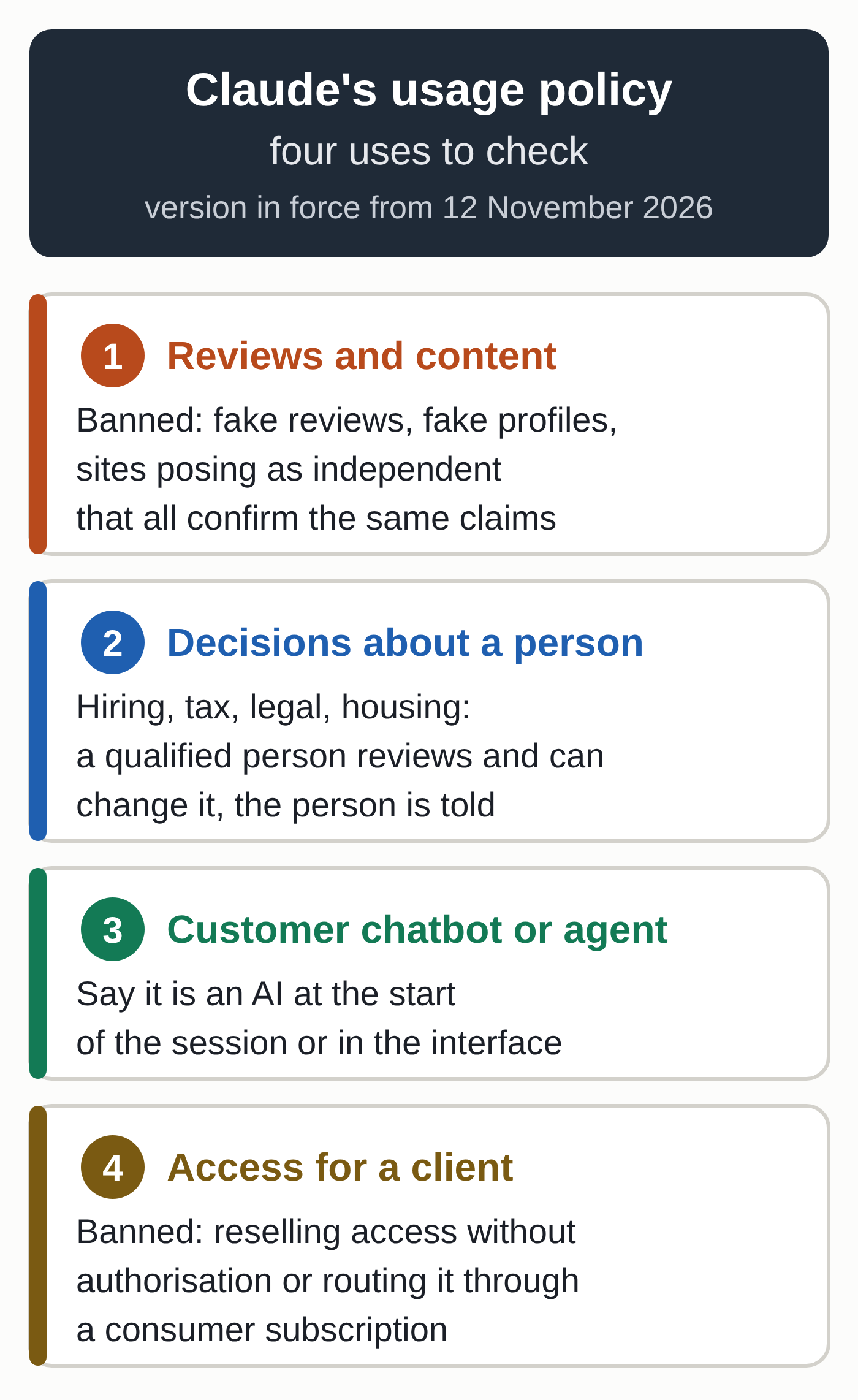
New for agencies: the policy now explicitly prohibits efforts to “manipulate the sources from which search engines or AI systems draw answers” with content that misrepresents its origin, authorship or independence. Its example is a network of sites posing as unaffiliated sources that corroborate the same claims.
In our reading, a provider that sells you visibility in AI answers through a network of sites it controls but presents as independent is caught by this rule. Building or maintaining the tools for such campaigns is also prohibited, as is selling them as a service.
Hiring, tax, legal advice, housing: a qualified person and clear disclosure
Anthropic uses the term “High-risk AI Recommendations” for advice and decisions that affect a person’s health, legal rights, finances, livelihood, or access to housing, education or essential services.
Two requirements apply, unchanged according to Anthropic. A qualified person must meaningfully review the recommendation, with the authority to change it, before it is given to the individual or used to make a decision, and that person remains responsible for it. The individual must also be clearly told that AI was used to produce it, without any need to name Anthropic, Claude or the model.
The list of areas, on the other hand, is now spelled out. Four come up often in a small firm or practice:
- Employment: screening, ranking or rejecting candidates, hiring, shifts, hours, pay, evaluating or disciplining a worker.
- Finance: advising an individual on their own taxes, preparing a tax return they will sign, recommending specific investments.
- Legal: advising someone on their rights or obligations, preparing legal documents they will sign or file.
- Housing: approving, refusing or ranking a rental or purchase application.
Credit, insurance, healthcare, education and public benefits are on the list too. Excluded are preparatory work (internal drafting, research, summaries or analysis that is not the final recommendation), general explanations of what a law says, business operations that do not concern a specific individual, and applying a fixed rule where the model exercises no judgement about the person.
In our reading, an accountant who has Claude prepare a first draft of a tax return, corrects it and stands behind it stays within the rules as long as the client is told. A small business that has Claude sort CVs must have the ranking reviewed by someone trained in recruitment who can change it, and must tell the candidates.
These requirements do not replace local law, the policy says. In Belgium and France, the GDPR and the EU AI Act also apply.
Chatbots and agents that deal with your customers
Any consumer-facing chatbot or AI agent that communicates directly with external users must tell them they are dealing with an AI, at a minimum at the start of each chat session or in the product interface. The obligation existed in 2025; the option to show it in the interface is new. In the European Union, Article 50 of the AI Act, which has applied since August 2, 2026, points the same way: people should know when they are interacting with AI.
You must also make sure your agents comply with the policy, including the actions they take through tools, browsers or connected systems: follow-up emails, posts, completed forms. Getting around the rules or terms of other platforms is still prohibited, something to bear in mind if you prospect on LinkedIn.
Reselling or sharing access to Claude
Another addition compared with the 2025 version: it is prohibited to “resell, proxy, or otherwise provide access to Claude through unauthorized means, including services that route requests through consumer subscriptions”. An agency or freelancer who plugs a client’s tool into their personal Claude.ai subscription is directly affected. For a tool built for a client, the usual route is the API, which falls under Anthropic’s Commercial Terms.
Before paying for a Pro or Max subscription for your business, also read Anthropic’s terms of service, which are separate from this policy.
What does not change for most of you
The policy makes clear that the weapons ban covers the software that makes weapons work and arming drones. A qualified person must be able to stop any machine controlled by Claude that could injure someone.
Tracking a person without their consent, including by analyzing data already collected, is prohibited, as is scoring people on their trustworthiness without telling them. In our reading, secretly analyzing an employee’s messages or movements falls into this category; tracking that people have agreed to, such as fraud detection, is still allowed.
What you can do before November 12
- List the ways you use Claude that lead to advice or a decision about a specific person: candidate, employee, client, tenant. For each one, name the qualified person who reviews the output and check that the individual is told.
- Check that your chatbot or customer-facing agent says it is an AI, at the start of the conversation or in its interface.
- Drop reviews written on behalf of customers, fake profiles and satellite sites, and ask your providers how they get you visibility in AI answers.
- If you are an agency or a freelancer, make sure no tool you deliver to a client runs through your personal subscription.
- Go through what your agents can do on their own (send, publish, pay) and keep a human check before anything goes out to a third party.
Questions still open
The policy sets no threshold for “sustained and needless”, and its general clause (warning, suspension, termination of access) applies to any violation. The idea of a qualified person also leaves room for interpretation: the policy asks for training or experience in the field, and the license the law requires where one exists. In a small business, name that person in writing.
That leaves the question of where the line falls between the clause on search engine sources and ordinary sponsored content. In our reading, it turns on the word “misrepresents”: a signed article presented as a partnership does not hide where it comes from.
If you want to hand your admin tasks to an assistant that learns how you work, see our AI assistant.