

On October 1, 2026, Google changed two pages of its documentation. Fake author profiles now count as “a form of deception”, and Google says it is critical to have a person check every piece of AI-generated content before it goes live. Between 6 and October 8, two SEO consultants reported a rise in manual actions, the penalties applied by a human reviewer at Google. If your site publishes text produced with AI, here is what can now get you a Google penalty, and what to check.
What Google wrote about AI-generated content
The first page is Google’s guidance on using generative AI content. According to Google’s changelog, it now includes information from the guidelines given to its search quality raters.
The guide explains that generative models “don’t retrieve facts, but predict a likely sequence of words”, which means they can get things wrong. That is why it says: “It is critical to manually factcheck and review all AI-generated content for accuracy and trustworthiness before publishing.”
That review also covers metadata that can appear in search results: the title element, the meta description, structured data and image alt text. The guide points to two sections of the rater guidelines: 4.6.5, on scaled content abuse, and 4.6.6, on main content created with little to no effort, originality or added value.
For online shops, the guide repeats two Google Merchant Center rules. An AI-generated image must carry the IPTC “TrainedAlgorithmicMedia” metadata. AI-generated product titles and descriptions must be supplied separately and labeled as AI-generated.
Fake authors are now “a form of deception”
The second page is Creating helpful, reliable, people-first content. In the “Who (created the content)” section, right after the advice to add accurate bylines, Google has added a paragraph whose key sentence reads: “Fabricating creator profiles (such as by using AI-generated headshots, made-up names, or false credentials to make content appear as if it was written by human experts) is a form of deception.”
The next sentence says any deception makes a page untrustworthy to users and to Google’s “automated quality systems”, and “is a signal of a low-quality page”. Matt G. Southern at Search Engine Journal reported the addition on October 2: it appears in the version dated October 1 and was missing from a copy saved on June 8.
The idea was already in the rater guidelines, Search Engine Journal notes. Now it is addressed directly to site owners. The same page defines main content and names the four qualities raters assess: effort, originality, talent or skill, and accuracy.
Google’s changelog does not list this edit (checked on October 9, 2026). Our article on Google’s E-E-A-T explains why the author’s identity matters when a page is assessed.
Manual actions are back, say consultants
On October 8, 2026, Barry Schwartz of Search Engine Roundtable rounded up several reports. Marie Haynes, a consultant who has handled manual actions for about twenty years, says she now gets several requests for help a week, up from almost none. She is seeing actions for thin content, pure spam and scaled content, and says most of the affected sites belong to legitimate, long-standing businesses. Consultant Daniel Foley Carter reports the same influx.
Google has not confirmed any increase. Barry Schwartz lists a dozen recent threads from Google’s help forum, including one reporting three rejected reconsideration requests after a clean-up of more than 6,000 URLs.
The September spam update finished rolling out on October 8, as our article on the September 2026 spam update explains. The two work differently: a spam update improves Google’s automated systems, while a manual action is applied by a human reviewer and shown in the Manual actions report in Search Console.
What this means for a small business or independent site
Google’s scaled content abuse policy targets large amounts of unoriginal content that provides little to no value to users, “no matter how it’s created”. The AI guide acknowledges that generative AI can be useful for research and for adding structure to original content.
On Reddit, SEO professionals describe the practices these rules target, without mentioning manual actions. One agency with more than 300 clients says management has staff produce articles with an AI assistant, and that its SEOs spent half a day fixing them. An employee at a company in the insurance sector found that 7,000 of its 8,900 web pages are comparison pages generated automatically, with no human-written content.
Since around September 29, another agency has seen a wave of links from spam sites that look AI-written: up to 3,800 for a single client.
Three common situations in small businesses fall under these rules:
- a blog filled with generated articles, signed with an invented first name and an AI-generated photo;
- near-identical city-by-city pages or product pages generated in bulk;
- articles published without review, with title tags and meta descriptions nobody has read.
There are two levels of risk. Automated systems can push these pages down in the results. A reviewer can also apply a manual action to part of the site or to the whole site; the report shows which.
What to do now
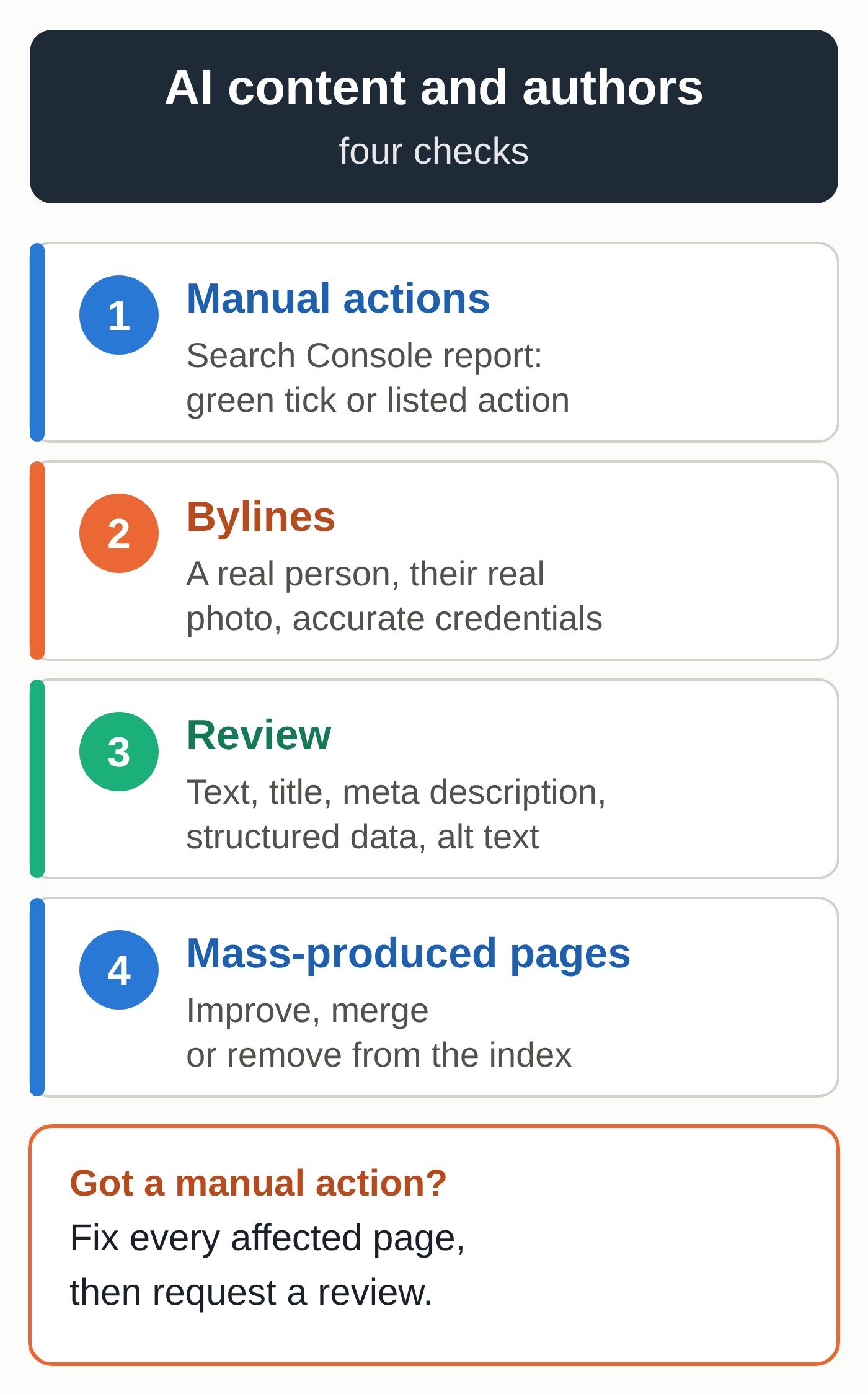
- Open Search Console, go to “Security & Manual Actions”, then “Manual actions”. If your site has none, Google shows a green check mark and a message.
- Audit your bylines. Every name must belong to a real person, with accurate credentials and, if there is a photo, a photo of that person. If no one can put their name to a piece, a company byline is an honest option.
- Review everything produced with AI before you publish it, including facts, figures and metadata.
- Find your mass-produced pages. Improve the ones that help readers, merge duplicates and remove the rest from the index: our guide to indexing explains how.
- Tell readers how a piece of content was made when they might wonder: Google suggests giving background on how automation was used.
- If you get a manual action, fix every affected page, then request a review from the report. According to Google, a good request explains the problem, describes the steps taken and documents the outcome. Most reviews take several days or weeks, and link-related ones can take longer. Don’t resubmit until you have a decision.
A “toxic” link score from a third-party tool is only that tool’s estimate. The Search Console report is the one place that shows a manual action for unnatural links. Our complete backlink guide covers the difference between a useful link and a risky one.
SynthID Detector: what Google can spot
On October 7, 2026, Google opened its SynthID Detector to everyone, worldwide, in English. It tells you whether an image, a video or an audio file was made with AI from Google or its partners, including OpenAI, NVIDIA, Kakao and, soon, Apple. Google says it has watermarked more than 180 billion images and videos since SynthID launched in 2023.
The tool does not analyze text, and Google’s announcement does not link it to search rankings. In practice, your visitors can now check your images themselves.
What to watch
On October 4, 2026, SEO consultant Lily Ray wrote that she expects a major Google update. She bases this on the documentation changes and on the pace of spam updates: four in 2026 (March, June, August and September), compared with one in 2025, by her count. Google has not announced anything so far.
Worth checking regularly: the Manual actions report for each of your sites, and the people-first content page, which Google changed without announcing it this time.
The limits of what we know
The rise in manual actions rests on what specialist consultants are seeing, and no overall figure has been published. Nor does Google say how its systems spot a fake author profile.
Google says the ratings from its quality raters don’t directly influence ranking. A byline alone does not lift a page in the results: Google’s Search Liaison account said so in January 2024, according to Search Engine Journal. The new paragraph targets deceptive bylines.
Check where your site stands
For an outside look at your bylines, your mass-produced pages and your Search Console, ask for our free SEO audit of your site.