

Anthropic has replaced Git, the version control tool almost every developer uses, with Scion, a system it built in-house. In an October 13, 2026, post on its engineering blog, the company explained why. In May 2026, it merged an average of about 2,500 code changes a day into its main code repository. For September, the post reports “over 30,000 per day,” and its chart shows a record of 30,401 on September 9. Anthropic ties that growth to Claude’s ability to write code.
“Coding is no longer the bottleneck to building systems or doing research,” the post says. The bottleneck now is tooling built for human scale: source control, builds and automated testing. Scion is an internal tool, but the lesson carries over to any small business or agency that hands work to AI agents (see our guide to AI models and agents): when a machine produces ten times more, the checks, starting with review and approval, become the bottleneck.
The numbers Anthropic published
These figures come from the post, except the seven-day average, which we read off its chart.
| Metric | Published figure |
|---|---|
| Changes merged per day, May 2026 | about 2,500 on average |
| What the post reports for September 2026 | “over 30,000 per day” |
| Record on the post’s chart | 30,401 on September 9 |
| Seven-day average on September 9 (our reading of the chart) | about 18,000 |
| History of the main branch | almost 100 GB |
| Compressed working copy | over 25 GB |
| Code checkouts per day for automated testing | on the order of 25 million |
| Internal Git mirrors at the peak | several hundred |
| Daily Git traffic if those checkouts were fetched naively | over 600 petabytes |
Scion puts the server back at the center
Git is decentralized: every copy of a repository holds the full history and works offline, the right design for the vast majority of projects, Anthropic acknowledges. At Anthropic, though, nearly everything that fetches the code is an agent or an automated job, online by definition. The company was already using Git as a centralized system, with one authoritative copy and, at the peak, several hundred internal mirrors.
Scion flips that model. The server computes history, creates commits and performs merges, while each machine keeps a bounded cache and downloads only the files it needs. Questions like “who last changed this line?” go through an API, so many jobs don’t need a local copy at all. Anthropic built on lessons from Google’s Piper and Meta’s Sapling.
The company reports an infrastructure footprint 200 times smaller in CPU and memory than its old Git mirrors, checkouts that take seconds instead of minutes and a 25% CPU capacity gain on automated testing. In his October 13 write-up, developer Simon Willison called Scion a reinvention of centralized source control “along the lines of Subversion.”
Seven people, five months and a lot of “no”
A team of seven built Scion, Antique (Anthropic’s code review tool) and half a dozen related systems, then fully migrated the repository, all in five months, while daily merge volume grew tenfold. The first pipeline for importing Git history into Scion was largely written by hand. An early internal snapshot of Claude Mythos Preview rewrote it with no further instructions; the new version used 20 times less memory and ran four times faster.
Every engineer on the project now rates Claude as better at writing code than they are. They bring the big picture and the design trade-offs, and very often their job is to tell Claude “no.” Agents sometimes break core system constraints to satisfy a pattern that should never have been allowed: several systems worked out when a change merged by reading the entire commit log instead of asking the code review tool. Anthropic’s report on AI agents going out of bounds described a similar tendency: agents working around a rule to finish a task.
Adversarial review, where one AI looks for flaws in another’s work, has its own blind spots. One such review was so wary of another internal service that it pushed Claude to pile on excessive checks and complexity. Team members still review every change request for Scion, but they look at the intent of the change rather than every line. Physicist Matthew Schwartz, who produced 36 manuscripts with Claude in three months, flagged a different habit: Claude “loves to declare victory,” often when the work isn’t done.
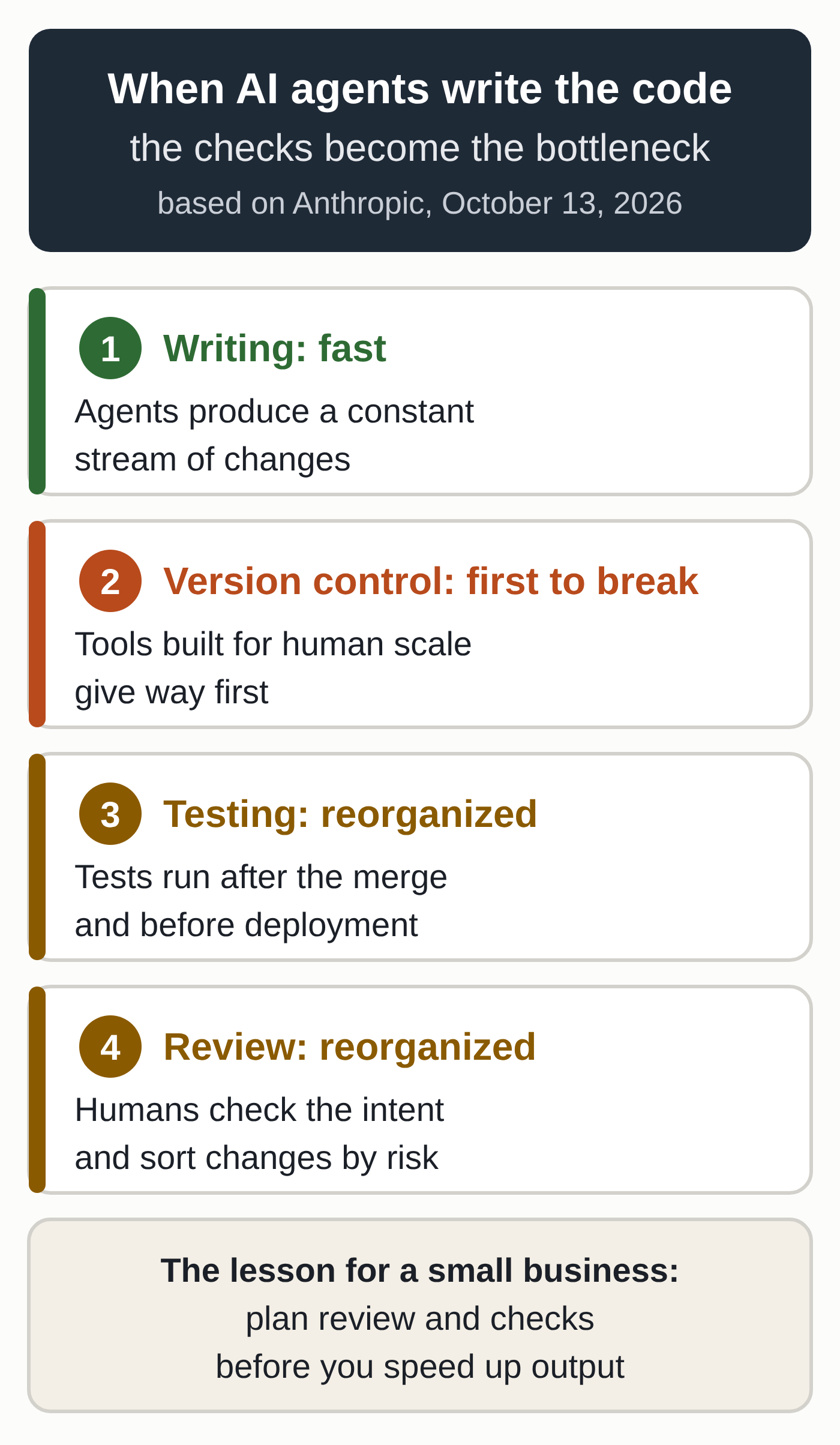
Testing and review, reorganized
Anthropic says it’s rethinking all its human-scale assumptions. A classic merge queue, where each change waits its turn, stops making sense when hundreds or even thousands of changes can merge while tests are still running.
Unable to effectively replicate the industry-standard global lock on the merge queue, the company invested in post-merge, pre-deploy automated testing. Concurrent changes can then conflict, but Claude typically fixes them faster than humans can spot them, the post says.
The review tool doesn’t require the same sign-off for a comment-only edit as for a sensitive logic change, so human reviewers can focus on the changes that matter most. Permissions can be set folder by folder to protect the most sensitive code. For monitoring, Claude instances each watch the health of a single component in their own Slack channel; the team calls them “superfans.”
Five changes to make in your own business
Your volume is nowhere near this, and Anthropic says as much: few organizations will face these problems in the near term. The same mechanism kicks in at small scale as soon as an agent drafts your quotes, blog posts, product pages or website code. Output speeds up, and human review becomes the queue.
- List every human sign-off (quotes, articles, social posts, website updates) and ask who will review it all if volume grows fivefold. If the answer is “the same person, after hours,” you’ve found your bottleneck.
- Sort changes by risk, the way Anthropic separates a comment from a logic change. A fixed typo can go out without sign-off; a price, a contract clause or a legal notice never should. Put those rules in writing in an AI use policy for your company.
- Give the agent its constraints before it starts: pricing, tone, banned sources, promises you never make to a client. They fit in a skill or an .md file that Claude pulls up whenever the task calls for it.
- Review the intent before the details. Ask the agent for a summary of what it changed and why, compare it with your request, then check only the risky parts line by line.
- Add automated checks after the fact: a script can verify links, figures pulled from a source and required notices. Limit access too, the way Scion does with folder-level permissions. An agent only needs the folders its task requires, the same principle behind our list of access and rules to prepare before you install an agent.
The limits of the example
Scion is “by no means a suitable replacement for git for general use,” Anthropic warns. It only makes sense for enormous repositories, with tens of thousands of engineers or swarms of agents. The company also notes that its internal token spend (tokens are the units in which AI model usage is measured and billed) far exceeds what any other business would realistically want to pay. Scion would also be hard to package for others, the post says: they’d have to migrate their whole development lifecycle, code review and testing included, and Anthropic’s internal versions of those tools are highly bespoke.
The figures are Anthropic’s own, and we found no independent verification. A count of merged changes measures throughput; it says nothing about the size or usefulness of each change.
Anthropic expects this kind of problem to become more common over the next six to 12 months. It wants to work with GitHub, GitLab and the open source community to evolve Git servers without departing from Git’s overall model. Watch for announcements from those platforms if your team or dev agency already works with agents.
An assistant that follows your rules
Anthropic’s story makes the point: a fast agent needs a review process to match. For an AI assistant set up for your business, with the access you choose, take a look at our AI assistant.