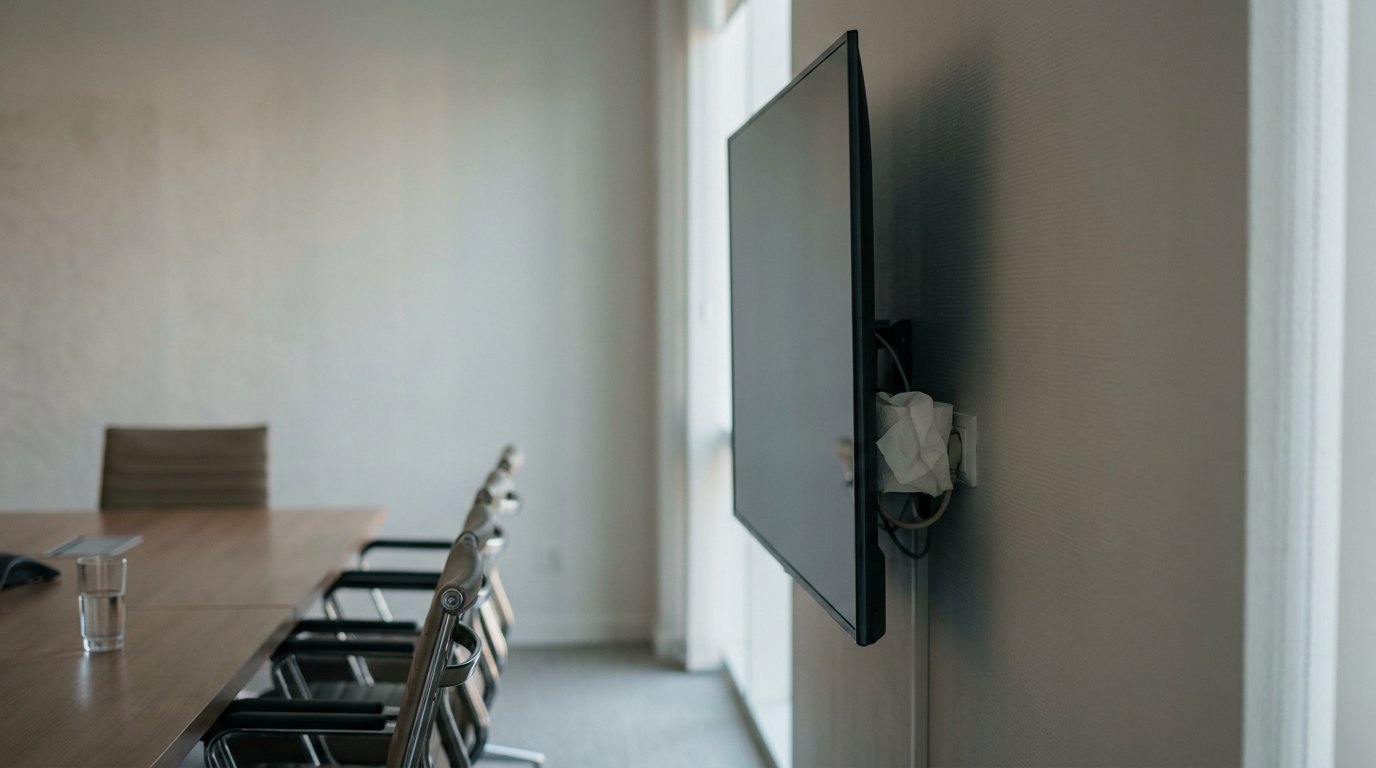

On October 13, 2026, the U.S. Department of Justice announced the arrest of Abdulrahman Alfozan, 35, a Saudi national hired by OpenAI as an engineer in July 2025. According to the criminal complaint unsealed that day, he plugged an audio recorder wrapped in toilet paper into a USB port on the back of the TV in an executive conference room at OpenAI in San Francisco. He was arrested on October 9 and made his initial appearance in federal court on October 13. The allegations in the complaint have not been proven, and he is presumed innocent.
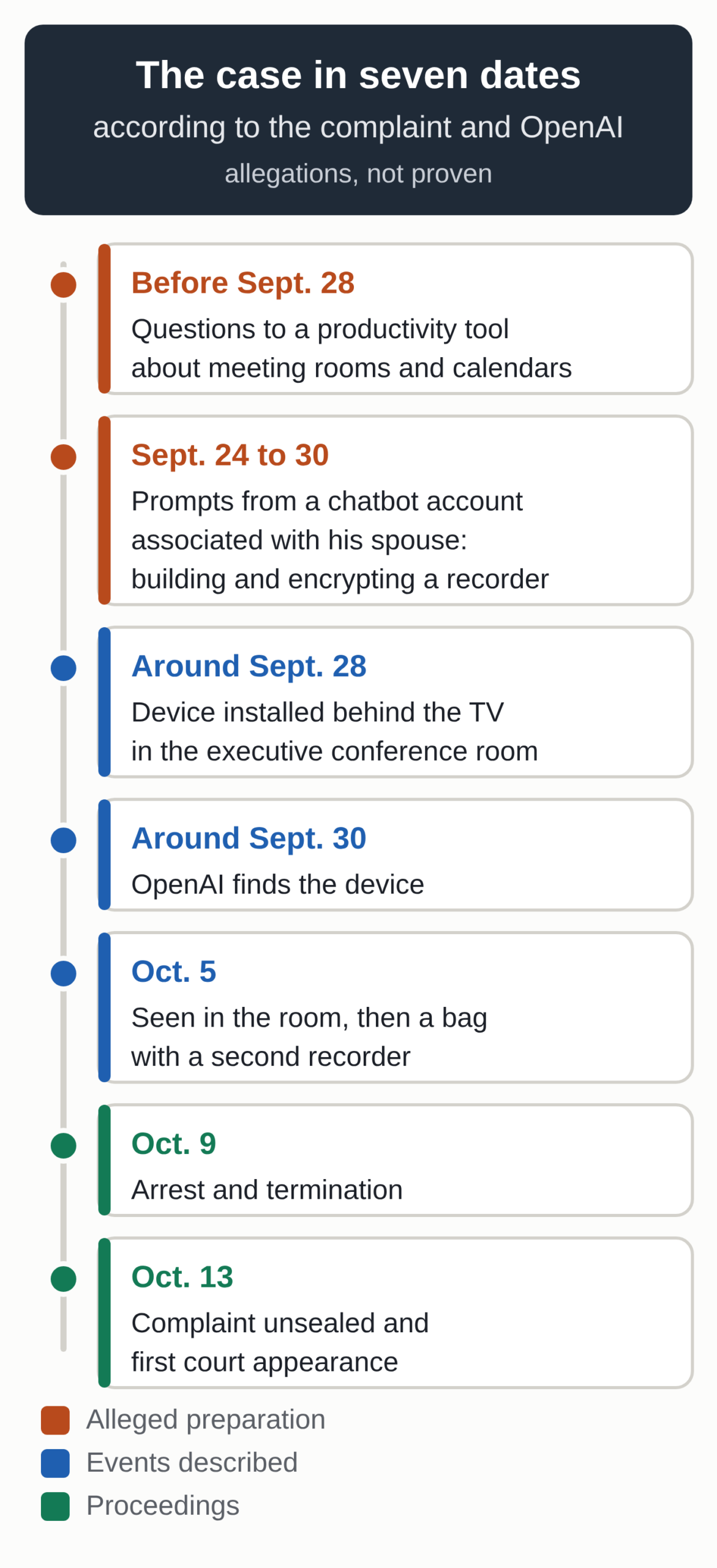
AI tools also appear in the case. According to the complaint, the engineer asked a productivity tool about meeting rooms and their calendars, and a chatbot account associated with his spouse was used to ask how to build an audio recorder and encrypt its SD card.
A recorder behind the executive conference room TV
According to the complaint, the device was installed around September 28, and OpenAI staff found it around September 30 in one of the company’s San Francisco buildings. Its contents were encrypted. The San Francisco Standard reports, citing OpenAI, that the company’s technical surveillance countermeasures team found it during a sweep of the room.
The complaint says meetings in that room often involve highly confidential information: proprietary research, product plans, business-development opportunities and government engagements. Security camera footage allegedly shows the engineer near the room on several dates before the discovery, even though he had no authorization to enter it or to attend those meetings.
On October 5, he allegedly entered the room and appeared to look behind the TV. The Justice Department released a photo of the moment. On or about the same day, according to the complaint, he left a bag unattended in another room, and OpenAI security staff who opened it found his wallet, his ID and a second recorder similar to the first.
A productivity tool and a chatbot in the complaint
Before September 28, according to the complaint, he asked a productivity tool about the addresses of OpenAI’s buildings, its meeting rooms and their capacity and calendars, where “leadership and exec” were located, and meetings with outside partners.
Between September 24 and 30, the complaint says, a chatbot account associated with his spouse sent prompts about building, installing, testing, hiding and remotely accessing a recording device. That account shared multiple identifiers and attributes with the engineer’s own chatbot account. The prompts quoted include how to “build a continuous audio recorder,” improve live listening and “encrypt the SD card.” On September 27 and 28, the same account allegedly asked about the very device that was later found, down to its MAC address.
The Justice Department release names neither the productivity tool nor the chatbot. On X, OpenAI said it used its own models to understand the device and trace it to the employee it says had planted it a few days earlier. It then referred the matter to the FBI. According to the San Francisco Standard, those models were used to analyze forensic images of the device’s storage.
The charge, OpenAI and the defense
He is charged with using or endeavoring to use a device to intercept oral communications. If convicted, he faces up to five years in prison and a $250,000 fine (about €223,000 at the European Central Bank rate of October 13, 2026), followed by three years of supervised release. FBI Director Kash Patel said the engineer allegedly hid the device “to secretly capture sensitive communications about the company’s super intelligence technology.”
In its October 13 statement, OpenAI said that at this time it has “no indications of this individual inappropriately accessing or exfiltrating model weights, source code, or customer data.” According to the San Francisco Standard, he worked on the product team, and OpenAI gradually restricted his access starting September 30. The company fired him on October 9, the day of his arrest, on a date it coordinated with the FBI to avoid disrupting the investigation.
Alfozan’s attorney, William Pernik, told CBS News that his client is presumed innocent. He warned against “jumping to conclusions at this very early stage of the case when very little information is known,” and against politicizing the prosecution based on factors like nationality.
Next hearing on October 19
The case is at a very early stage: a criminal complaint and a first court appearance, with no verdict. A detention hearing is scheduled for October 19 in federal court in the Northern District of California, according to CBS News and the San Francisco Standard. The device’s contents were encrypted, and the Justice Department release does not say what it recorded, who the recordings were meant for or what they were meant to achieve. The Justice Department and OpenAI both say the FBI investigation is ongoing. On October 14, the day after the arrest was announced, eight US states sued OpenAI, accusing it of misleading consumers about ChatGPT’s safety (see our article on the eight state lawsuits against OpenAI).