
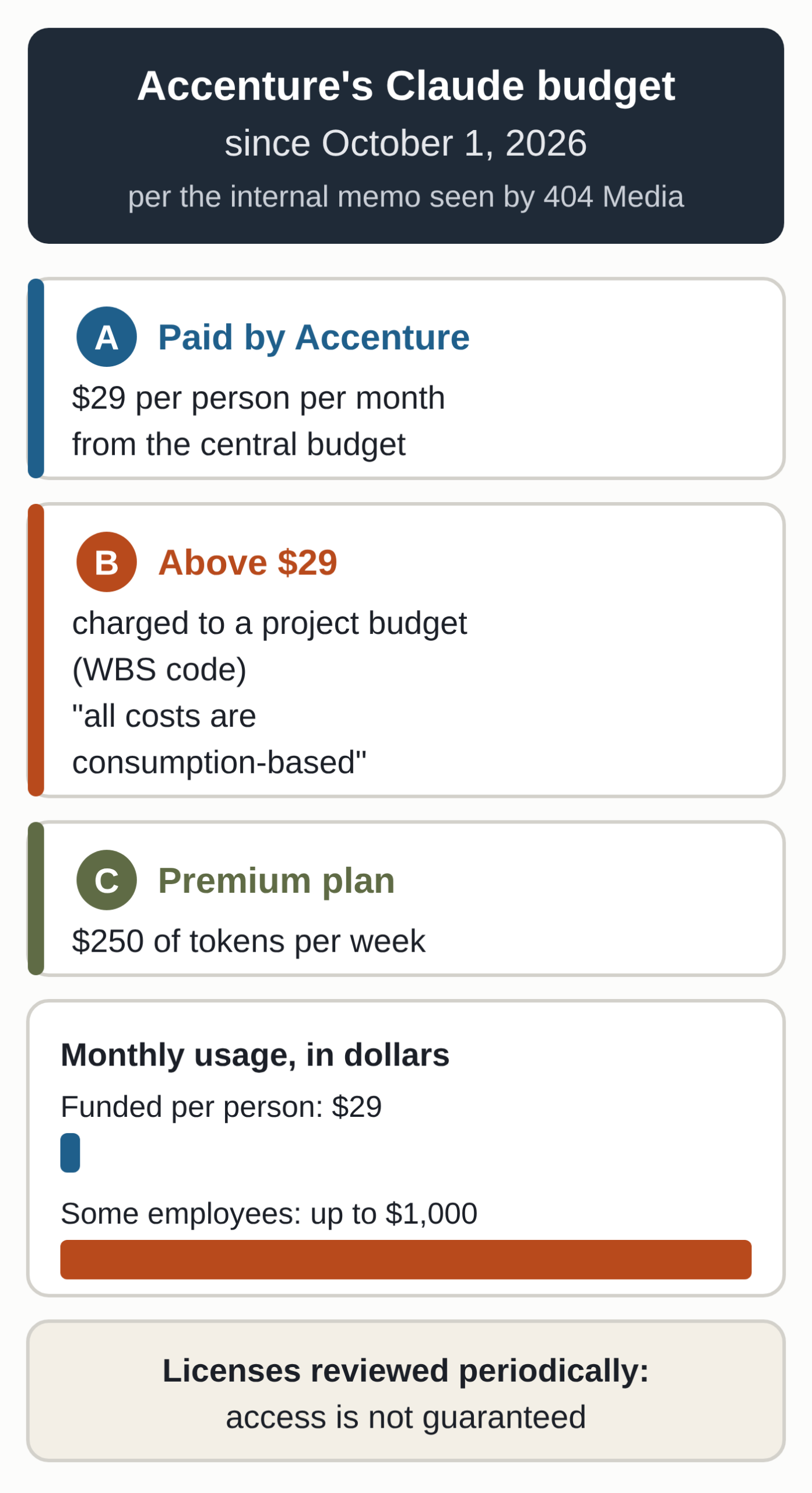
Accenture now covers only $29 of Claude per person per month for many employees on Claude Enterprise, 404 Media reported on October 15. Since October 1, 2026, anything above that has to be charged to a project budget, and some of those employees had been spending as much as $1,000 a month. In February, the same consulting firm told its associate directors and senior managers that they would need to use its AI tools regularly to move into leadership roles. The decision raises a question any freelancer or small business buying Claude for a team will recognize: who foots the bill when one person’s usage blows far past the plan?
The $29 rule is Accenture’s own: Anthropic has not changed its prices or its plans. A flat subscription and pay-as-you-go billing need different controls, and our guide to Claude subscription plans (Pro, Max or Team) walks through each option.
The memo, in effect since October 1
The memo is titled “Claude Enterprise Users: Important Updates to Licensing and Usage Costs.” 404 Media has seen it, but its story is available in full only to registered members. The details below come from The Next Web, which summarized that story on October 16, and from 24/7 Wall St., which reported on the memo the same day.
The memo states that “all costs are consumption-based.” Above $29, employees have to charge the extra usage to a WBS (Work Breakdown Structure), Accenture’s budget code for a specific project or team. According to 404 Media, the firm’s Premium plan comes with $250 of token usage a week, but many employees are on the General plan.
Access itself is now conditional. “Providing a WBS and obtaining a license does not guarantee indefinite or ongoing access to Claude,” the memo warns. Accenture makes Claude Enterprise available based on role and business need, reviews licenses periodically and may move them where they bring the most value.
Consultants at $500 to $1,000 a month
Internal messages seen by 404 Media show employees trying to move to Premium accounts so their projects don’t have to pay for the extra usage. “How can I speed up the upgrade to a premium account? This obviously has a significant impact on project costs,” wrote one of them, whose usage was above $500 a month, as it had been in previous months.
Another, who says they use Claude Code “extensively,” is building and testing an AI accelerator for several Accenture clients, at a cost that usually runs $500 to $1,000 a month. A third said they had lost Claude access entirely.
An Accenture spokesperson told 404 Media that the company makes AI available to all its people and keeps investing in it. “Our approach today is to provide the right tool for the right work,” the spokesperson said. The statement does not dispute the memo.
In February, Accenture tied promotions to AI use
In February 2026, the Financial Times reported on an internal email to Accenture’s associate directors and senior managers: “Use of our key tools will be a visible input to talent discussions.” The firm confirmed the report to CNBC on February 19. According to Fortune, it was already tracking some senior staff’s weekly logins to its AI tools. The FT reported that staff in 12 European countries, which the reports do not name, were exempt, as was the division that handles U.S. federal government contracts.
Before that, on December 9, 2025, Accenture and Anthropic launched the Accenture Anthropic Business Group, with about 30,000 Accenture professionals to be trained on Claude, according to Accenture’s announcement. The firm also said Claude Code would go to tens of thousands of its developers. Anthropic CEO Dario Amodei called it “our largest ever deployment.”
The $29 memo cited an Accenture survey in which 82% of more than 3,000 executives said they are increasing their AI investment, The Next Web reported. 404 Media sees “a special irony” here: the firm encourages its clients to invest heavily in AI while reining in its own employees’ usage.
A flat plan or a usage-based bill
Anthropic runs two pricing models side by side, according to its pricing page, checked on October 17, 2026. Pro, Max and Team seats carry a fixed monthly price and usage limits. Enterprise charges for a seat, about €18 a month billed annually with a 20-seat minimum, then bills usage at API rates: “Usage cost scales with model and task,” the page says. Prices there are listed in dollars before tax, and we convert them at the European Central Bank rate for October 16 (€1 = $1.1253).
According to 24/7 Wall St., Accenture’s $29 targets a consumer subscription price point. A Pro plan, at about €18 a month before tax when billed monthly, caps your usage: when you hit the Claude Pro usage limit, you either wait or pay more. With usage-based billing, spending keeps going until someone sets a cap. Agentic coding tools such as Claude Code, which work through complex tasks on their own, burn through far more tokens, 24/7 Wall St. adds.
The model you pick also moves the bill. On the API, Opus 5.5 costs 40 times as much as Haiku 5.5 per million tokens, for both input and output, on prompts of up to 100,000 tokens. Above that threshold, Haiku 5.5 charges five times as much for both input and output, so long contexts come at a price. Our rundown of Claude models shows which one fits each kind of task.
For agencies, the risk sits mostly in fixed-price work. More than 65% of Accenture’s bookings are fixed-price, 24/7 Wall St. points out. On those contracts, AI usage that nobody priced in up front comes straight out of the firm’s margin.
Budgeting AI by person and by project
- Sort your use cases. Someone who drafts and summarizes may get by on a Pro plan or a standard Team seat. A developer running Claude Code all day is more likely to need Max, a premium seat or an API budget.
- Set a monthly budget per person and check usage every week. Team and Enterprise both let you cap spending per user and for the whole organization, according to Anthropic’s pricing page. Turn those caps on before the first overrun.
- Charge AI to the project, the way Accenture does with WBS codes. Add an AI line to the quote (subscriptions or estimated usage), track usage by client, for example with one API key per project, and compare the estimate with actual spend at the end of the month.
- Hand routine tasks to a cheaper model. Email triage, summaries and data extraction can run on Claude Haiku 5.5; keep Opus for the work that justifies it.
- Write the rule into your company AI policy: who gets which plan, who approves an overrun and what happens when the budget runs out.
Before you pay for a Claude plan for your business, check the terms first: Anthropic’s pricing page says prices and plans are subject to change at its discretion.
A memo Accenture hasn’t published
Accenture has not published the memo or said how many employees are affected, 24/7 Wall St. notes. It is also unclear whether the $29 covers the Enterprise seat price or only usage, and whether other AI tools at the firm follow the same rule.
The February rule covered Accenture’s “key tools” and did not name Claude. Nothing suggests that using Claude specifically counts toward promotion. Our account of the memo relies on The Next Web’s summary of the 404 Media story and on 24/7 Wall St.; we have not read 404 Media’s full text.
To roll out an AI assistant in your business with usage rules set from day one, take a look at our AI assistant.