
On October 15, 2026, Meta released the weights of Muse Spark Open, the open version of its Muse Spark model. It has 816 billion parameters, 42 billion of them active for each token. Its context window reaches one million tokens, and it takes text, images, video and audio as input. In its announcement, Meta calls it “the most capable US open-weight model to date,” built for coding and agentic work.
The license allows free commercial use, both internally and inside products sold to others. Through the API, the model costs the same as the closed version of Muse Spark: $1.25 per million input tokens and $4.25 per million output tokens (about €1.12 and €3.79). Two clauses matter directly to agencies: a “Built with Muse Spark Open” notice you have to display, and a ban on presenting the model’s output as written by a human.
The release comes three days after Muse Wonder, Meta’s new closed model for agents, and on the same day as NVIDIA’s open Nemotron 3.5 models. On October 19, MiniMax launched M3.1 Flash, billed as an open-weight model, without releasing its weights yet. On October 23, Meta launched its Muse personal agent in Japan; Mark Zuckerberg says Muse Spark is the default model in its free tier.
On November 9, Meta launched Muse Ember, a small closed model built for the repetitive work of agents, and did not release its weights.
Where to get the model
The weights are available on Hugging Face, Amazon SageMaker AI, Google Cloud Model Garden and Microsoft Foundry, so you can run the model on your own servers or with the host of your choice. When you self-host, every prompt and every response stays inside your infrastructure, according to Meta’s documentation.
According to Meta, six hosts already serve the model through an API (Baseten, Fireworks AI, Groq, Modal, Nebius and Together AI), and it is also available through the OpenRouter gateway. On Hugging Face, downloads go through a manually reviewed request that asks for your full legal name, your date of birth and your organization’s full name with its corporate identifiers. You can’t edit the form once it’s submitted.
Two Mac Studios or a server with 700 GB of memory
The 42 billion active parameters are misleading when it comes to hardware. Each token only uses part of the model, but all 816 billion parameters have to stay loaded in memory, Meta’s documentation explains. The full BF16 version weighs about 1.65 TB, and the compressed NVFP4 version about 537 GB. The model card on Hugging Face calls for at least 700 GB of GPU memory for NVFP4 and 2 TB for BF16.
Context memory comes on top of the weights. On November 5, 2026, Google researchers published Muir, an architecture that keeps that memory fixed at 25 MB over 10 million tokens, so far tested only on small research models.
Meta and Apple prepared another option: two Mac Studios with the M5 Ultra chip and 512 GB of memory each, linked together and running MLX, Apple’s machine learning framework for its chips. Meta used that setup to run Muse Code, its coding tool, and ship bug fixes and new features to an open-source iOS app. Apple’s French online store says the 512 GB option for the M5 Ultra will be available in late October (checked October 16, 2026). The New Stack expects two of those machines to cost “the price of a compact car.”
On the PC side, Nvidia’s RTX Spark laptops also promise local AI, but on Linux and on wall power, their GPU can stay throttled.
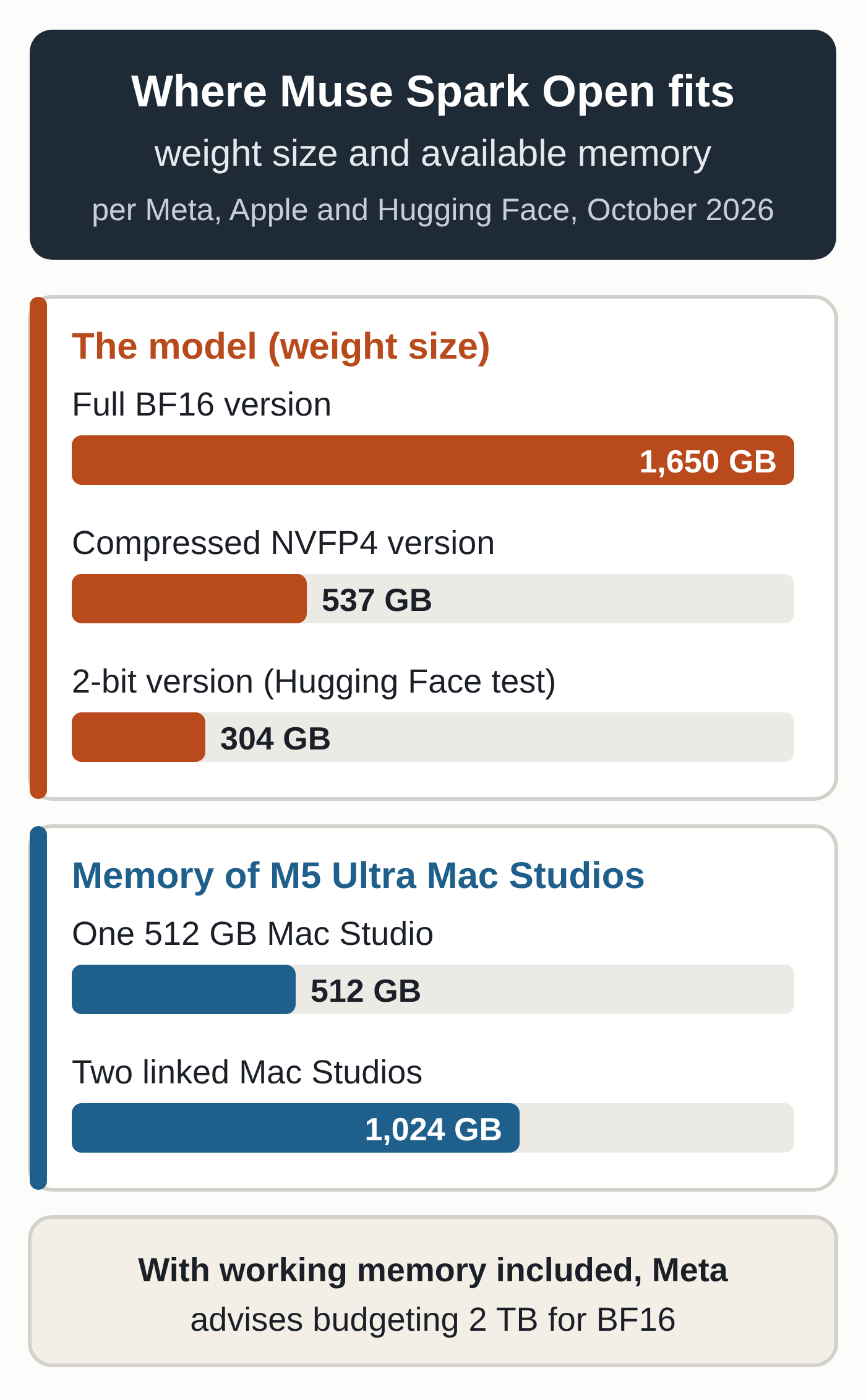
Hugging Face tested other compressed versions. On a single 512 GB Mac with an M3 Ultra, a 2-bit version takes 304 GB and generates 18 tokens per second. The model card notes that compressed versions may show minor quality differences in edge cases.
How much does Muse Spark Open cost through the API?
OpenRouter prices on October 16, 2026, per million tokens, converted at the European Central Bank rate for October 15 (€1 = $1.1208):
| Meta model | Input | Output | Downloadable weights |
|---|---|---|---|
| Muse Spark Open | $1.25 (€1.12) | $4.25 (€3.79) | yes |
| Muse Spark 1.3 | $1.25 (€1.12) | $4.25 (€3.79) | no |
| Muse Wonder | $4 (€3.57) | $20 (€17.84) | no |
The five hosts listed on OpenRouter on the morning of October 16 (Baseten, Fireworks, Modal, Nebius and Together) all charge that rate, and four of them bill cached input tokens at $0.15 per million (about €0.13).
Reasoning effort also affects the bill. The model card sets it to the maximum level (xhigh) by default when you host the model yourself; OpenRouter defaults to “medium.” Hugging Face points out that reasoning can’t be turned off and recommends the “low” setting, which uses fewer tokens, for simple tasks.
The scores Meta published
Meta compares Muse Spark Open only with other open models, including Thinking Machines’ Inkling, NVIDIA’s Nemotron 3 Ultra, Mistral Large 4 from the French company Mistral AI, and three Chinese models: Qwen3.8, GLM 5.3 and Kimi K3. No model from Anthropic, OpenAI or Google appears in the table.
Muse Spark Open comes out on top in two agent benchmarks: 89.2 on MCP-Atlas versus 84.5 for Qwen3.8, and 61.8 on JobBench, just ahead of GLM 5.3 (61.4). Kimi K3 beats it on the other agent benchmarks in the model card, for example 76.5 to 72.8 on Toolathlon Verified, a tool-use test. On GDPval-AA v2, it ranks fifth out of seven with 1,401 points, behind GLM 5.3 (1,653), Qwen3.8 (1,613), Kimi K3 (1,537) and Mistral Large 4 (1,424).
In coding, it trails Kimi K3: 76.4 versus 85.0 on Terminal-Bench 2.1, and 60 versus 68 on DeepSWE 1.1. These numbers come from Meta, which lays out its methodology in a note released with the announcement.
The license terms
Meta says it is releasing the weights under a license “with limited commercial terms.” Frederic Lardinois of The New Stack compares it to the license for Kimi K3, the open model from China’s Moonshot AI. The Muse Model License, dated October 15, 2026, gives you the right, free of charge, to use, modify, distill and resell the model.
The only revenue threshold applies to companies that sell access to AI models through an API. If their gross revenue, affiliates included, exceeds $20 million over any 12 consecutive months (about €17.8 million), they must notify Meta and sign a separate agreement before offering the model as part of that service. Internal use and building the model into your own product are exempt.
The first obligation is the notice. Every product or service that uses the model, or a model derived from it, must prominently display “Built with Muse Spark Open” in its interface, documentation, website or settings menu. A model trained on Muse Spark Open’s output counts as a derivative.
The second obligation comes from the usage policy attached to the license, which bans representing your use of the model, or its output, as human-generated. An agency that uses it to write copy for clients can’t sell that copy as written by a person.
The same policy bans practicing a regulated profession without a license, for example by giving financial, legal or medical advice, and states that the model isn’t intended for anyone under 18. For a company based in Europe, the contracting party is Meta Platforms Ireland Limited, and Meta claims no ownership of the output.
Open questions
Meta says its full safety evaluation report is coming “soon.” As of the morning of October 16, 2026, we haven’t found any independent testing of the published scores. The license doesn’t spell out how the “Built with” notice applies to a customer who only calls a host’s API.