
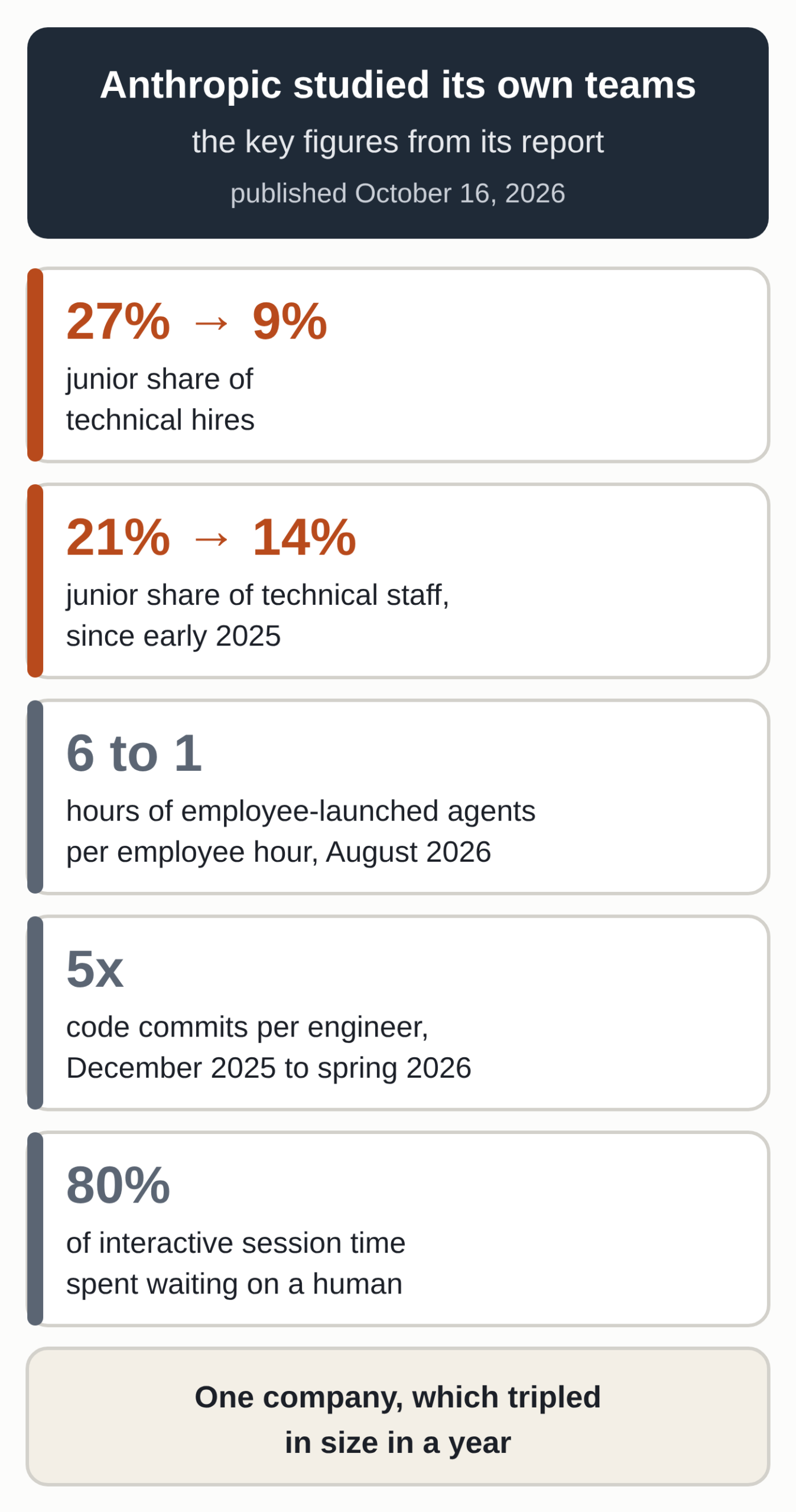
On October 16, 2026, Anthropic, the maker of Claude, published a study of its own workforce based on internal company data. In its technical departments, juniors went from 27% to 9% of hires, and from 21% to 14% of staff since early 2025.
In August, the AI agents that employees launched worked six times as many hours as the employees themselves. Code commits per engineer grew fivefold between December 2025 and late spring 2026. The authors see their company, at the frontier of AI adoption, as a possible leading indicator for the rest of the economy. If your agency or small business already hands work to Claude, ChatGPT or Codex, that includes you.
The report, titled “How employment is changing at Anthropic,” was written by Nathan Wilmers, Regina Catipon, Maxim Massenkoff and Peter McCrory for The Anthropic Institute. It draws on HR records, AI usage data, output metrics, internal surveys, Slack conversations, calendars, hiring decisions and 17 interviews. We previously reported how the flood of code pushed the company to replace Git with its own system, Scion.
The junior share is shrinking in technical teams
Since December 2025, the share of job postings aimed at juniors has dropped especially sharply. On the non-technical side, juniors still made up about 25% of staff at the last data point on the report’s chart.
Talk of lower demand for juniors first surfaced in January 2026 in core technical functions. The teams that relied most on Claude found that writing code and hunting bugs could increasingly be handed off to it. By April, engineering and research had deprioritized hiring for entry-level technical roles. In a survey that same month, about a third of machine learning managers and a fifth of software engineering managers said they were hiring less because of AI.
Anthropic hasn’t stopped hiring, and the report mentions no layoffs. The company tripled in size in the past year. Technical hiring is still growing in absolute numbers, just more slowly than hiring in sales, finance and recruiting: technical departments went from 61% to 56% of headcount. Administrative functions, which usually grow along with a company, added few people because AI assistants, automated review and outsourced support took over.
Six agent hours for every employee hour
According to session telemetry, total work hours across all agents, autonomous and interactive, passed employee hours for the first time in March 2026. Counting only the agents launched by employees, the ratio hit 6 to 1 in August, and 19 to 1 in research teams, according to the report’s chart.
That ratio counts machine hours and does not measure how much work gets done. Agent hours are runtime, including inference and active tool use but excluding any wait longer than 30 minutes. Human hours assume a 40-hour week per employee.
Five times as many commits per engineer
With December 2025 indexed at 100, commits per engineer reached 5.1 times that level by late spring 2026. Queries per data scientist and contracts per legal employee were at 3.1 times, deals per salesperson at 1.7 times and invoices per accounts payable processor at 1.4 times.
Among non-technical employees, sessions with a coding agent went from 2 a month in August 2025 to 90 in May 2026. One sales rep says they built their own dashboard in three to four hours.
The authors admit that the company’s growth muddies the picture: “It is easier to close deals when you sell a strong model.” To isolate the effect of AI, they compare 192 engineers who adopted coding agents with 74 who did not during the period. They warn that “tool adoption is not random” and that more code “does not necessarily mean better code or business impact.” On quality, they found no difference between code written by agents and code written by hand, as measured by how often lines were later removed or reverted.
Human attention is now the bottleneck
The agents wait. According to the authors, interactive Claude sessions spend about 80% of their time idle, waiting for human input. Reading everything those sessions produce would take more than half the work week, even for non-technical teams. One engineer describes facing “an army of Claudes, with every one asking for my attention.”
A growing share of the job now consists of managing the agents. This “meta-work” (writing specs, having one agent review another, monitoring pipelines) rose from 10% of the average employee’s interactive sessions in fall 2025 to 22% in spring 2026. Standing instructions written for agents went from a few hundred in July 2025 to 8,500 a year later.
Meetings are taking up more time, too: the median employee spends 20% more time in them than a year ago, and technical individual contributors spend 16% more. When a decision is made in a meeting and nobody writes it up, the agents miss the context they need to update their goals. At Anthropic, private work in unlogged meetings or direct messages is discouraged as a result.
Hiring criteria are changing
The authors analyzed interview scorecards for thousands of hires made since 2024. In 2024, hiring managers noted a candidate’s track record with AI tools in about 5% of assessments for technical roles and 7% for non-technical ones. By 2026, those rates had tripled for technical roles and quadrupled for the rest.
For technical candidates, comments on autonomy and judgment grew the most, and domain expertise shrank as a share of the assessment. For non-technical candidates, customer and mission orientation gained ground, while execution skills came up less often.
In a note published the same day, Anthropic reports that in August 2026, its staff on average expected AI to be able to do 75% of their current work by 2030, compared with 28% for the US workers surveyed.
At Accenture, AI use now counts toward promotions: since February, its associate directors and senior managers have had to use the firm’s AI tools to move into leadership roles. Since October 1, the firm has capped the Claude spending it covers for many employees.
Our advice for agencies and small businesses
The study covers a single company, but some of the dynamics it describes can show up as soon as a team hands tasks to agents.
- Rethink how you train your next junior. At Anthropic, entry-level tasks (writing code, hunting bugs, managing calendars) are increasingly going to agents. In some roles, the report notes, employees are drifting away from the hands-on work that built their skills. Have your junior review agent output and handle client contact, where there is still plenty to learn.
- Budget for review time, which is becoming a cost in its own right. Decide who signs off on what before you install anything, as laid out in our guide to preparing for an AI agent.
- Write your instructions down once. In a small team, well-written Claude skills play the role of Anthropic’s 8,500 standing instructions: what the agent should know without being told twice.
- Let non-developers build their own tools. A salesperson or an assistant can already automate office tasks without writing code, using Claude Cowork, which comes with Claude’s paid plans.
- Put decisions in writing. Meeting notes now serve the agents too.
- Show how you use AI. Hiring managers at Anthropic increasingly look for it. As a freelancer, you can walk clients through how you work with agents.
The limits of a one-company study
Anthropic is an unusual case: an AI lab that sells the tools it studies, tripled its headcount in a year and is reporting on itself. The authors acknowledge that many of Anthropic’s employment practices “cannot be replicated across the economy.” The study is neither a labor market statistic nor a forecast for any country.
The report closes with three features of Anthropic’s approach: broad employee stock ownership, an early warning system for jobs at risk and internal redeployment. The authors say redeployment could help employers resist “so-so” automation, the kind that replaces workers for minimal productivity gains. None of these measures directly addresses the slowdown in junior hiring, they write: “Employment protections for incumbents will not benefit those not hired to begin with.” They call for government policy on retraining and income support.
Before you hire, look at the tasks
For a small business, the next hire starts with two questions: which tasks to give an agent, and who will review its work. If you want to hand off part of your admin work with review rules set from day one, take a look at our AI assistant.