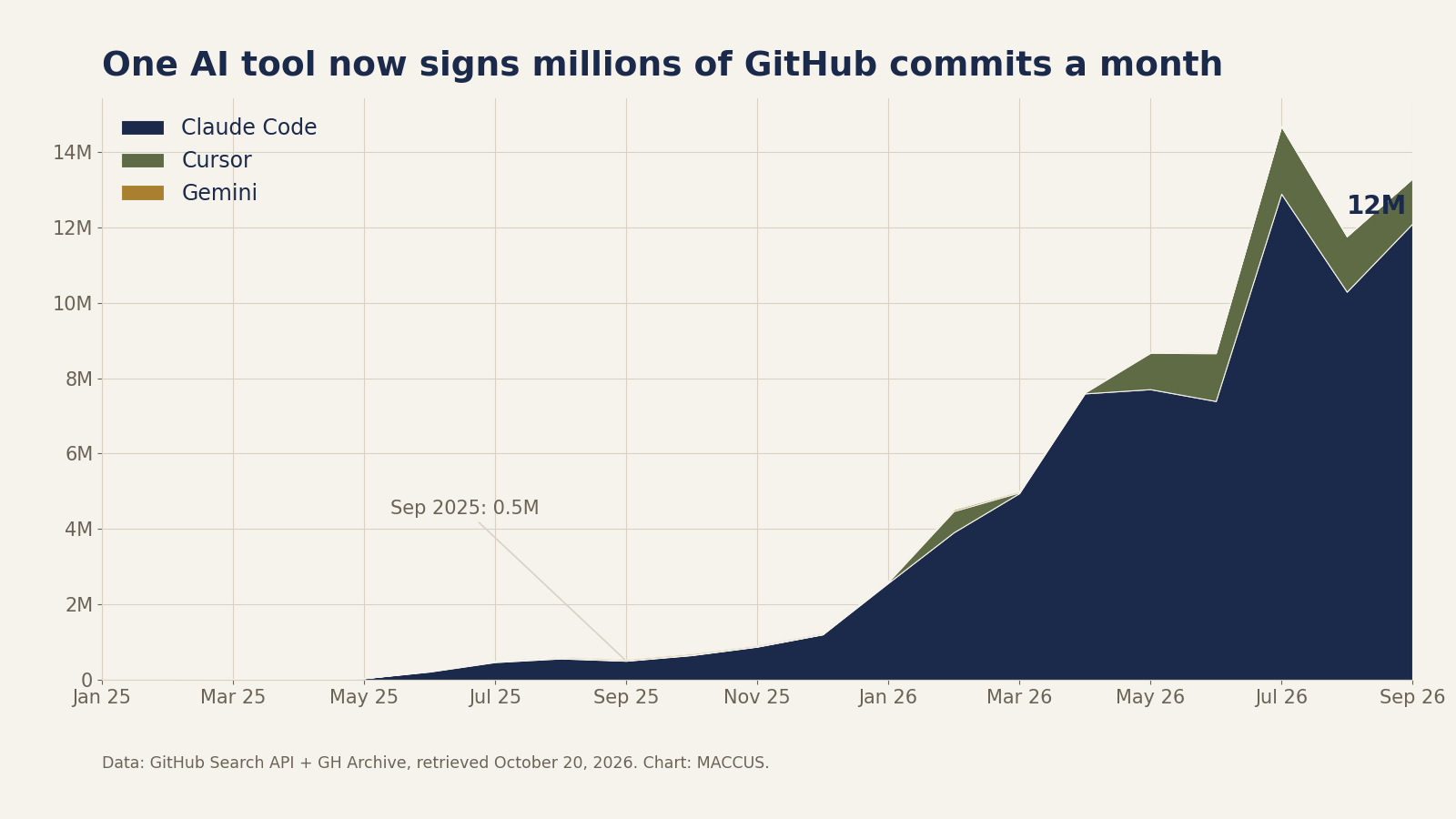

One AI coding tool, Claude Code, signed more than ten million public commits on GitHub this September. Almost all of them sit in small projects that hardly anyone watches. The open web is quietly taking in agent-written code through its least-watched corners, and that is the part I would keep an eye on.
The signature is a line Claude Code adds at the bottom of a commit, Co-Authored-By: Claude. I counted it, and the marks left by the other coding agents, month by month with GitHub’s public search, then checked the count against GitHub’s raw archive of public activity.
From a few hundred a month to the millions
When Claude Code launched early last year, its signature was a curiosity, a few hundred commits a month, the kind of number you could almost list by hand. Now it runs into the millions every month, and it has climbed through most of this year without pausing. It rose fastest through the spring and summer, as the tool went from a few early users to a default. The climb is the solid part of this story, and the chart at the top shows it.
Almost all of it is one tool
This is nearly a one-company story. Another signature, from an editor called Cursor, is growing fast and still trails far behind. Google’s Gemini barely shows up in the commit record. OpenAI’s Codex leaves no commit signature at all; it works through pull requests instead, a split a June census of open-source repositories found too. When people say coding agents are everywhere, what they mostly mean, in the public record at least, is this one tool and its default signature line.
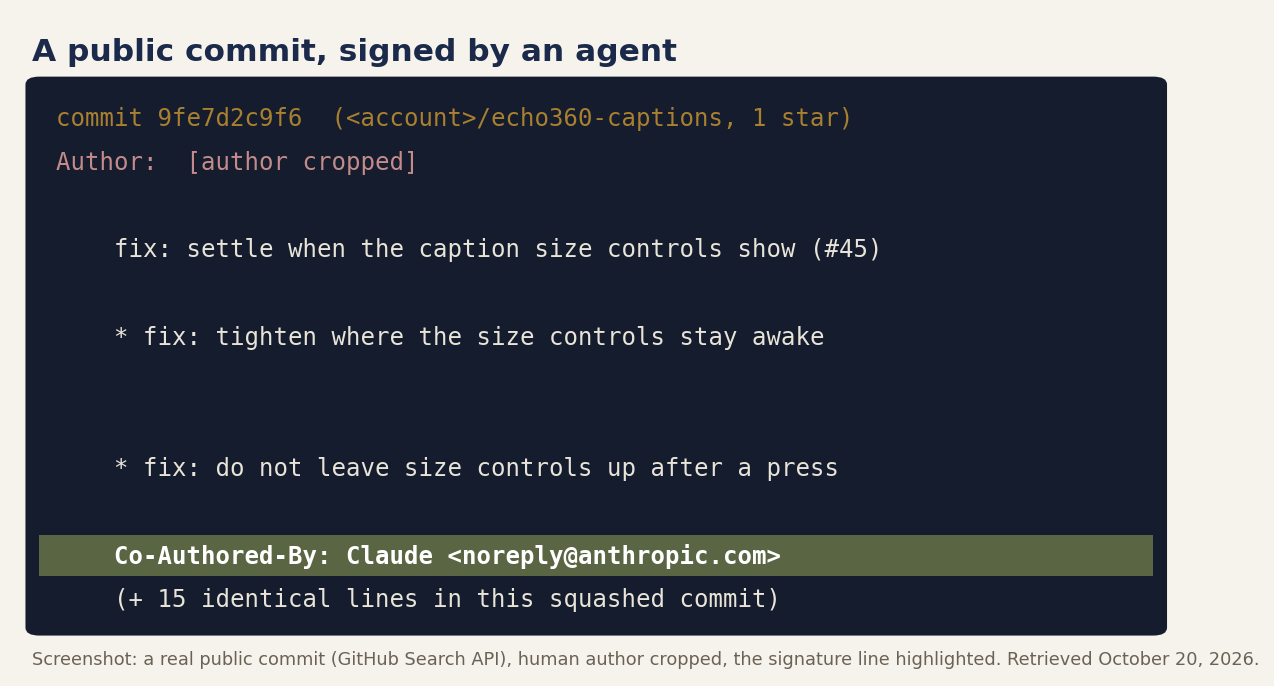
The signed commits themselves are mostly small and quiet, the routine maintenance that keeps software running. The card below is a real one, pulled straight from GitHub: a tiny fix in a repository almost nobody watches, the Claude line at the bottom, the human author cropped out.
Most of it lands where nobody is looking
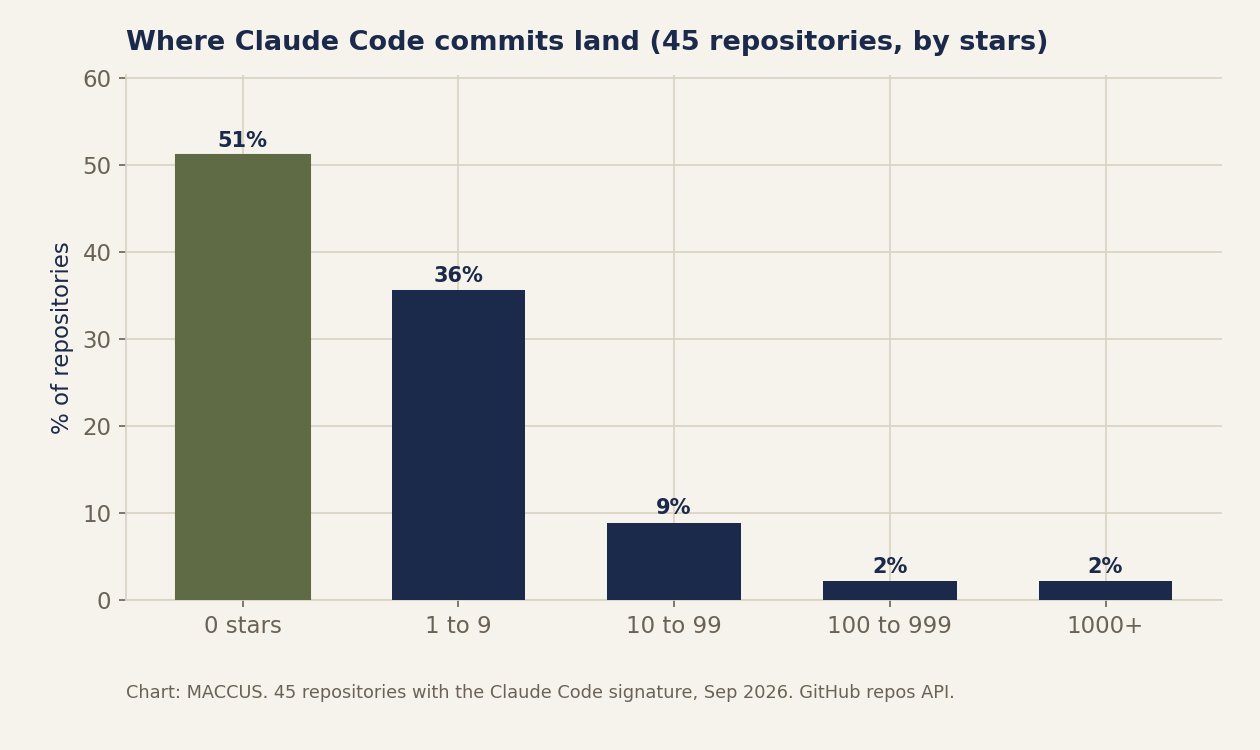
This is the part that stayed with me. More than half the repositories I sampled carried no stars at all. These are not the big, well-tended libraries that much of the software world depends on and reads. They are the long tail of the open web: a one-person command-line tool, a script that renames files, a hobby bot, the kind of project a single developer keeps going in their spare time and few others ever open.
It makes sense that this is where the tool lands. A developer reaches for an agent most readily on the small, unglamorous jobs, the chores they would rather not do by hand, and those chores live in exactly these small repositories. The big projects have reviewers, style guides and gatekeepers; the small ones often have one person and a good intention.
That is where the weight settles first. Someone has to read agent-written code before it is trusted, and someone has to answer who owns it and who is on the hook when it breaks. On a big project a team does that. On these, it falls on the volunteer who maintains the thing, and on the companies that quietly build on top of those small projects without ever saying so. A flood of machine-written commits is easiest to wave through exactly where there are the fewest people to check it.
Nobody can measure the true share
Set against all of GitHub, the signature sits on roughly one in a hundred public commits.
I would not lean on that figure harder than it can bear. GitHub only estimates totals this large, and the same query handed me counts that differed twofold in a single afternoon. The real share of code now written by AI is something no outsider can measure cleanly.
Dario Amodei, Anthropic’s chief executive, said last year that AI would soon be writing ninety percent of the code. He was describing the labs’ own work, where it comes far closer to true, as the company’s own figures show. The signature I counted is a floor: a developer can switch it off, and pasted code carries no mark. What it measures is the open web, a different question from what one company does behind its own walls.
What the open web is quietly absorbing
So here is my read. Agent-written code is now a real and fast-growing presence on GitHub, it comes almost entirely from one company’s tool, and it is piling up fastest in the projects with the fewest eyes on them. The scale is not the worrying part. The place it is landing is.
I write this from Belgium, where none of these labs sit, and the second-order effect is the one I would watch here. European firms lean on the same long tail of small open-source projects as everyone else, and those projects are now absorbing machine-written code faster than their maintainers can plausibly review it. A dependency that was safe last year because a careful person read every change is a different thing once the changes arrive faster than any one person can read them.
If the climb continues at anything like this rate, a year from now the signature is on many times as many commits a month, and still mostly in repositories nobody watches. The one thing I would watch is whether the people carrying that review-and-ownership load, the maintainers of small projects, get any help with it.
This counts one visible mark and nothing else. It cannot see AI code pasted in without a signature, it cannot see private company code, and it cannot settle what any firm does behind its own walls.
Method and numbers
I used GitHub’s public search API to count the exact co-author line of each coding agent, by committer date, every month from January 2025 (October 2026 is partial, off the chart). Claude Code’s line appeared on 406 commits in January 2025, about 503,700 in September 2025, and a September 2026 total that ran from 10.1 to 20.5 million over repeated same-day pulls, so I report a floor. Cursor reached about 1.2 million this September; Gemini stayed in the low thousands; Codex leaves no commit line. Against GitHub’s own all-commits estimate, about 1.1 billion, that is near one percent; a push-anchored denominator from GH Archive, about 165 million a month, puts it near seven percent. In a 2025 window with full archive data, the two methods matched within about four percent. Of 45 sampled Claude-signed repositories, 51 percent had no stars. Month-by-month figures are in the dataset.
Sources
- How employment is changing at Anthropic, Anthropic, October 16, 2026
- CEO Speaker Series With Dario Amodei of Anthropic, Council on Foreign Relations, March 10, 2025
- Dario Amodei: We are near the end of the exponential, Dwarkesh Patel, February 13, 2026
- Detecting AI Coding Agents in Open Source: A Validated Multi-Method Census of 180 Million Repositories, Arsham Khosravani and Audris Mockus, arXiv, June 23, 2026
- GH Archive, gharchive.org, retrieved October 20, 2026
- REST API: Search, GitHub, retrieved October 20, 2026
Header image: chart by MACCUS, data from the GitHub Search API and GH Archive, retrieved October 20, 2026.