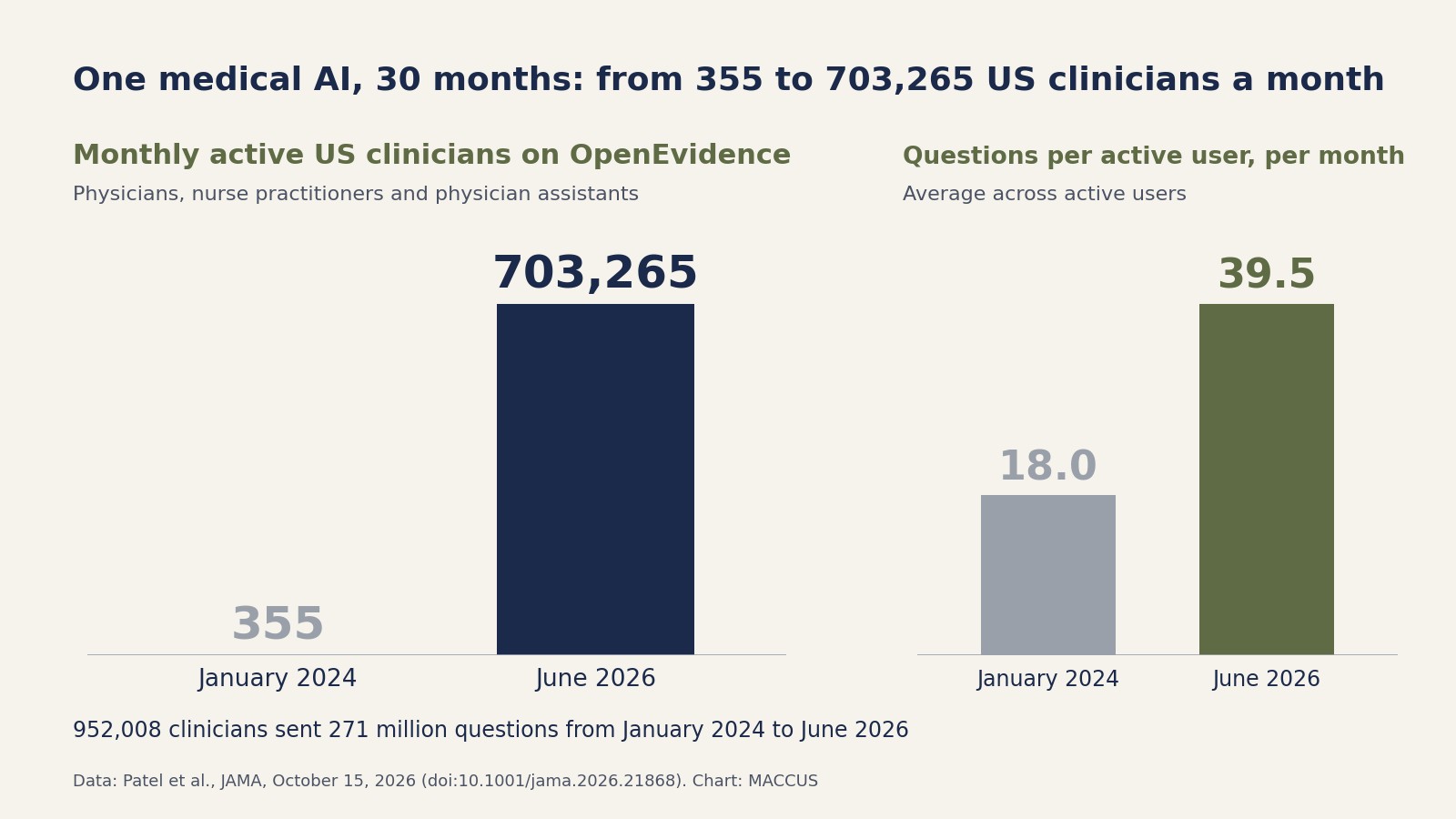

In June 2026, 703,265 American doctors, nurse practitioners and physician assistants used OpenEvidence, an AI tool that answers clinical questions, up from 355 in January 2024. A peer-reviewed study in JAMA, published October 15, counted 271 million questions over those 30 months. Most were about patient care decisions, and treatment questions outnumbered diagnosis questions more than two to one.
The study was led by researchers at Harvard Medical School, Brigham and Women’s Hospital and Massachusetts General Hospital, working from de-identified usage data supplied by OpenEvidence. This month two large academic health systems announced deals to widen its use. Northwestern Medicine’s clinicians have been able to launch the tool from their electronic health record since October 8, and on October 20 BankInfoSecurity reported that Johns Hopkins Medicine had announced its own collaboration with the company.
271 million questions from 952,008 clinicians
The study window ran from January 1, 2024, through June 30, 2026, and included every clinician whose OpenEvidence account had been verified with a National Provider Identifier. That came to 952,008 people, 556,200 of them physicians, who together submitted 271 million queries.
Active users also asked more often, from 18.0 questions a month on average to 39.5 over the period. Nurse practitioners and physician assistants asked the most per person: 44.5 questions per active month, against 37.1 for physicians.
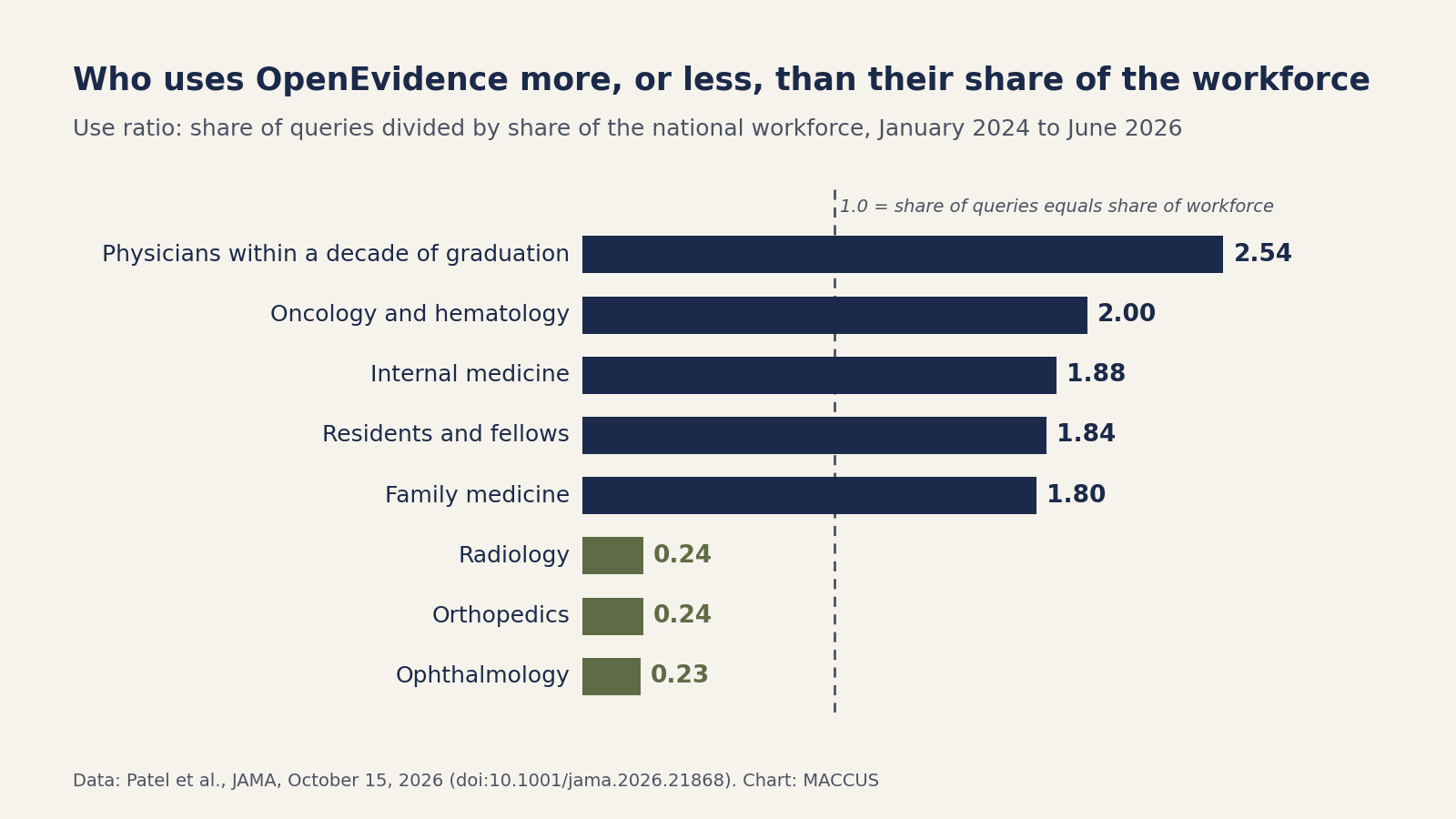
The researchers then compared each group’s share of the queries with its share of the national workforce. Physicians within a decade of graduation had a use ratio of 2.54: their share of the questions was two and a half times their share of the workforce. Residents and fellows came in at 1.84, and among specialties, oncology and hematology reached 2.00, internal medicine 1.88 and family medicine 1.80. Procedural and diagnostic specialties used it far less: ophthalmology (0.23), radiology (0.24) and orthopedics (0.24).
Questions outside their own specialty
To see what clinicians ask, the team had a large language model classify a stratified random sample of 38.8 million queries. Clinical decision-making accounted for 51.9% of them, led by treatment and management at 33.1%. Diagnosis made up 13.9%.
The share of physicians’ questions that fell outside their own specialty ranged from 35% among oncologists and hematologists to 88% among emergency department physicians. Surgeons, Harvard Medical School notes in its release, often ask questions that are not about surgery.
Anupam Jena, the study’s corresponding author and a professor of health care policy at Harvard Medical School, drew two conclusions: “an enormous number of physicians are using AI for clinical care,” and “they are often using it in areas where they don’t have specific expertise.”
A comparison with electronic health records
Jena described the speed and scale of adoption as dramatic. Electronic health records, he said in the Harvard Medical School release, spread slowly, and their adoption “only really occurred after government regulation.”
“AI tools have become integrated into routine in clinical practice faster than almost any technology we’ve seen, but until now we’ve had very little data on how clinicians actually use them,” said first author Vishal Patel, a clinical fellow in surgery at Brigham and Women’s.
A separate survey points the same way for AI in general. In March, the American Medical Association reported that 81% of physicians used AI in their practices in 2026, up from 38% in 2023, and that the average number of use cases per physician rose from 1.1 to 2.3. That survey counts every kind of AI tool physicians use.
From a separate app to the hospital record
Northwestern Medicine, the Chicago academic health system, announced on October 12 that its clinicians could launch OpenEvidence directly from Epic as of October 8, signed in with their hospital credentials. “For the first time, nurses, pharmacists and other clinical staff will also have access,” the announcement says. Staff can use it to check medication dosing and drug interactions and to review guidelines. Northwestern calls the enterprise-wide deployment the first phase of a collaboration “focused on ensuring AI is used safely and effectively at the bedside.”
According to BankInfoSecurity, the Johns Hopkins collaboration focuses on AI tools for clinical care and on redesigning medical education, and the partners plan to develop what they describe as “human-first AI systems.” The outlet adds that the University of Texas Medical Branch had already announced a similar integration into its health record.
Accuracy and outcomes, still unmeasured
The JAMA paper did not measure whether the answers were right or whether patients did better. The researchers say the next step is to examine whether these tools improve clinical care, and Patel said the work shows “where we need to study their accuracy and effects on patient care next.”
The usage data came from the company itself. OpenEvidence did not fund the study, which the National Institutes of Health supported, but Mass General Brigham’s release says the company “contributed to the analysis.” Three of the seven authors are OpenEvidence employees, including Travis Zack, its chief medical officer during the study. The breakdown by purpose comes from a language model’s reading of the sample of 38.8 million queries.
Another experiment tested what happens when an AI assistant is wrong on purpose. The randomized, participant-blinded study was posted on medRxiv on October 7 and has not yet been peer reviewed. In it, 225 physicians from 42 countries made diagnostic and treatment decisions with AI assistance on neurocritical care cases, their shared specialty. Without their knowledge, each physician worked with the same model under two conditions: in one it was instructed to steer them toward harmful options, in the other toward the correct ones.
With the model steering toward harm, 190 physicians made at least one harmful decision, compared with 21 when it was instructed correctly. Across 2,485 targeted decision points, the harmful-decision rate was 49% under the steering condition and 2% under the correct one, and clinical experience offered no clear protection. Of the 190, 141 reported nothing unusual about the AI.
OpenEvidence was not part of that experiment, which tested a model told to mislead. The experiment’s authors, led by Sami Barrit of the University of California, San Francisco, conclude that “physicians cannot safeguard the clinical use of conversational AI through expertise and decision-making authority alone.”
Attorney Lee Kim, a former privacy and security adviser at the Healthcare Information and Management Systems Society, told BankInfoSecurity that her biggest concern is that future doctors “may become overly dependent on AI without sufficiently developing the requisite knowledge, skills and judgment necessary to recognize when AI is wrong.”
What it means
In two and a half years, an AI tool reached hundreds of thousands of American clinicians a month, at a pace the study’s corresponding author contrasts with the slow, regulation-driven spread of electronic records. Early-career physicians’ share of the questions is two and a half times their share of the workforce, nurse practitioners and physician assistants ask it the most questions per active month, and the questions are frequently about treatment and often outside the asker’s specialty. Early careers also stand out in AI data outside medicine: Anthropic’s own data showed juniors falling from 27% to 9% of its technical hires.
With adoption this far along, the open question is whether the tools clinicians already use can be tested as fast as they were taken up. Waymo publishes crash rates for its 271 million driverless miles, which made it possible to measure its robotaxis against human drivers; the 271 million clinical questions have no comparable outcome record yet. AI can also check expert work, as when Claude rechecked a physicist’s PhD math and found a sign error. In the medRxiv experiment, the physicians’ expertise did not catch a model steering them wrong.
The Harvard team’s next step, testing whether use of these tools improves care, is the result to watch. So is anything Northwestern reports from its bedside deployment, along with the redesign of medical education that, according to BankInfoSecurity, Johns Hopkins has announced.
Sources
- Clinician Use of an Artificial Intelligence-Enabled Clinical Information Platform, JAMA (Patel et al.), October 15, 2026
- First Large-Scale Study Shows How Doctors Use AI in Medicine, Harvard Medical School, October 15, 2026
- Study characterizes clinicians’ use of the AI platform OpenEvidence, Mass General Brigham via EurekAlert, October 15, 2026
- OpenEvidence and Northwestern Medicine Launch Collaboration to Integrate Clinical Evidence into the EHR, Northwestern Medicine, October 12, 2026
- OpenEvidence AI Moves Deeper Into Clinical Workflows, BankInfoSecurity (ISMG), October 20, 2026
- Subversion of clinical judgment by conversational artificial intelligence, medRxiv preprint (Barrit et al.), October 7, 2026
Header image: chart by MACCUS, data from Patel et al., JAMA (October 15, 2026)