
On October 22, 2026, OpenAI made its Decisions API generally available. Called through POST /v1/decisions, it reads text, an image or JSON data, then answers closed questions with a probability, a choice from a list or a score, without writing any prose. The API changelog announced it in one line: “The Decisions API is now generally available with gpt-6-luna.” That model, the cheapest in the GPT-6 lineup, is the only one the API accepts.
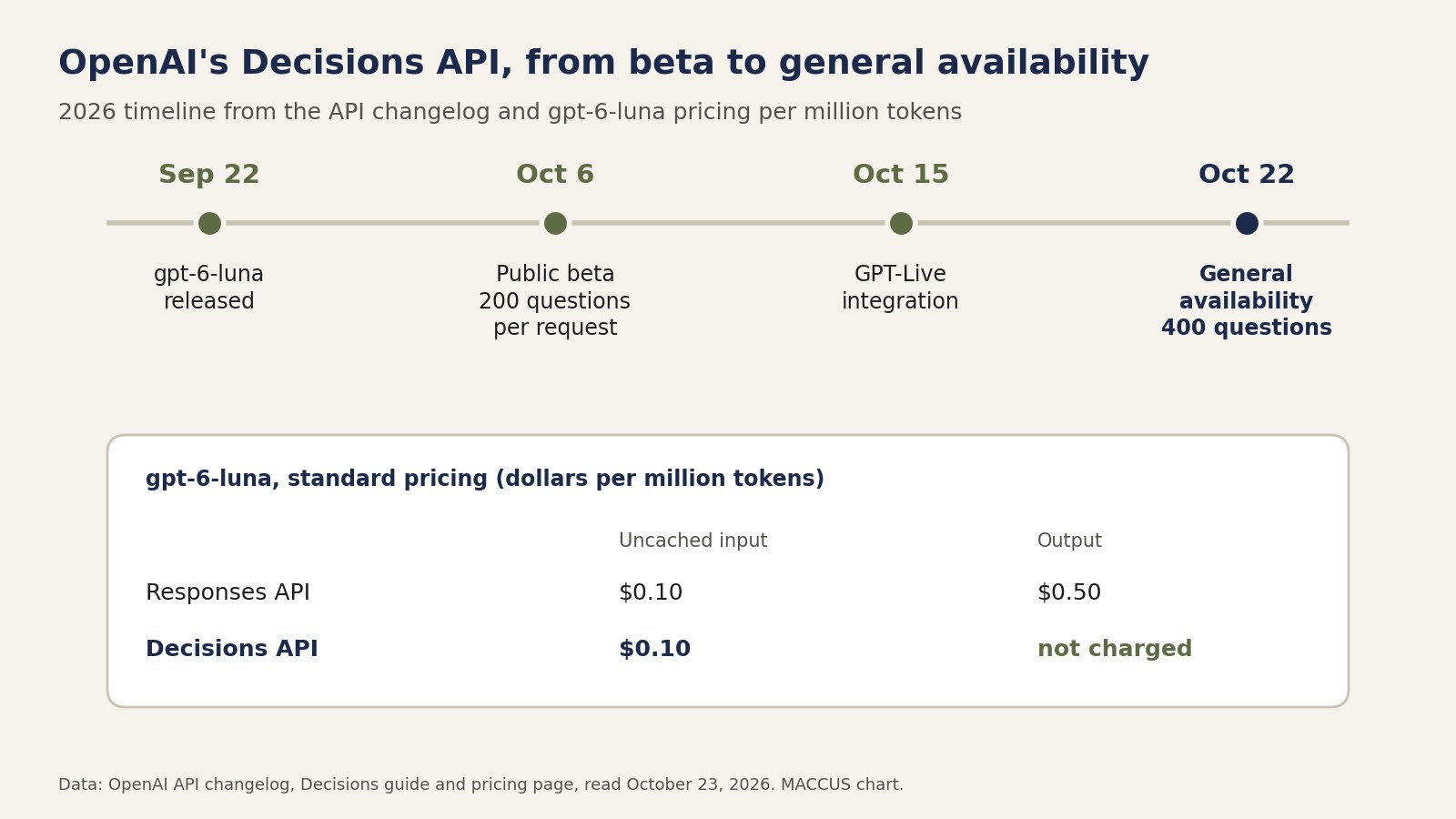
According to OpenAI’s guide to Decisions, uncached input costs $0.10 per million tokens. “Output tokens are not charged,” the same page says. A request can now hold up to 400 questions, up from 200 during the public beta that opened on October 6. Regional processing is available in the United States and in Europe (the European Economic Area and Switzerland).
The gpt-6-luna model came out on September 22, alongside GPT-6 Sol. OpenAI describes it as its most efficient model for focused, high-volume tasks. Our guide to OpenAI’s GPT models covers where it sits in the lineup and what it costs. Decisions is aimed at developers who call OpenAI’s API; nothing changes for ChatGPT users.
Three question types, with numeric answers
The guide describes requests in three parts: the model, a shared input (a text string, or a sequence of messages, tool calls and their outputs) and a list of named questions. The API returns one answer per question, in a format set in advance.
A “predicate” question checks a condition, such as visible damage on a product, and returns the probability, between 0 and 1, that it holds. A “choice” question picks one value from those the developer supplies, with a probability for each option and a confidence value.
A “score” question places the input on a scale of 2 to 10 ordered levels. The result is the average of the level numbers (counted from 0), weighted by their probabilities, so it can fall between two levels. In the guide’s example, probabilities of 0.1, 0.7 and 0.2 across three severity levels produce a score of 1.1.
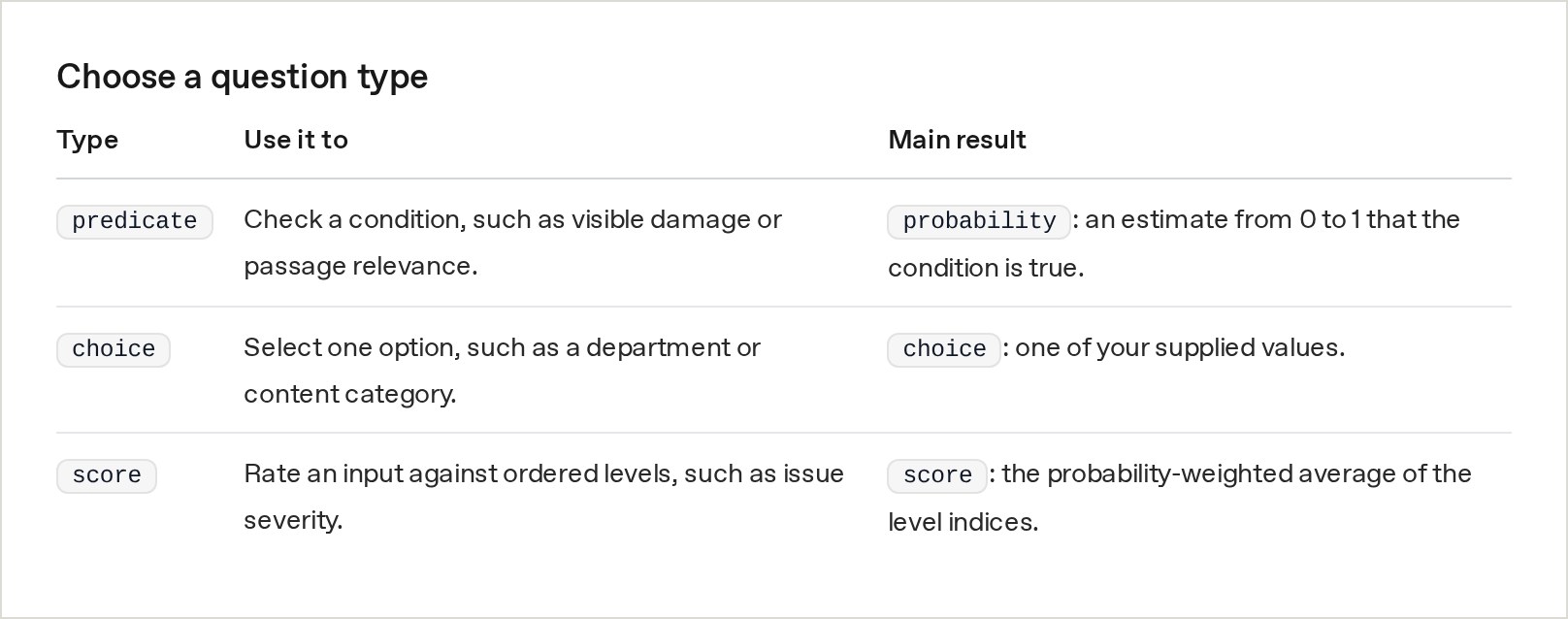
Most of the guide’s detailed examples come from customer service and online retail: spotting a crack, tear or dent in a product photo; routing a complaint to billing, technical support or shipping; rating the severity of a bug. Others check order data to confirm that a ticket really describes a duplicate charge, or compare candidate images against a reference image.
OpenAI sends other jobs elsewhere: Structured Outputs in the Responses API to extract fields or get a written explanation, and function calling to have a model request a tool. Decisions returns answers, and the application itself carries out whatever actions they select. Files, audio and item references aren’t supported, and a question that depends on another question’s answer needs a second request.
What’s new since the October 6 beta
The changelog shows general availability arriving 16 days after the beta. The public beta, which opened on October 6, promised to turn text and images into typed answers “10x faster than the Responses API.” On October 15, OpenAI connected Decisions to GPT-Live, its live voice API, so an app can act while the user is speaking or react to what the voice assistant says.
The guide lists nine additions since the beta, including the 400-question cap. Prompt caching lets requests reuse the shared beginning of the input, as long as it runs at least 1,024 tokens; question content stays outside the cache. Each question can carry its own images to compare against the shared input.
Structured data can now go in directly as JSON, and images can be passed as public URLs. During the beta, they had to be embedded in the request as base64, according to the news site Mixed.
The API can now evaluate a conversation history that includes function and tool calls. An organization-level usage report counts each request once, however many questions it holds. Native GPT-Live integration and Private Link, a private connection for sending requests, round out the list.
Pricing based on what the model reads
The guide says cache reads get a discount and cache writes are billed, at gpt-6-luna’s standard caching rates.
OpenAI’s pricing page, checked on October 23, has no separate line for Decisions. For gpt-6-luna, it lists $0.01 per million cached input tokens and $0.125 per million tokens written to the 30-minute cache. The same model, called through the Responses API, costs $0.10 per million input tokens and $0.50 per million output tokens. Input costs the same either way; the difference is output, which Decisions doesn’t bill.
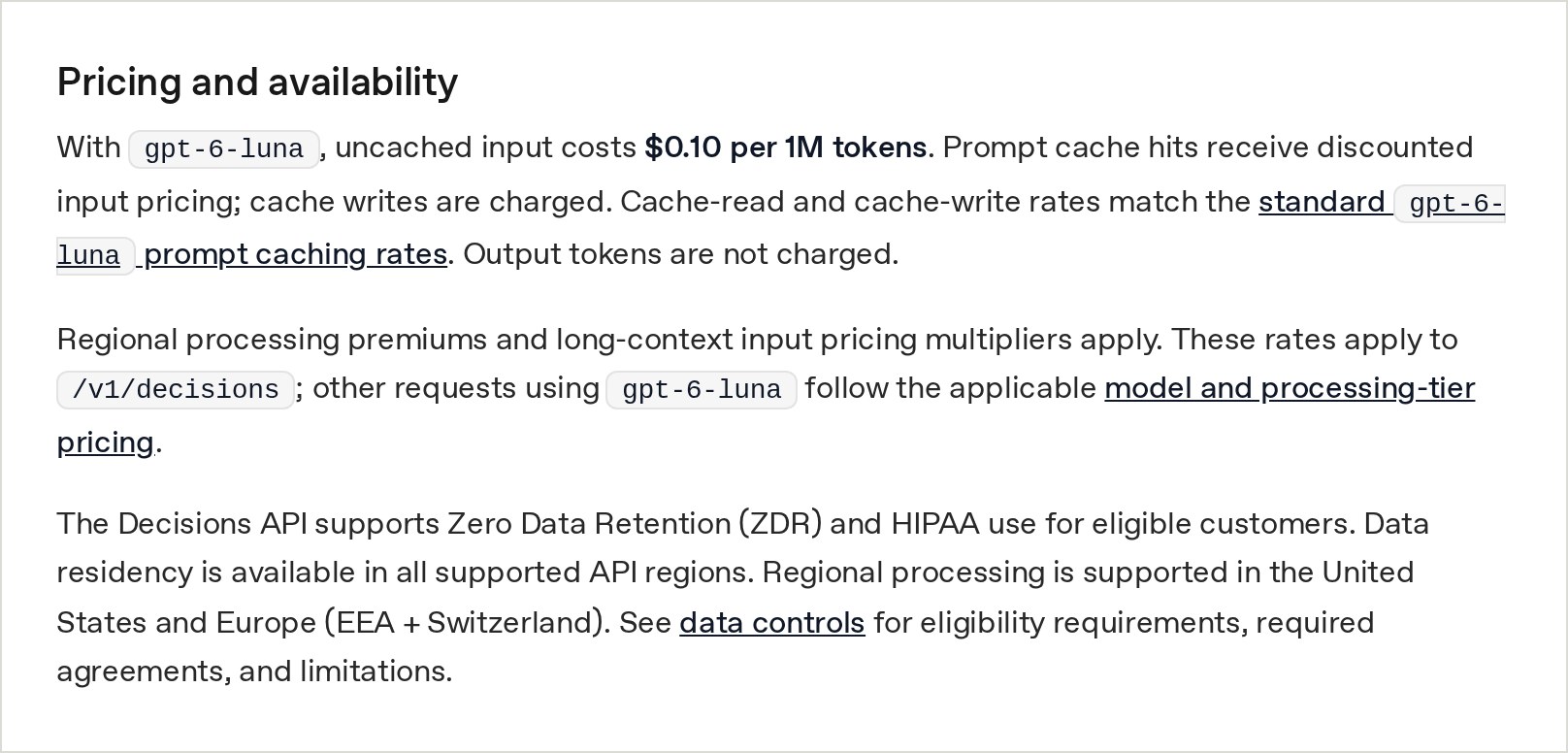
The guide flags two possible surcharges: the regional processing premium and long-context multipliers. Per the gpt-6-luna model page, requests with more than 272,000 input tokens are billed at twice the input and cache rates. The same page puts the regional premium at 10%, in line with the pricing page’s rule for models released on or after March 5, 2026. The Decisions guide gives no figure specific to this API.
Other companies have announced API prices in recent days. MiniMax launched M3.1 Flash at $0.15 per million input tokens, and DeepSeek set the price of its web search at $0.75 per 1,000 calls.
Data retention and processing in Europe
OpenAI’s data controls page says abuse monitoring logs are kept for up to 30 days by default. For eligible customers, the guide lists support for Zero Data Retention and for use under HIPAA, the US health privacy law. Uploaded images are scanned for child sexual abuse material.
Data residency is offered in every API region, and regional processing is available in the United States and in Europe, the latter through eu.api.openai.com. Access isn’t automatic: the data controls page directs customers to OpenAI’s sales team to check eligibility. Any region other than the United States also requires OpenAI’s approval for abuse monitoring controls and a signed Modified Retention amendment. Regional processing sets where the computation runs; the page mentions neither France nor the GDPR.
Ten times faster, according to OpenAI
The guide describes an API that returns answers “about 10x faster than the Responses API.” Neither the guide nor the changelog publishes a benchmark, a response time in milliseconds or an accuracy rate compared with a full model call. On October 7, the day after the beta opened, Mixed had already pointed out that the figure came with no measurement behind it.
In the same article, Mixed noted that the gpt-6-luna model page left v1/decisions out of its endpoint table. As of October 23, that row is still missing. The guide says nothing about supported languages, and all of its examples are in English, so answer quality on text in other languages, French included, is undocumented. OpenAI recommends setting decision thresholds from labeled examples, based on the cost of false positives and false negatives.
What it means
OpenAI is carving out a separate API for closed questions, such as sorting an email, flagging a review, checking a product photo or routing a ticket. Many business automations ask a model that kind of question, including the ones tools like n8n string together in an AI agent built without coding. With Decisions, the bill covers what the model reads, and the answer comes back as a number or a label. Anthropic’s Claude models bill for both the text sent and the text generated, at the prices laid out in our guide to Claude models.
General availability comes with no independent measurement. The documentation claims a speed gain without a benchmark and publishes no accuracy rate or results on non-English text. For a European customer that opts for processing in Europe, the gpt-6-luna model page puts the extra cost at 10%, and access requires OpenAI’s approval.
Still to watch: a Decisions line on OpenAI’s pricing page, independent speed and accuracy measurements, support for models beyond gpt-6-luna and published results on non-English text.
Sources
- Changelog, OpenAI (API documentation), entries of September 22 and October 6, 15 and 22, 2026
- Decisions, OpenAI (API documentation), read October 23, 2026
- Pricing, OpenAI (API documentation), read October 23, 2026
- GPT-6 Luna Model, OpenAI (API documentation), read October 23, 2026
- Data controls in the OpenAI platform, OpenAI (API documentation), read October 23, 2026
- OpenAI’s Decisions API runs on gpt-6-luna alone, and the model’s own endpoint table omits it, Mixed (Shane S. Ellison), October 7, 2026
Header image: MACCUS chart, based on OpenAI’s API changelog, Decisions guide and pricing page, read October 23, 2026