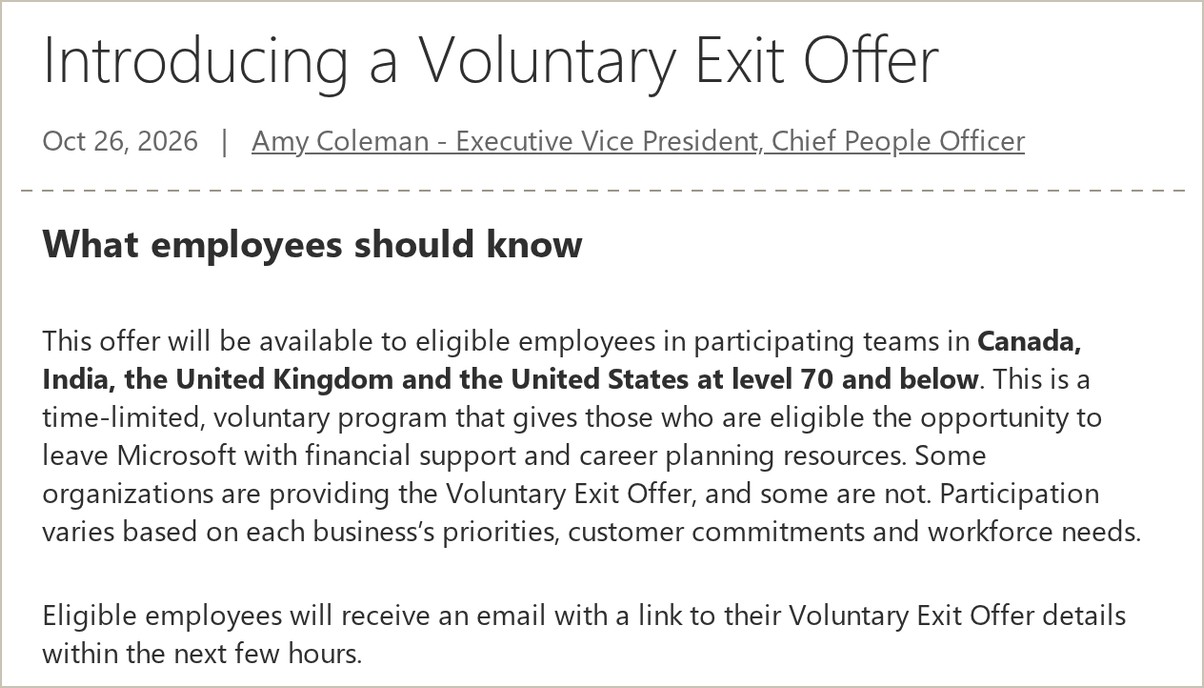
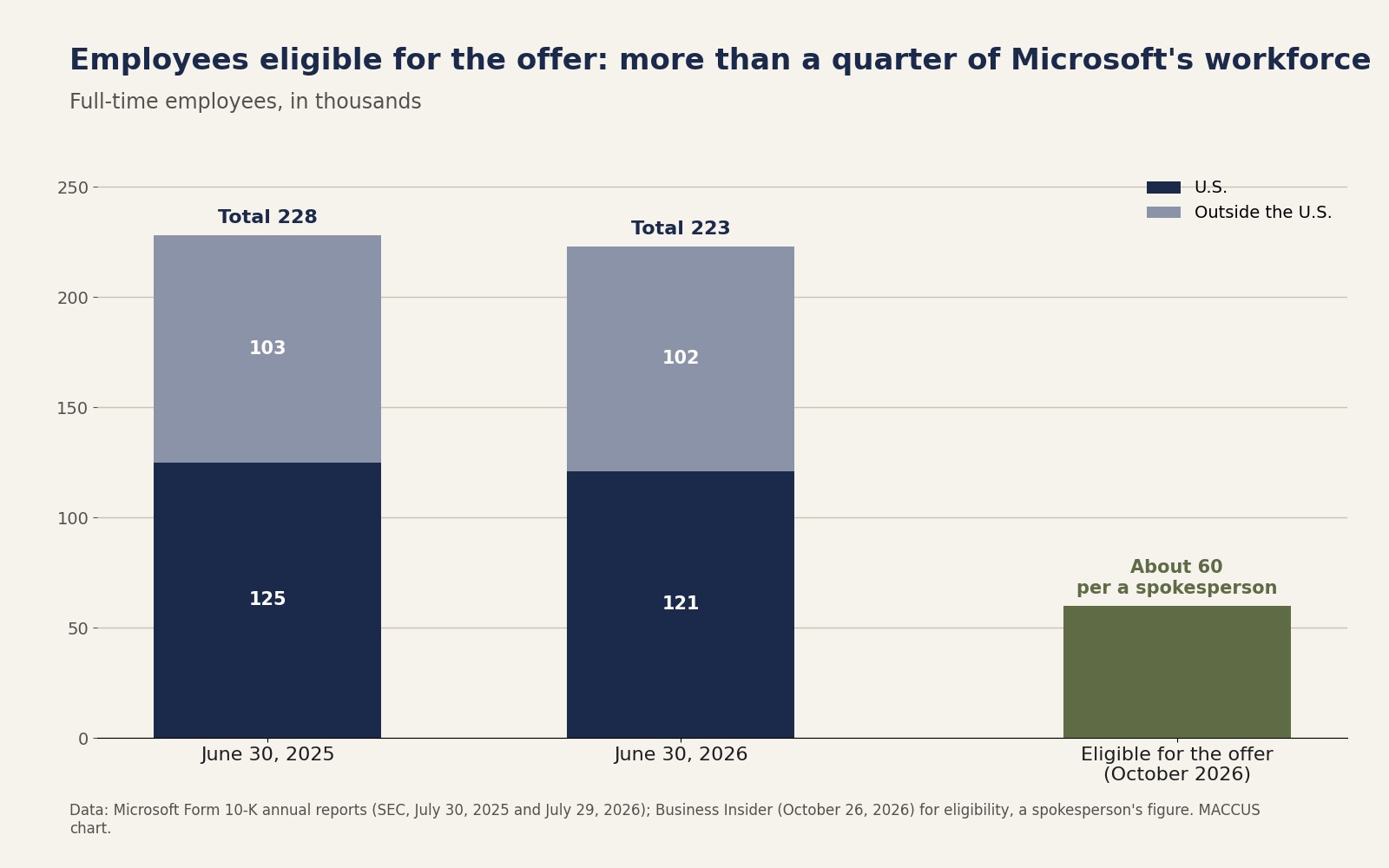
Microsoft opened a “Voluntary Exit Offer” on Monday, October 26, 2026, for some of its employees in Canada, India, the United Kingdom and the United States. About 60,000 people are eligible, more than a quarter of the company’s workforce, a Microsoft spokesperson told Business Insider. Amy Coleman, executive vice president and chief people officer, announced the offer in a message to employees that Microsoft posted the same day on its official blog.
It is Microsoft’s second buyout program of 2026, six months after a voluntary retirement program for U.S. employees. The offer comes two days before the company reports quarterly earnings on Wednesday, October 28. Microsoft’s message does not mention artificial intelligence. British bank Barclays did, when it announced on October 22 that it was cutting about 5,000 jobs and named AI among the reasons.
Amy Coleman’s message
Posted at 11:33 a.m. EDT (15:33 UTC), the text is a post from Viva Engage, Microsoft’s internal social network, “edited slightly for external use.” The offer covers eligible employees “in participating teams” in the four countries “at level 70 and below” on Microsoft’s internal job-level scale. Coleman calls it “a time-limited, voluntary program” that lets people “leave Microsoft with financial support and career planning resources.”
“Some organizations are providing the Voluntary Exit Offer, and some are not,” she wrote, adding that participation “varies based on each business’s priorities, customer commitments and workforce needs.” The offer gives employees who are considering a future outside the company the chance to leave now, with support. It also gives participating organizations “another way to adapt their workforce to changing needs.”
Eligible employees were to receive an email with the details of their offer within hours. “The Voluntary Exit Offer is new for us. We’ll learn from it,” Coleman wrote.
About 60,000 eligible, with a decision due in early December
About 60,000 employees will be eligible, the Microsoft spokesperson told Business Insider, in line with the scale Bloomberg and The Seattle Times reported on Monday. Employees will have until early December to decide, and those who accept will leave at the end of the year. The terms will be similar to Microsoft’s standard severance, and there are no plans for another buyout at this time, the spokesperson said.
Level 70 includes senior leaders, according to Business Insider, and several parts of the company are not participating: sales teams, some engineering and some corporate functions. When Microsoft laid off U.S. employees earlier this year, Business Insider noted, severance included at least 60 days of base pay and, for most employees, up to 39 weeks, depending on seniority and tenure.
As of June 30, 2026, Microsoft employed about 223,000 people full time, 121,000 of them in the U.S., according to its annual report filed with the Securities and Exchange Commission. A year earlier, it had 228,000.
A second offer, broader than April’s
On April 23, Microsoft announced the first voluntary buyout in its 51-year history, CNBC reported. The program was limited to the U.S. and open to employees, at the senior director level and below, whose age and years of service added up to 70 or more. About 7% of U.S. employees were eligible, according to a person familiar with the plans, CNBC reported. Employees on sales incentive plans could not take part.
On April 29, during the earnings call, Chief Financial Officer Amy Hood said the company’s outlook included about $900 million in one-time costs for the program. On July 6, Coleman wrote that more than 30% of eligible employees had taken it and that the company would “continue exploring similar approaches in the future.”
The October offer covers four countries instead of one, and each organization decides whether to take part. Microsoft describes it as building on “what we learned earlier this year through the Voluntary Retirement Program,” without saying whether the spring’s age-and-tenure requirement still applies.
A shrinking workforce
On the April 29 call, Microsoft said it expected headcount to decrease in the fiscal year that began in July. It also expected to spend roughly $190 billion on capital expenditures in calendar 2026, including about $25 billion from higher component prices.
On July 6, Microsoft said it was eliminating about 4,800 roles, or about 2.1% of its global workforce, mostly in its Commercial and XBOX organizations. More than 4,000 employees had been redeployed into new roles over the past year, according to Coleman’s memo that day. She warned that “there will be more changes ahead” in other parts of the business.
The same memo said that “the roles eliminated today are not being replaced by AI.” It added that “AI is changing how work gets done” and that some everyday tasks can now be automated.
Unanswered questions before Wednesday’s earnings
The official message does not say how many employees are eligible, how much they would receive or when they must decide. The figures available come from the spokesperson quoted by Business Insider, and the detailed terms are only in the emails sent to employees. Microsoft has not disclosed the cost of the offer or how many departures it expects.
In April, the CFO put a cost on the retirement program during the earnings call, six days after it was announced. The results due October 28 cover the July-to-September quarter, which closed before this offer, and Microsoft has not said whether it will give an estimate that day.
Microsoft has not explained why it chose these four countries. No European Union country is on the list, so neither France nor Belgium is covered, and the U.K. is the only European country included.
What it means
In six months, Microsoft has gone from a one-time offer for U.S. employees whose age and tenure added up to 70 to an offer open to about 60,000 employees in four countries, more than a quarter of its global workforce. Nobody is required to leave. But the stated goal, giving organizations “another way to adapt their workforce,” amounts to a headcount reduction whose size will depend on how many people accept. Business Insider called the offer the company’s “latest attempt to slim its workforce without another round of involuntary cuts.”
Microsoft does not tie the offer to AI, even though in April it projected roughly $190 billion in capital spending for 2026 and a smaller workforce. In July, the company said AI was not replacing the roles it cut.
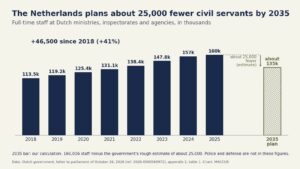
Other employers make that link openly, Barclays among them. In Japan, according to a Nikkei survey, more than 1 in 5 large companies may hire fewer graduates from 2029 as AI spreads. In the Netherlands, the government names AI among the levers in a plan for about 25,000 fewer civil service jobs by 2035. The return on AI spending is still debated: on October 24, Apollo chief economist Torsten Slok wrote that AI had delivered no financial payoff yet to U.S. companies outside the tech sector.
The next two milestones are the earnings call on Wednesday, October 28, and the early December deadline. By the deadline, Microsoft will know how many employees chose to leave, though it has not committed to publishing that number. Those departures take effect at the end of the year. In July, Coleman warned of more changes, and the spokesperson said only that no other buyout is planned at this time.
Sources
- Introducing a Voluntary Exit Offer, Amy Coleman, The Official Microsoft Blog, October 26, 2026
- Microsoft is offering buyouts to around 60,000 employees. Read the memo., Ashley Stewart, Business Insider, October 26, 2026
- The latest in our company transformation, Amy Coleman, The Official Microsoft Blog, July 6, 2026
- Microsoft Fiscal Year 2026 Third Quarter Earnings Conference Call, Microsoft Investor Relations, April 29, 2026
- Microsoft Corporation, Form 10-K, fiscal year ended June 30, 2026, SEC (EDGAR), July 29, 2026
- Microsoft plans first-ever voluntary employee buyout for up to 7% of U.S. workforce, Jordan Novet, CNBC, April 23, 2026
- Microsoft announces quarterly earnings release date, Microsoft, October 7, 2026
Header image: MACCUS diagram. Data: Microsoft, CNBC and Business Insider, April to October 2026