About one in six full-time jobs in the Dutch central civil service would disappear by 2035 under a plan the government sent to parliament on Monday, October 26. That is roughly 25,000 posts in the ministries, inspectorates and agencies that collect taxes, pay benefits and handle residence permits. The plan names artificial intelligence as one of the ways to do the work with fewer people.
It is the first time Eric van der Burg, the junior minister in charge of what the cabinet calls “effective government,” has estimated how many jobs the cuts will cost, NOS reported. In its news release, the government said it will present targets and savings plans “for using AI to work more productively” in the first quarter of 2027. “We can’t keep doing what we did,” Van der Burg said. Quotes from Dutch sources are our translations.
A €3.5 billion target and a rough job estimate
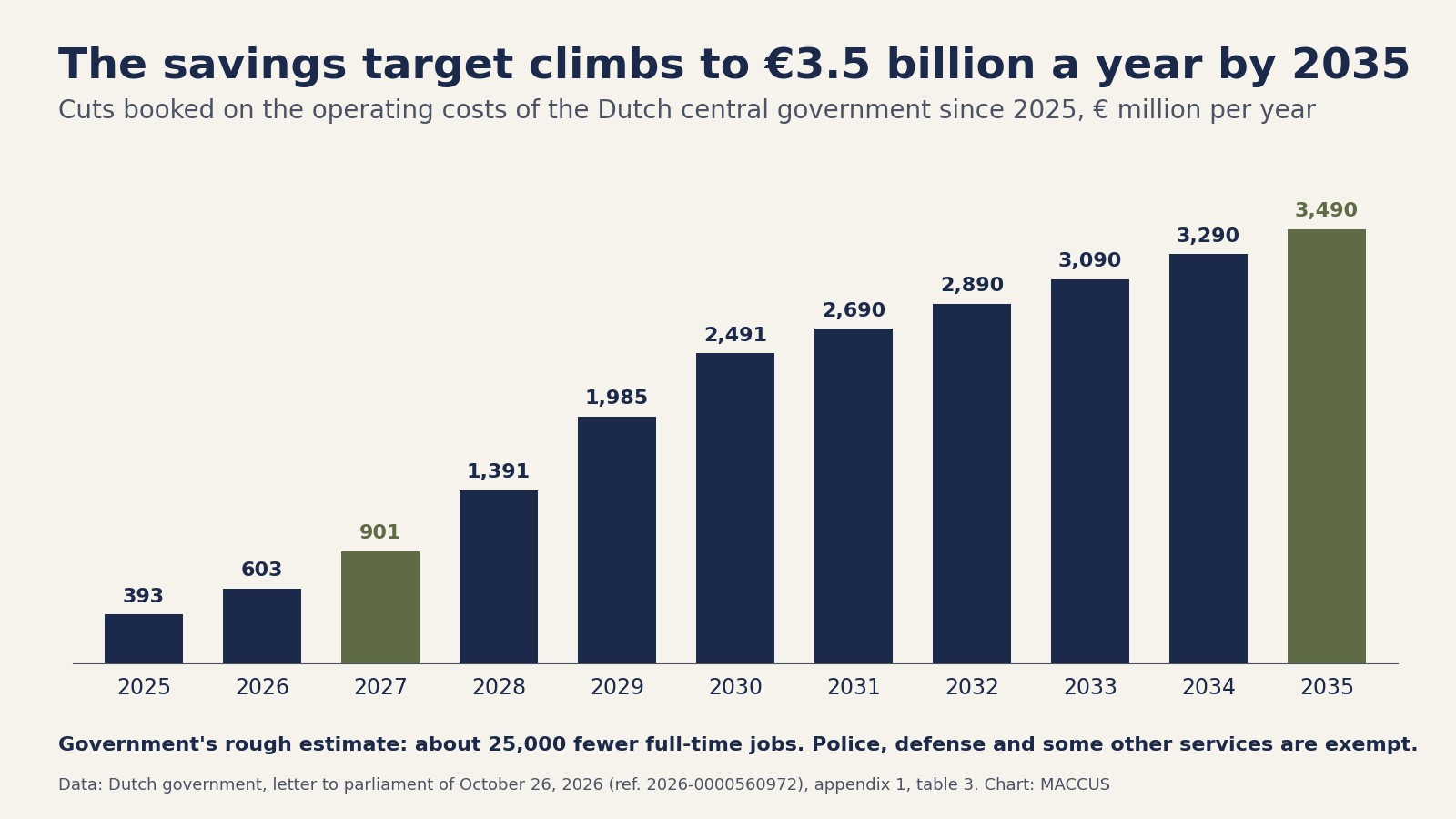
The number comes from the letter to parliament and its appendix, 15 pages in all. On December 31, 2025, the central civil service had 160,016 full-time equivalents in ministries, inspectorates and implementing agencies. The Schoof and Jetten cabinets have budgeted cuts to its operating costs that rise from €393 million in 2025 to €901 million in 2027 and €3.49 billion a year in 2035.
How many jobs that takes depends on whether the cuts fall on higher or lower pay grades, the letter says. Its “rough estimate” is a reduction of “around 25,000” full-time jobs, about 16% of today’s workforce, the share NOS reported. Reuters reported a cut of “around 20%” of all government jobs. The letter applies the 20% figure to individual organizations, many of which face staff cuts of about 20%, rising to about 45% for some and about 60% in one case as temporary budgets run out.
Police and defense are exempt. The letter also names the prison service, the security services and the public prosecutor’s office among the organizations spared one or more of the cuts. Agencies already under strain get no advance exemption, NOS reported, naming the benefits agency UWV, the immigration service IND and the tax office.
AI is one lever among several
The press release lists AI next to other measures. Ministries will pare down their facilities, standardize IT systems and buy as a group more often, with fewer requirements, and offices will aim for one desk for every two employees. The cabinet wants to scrap or simplify at least 500 rules a year. It also wants to sharply reduce its 28 standing advisory councils, its roughly 150 advisory committees and its policy evaluations, now about 400 a year.
The letter says AI projects already run in several parts of the civil service and that the aim is to apply AI “ever more broadly,” within limits on security, data quality and sovereignty. That requires changes to infrastructure and “a fundamental rethink of work processes.” Procurement will be screened systematically for places where AI can be brought in. The 2027 targets respond to a parliamentary motion from the VVD and CDA, two of the three governing parties.
The government does not expect efficiency gains alone to close the gap. The CPB, its economic forecaster, considers a general efficiency gain of 0.5% a year realistic, which the letter says covers about a third of the target. “Choices are needed about what the government will do differently, less or no longer,” the letter adds. Those choices have not been made yet, and a multiyear plan is due within six months, with the details of the cuts to follow in the spring budget memorandum.
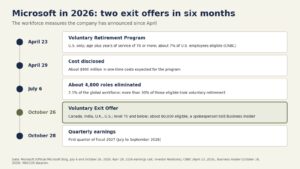
Large private employers are shrinking their workforces too. This month, Barclays named AI among the reasons for 5,000 job cuts, and on the same Monday Microsoft opened a voluntary exit offer to about 60,000 employees, without linking it to AI.
A civil service that grew 41% in seven years
The appendix shows the central civil service growing from 113,500 full-time equivalents in 2018 to 160,000 at the end of 2025, an increase of 46,500, or about 41%. Most of these civil servants, 112,200 at the end of 2025, work on the implementation side, including 38,100 at the tax, benefits and customs administration. Policy and support staff grew fastest, by 56% between 2019 and 2025.
Earlier cabinets also wanted fewer civil servants, and the numbers only went up, NOS noted. The appendix draws the same lesson from 20 years of cuts: “On paper the savings were achieved, but new spending kept the government growing.” Asked about that record, Van der Burg said this cabinet will follow through because everyone sees “that it has to change,” NOS reported.
British civil servants report fast AI uptake
The Alternative People Survey, published in Britain on October 26 by the think tank Re:State, Civil Service World and the research firm Public First, collected answers from 1,747 civil servants. Among the 1,456 who work outside frontline operational delivery, 82% said they use AI in their work, up from 30% a year earlier. The survey is self-selecting, and its authors say it is not representative of the workforce.
Of those users, 74% draft and edit documents with AI, 59% search for information and 16% automate a process. “For most of Whitehall, AI is a better word processor,” Joe Hill, Re:State’s director of strategy, wrote in Civil Service World. He argued that the British government’s expected productivity gains “just won’t happen until someone turns the hours into fewer posts or better work.”
The plan’s own caveats
The appendix itself urges caution about AI. Its second lesson from past cuts reads: “Do not overestimate the staffing effects of digitalization and AI.” Government processes were digitized and automated over two decades, it says, but “the promises of lower costs and headcount were not kept.” The result was new tasks, more staff capacity and more external staff.
The appendix also warns that hiring freezes in past rounds caused a relatively large number of good people to leave, stopped new talent from coming in and kept young staff from moving up, so that “years later you are missing whole cohorts.” Because most civil servants work on the implementation side, it adds, the cuts may affect service delivery and continuity.
The Dutch union federation FNV has already rejected the AI argument for the tax office. On October 16, it responded to a cabinet plan for €162 million in extra cuts there, on top of €277 million already announced, which the cabinet expects to absorb partly through simpler tax rules, AI and more help from chatbots, according to FNV. “And now the magic word AI is suddenly supposed to make hundreds of millions of euros in savings possible? That is pie in the sky,” said Jasper de Jong of FNV Overheid, the federation’s public-sector branch.
What it means
The letter writes AI into a national staffing plan that comes with a job estimate, though what AI itself should deliver will not be set until 2027. On the same Monday, Sweden’s government offices blocked ChatGPT and Claude on staff computers to steer staff toward approved tools such as Microsoft’s Copilot. On an accelerationist reading, the Dutch plan shows a state whose civil service grew by 46,500 full-time equivalents in seven years now expecting software, simpler rules and fewer advisory bodies to absorb part of the work. A self-selecting British survey suggests that, in Whitehall at least, staff have already taken up the tools, largely on their own initiative.
The risk falls on the people who rely on the agencies that are not exempt. NOS described the tax office, UWV and IND as already under pressure, and FNV says the tax office lacks the staff to do its work today. The government’s own review of past cuts says digitization brought new tasks and more external staff, and its letter warns that the cuts may affect service delivery and continuity.
The first checkpoint is December 1, when the parliamentary committee debates the plan. In the first quarter of 2027, the AI targets and savings plans are due, and the cabinet is to say what AI should save in its own workforce. The cabinet has also promised to report each spring and fall on a monitor that tracks civil servants, external staff and operating costs.
Sources
- Kabinet werkt aan slagvaardige overheid: eenvoudiger, slimmer en kleiner, Government of the Netherlands (Rijksoverheid), October 26, 2026
- Voortgangsbrief Slagvaardige Overheid, Dutch Ministry of the Interior and Kingdom Relations, letter to the House of Representatives, ref. 2026-0000560972, October 26, 2026
- Kabinet wil 25.000 rijksambtenaren minder, politie en defensie uitgezonderd, NOS, October 26, 2026
- Netherlands aims to cut around 20% of government jobs over next decade, Reuters (via Yahoo Finance), October 26, 2026
- FNV: Extra bezuinigingen op Belastingdienst zijn waanzin, FNV, October 16, 2026
- The Alternative People Survey 2026, Re:State, Civil Service World and Public First, October 26, 2026
- Whitehall has done the easy half of its AI revolution, Joe Hill, Civil Service World, October 26, 2026
Header image: chart by MACCUS, data from the Dutch government’s letter to parliament of October 26, 2026 (appendix 1, table 1)