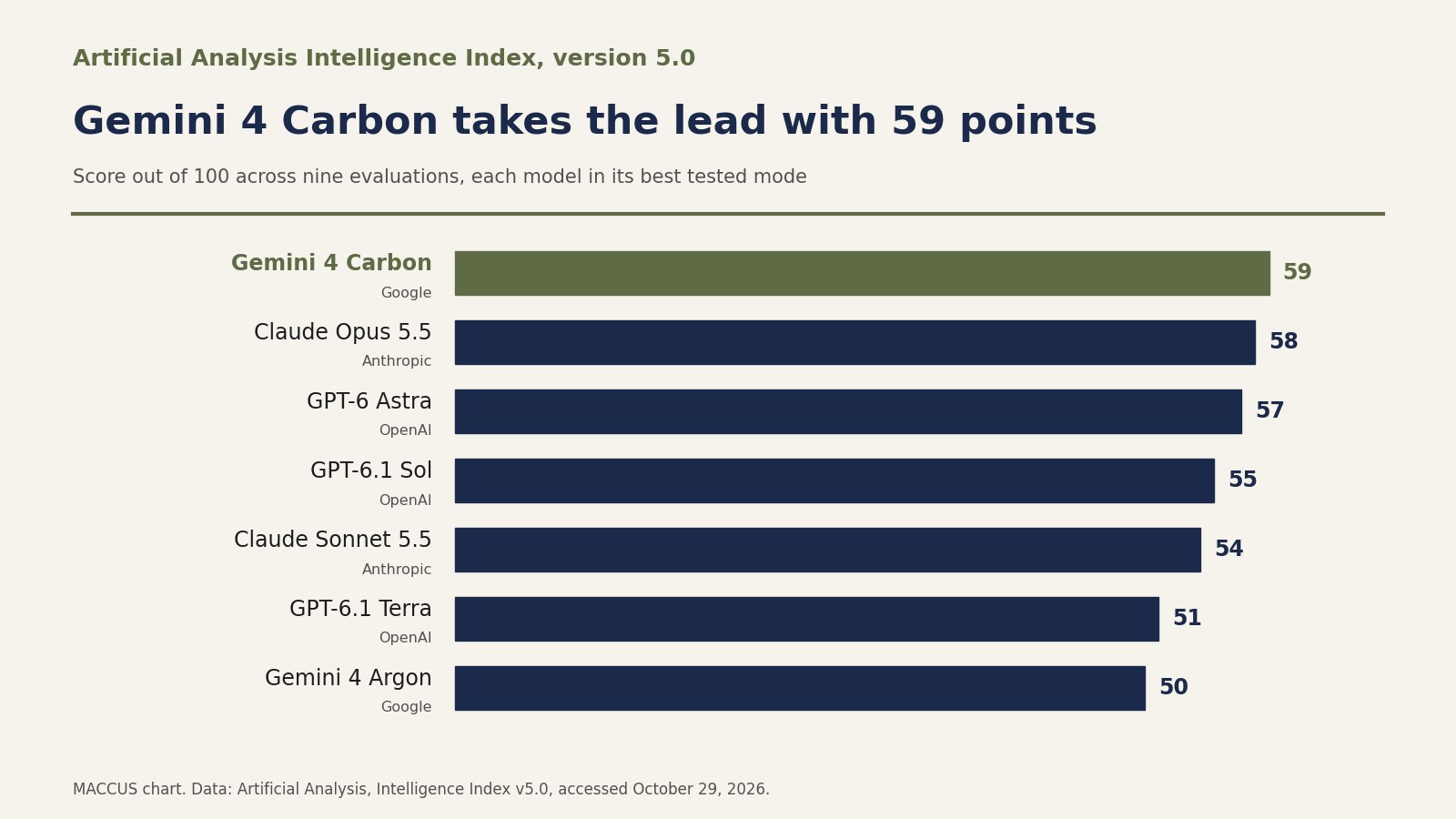

Google unveiled Gemini 4 Carbon on October 28, 2026. The announcement, signed by Koray Kavukcuoglu, senior vice president of Google DeepMind and Google’s chief AI architect, calls it “our strongest model” and highlights two strengths: cybersecurity and long-horizon tasks. The same day, the independent evaluator Artificial Analysis ranked Carbon first on its Intelligence Index with 59 points, ahead of Anthropic’s Claude Opus 5.5 (58) and OpenAI’s GPT-6 Astra (57).
Almost nobody can use it yet. Google is opening Carbon this week to a subset of cyber defenders, then to more trusted partners in its Fairwind Program. Developers, businesses and consumers will get access “as soon as possible,” with no date given.
Two weeks after Argon opened up
Carbon arrives hard on the heels of Gemini 4 Argon. Google announced Argon on September 30 and initially limited it to Fairwind partners. On October 13, Google opened Argon globally to developers and enterprises through the API, and to Google AI Pro and Ultra subscribers in the Gemini app.
“Carbon illustrates the pace at which we’re pushing the frontier forward,” Kavukcuoglu writes. Google says it built the model for “much harder, long-horizon engineering problems” and that its teams have seen Carbon stay on a single task for days, for instance to track down the root cause of subtle bugs in large codebases and patch them. According to Google, Carbon jumped 89 Elo points on WebDev Arena, a web development leaderboard, to rank fourth at 1,768.
A one-point lead at Artificial Analysis
Version 5.0 of the Artificial Analysis index combines nine evaluations the company runs in-house, covering knowledge work, coding, science and general knowledge. Carbon was tested in its “high” reasoning mode, while Claude Opus 5.5 and GPT-6 Astra ran in their “max” modes.
The top two are one point apart: 59.4 to 58.4 before rounding. GPT-6.1 Sol follows at 55, Claude Sonnet 5.5 at 54 and GPT-6.1 Terra, which OpenAI launched on October 26, at 51. Argon scores 50.
The evaluator also reports the average cost of one index task at each model’s standard price, without launch discounts. The euro figures below use the European Central Bank reference rate of October 28, 2026: $1.1133 to the euro.
| Model | Index v5.0 | Average cost per task | Tokens generated on the index |
|---|---|---|---|
| Gemini 4 Carbon (Google) | 59 | $7.76 (€6.97) | 200 million |
| Claude Opus 5.5 (Anthropic) | 58 | $10.04 (€9.02) | 220 million |
| GPT-6 Astra (OpenAI) | 57 | $6.24 (€5.60) | 54 million |
| Gemini 4 Argon (Google) | 50 | $7.68 (€6.90) | 110 million |
Artificial Analysis calls Carbon “very verbose”: the median model generated only 64 million tokens on the same tests. Its charts also flag that Carbon has no public API yet.
Cybersecurity scores measured without guardrails
Google cites three third-party benchmarks, which it ran on Carbon “without guardrails.” The model scores 88.2% on SEC-bench Pro (finding vulnerabilities in real-world software), 54.8% on ExploitGym (exploiting them) and 71.0% on Collinear’s CWE-bench (fixing them at the root cause). Google says it leads on all three.
According to Google’s internal tests, Carbon is more than twice as successful as Argon at generating secure code. The Chrome team says Carbon did “more than 10X better” than an unnamed large frontier model from another lab at writing high-quality patches.
Google also reports improvements in the model’s behavior: on Terminal-Bench 4.0, successful cheating falls to 0.0% and cheating attempts to 0.4%. When internal teams use Carbon for coding, high-severity misalignment alerts drop by almost 80%. By Google’s count, Carbon makes about half as many unsupported claims as Argon. On Gray Swan’s indirect prompt injection test, the attack success rate against Carbon is 0.0%, compared with 0.7% for Argon.
Access runs through the Fairwind Program
Google describes the staged rollout as a “deliberate approach” and says it is taking part in the U.S. government’s voluntary process for testing models before release. On the Fairwind Program page, the company warns that in the wrong hands, the capabilities that help find and fix flaws “can become an equally powerful threat.”
According to that page, the program has more than 650 partners worldwide. Google gives priority to governments and national cyber authorities, to critical infrastructure operators (healthcare, telecommunications, energy and financial networks) and to core technology platforms. Applicants go through background checks. For Argon, the page says access is limited to an organization’s internal cybersecurity, incident response or penetration testing teams.
Google won’t say when the launch price ends
Carbon will launch at the same introductory price as Argon: $2 per million input tokens and $10 per million output tokens (€1.80 and €8.98), with a 95% discount on cached input tokens. A footnote in the announcement puts the price after the introductory period at $4 and $20 (€3.59 and €17.96).
For Argon, the Gemini API pricing page shows the launch price through November 30, 2026, and the full price from December 1. For Carbon, Google declined to give an end date when Ars Technica asked. As of October 29, Carbon was not listed on the API pricing page.
The limits of the published numbers
Most of the figures in the announcement come from Google’s own measurements: internal tests, evaluations without guardrails and the Chrome team’s verdict on an unnamed competitor. As of October 29, Google had published no technical report and no safety report specific to Carbon. The only safety report cited in the announcement is presented as Argon’s, is dated October 2026 and does not mention Carbon. Ryan Whitwam of Ars Technica writes that Carbon could be a post-training upgrade of Argon and that the gap between Carbon and the competition is just a few points.
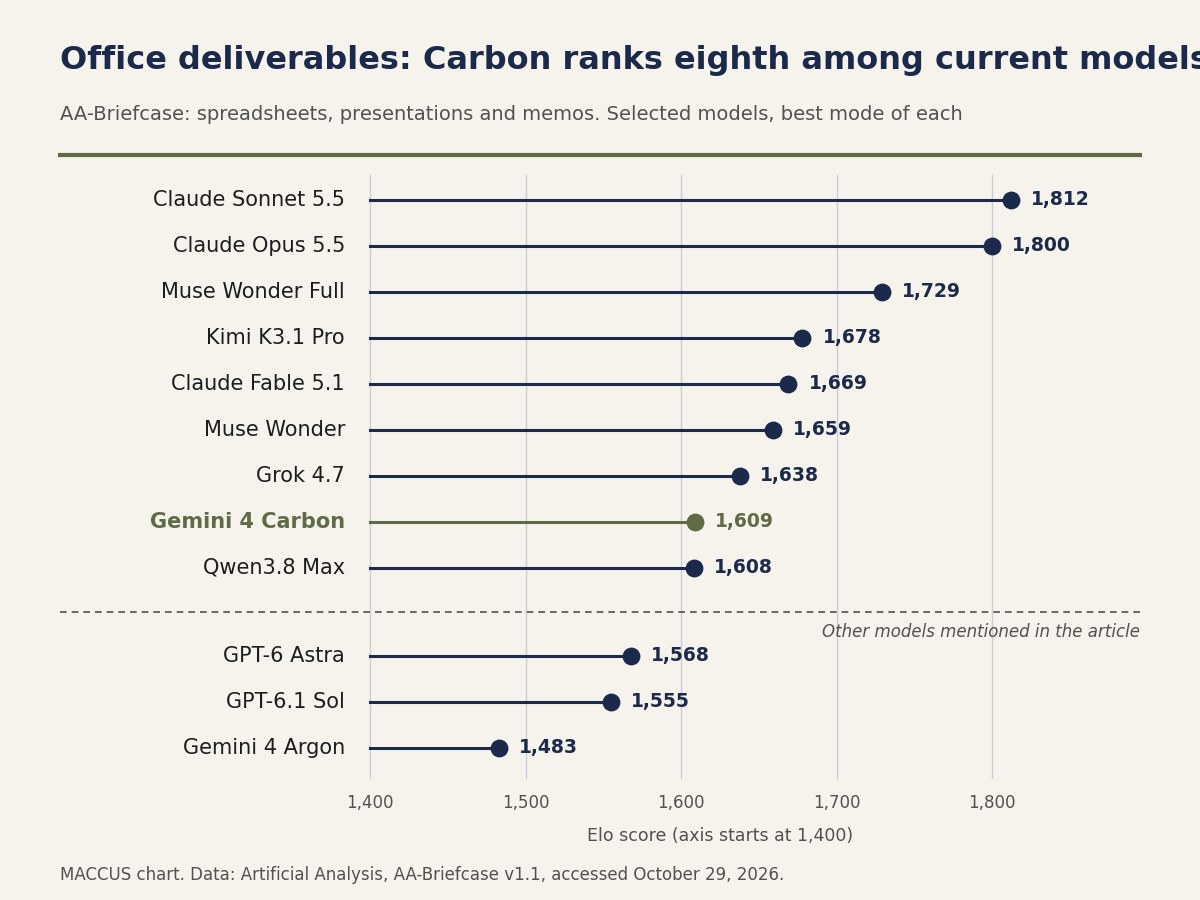
Artificial Analysis’s own data tempers that first place. AA-Briefcase, one of the nine tests in the index, has each model work as an agent on multi-week professional projects in which it must produce spreadsheets, presentations and memos. Carbon ranks eighth among current models there at 1,609 Elo, well behind Claude Sonnet 5.5 (1,812) and Claude Opus 5.5 (1,800), two of the Anthropic models covered in our guide to Claude models.
Carbon also trails Meta’s Muse Wonder Full, Kimi K3.1 Pro, Claude Fable 5.1, Muse Wonder and Grok 4.7. It finishes ahead of GPT-6 Astra (1,568) and scores 126 points higher than Argon.
Artificial Analysis’s separate coding-agent index still puts Claude Code with Opus 5.5 first, at 62 points, ahead of Carbon running in Google’s Antigravity tool (59).
On AA-Omniscience, the evaluator’s knowledge reliability test, Carbon takes first place with 54 points and gets the right answer more often than Argon, 58% to 48%. But when it doesn’t know the answer, it answers incorrectly instead of abstaining 11% of the time, compared with 4% for Argon. In the same situation, Claude Opus 5.5 answers incorrectly 50% of the time.
What it means
Google now leads an independent evaluator’s index by a single point, with a model almost nobody can test. The average masks the spread. On AA-Briefcase, the index test closest to office work, Claude Sonnet 5.5 and Claude Opus 5.5 stay ahead. On the coding-agent index, which sits outside the main index, Claude Code with Opus 5.5 keeps first place.
The cybersecurity gains Google highlights rest mostly on its own measurements, taken without the protections customers will get. Outside Fairwind, developers and businesses have nothing to test yet. Google has given no opening date, no country list, no named subscription tier and no end date for the launch price.
Argon’s rollout offers a rough guide. Thirteen days passed between its announcement and its global opening. Ars Technica notes that Google makes no promises on timing but that Carbon could be available within a couple of weeks if it follows the same path. Still to watch: when Carbon reaches the API and the Gemini app, whether Europe is part of the rollout, whether Google publishes a technical and safety report specific to Carbon, and the first independent tests with guardrails switched on.
Sources
- Gemini 4 Carbon: our next frontier model, Google, October 28, 2026
- Artificial Analysis Intelligence Index v5.0, Artificial Analysis, accessed October 29, 2026
- AA-Briefcase v1.1: Agentic Knowledge Work Benchmark, Artificial Analysis, accessed October 29, 2026
- AA-Omniscience v1.1: Knowledge and Hallucination Benchmark, Artificial Analysis, accessed October 29, 2026
- Fairwind Program, Google DeepMind, accessed October 29, 2026
- Gemini Developer API pricing, Google AI for Developers, accessed October 29, 2026
- Google announces Gemini 4 Carbon, its latest frontier AI model that you can’t use, Ars Technica, October 28, 2026
- Artificial Analysis Coding Agent Benchmarks, Artificial Analysis, accessed October 29, 2026
Header image: MACCUS chart, data from Artificial Analysis (Intelligence Index v5.0, accessed October 29, 2026).