
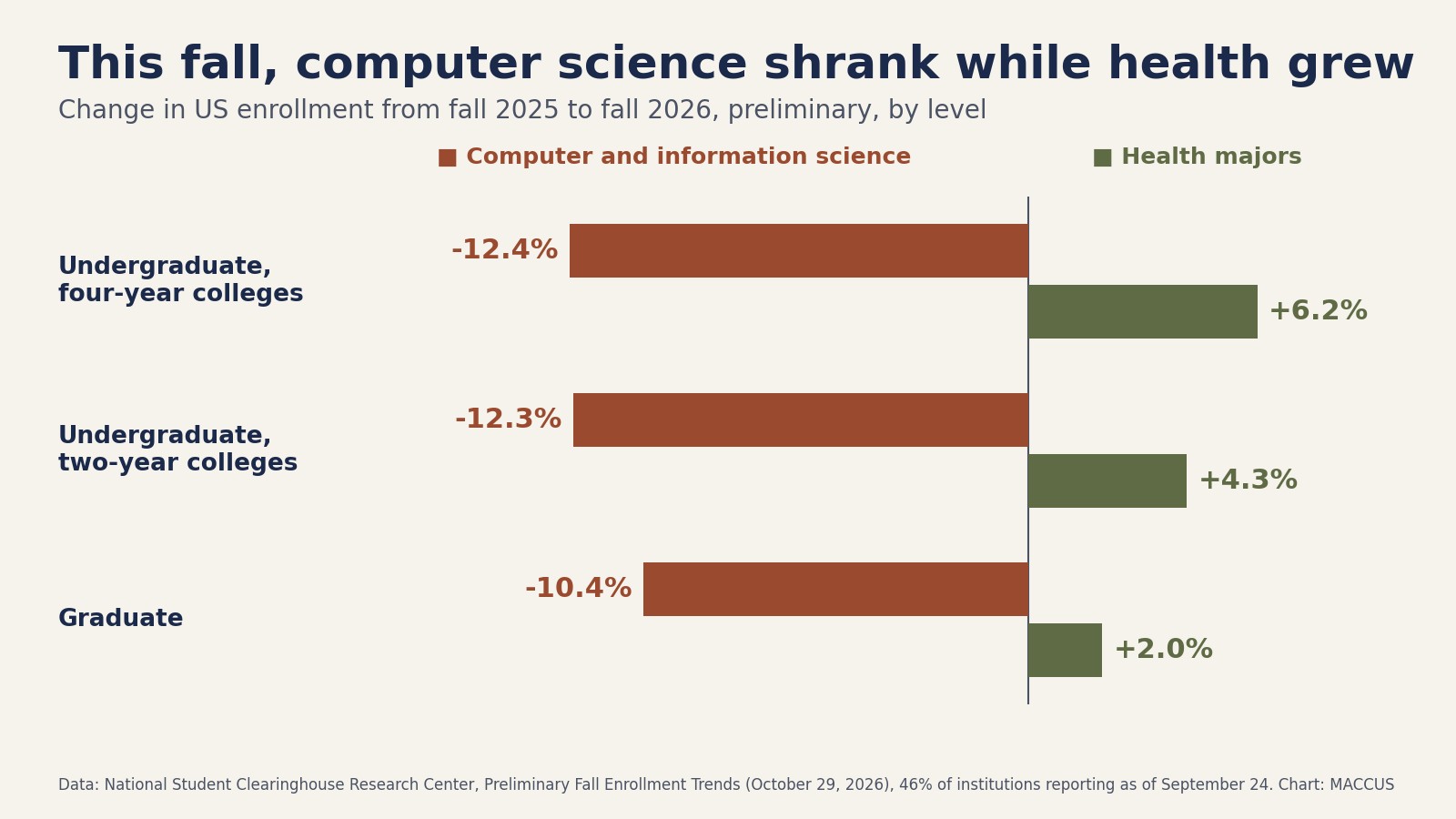
US four-year colleges have about 88 computer science undergraduates this fall for every 100 they had last fall. The National Student Clearinghouse Research Center published preliminary data on October 29 showing that enrollment in computer and information science programs fell 12.4% at four-year colleges, 12.3% at two-year colleges and 10.4% at the graduate level, the steepest losses of any field in the data.
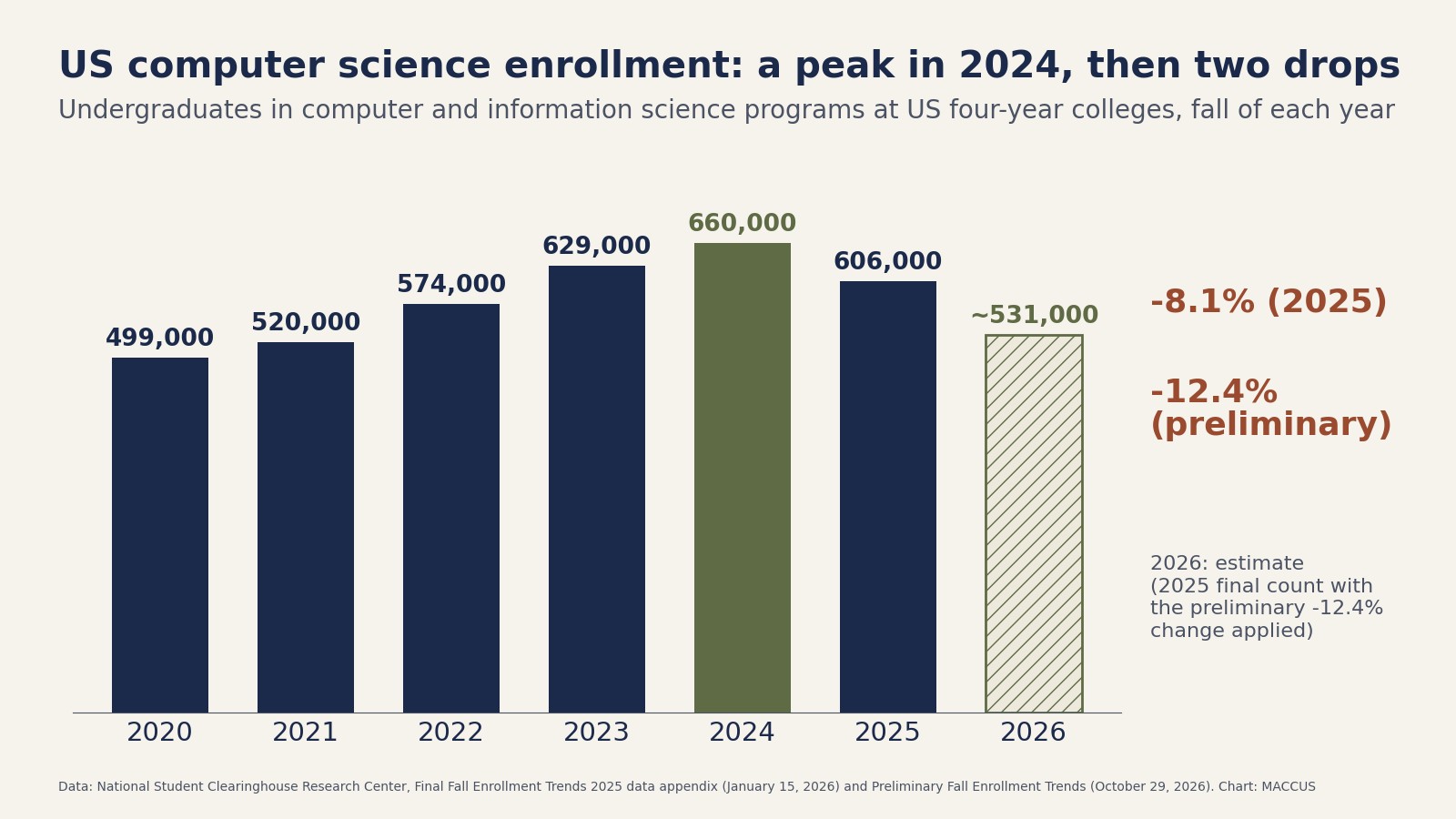
The field is down for a second year in a row. In fall 2024 it peaked at about 660,000 undergraduates at four-year colleges, up from 499,000 in 2020. A year later the count was down 8.1%, to about 606,000, according to the Clearinghouse’s final data for fall 2025. Using the Clearinghouse’s data, Bloomberg puts the loss over two years at 18.4% for undergraduate programs and 27.1% for graduate programs.
Over the same period, health and engineering majors grew. In 2024, recent computer science graduates had one of the highest unemployment rates of any major.
A second drop, and a steeper one
The Clearinghouse collects data from colleges that account for 97% of US enrollment. Its October report is an early look: it covers 7.92 million enrollments reported by 46% of institutions as of September 24, and the final figures follow in January 2027. Total enrollment held steady this fall (up 0.2%). Undergraduate enrollment rose 0.6%, while master’s enrollment fell 3.7%.
The Clearinghouse’s press release runs the item under the heading “Computer science enrollment falling further” and gives no cause. Health majors moved the other way: up 6.2% at four-year colleges, 4.3% at two-year colleges and 2.0% at the graduate level.
“Those are just remarkable declines for a field that until recently was one of the fastest growing areas that we’d seen in higher education,” Matthew Holsapple, the Clearinghouse’s senior director of research, told Bloomberg. At a press briefing covered by Higher Ed Dive, he added: “Computer science led years of strong growth before reversing direction last fall, where we started to see numbers really drop. This year, it’s even more pronounced.” At the undergraduate level, engineering and health professions programs each grew by more than 6% this fall, the trade publication reported.
The category the Clearinghouse tracks, computer and information sciences and support services, also includes IT administration and networking programs. The fall 2025 data appendix shows the computer science major itself fell harder than the whole family that year: 11.2% at four-year colleges, to about 206,000 students. Enrollment in computer programming fell 25.9%. IT administration programs slipped 1.5% and networking programs grew 10.1%.
A thinner entry level
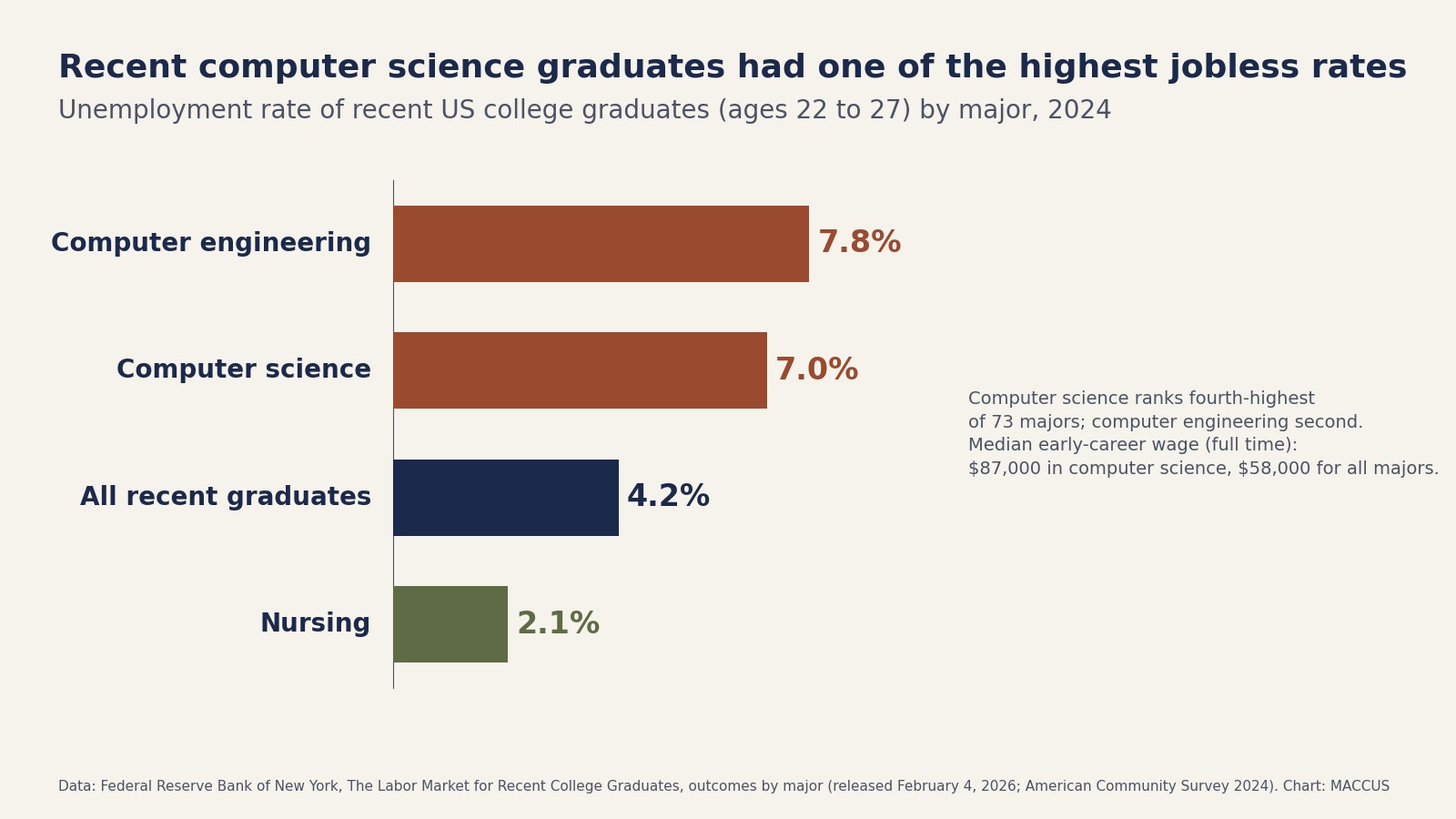
The drop comes as graduates in the field have struggled to find work. In 2024, recent computer science graduates aged 22 to 27 had an unemployment rate of 7.0%, the fourth-highest of 73 majors in the Federal Reserve Bank of New York‘s table. Computer engineering graduates were at 7.8%, nursing graduates at 2.1% and all recent graduates at 4.2%. Conditions “remained challenging” through the second quarter of 2026, the bank says: the unemployment rate of recent graduates stayed at about 5.6%, and 42% of them worked in jobs that typically do not require a degree.
Employment of 22-to-25-year-olds in the occupations most exposed to AI is about 19% below where it would be had it kept pace with the same age group in less exposed jobs. That estimate comes from an August 12 revision of a Stanford Digital Economy Lab study by Erik Brynjolfsson, Bharat Chandar and Ruyu Chen, based on ADP payroll records through June 2026. The gap was 15% a year earlier. Experienced workers show no comparable gap, and the adjustment appears to come mainly through fewer hires of young workers, the authors write.
At Anthropic, the maker of Claude, juniors have fallen from 27% to 9% of technical hires since early 2025, according to a study of the company’s own workforce. Bloomberg ties the enrollment drop to AI, writing that companies are eliminating many entry-level coding roles.
Computer science graduates who found full-time work earned far more than graduates overall: in the New York Fed’s 2024 figures, their median early-career wage was $87,000, against $58,000 for all majors. That year, only 19.1% of recent computer science graduates worked in jobs that typically do not require a degree, against 39.4% of all recent graduates.
Caveats in the numbers
The Clearinghouse does not mention AI, and the researchers who have looked at its effect on young workers and on course choices say their data do not establish cause. The Stanford team calls its findings “descriptive patterns, not causal estimates of the effect of AI,” and notes that the gaps are larger in its ADP sample than in national survey benchmarks. Jacob Light, an economist at Stanford’s Hoover Institution, found in a July paper that computer science’s share of course enrollments at the colleges he studied fell in 2025-26 for the first time in roughly two decades. He lists several possible causes, from AI changing how students do coursework to “broader weakness in the technology labor market unrelated to AI,” and treats the pattern “as descriptive evidence rather than as an estimate of the causal effect.”
The October figures are preliminary and come from a panel of colleges that reported every year, so they may be revised in January. They also say nothing about international students, who may account for part of the graduate decline. New foreign student enrollment fell 17% in fall 2025, according to an analysis by JB International and NAFSA cited by Bloomberg, and the Clearinghouse’s final count for that fall showed international graduate enrollment down 5.9%.
The decline also follows fast growth: four-year undergraduate enrollment in the field rose 32% between 2020 and 2024. By our calculation, if the 12.4% preliminary drop holds on the final count, the field would be back to about 531,000 undergraduates at four-year colleges, between its 2021 and 2022 levels.
The Bureau of Labor Statistics forecast points the opposite way: it projects employment in computer and mathematical occupations to grow 7.3% from 2025 to 2035, about twice the 3.5% average for all jobs, largely because of “the continued proliferation of digital tools and AI solutions across the economy.” Data scientists rank among the ten fastest-growing occupations, at 34.6%. Nurse practitioners top the list, at 41.0%.
What it means
A field that added about 160,000 undergraduates in four years gave back roughly 54,000 in one, and is on track to lose more this year. The drop comes as the data on young workers show fewer hires at the bottom of the ladder and higher unemployment for recent graduates. Employers elsewhere report the same thinning at the entry level, from Japanese companies that say they may hire fewer graduates from 2029 to Anthropic’s own hiring.
The numbers allow two readings, and the data will not decide between them soon. One says students repriced the degree once AI tools started writing the code that juniors used to write. The other notes that federal projections still expect computer jobs to grow twice as fast as total employment, and that new roles are appearing around AI itself, such as forward-deployed engineer, with more than 7,300 US job ads in the first nine months of 2026. If both hold, fewer computer science graduates will leave college in the late 2020s.
The Clearinghouse’s final fall 2026 report comes in January 2027, with full coverage and, according to Bloomberg, international student figures. The New York Fed updates its figures by major every February. The next revision of the Stanford payroll series will show whether the 19% gap is still widening.
Sources
- Clearinghouse Enrollment Insights Series: Preliminary Fall Enrollment Trends, National Student Clearinghouse Research Center, October 29, 2026
- Total Higher Ed Enrollment Holds Steady in Preliminary Fall Enrollment Trends Report, National Student Clearinghouse (PR Newswire), October 29, 2026
- Clearinghouse Enrollment Insights Series: Final Fall Enrollment Trends, National Student Clearinghouse Research Center, January 15, 2026
- Student enrolment in US computer science programmes falls as AI takes jobs, Elizabeth Rembert, Bloomberg (via Business Standard), October 29, 2026
- Undergraduate enrollment inched up this fall, while master’s dips 3.7%, Ben Unglesbee, Higher Ed Dive, October 29, 2026
- The Labor Market for Recent College Graduates, Federal Reserve Bank of New York, August 6, 2026
- No Widespread Displacement, but the AI Employment Gap for Young Workers Has Widened to 19%, Stanford Digital Economy Lab, August 12, 2026
- How exposed is higher education to Artificial Intelligence?, Jacob Light, Hoover Institution, Stanford University, July 20, 2026
Header image: chart by MACCUS, data from the National Student Clearinghouse Research Center (Final Fall Enrollment Trends 2025 data appendix, January 15, 2026; Preliminary Fall Enrollment Trends, October 29, 2026)