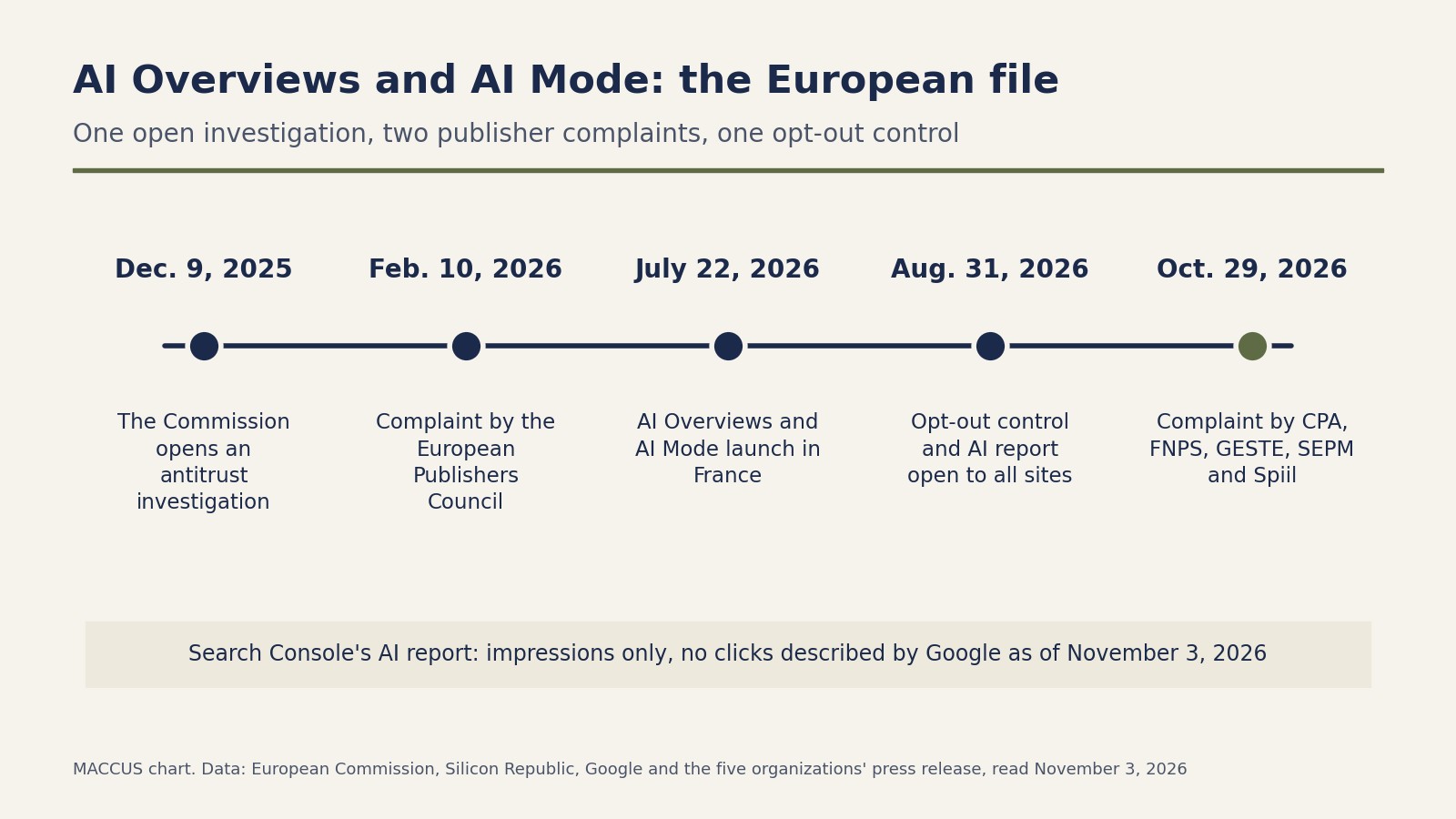

Five French trade groups representing website publishers (CPA, FNPS, GESTE, SEPM and Spiil) filed a complaint against Google with the European Commission on October 29, 2026. It targets AI Overviews and AI Mode, two Google Search features that launched in France on July 22 and answer queries directly from web content. The complainants tie their filing to the abuse-of-dominance investigation the Commission has been running since December 2025.
Their joint press release calls them “the broadest coalition of French website publishers’ associations and trade organizations ever assembled” before the EU’s competition authority. The coalition reaches beyond the press. It brings together the specialist press (FNPS), magazine publishers (SEPM) and independent online news outlets (Spiil, with 250 news companies and 350 publications). GESTE, which represents about a hundred online publishers, and CPA, the trade body for performance-based digital marketing founded in 2008, round out the group.
A complaint tied to the December 2025 investigation
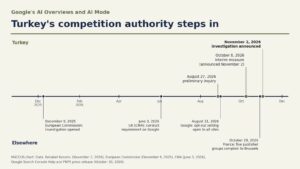
The Commission’s investigation, opened on December 9, 2025 (case AT.40983), looks at “to what extent the generation of AI Overviews and AI Mode by Google is based on web publishers’ content without appropriate compensation for that, and without the possibility for publishers to refuse without losing access to Google Search.”
The five groups say they want to “contribute to the investigation” by providing “factual evidence gathered from French publishers and an analysis of the practices observed” since July 22. They argue that France’s late launch, “nearly two years after” other markets, let them document these practices from day one.
The European Publishers Council, whose members are European media groups, had already filed its own complaint on February 10, 2026, Silicon Republic reported. Google responded at the time that these “inaccurate claims are an attempt to hold back helpful new AI features that Europeans want.” According to Reuters, as cited by The Next Web, the Commission sent publishers a questionnaire in July about Google’s opt-out control, with answers due by August 28.
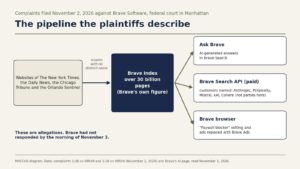
In the US, publishers are also going after data suppliers: on November 2, The New York Times and three other newspapers sued Brave, accusing it of selling their articles to AI companies.
The publishers’ grievances
The press release summarizes the complaint, whose text is not attached. It says the July 22 rollout “raises serious concerns” about “how the system was imposed and publishers’ visibility, traffic and business models.” The signatories describe a dependency: publishers need the search engine to reach their audience, while their content feeds features “likely to replace visits to their own sites, while giving them no transparency or real control.”
They ask the Commission to examine the effects on competition, on publishers’ control over their content and on the economic viability of their online businesses, to protect media pluralism. The release puts no figure on any harm and asks for no specific remedy.
No clicks in Search Console’s AI report
On launch day, CPA, GESTE and Spiil were already complaining that publishers lacked “dedicated Search Console data that would let them assess clicks and performance for AI Overviews and AI Mode.”
Google opened a generative AI performance report to all sites on August 31, 2026. Its Help page describes impressions for AI Overviews and AI Mode, broken down by page, country, device and date. It describes neither clicks nor query-level data. When it announced this data on June 3, Google wrote that “we’ll introduce additional metrics over time.”
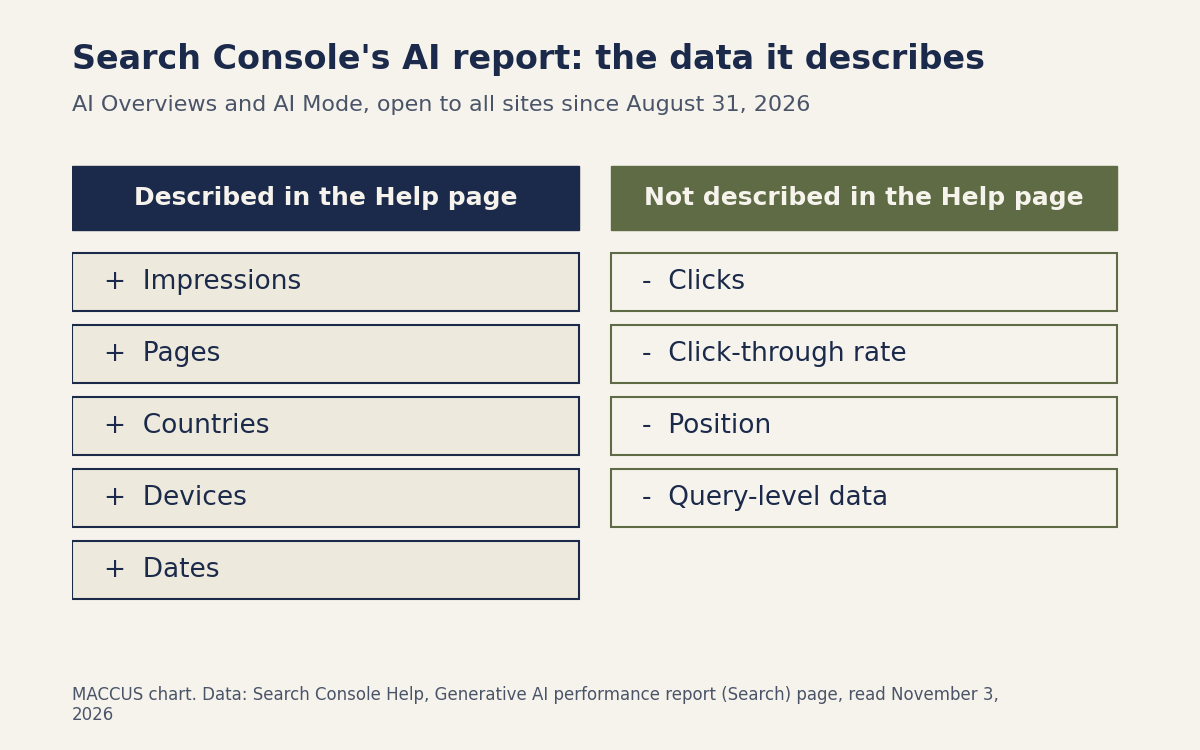
On November 2, Search Engine Roundtable flagged a LinkedIn post saying a Google employee, speaking at a Search Central Live event, had said Google expected to add click and query data to this report, with no timeline. Gary Illyes of Google replied that he didn’t think the company had phrased it that way: “The team is super interested in giving more data, data that makes sense, but we don’t have anything to announce yet.”
An opt-out that comes at a price
As of November 2, Google had not published a detailed response to the complaint, Silicon.fr reported, and was highlighting the “Search generative AI control” in Search Console, available to all sites since August 31. According to the Help page, the “Exclude” option removes a site’s links and content from AI Overviews, AI Mode and the generative AI features in Discover, and the site then won’t receive “any traffic or impressions” from them. The choice isn’t used as a ranking signal elsewhere in Search. The control doesn’t cover model training, which falls under Google-Extended and, starting in early 2027 according to Google, the shared robots.txt token announced on October 30.
On August 11, before the control opened to all sites, France’s alliance of general-news publishers, the Alliance de la presse d’information générale (APIG), warned that keeping articles out of AI Overviews came at a cost: “this technical withdrawal [leads to] a loss of visibility,” according to Next. In Turkey, the competition authority (Rekabet Kurumu) issued an interim order on October 8 requiring, for news publishers only, that this choice stay independent of their visibility in Google’s other services.
A single-site test published in late October offers an early hint of that cost. SEO Cyrus Shepard temporarily opted a site out of the AI features: its AI impressions, about 8% of the total, dropped to zero, and its regular organic clicks fell as well, he reported on LinkedIn. Search Engine Roundtable, which covered it on October 30, called it a very limited study.
Claimed losses, figures from other markets
The October 29 release includes no figures on French publishers’ traffic, and the evidence handed to the Commission is not public. The figures coalition members have cited so far come from the July 22 release by CPA, GESTE and Spiil and cover markets where the features already existed (“wherever AI Overviews has launched”).
That release cited an experiment by researchers at the Indian School of Business and Carnegie Mellon: 39.8% fewer organic clicks when an AI Overview appears. Noella Boullay, deputy director of CPA, pointed to “up to 58% fewer clicks to publishers’ sites, according to Ahrefs.” On October 29, Reddit CEO Steve Huffman named Google’s AI answers as the leading cause of the decline in visits that search engines send to the site, in what he called a two-part “hypothesis.”
Google maintains that the features are “designed to help people find and visit great websites.” In its June 3 blog post, updated on August 31, it claims more than 2.5 billion monthly users for AI Overviews and more than one billion for AI Mode, and says it has increased the number of links in responses. It publishes no click-through rate.
What it means
After the media groups, the complaint brings into the case sites that live on search traffic, many of which are not news outlets. The complainants’ central argument, their dependence on the search engine, echoes the Commission’s reasoning that many publishers “do not want to risk losing access” to Google Search.
The investigation has no legal deadline and, the Commission notes, its opening does not prejudge the outcome. The proceeding also relieves national competition authorities of their power to apply EU competition rules to the same practices. APIG’s complaint to France’s competition authority, the Autorité de la concurrence, rests on different grounds: the commitments Google made in 2022 on negotiating payment for news content.
Each side claims more than it has shown. Publishers have released no measurement of their losses in France, and Google no click-through rate; its report doesn’t let any site calculate its own. Measurement has become a sticking point between publishers and Google.
Still unknown are the exact content of the complaint, Google’s response, what the Commission will do with the answers to its July questionnaire and whether it will send Google a statement of objections. Also worth watching are whether click data reaches Search Console’s AI report and how the Autorité de la concurrence rules on APIG’s complaint.
Sources
- AI Overview et AI Mode : une coalition inédite d’organisations françaises d’éditeurs dépose plainte auprès de la Commission européenne, CPA, FNPS, GESTE, SEPM and Spiil (press release published on geste.fr), October 29, 2026
- AI Overview et AI Mode : une coalition inédite d’organisations françaises d’éditeurs dépose plainte auprès de la Commission européenne, CPA, October 30, 2026 (with the CPA, GESTE and Spiil release of July 22, 2026)
- Commission opens investigation into possible anticompetitive conduct by Google in the use of online content for AI purposes, European Commission, December 9, 2025
- Generative AI performance report (Search), Search Console Help, Google, read November 3, 2026
- Search generative AI control, Search Console Help, Google, read November 3, 2026
- New opportunities, control and insights for website owners, Google, June 3, 2026, updated August 31, 2026
- Gary Illyes Implies Click Data Not Coming To Google Search Console AI Reporting, Search Engine Roundtable, November 2, 2026
- Google AI Overviews & AI Mode 0.9% Click-Through Rate Says Small Opt Out Study, Search Engine Roundtable, October 30, 2026
Header image: MACCUS chart. Data: European Commission, Silicon Republic, Google and the five organizations’ press release, read November 3, 2026.