Google has rewritten its definition of “Crawled - currently not indexed,” a status for pages the search engine visited but left out of its results. The new text, published between October 26 and November 3, 2026, calls the status “a common message for many sites” that “doesn’t necessarily indicate an issue that needs attention.”
Site owners see this status in Search Console, Google’s free tool that shows how its search engine handles their pages. It covers pages that Google crawled, meaning its software downloaded them, but didn’t add to its index. The index is the database that Google’s search results come from.
On the Search Console help page, the new definition also says Google doesn’t index every page on the web. It drops a line from the old version, which said there was no need to resubmit the page for crawling.
Search Engine Roundtable, a news site that covers search engines, reported the change on November 3. On November 5, the French version of the help page carried a translation of the new English text. We found no Google announcement about the change.
Separately, site owners on Reddit report pages dropping out of Google’s index, in one case within a few days. So far, nothing links these reports to the rewrite.
The indexing report and its statuses
Search Console’s “Page indexing” report sorts every page address (URL) that Google knows about into two groups: indexed and not indexed. A page that isn’t indexed can’t show up in search results. The report’s help page says in its general guidance that “Non-indexed URLs can be fine.” That line was already there before the rewrite.
For each page that isn’t indexed, the report gives the reason as a status. “Crawled - currently not indexed” means Googlebot, the program Google uses to fetch pages, downloaded the page but Google didn’t add it to its index. A related status, “Discovered - currently not indexed,” covers a page Google knows about but hasn’t crawled yet. Our guide to Search Console indexing statuses explains each status in the report.
The old definition and the new one
As of October 26, the definition was still two sentences long. The Internet Archive, which keeps dated copies of web pages, saved the English version that day: “The page was crawled by Google but not indexed. It may or may not be indexed in the future; no need to resubmit this URL for crawling.”
The new text keeps the first sentence and replaces the second with three new ones. The first new sentence reads: “Google doesn’t index all pages across the web, so this is a common message for many sites and doesn’t necessarily indicate an issue that needs attention.”
The second new sentence covers “important pages.” For those, it points site owners to the URL Inspection tool, a Search Console feature that shows the status of a single page address. It also mentions “other tools” for finding out what keeps those pages from appearing. It gives one example: Google’s crawlers being blocked.
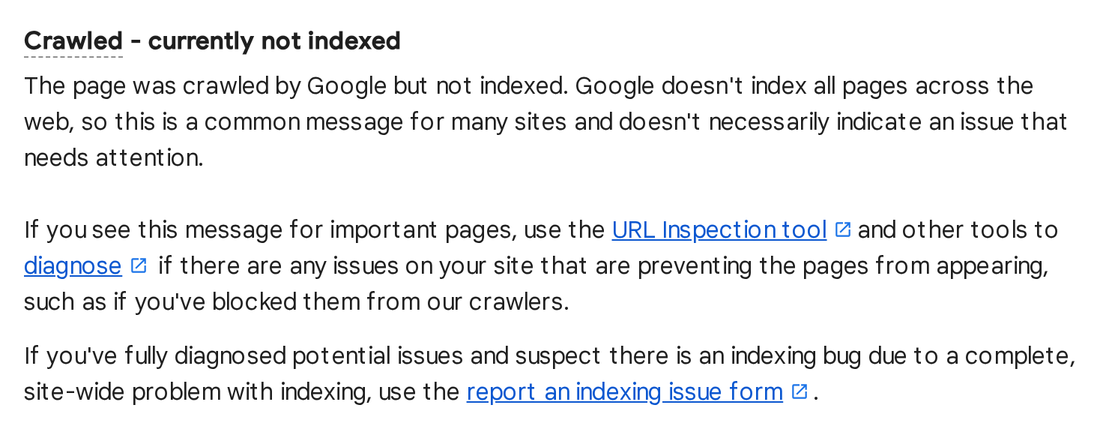
The last new sentence covers indexing failures across an entire site. It applies when an owner has “fully diagnosed potential issues” and suspects “a complete, site-wide problem with indexing.” In that case, the help page points the owner to the “report an indexing issue form.”
The definition of “Discovered - currently not indexed” didn’t change, and the rest of the English page matches the October 26 copy.
A form for site-wide indexing failures
The form itself isn’t new. Google launched it in April 2021, at first for site owners based in the US, according to a Search Engine Roundtable article from April 29, 2021. The form requires signing in to a Google account. In 2021, it asked a series of questions to confirm that the problem was on Google’s side.
The old definition didn’t point to this form. The new one does, but only in one case: a failure that would keep an entire site out of the index. For individual pages, the help page mentions only the URL Inspection tool and “other tools.”
The new definition leaves out page quality
Search Engine Roundtable notes that the new text doesn’t mention page quality. Google covered that topic in a July 16, 2026, episode of Search Off the Record, its podcast about search. The episode was about the indexing report.
In it, Martin Splitt asked John Mueller whether these not-indexed statuses were often a sign of a quality issue. Both are on Google’s Search Relations team, which works with site owners. “Sometimes,” Mueller answered, according to Search Engine Roundtable’s transcript. He added that when Google has serious doubts about a site’s quality, it crawls and indexes fewer of its pages.
The episode’s description made a related point back in July. It encouraged reading the report for trends rather than as a list of errors to fix. It also said a healthy website doesn’t need 100% of its pages indexed.
Google’s documentation on how search works, last updated December 18, 2025, also states that “Indexing isn’t guaranteed.” Its list of common indexing issues starts with “The quality of the content on page is low.”
Reddit users report pages dropping out of the index
Several Reddit discussions posted since October 31 deal with this status. One poster runs an IT troubleshooting site that launched in early September. The site is built on WordPress, a website-building platform, and has about 90 articles written with the help of AI.
According to the poster, almost all of those articles switched to “Crawled - currently not indexed” within about three days, around October 23. The poster says impressions, meaning the number of times the pages appeared in Google’s results, fell from about 300 a day to almost zero.
Another poster says Google is removing large numbers of pages from its index on several sites they follow. They blame generic or AI-recycled content but haven’t published any data.
A third account comes from a developer whose blog is built with Next.js, a toolkit for building websites with JavaScript code. The developer says the posts’ text, which loads in the reader’s browser, doesn’t appear in the version of the page that Google analyzes. A week after requesting indexing again, the developer had seen no change.
These are isolated cases, and their causes haven’t been established. As of November 5, the Google Search Status Dashboard, Google’s public page for search incidents and updates, reports no recent indexing incident. The last search change it lists is the September 2026 spam update. That update started on September 24 and lasted almost 14 days.
Questions Google hasn’t answered
Google hasn’t said exactly when it changed the definition, or why. As of November 5, the changelog for Search Central has no entry about the rewrite. Search Central is Google’s documentation site for its search engine.
That site is separate from the Search Console help center, where the definition appears. Its changelog records edits such as an update to the quota page for Google’s Indexing API on October 16. The Indexing API is a service for notifying Google about certain pages.
The word “common” comes with no number. The help page doesn’t say what share of crawled pages stays out of the index. The words “not necessarily” also leave open when the status does point to a problem worth fixing.
Google doesn’t explain why it removed the sentence about resubmitting the page. Its Search Central page on asking Google to crawl a site again, last updated December 10, 2025, makes no promises: “Requesting a crawl does not guarantee that inclusion in search results will happen instantly or even at all.” It adds that “there’s a quota for submitting individual URLs” and that “requesting a recrawl multiple times for the same URL won’t get it crawled any faster.”
What it means
The new definition changes the tone. The old one explained the status and gave a single instruction: there was no need to resubmit the page. The new one is reassuring: many sites see this status, and it doesn’t necessarily call for action.
The help page already said that all non-indexed URLs “can be fine.” The new text applies that principle to this one status, in line with what Google said in the July podcast episode.
The change matters most to site owners who check this report but aren’t specialists, and to the consultants who read it for them. The help page offers them one way to report a problem to Google, the form. It covers only failures that would hit an entire site.
Google says the status is common but doesn’t put a number on it. Its Search Relations staff and its general documentation still name page quality as one reason pages stay out of the index. The new definition doesn’t mention quality.
So far, nothing links the rewrite to the reports posted on Reddit, which involve only a handful of sites.
Google could rewrite the definition of “Discovered - currently not indexed” and the URL Inspection tool’s messages along the same lines. Makers of search engine optimization (SEO) software could publish data on the share of crawled pages that stay out of the index. Those numbers would show what Google means by “common.”
Sources
- Page indexing report, Google Search Console Help, version accessed November 5, 2026
- Page indexing report (archived copy), Internet Archive, October 26, 2026
- Google Updates Crawled - Currently Not Indexed, Search Engine Roundtable, November 3, 2026
- How to read the Indexing Report, Search Off the Record (Google), July 16, 2026
- Google On Discovered vs Crawled Not Indexed Quality Issues & AI-Generated Content, Search Engine Roundtable, July 16, 2026
- In-Depth Guide to How Google Search Works, Google Search Central, updated December 18, 2025
- Ask Google to Recrawl Your Website, Google Search Central, updated December 10, 2025
Header image: MACCUS chart. Data: Google Search Console Help, archived copy of October 26, 2026 and version of November 5, 2026.