
Starting January 11, 2027, websites that use server-side GTM will send their visitors’ full IP addresses to Google’s advertising tools by default. In that setup, Google Tag Manager runs on a server the site controls instead of in the visitor’s browser. That matters because an IP address, the number that identifies a visitor’s internet connection, is usually personal data under European law. Site owners will still be able to mask it, but only if they set that up themselves.
Google announced the change in a notice emailed to its customers. Titled “Updates to network signal processing in server-side tagging,” the notice carries no date. It became public on November 2, 2026.
Adriaan Dekker, an independent Google Ads consultant based in Rotterdam, the Netherlands, posted it on LinkedIn on November 2. On his blog, he describes it as a mandatory service announcement that Google sent to Tag Manager users that same day. Three search marketing news sites picked it up: PPC Land on November 2, Search Engine Journal on November 3 and Search Engine Roundtable on November 4.
How server-side GTM works
Google Tag Manager is a tool for installing tags on a website. A tag is a small piece of code that sends data to an outside tool: Google Analytics to measure traffic, Google Ads to run ads, or another vendor’s product. Tag Manager stores a site’s tags in a container.
In the standard setup, the container runs in the visitor’s browser and sends the data straight to each tool. In the server-side setup, the browser sends the data to a container on a server the advertiser hosts, which passes it on.
Google’s documentation sums up the difference: a server container “doesn’t run in the user’s browser or on their phone.” Instead, “it runs on a server that you control.” Only its owner has access to the data until they choose to send it elsewhere. That server is where the IP address gets passed on in full or masked.
The four changes in the notice
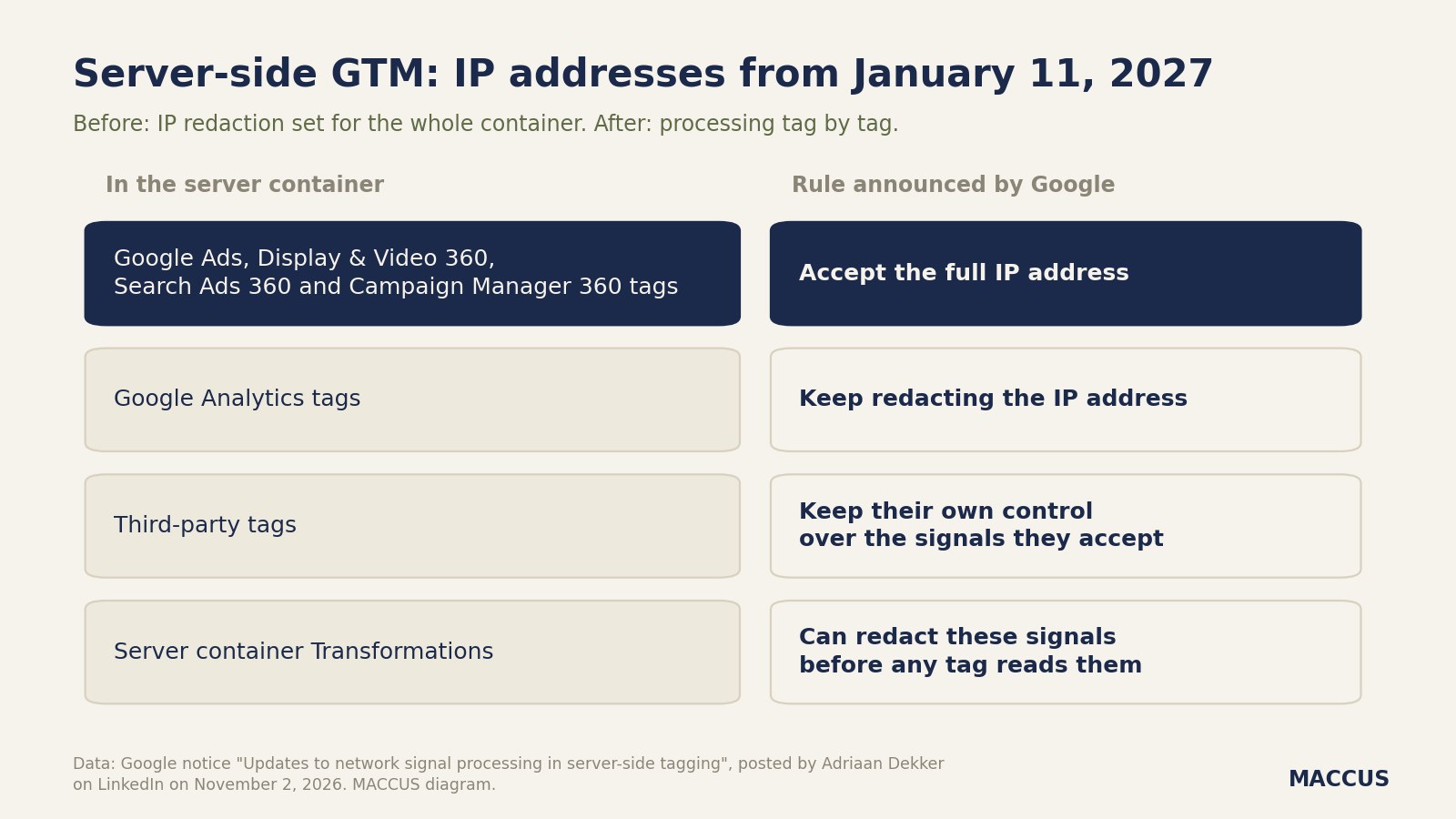
According to the notice, server containers “will transition from container-wide IP address redaction to individual tag-level processing.” Redaction here means masking. Until now, one masking rule could cover the whole container. Starting January 11, each tag will be handled separately.
The notice lists four effects. First, tags that send data to Google Ads, Display & Video 360, Search Ads 360 and Campaign Manager 360 “will now accept the full IP address.” The last three are part of Google Marketing Platform, a Google suite of tools for buying ad space, managing search campaigns and measuring results.
Second, Google Analytics tags “will continue to apply IP redaction.” Third, tags from other vendors “will maintain independent control over the signals they accept.” Fourth, Transformations “can redact these signals before any tag accesses the data.” A Transformation is a server container feature that edits data before a tag reads it.
Google says the change will “facilitate improvements to Ads measurement and personalization.” The notice adds that the update “integrates privacy-enhancing technologies (PETs).” It also claims the update filters spam and invalid traffic, such as bots and fake clicks, and improves campaign performance.
The notice also spells out what advertisers must do, since the change involves processing network signals such as the IP address. Before any data is collected, advertisers “must ensure proper end-user notices and legally required consents are in place.” Advertisers who use Google’s ad products in the European Economic Area (the EU plus Iceland, Liechtenstein and Norway) “must strictly adhere” to Google’s EU user consent policy.
Google’s help article on masking the address
For “detailed opt-out instructions,” the notice points to a Google help article but doesn’t name it. The help article on the subject, “IP address redaction for server-side tagging,” is available only in English. It doesn’t mention the January 11 date.
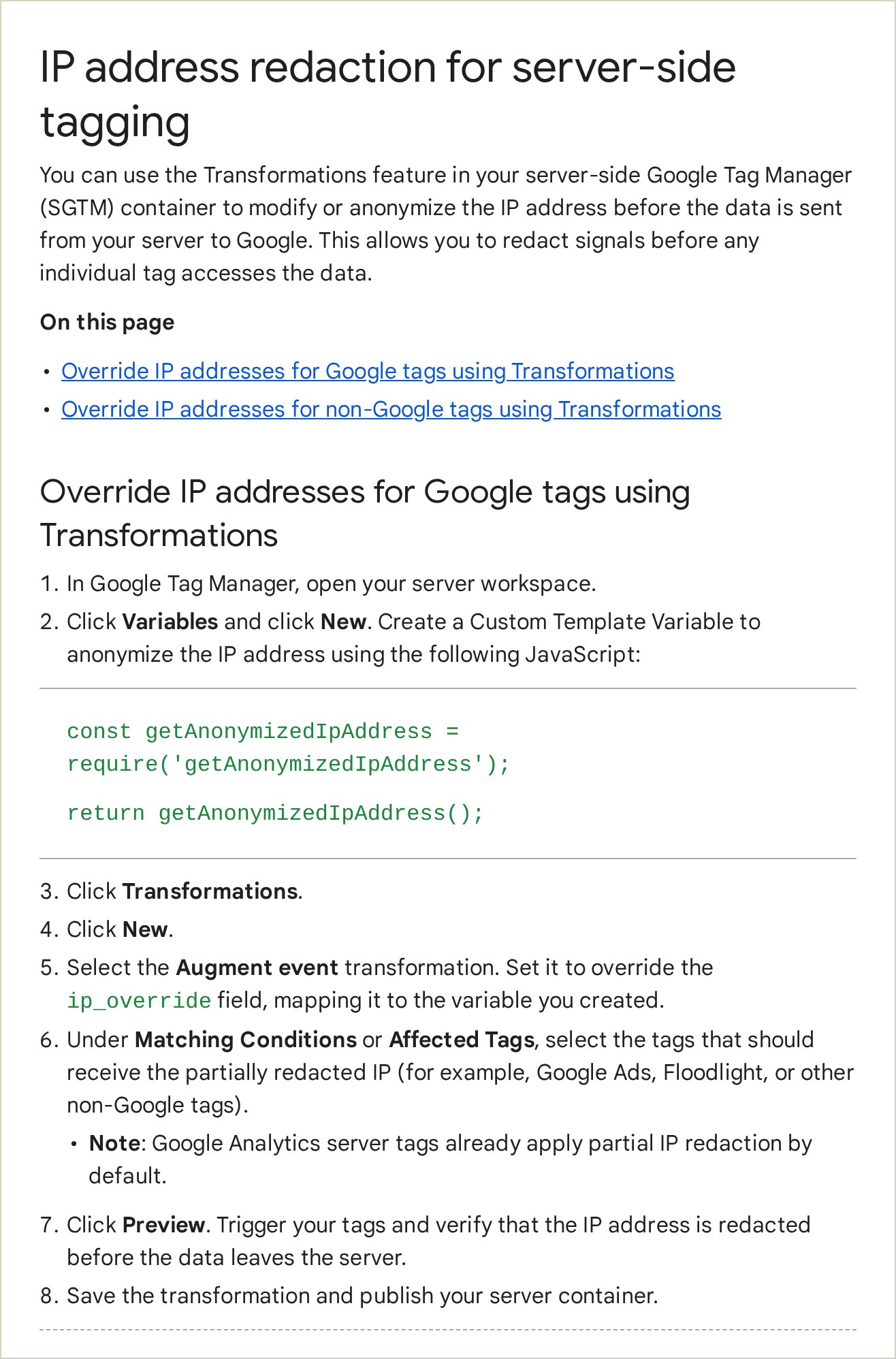
The help article describes a two-part setup. The first part is a custom variable, a small block of code that calls the getAnonymizedIpAddress function to mask the address. The second part is a Transformation that writes the masked address into the ip_override field. That field holds the IP address of each tracked event, such as a page view.
In the article’s last steps, the container’s admin picks the tags the Transformation applies to. The admin then checks the result in Preview mode, Tag Manager’s testing tool, before publishing.
Google’s developer reference, the company’s technical documentation for programmers, shows how the function masks an address. On an IPv4 address, the older format made of four numbers, the function replaces the last number with a zero: 198.51.100.42 becomes 198.51.100.0. An IPv6 address, the newer format, is 128 bits long; the function keeps the first 48 bits and sets the other 80 to zero. The help article calls the result a “partially redacted IP.”
The function is missing from an October 12, 2026, copy of that reference page. The copy was saved by the Internet Archive, a service that stores past versions of web pages. The live page lists the function and shows an update dated October 30.
The help article notes that Google Analytics server tags “already apply partial IP redaction by default.” Tags from other vendors can differ: some read the IP address from a custom header or an event parameter instead of ip_override. A header is technical data sent with each request, and an event parameter is a detail attached to a tracked event. For those tags, the article calls for a Transformation aimed at the field the tag actually reads.
European law and Google’s consent policy
Under European law, an IP address is usually personal data, meaning information tied to a person who can be identified. France’s data protection authority, the CNIL, lists IP addresses among personal data in its definition of the term (in French).
The Court of Justice of the European Union, the EU’s highest court, ruled on dynamic IP addresses on October 19, 2016, in the Breyer case (C-582/14). A dynamic IP address changes with each connection. The court found that such an address is personal data for a website operator on one condition. The operator must have legal means to have the visitor identified through information held by the visitor’s internet service provider.
Google’s EU user consent policy covers the European Economic Area, the UK and Switzerland. It requires legally valid consent for cookies, the small files a site stores in the browser, where the law demands it. It also requires consent to collect, share and use personal data to personalize ads.
Under the policy, advertisers must keep records of that consent and clearly identify each party that may collect, receive or use the data. If they don’t comply, Google may limit or suspend their use of the product, or end the agreement.
What Google left unsaid
Google doesn’t name any of the privacy-enhancing technologies it mentions. It also gives no figures for the promised performance gains. As of November 5, the change wasn’t in Tag Manager’s release notes, the page that lists the tool’s new features. The latest entry there was dated October 12.
Search Engine Journal points out other gaps. The notice doesn’t explain how masking for the whole container is set up today. Nor does it say how the change will work with consent mode. Consent mode is a feature that tells Google whether a visitor accepted cookies, so tags can adjust.
The notice also says nothing about the data that Floodlight tags in server containers have sent to Google without consent since July 2025, a change listed in Tag Manager’s release notes. Floodlight is the Campaign Manager 360 tool that counts conversions, such as purchases. Google’s notice doesn’t say where full IP addresses will be stored, or for how long.
PPC Land notes that the notice never defines “network signals.” The IP address is the only example it gives.
Google is planning a similar change for Google Analytics and says it will share the exact dates later this year. A help page on updates to Analytics data controls covers IP addresses that the Google tag and SDK collect automatically. They “will be encrypted and flow to your linked Google Ads account.” The Google tag is Google’s tracking code for websites, and the SDK is its software development kit for apps.
What it means
The change is about a default setting. Starting January 11, Google’s ad tags will get the full address unless the container owner blocks it.
To block it, the owner has to set up a Transformation in the container. A single help article, in English only, describes the method. That method relies on a function that wasn’t in Google’s developer reference on October 12.
The change affects sites that route Google Ads or Floodlight tags through a server container, including sites with European visitors. The notice leaves the legal responsibility with the advertiser: inform visitors, collect consent where the law requires it and follow Google’s EU policy. It doesn’t say whether the full address will still be sent when a visitor has declined advertising cookies. For a European site, that is the question that matters most.
Google Ads has switched on other features by default this fall, and advertisers have to turn them off themselves. Since October 12, Google Ads can automatically add an advertiser’s promotions to its ads. On October 23, another default was flagged: adding an advertiser’s online videos to new Performance Max campaigns. Performance Max is a largely automated type of Google Ads campaign.
Google announced the server container change only in an email to customers. It published no blog post and no release note. The same was true of Performance Max filtering out brand searches. Google added it to a help page without notice, and it was spotted on November 2.
The next thing to watch is whether Google adds the change to its release notes and the date to its help article before January 11. Two questions remain open: what happens to the IP address of visitors who decline consent, and when Google Analytics will start encrypting IP addresses.
Sources
- Google notice “Updates to network signal processing in server-side tagging,” posted by Adriaan Dekker, LinkedIn, November 2, 2026
- IP address redaction for server-side tagging, Google Tag Manager Help, read November 5, 2026
- Server-side tagging APIs (getAnonymizedIpAddress), Google for Developers, updated October 30, 2026
- EU user consent policy, Google, read November 5, 2026
- Updates to Google Analytics data controls, Google Analytics Help, read November 5, 2026
- Judgment in Case C-582/14 Patrick Breyer v Bundesrepublik Deutschland, Press Release No 112/16, Court of Justice of the European Union, October 19, 2016
- Google Ad Tags In Server-Side GTM To Get Full IP Addresses, Search Engine Journal, November 3, 2026
- Google ad tags gain full visitor IP addresses in server-side GTM in 2027, PPC Land, November 2, 2026
Header image: MACCUS diagram, data from Google’s notice “Updates to network signal processing in server-side tagging” (November 2026)