In US traffic, a visit from a ChatGPT ad earned the website $0.89 on average (about €0.79 at the European Central Bank’s reference rate for November 2, 2026). A visit from a Google Search ad earned $2.45 (about €2.18), so the ChatGPT visit was worth 64% less. That is the central finding of a working paper released in October 2026 by Maximilian Kaiser of WU Vienna (Vienna University of Economics and Business) and Christian Schulze of the Frankfurt School of Finance & Management.
On November 2, Search Engine Land, PPC Land and Search Engine Journal reported on the paper, titled “Can Advertising Fund Free AI?” It spans the first 28 weeks of advertising in ChatGPT and draws on analytics data from nearly 1,900 online stores.
Nearly 10 billion visits
The authors drew on 60 weeks of Google Analytics 4 data, nearly 10 billion sessions recorded from June 29, 2025, to August 22, 2026. Grips Intelligence, an ecommerce analytics company, provided the data free of charge. The first panel covers 1,898 websites with combined annual sales of about $16 billion.
The second panel includes 387 websites that received at least one click from a ChatGPT ad. Of those, 102 track all of their sales. For 31 of the 102, a linked Google Ads account also shows what they paid for Google Search clicks. What advertisers paid for ChatGPT clicks is not in the data.
The design relies on the country-by-country rollout of the ads. They launched in the United States on February 9, 2026, then in Australia, Canada and New Zealand on April 16, the United Kingdom on June 4, Japan and Korea on June 19, and Brazil and Mexico in early August. The European Union is the control group: ads did not appear there until August 24, two days after the study window closed. Ads are shown only to users on the Free and Go plans.
Fewer purchases, smaller orders
Visitors who arrive from a ChatGPT ad buy less often: 0.37% of them place an order, compared with 1.17% for Google ads. On the same website, with device and week held constant, their orders are $74 smaller on average.
The gap shows up almost everywhere. Of the 87 advertisers buying both kinds of ads for US traffic, 84 earn less per ChatGPT visit. Among those 87, 73 recorded no sales at all from ChatGPT ads despite 18,726 paid visits combined, and the other 14 account for all 570 transactions observed.
A single advertiser accounts for 66% of the purchases from ChatGPT ads across the 102 sites. Removing it from the sample widens the gap between ChatGPT and Google in conversion and in revenue per visit, the authors note. Paid ChatGPT visitors also leave faster: they view 1.4 fewer pages and spend 104 fewer seconds on the site than direct visitors.
A click worth $0.26
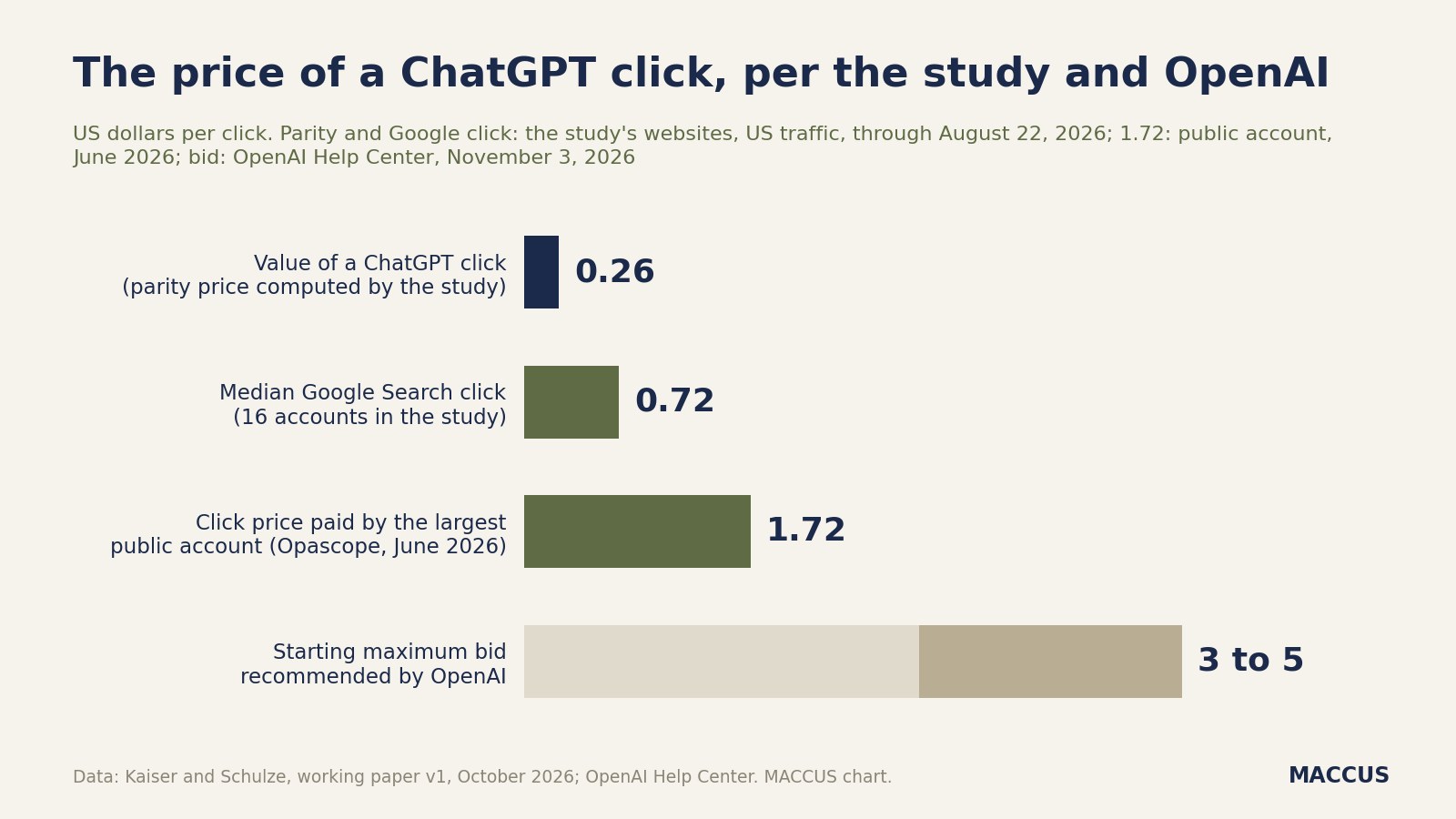
The authors calculate a “parity price”: the price at which a ChatGPT click would return as much per dollar spent as a Google Search click. For 16 accounts with mostly US traffic, the median Google click costs $0.72. Since a ChatGPT visit earns 36% of what a Google ad visit earns, a ChatGPT click would be worth about $0.26 (€0.23), with a range of $0.05 to $0.57.
Actual prices are much higher. In June, Opascope, which runs ad campaigns for clients, published figures from the largest account with public data. That account paid $1.72 per click (about €1.53), more than six times the parity price. OpenAI’s “Ads in ChatGPT: The Basics” help page recommends a maximum bid of $3 to $5 per click (about €2.67 to €4.46) to start a pay-per-click campaign.
Slightly fewer organic referrals
The study also measures how the ads affected ChatGPT’s organic referrals, the visits its unpaid recommendations send to websites. In the 13 weeks after ads launched in a country, the baseline estimate shows a 5.9% drop in those visits relative to the European Union. The confidence interval runs from a 12.6% drop to a 1.2% increase, so the estimate does not establish a decline with confidence.
When the authors account for ChatGPT’s faster growth in North America, as measured by OpenAI itself, the estimated drop grows to 7.2% or 8.4%. The conversion rate on those visits showed no detectable change: down 0.02 percentage points from a pre-launch 2.21%.
The channel remains small. Over the last four weeks of the study window, organic visits from ChatGPT made up 0.40% of all traffic to the 1,898 sites. SEO consultant Marie Haynes published GA4 data from 100 sites on October 21 and found ChatGPT traffic equal to 0.62% of the visits those sites got from Google organic search.
OpenAI’s own numbers
On August 31, OpenAI announced an annualized revenue run rate of $1 billion for ChatGPT Ads. It cited an ecommerce advertiser whose sales reached three times its ad spend over 28 days. The same day, the self-service Ads Manager opened in 31 European countries, including France and Belgium, as detailed in our October report on ChatGPT ads.
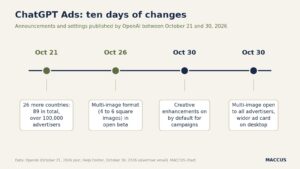
On October 21, OpenAI said more than 100,000 advertisers had used the platform since launch and that ChatGPT Ads was available in 89 countries. On October 30, it switched on AI rewriting of ads by default. The ChatGPT Ads FAQ states that the platform “does not yet have performance benchmarks across advertisers, industries, or campaign types.”
In a Reddit post on November 2, a performance marketing agency testing Ads Manager said a few brand-new client accounts had received a “spend €500, get €500” ad credit offer. OpenAI support did not tell the agency what the eligibility criteria were.
Another advertiser, new to the platform, asked whether there is any way to see which prompts trigger their ads, because Ads Manager does not show it. OpenAI’s help page says the “context hints” advertisers provide guide ad matching but do not guarantee delivery in any specific conversation.
Limits of the study
The paper is a first version that is under review and has not yet been peer-reviewed. The authors call the advertising results descriptive: advertisers chose for themselves whether to buy ChatGPT ads, so the results do not show cause and effect. A campaign becomes visible in the data only with its first paid click, so campaigns that never got a click are missing.
The data captures only the last click that brought a visitor to the site. A purchase made later, after a return visit through Google or a direct visit, is not credited to ChatGPT. A comparison with similar websites that do not buy ChatGPT ads found no detectable lift in traffic from other channels, but the test can rule out only large lifts, and smaller effects remain possible. The parity price also assumes similar profit margins in both channels.
The two panels differ. The first is mostly online stores, while half of the websites in the second are in services, software, education and finance. The study window ends before ads reached Europe. PPC Land adds that it ends before most of the changes OpenAI has made since, and that conversion-optimized campaigns, launched on June 5, are not analyzed separately.
OpenAI’s help page warns that its ad-review crawlers may visit landing pages with tracking parameters, and that third-party analytics tools may count those visits as paid traffic.
The paper’s competing-interests statement says Maximilian Kaiser previously worked for Grips Intelligence and is now its scientific adviser. It adds that the company had no right to review the paper, has no commercial relationship with OpenAI and does not sell measurement tied to ChatGPT Ads.
What it means
The study measures what a ChatGPT click is worth using merchants’ own analytics data, from outside the platform. Until now, much of the published performance data had come from OpenAI, its ad tech partners or measurement vendors, PPC Land notes.
For US traffic on the sites studied, the gap with Google is wide. A visit from a ChatGPT ad earns about a third of what a visit from a Google ad earns, while the reference click the authors use, from the account Opascope reported on, costs about 2.4 times the median Google click.
Ads served in Europe since August 24, including those bought through self-service since August 31, fall outside the study. Delivery there differs in at least one way: according to OpenAI’s “Ads in ChatGPT” help page, personalized ads are not initially available in the European Economic Area or Switzerland. The study says nothing about what a click is worth under those conditions.
The authors offer one reading of their results: ChatGPT ads sit below the answer, apart from the recommendation, which may explain both the low value of the clicks and why organic referrals were largely spared. Moving the ads closer to the answer could raise their value but make ChatGPT less useful.
OpenAI says it is exploring “new ways for businesses to interact with consumers in more native ways in ChatGPT.” At Google, Chief Business Officer Philipp Schindler also cited “the lower monetization we were seeing in AI Mode” among the reasons for slower search growth when Alphabet reported quarterly results on October 28.
Three things are worth watching: a possible second version of the paper with European data; the first performance benchmarks, which OpenAI says it does not yet have; and whether ads move into the answer itself.
Sources
- Can Advertising Fund Free AI? Evidence from ChatGPT’s International Advertising Rollout, Maximilian Kaiser and Christian Schulze, working paper v1, October 2026
- Ads in ChatGPT: The Basics, OpenAI Help Center, accessed November 3, 2026
- Frequently asked questions, ChatGPT Ads, OpenAI Help Center, accessed November 3, 2026
- A milestone in expanding access to AI, OpenAI, August 31, 2026
- ChatGPT Ads expands across Europe, OpenAI, August 18, 2026, updated August 31, 2026
- ChatGPT Ads expands to 26 new countries as over 100,000 advertisers have used the platform, OpenAI, October 21, 2026
- Ads in ChatGPT, OpenAI Help Center, accessed November 3, 2026
- ChatGPT ad visits earn shops $0.89 against $2.45 for Google search ads, PPC Land, November 2, 2026
Header image: MACCUS chart, data from Kaiser and Schulze (working paper v1, October 2026)