Google’s Chrome browser will stop running XSLT on November 17, 2026, when version 158 is scheduled to reach most users. In Chrome, the sitemap built into WordPress and those of several major SEO plugins will then lose their table layout. SEO plugins are add-ons that tune a WordPress site for search engines. Their makers say search engines are not affected.
Sitemaps are the files that list a site’s pages for search engines. They are written in XML, a data format meant for machines. XSLT is the language that turns them into a table a person can read in a browser. Our complete guide to sitemaps explains what sitemaps do.
Site owners who open their sitemap in Chrome have seen a warning banner since at least early October. The banner says: “This site uses XSLT; that functionality is being removed from this browser very soon.” Yoast, the company behind the Yoast SEO plugin, noted it in a ticket opened on October 2 to track the issue. On the evening of November 5, the banner prompted a thread titled “This site uses XSLT Warning” in Reddit’s technical SEO forum.
Chrome laid out the plan in October 2025
The Chrome team laid out the plan on October 29, 2025, on a page titled “Removing XSLT for a more secure browser.” Google, which makes Chrome, gives two reasons.
The first is security. Chrome runs XSLT with libxslt, an old library of code written in the C and C++ programming languages. Code of that kind is prone to memory-handling flaws, which can let an attacker run code on a visitor’s machine.
The second is low usage. According to Google, about 0.02% of web page loads use XSLT. Fewer than 0.001% of page loads go through an instruction placed at the top of an XML file, and that is the method sitemaps use.
Chrome’s published timeline has eight steps, and three of them matter for sitemaps. Since Chrome 143 shipped on December 2, 2025, XSLT has been officially deprecated, or slated for removal, with warnings shown only in developer tools. On November 17, 2026, it stops working in Chrome’s stable version, the one most people use. On August 17, 2027, with Chrome 176, it is gone for everyone.
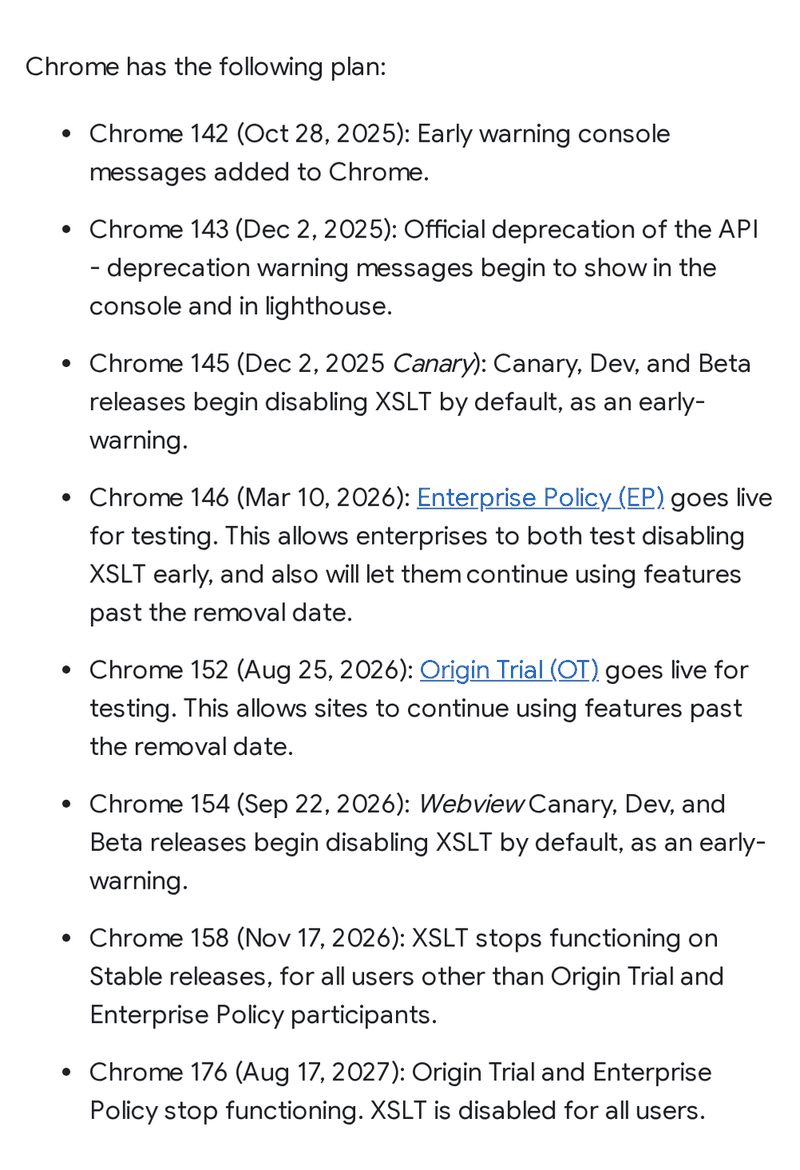
Two exceptions let XSLT keep working until August 17, 2027. A site can join a Chrome trial program that keeps a feature alive while it is being removed. A company can also turn on a policy, an administrator setting, for the Chrome browsers it manages.
Chrome 158 is already reaching some users. Since November 4, Google has been shipping it to “a small percentage” of Windows users. The November 17 date for the general release comes from the release calendar of Chromium, the open-source project Chrome is built on. The current stable version, Chrome 157, came out on November 3.
The same Chrome page says Firefox and WebKit, the engine behind Safari, also plan to remove XSLT. The tracking ticket Mozilla opened for Firefox on September 25, 2025, sets no date. Earlier this fall, Chrome also changed how it handles image formats: it began displaying JPEG XL, which Google Images doesn’t support yet.
Which sitemaps change their look?
The affected sitemaps start with a line that tells the browser to apply an XSL stylesheet, a formatting file written in XSLT. The current version of WordPress puts that line in its built-in sitemap. On November 6, Rank Math and All in One SEO, two widely used SEO plugins, still had that line in the sitemaps of their own websites.
The sitemap file itself stays online with the same content. What changes is how it looks in a browser. According to Yoast’s ticket, Chrome will show the raw XML code as a tree instead of the table.
The banner warns that the page “will likely no longer display correctly” once the feature is gone. It suggests installing a browser extension, a small add-on for Chrome. Chrome’s page points to one that recreates XSLT.
WordPress drops the stylesheet in version 7.2
The developers of WordPress itself moved first. On October 3, 2026, developer Peter Wilson added a change to the WordPress code, titled “Sitemaps: Remove XSL stylesheets.” The note attached to the change cites the removal of XSLT from browsers, which can make sitemaps fail to display.
The change ships with WordPress 7.2, which its developers have scheduled for December 8, 2026. The current version, 7.1.4, keeps the XSL line. From November 17 to December 8, the built-in WordPress sitemap will still point to an XSL stylesheet that Chrome no longer runs. Once 7.2 is out, it will use no stylesheet at all, and Chrome will show it as raw XML.
SEO plugins move at different speeds
SEO plugins such as Yoast SEO and Rank Math replace the WordPress sitemap with their own. By November 6, The SEO Framework was the only one of the four plugins below to ship a sitemap styled with CSS. CSS is the web’s standard styling language. The table also shows each plugin’s active installs, the number of sites using it according to WordPress.org, the official WordPress site.
| Plugin | Active installs (wordpress.org) | Status as of November 6, 2026 |
|---|---|---|
| Yoast SEO | 10 million+ | CSS stylesheet ready for version 28.9, not released yet |
| Rank Math SEO | 4 million+ | no replacement announced |
| All in One SEO | 2 million+ | no mention in the release notes (version 5.0.5, November 4) |
| The SEO Framework | 200,000+ | CSS stylesheet since version 5.2.0, October 14 |
At Yoast, the October 2 ticket was closed on October 28. The fix replaces XSLT with a CSS stylesheet that keeps the table look. The ticket lists what is lost: links are no longer clickable, the sentence giving the number of URLs disappears, and dates show in a raw technical format.
The latest public version of Yoast SEO is still 28.8, released October 27. The sitemap on yoast.com, the company’s own site, already points to a CSS stylesheet. Yoast’s News, Video and Local SEO add-ons keep XSLT until each one gets its own fix.
Rank Math’s support team replied in late October, in a thread about the banner on the WordPress.org forum. It called the banner “a browser compatibility warning” that does not point to a problem with the sitemap. The team said it does “not have an announcement” about a replacement. Version 1.0.281 of Rank Math, released November 3, doesn’t mention one either.
Outside WordPress, Statamic, another system for building and managing websites, removed the XSL stylesheet from its SEO Pro add-on on November 5. A user had reported the banner the same day.
No announced effect on search engines
Every plugin maker that has commented says search engines are not affected. Yoast’s ticket gives the reason: search engines read the XML and ignore the stylesheet. Rank Math’s support team and Statamic’s fix say the same.
Google’s documentation page “Build and submit a sitemap,” updated in July 2026, doesn’t mention stylesheets. It asks for a file in an accepted format, saved in UTF-8, a standard text encoding. It also says submitting a sitemap “is merely a hint”: Google doesn’t commit to downloading the file or using it to crawl, or explore, the site.
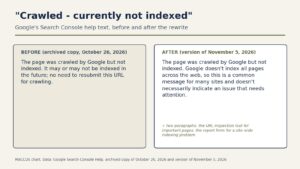
Google also says it doesn’t index every page on the web, meaning it doesn’t store them all for its search results. It says so in the new definition of the “Crawled ‑ currently not indexed” status in Search Console, Google’s site monitoring tool.
As far as we know, Google Search, the team that runs Google’s search engine, hasn’t commented. Chrome’s page doesn’t mention sitemaps either. It does mention RSS feeds, which list a site’s latest posts for reader apps. Some of those feeds use XSLT to display in a browser.
Questions Chrome and Yoast leave open
Chrome’s release blog doesn’t say whether XSLT is already off for the Windows users who got Chrome 158 early.
Yoast hasn’t announced a release date for version 28.9. The company publishes its code on GitHub, a code-sharing site. There, the work for that version is grouped under a milestone, or planning target, due November 17. A fifth release candidate of version 28.9, a near-final test build, came out on November 5.
What it means
The change affects how a sitemap looks to people. The plugin makers say it has no effect on search engines, and Google’s sitemap documentation points the same way. As of November 6, we had found no confirmation from a Google Search spokesperson.
Site owners, agencies and developers who open a sitemap in Chrome to check it are the ones who will notice. Raw code where a table used to be can look like an outage. The main risk is a false alarm, or a rushed fix to a file that works.
For three weeks, from November 17 to December 8, the built-in WordPress sitemap will point to an XSL stylesheet that Chrome no longer runs. Once WordPress 7.2 is out, it will have no styling at all. Yoast SEO users are waiting on version 28.9.
The next things to watch are the release of Yoast 28.9 and the release notes of Rank Math and All in One SEO, then WordPress 7.2 on December 8. On August 17, 2027, the two Chrome exceptions end: the trial program and the company policy. Mozilla has yet to set a date for Firefox.
Sources
- Removing XSLT for a more secure browser, Chrome for Developers (Google), October 29, 2025, accessed November 6, 2026
- Early Stable Update for Desktop, Chrome Releases (Google), November 4, 2026
- Sitemaps: Remove XSL stylesheets, WordPress (wordpress-develop repository), October 3, 2026
- WordPress 7.2, Make WordPress Core, accessed November 6, 2026
- Replace the XSLT sitemap stylesheet with CSS before Chrome removes XSLT, Yoast (GitHub), October 2, 2026
- This site uses XSLT; that functionality is being removed from this browser soon!, Rank Math SEO support forum (WordPress.org), October 22, 2026
- Remove XSL stylesheet from sitemaps, Statamic SEO Pro (GitHub), November 5, 2026
- Build and Submit a Sitemap, Google Search Central, updated July 8, 2026
Header image: MACCUS chart. Data: Chrome for Developers, Chrome Releases, wordpress-develop repository and Make WordPress Core, accessed November 6, 2026.