OpenAI is removing bid caps from ChatGPT Ads, its advertising platform. Starting Monday, November 9, 2026, advertisers who create a self-serve campaign can no longer cap what the system bids to show their ads. They will set an average cost to aim for instead, or let the system bid with no target. Running campaigns that still use a cap lose it on January 1, 2027.
A cap and a target work differently. Until now, advertisers could cap the bid, the amount the system offers in each auction that decides which ad appears. A cost target is an average to aim for, per click or per conversion, such as a purchase. The system may bid higher than the target in any single auction.
OpenAI announced the change in an email to advertisers, which the trade site Search Engine Roundtable quoted on November 5. OpenAI’s Help Center, its support site, details the change on a page updated the same day.
The change applies in France and Belgium too. Ads Manager is OpenAI’s self-serve tool for businesses that buy ChatGPT ads on their own. OpenAI’s “Ads Manager Availability” page lists France and Belgium, along with Luxembourg and Switzerland, among the countries where it is offered. Neither the Help Center page on bidding nor the email excerpts published by Search Engine Roundtable mention a country exception.
Two cost targets and a renamed strategy
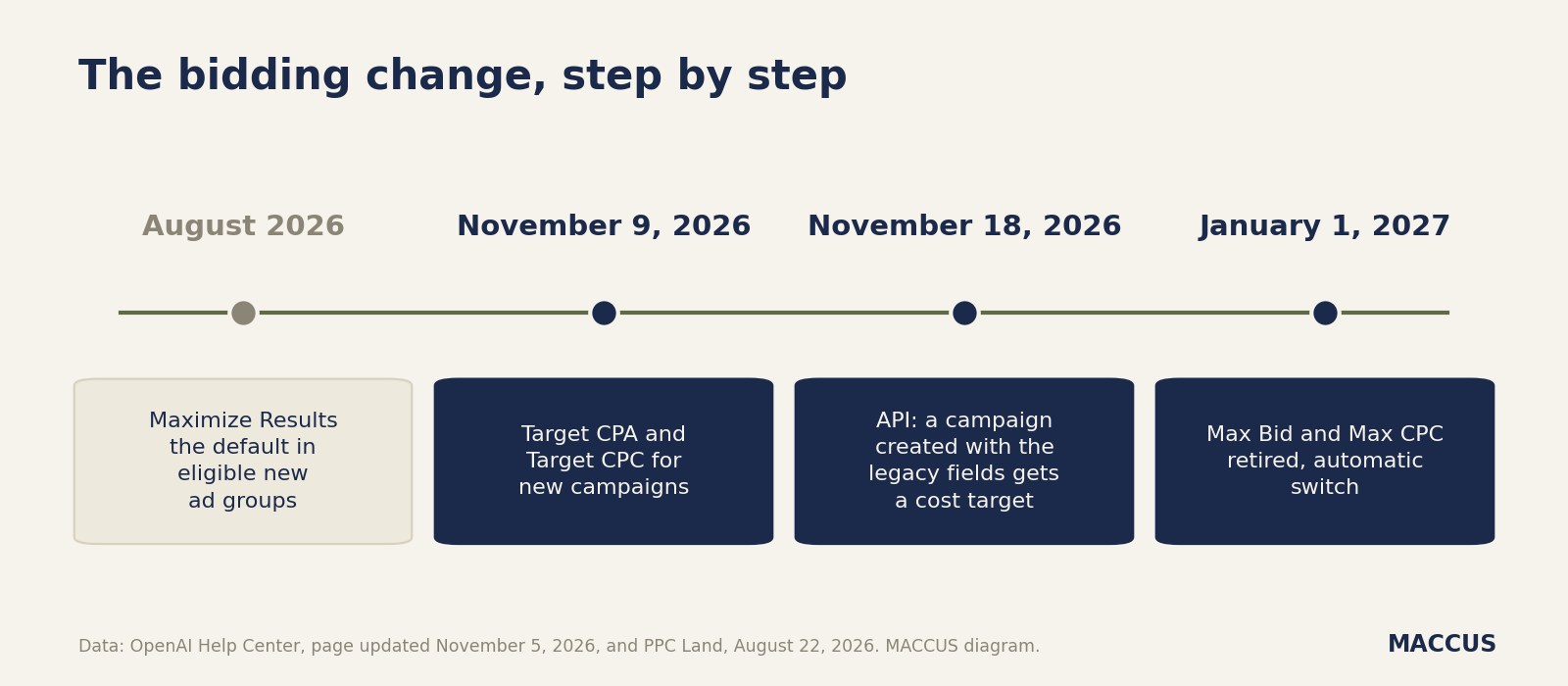
The first new setting, Target CPA, is for conversion campaigns. A conversion is the action the advertiser wants, such as a purchase or a contact request. Starting November 9, Target CPA, short for “target cost per action,” replaces the Max Bid cap in new conversion campaigns.
According to the Help Center page, the advertiser enters the average amount it wants to pay per conversion. The system then adjusts its bids and the way it delivers the ads to get close to that amount. In OpenAI’s example, the advertiser aims for an average cost of $50 per conversion. Some conversions may cost more, others less, and the actual average may land above or below the target.
The second setting, Target CPC, arrives the same day in new click campaigns, which seek clicks rather than conversions. The name stands for “target cost per click.” It replaces Max CPC, short for maximum cost per click, which caps every bid. Target CPC lets the system bid above or below the target in each auction to get as many clicks as possible from the budget.
The third option already exists and has a new name. Maximize Results, also called Autobid, becomes Intelligent bidding. It sets no cost target and adjusts bids on its own to get as many results as possible from the budget.
The transition timeline
The change starts on November 9 in Ads Manager. The email quoted by Search Engine Roundtable puts it this way: “Starting Monday, November 9, you can optionally choose a cost target in Ads Manager when you create a campaign or update an existing one.”
Campaigns already running keep Max Bid or Max CPC for now. Their advertisers can switch to a cost target starting November 9. On January 1, 2027, the switch becomes automatic. Target CPA then replaces Max Bid in the remaining conversion campaigns, and Target CPC replaces Max CPC in click campaigns.
The timeline is different for the API, short for application programming interface. It is the connection that partner software uses to create and manage campaigns. Before November 18, the two API fields that carry the cap, Max Bid and Max CPC, work as before.
From November 18 through December 31, those fields remain supported. What they do changes in two cases: when software creates a campaign, and when it changes the bid type of an ad group. An ad group is a subdivision of a campaign with its own bid settings. In both cases, the API will select Target CPA or Target CPC and treat the amount it receives as an average cost target.
Starting January 1, 2027, those fields will no longer be supported.
Caps have been fading since August
OpenAI changed the default bidding setting in August. According to PPC Land, a site that covers online advertising, Maximize Results then became the preselected strategy in eligible new ad groups. OpenAI’s documentation at the time, quoted by the site, said this strategy put the number of results first, without guaranteeing a specific cost per conversion or per click.
According to PPC Land, the only documented way to keep a cap at the time was the manual Max Bid option. That option disappears from new Ads Manager campaigns on November 9 and from all campaigns on January 1.
OpenAI’s Help Center page on bidding says ChatGPT Ads is becoming “more intelligent by default.” According to the page, the system is taking on more of the work of managing campaigns. On October 30, OpenAI also turned on AI rewriting of ads by default.
Microsoft Advertising, the ad platform behind the Bing search engine, made a similar decision, which PPC Land reported on August 22, 2026. The change concerned new campaigns aiming for the most conversions, the highest total conversion value or the most clicks. Starting October 1, 2026, those campaigns would no longer accept a maximum cost per click. Microsoft said it was removing the option “in order to simplify bidding.”
OpenAI’s own caveats about its targets
The Help Center page warns that a target is not a guaranteed price. The actual average cost can be higher or lower, and each conversion or click can cost a different amount. The page asks, “Is a cost target a guaranteed maximum?” OpenAI’s answer is “No.”
The bid target and billing are separate settings. A conversion campaign can be billed per click or per impression, meaning each time the ad is shown. A campaign set to Target CPA is therefore not billed per conversion.
OpenAI also asks advertisers to set realistic targets. In its example, an advertiser spends $400 and gets 10 purchases, an actual cost of $40 per purchase. According to the page, setting a $20 target does not mean the system can deliver purchases at half the observed cost. A target below recent performance may hold back ad delivery, so the ads are shown less often.
Conversion campaigns depend on the data the advertiser sends to OpenAI. The advertiser must use the OpenAI Pixel, the Conversions API, or both. The pixel is a piece of code installed on the advertiser’s website. The Conversions API sends conversion data directly from the advertiser’s own server.
A metric called Event Quality Score rates how useful that data is. According to OpenAI, a high score does not show that there are enough conversions. Weak or missing conversion data can reduce ad delivery and leave part of the budget unspent. The OpenAI Help Center pages we read give no minimum number of conversions.
Meta, the parent company of Facebook and Instagram, does give a rough threshold for ads on its platforms. There, campaigns are split into ad sets, the equivalent of ad groups. Meta shared its own analysis in an October 21, 2026, post on its Meta for Business site. It found that ad sets under roughly 50 conversions a week paid about 28% more per purchase.
Questions OpenAI has not answered
The Help Center page does not say how far a single bid can go above the target. It is also unclear what will happen to the amount set in Max Bid during the automatic switch on January 1. Neither the Help Center page nor the email excerpts quoted by Search Engine Roundtable answer that question.
Another OpenAI Help Center page still describes a “Bid Cap,” the maximum amount the advertiser is willing to bid for a conversion. That page, on conversion campaigns, was updated around October 20.
What it means
After January 1, none of the three strategies on the Help Center page will cap individual bids. The budget and the average cost target, when there is one, will guide the bids instead. Until then, campaigns already set to Max Bid or Max CPC keep their maximum bid, an amount the system will not bid above.
Self-serve advertisers are affected first, including in France and Belgium. For partner software connected to the API, the key date is November 18, when the old fields change meaning. If software that has not been updated creates a campaign or changes an ad group’s bid type, the caps it sends will be read as averages.
OpenAI describes these targets as a more direct way to steer campaigns toward customer acquisition goals. Neither the Help Center page nor the email excerpts quoted by Search Engine Roundtable give any figure comparing results under Target CPA with results under Max Bid.
ChatGPT Ads is following the path Microsoft Advertising took, with fewer caps set by the advertiser and more decisions left to the system. The first reports from advertisers after November 9 will show whether average costs stay close to the targets they set.
Two points are worth watching before January 1. One is how campaigns still set to Max Bid are switched automatically. The other is whether OpenAI updates the conversion-campaign page that still describes a Bid Cap.
Sources
- Bidding strategies and how pricing works in ChatGPT Ads, OpenAI Help Center, updated November 5, 2026
- OpenAI Updates ChatGPT Ads Bidding Options For Max Bid or Max CPC, Search Engine Roundtable, November 5, 2026
- Ads Manager Availability, OpenAI Help Center, accessed November 6, 2026
- Conversion-optimized Campaigns, OpenAI Help Center, accessed November 6, 2026
- Microsoft retires Max CPC as ChatGPT Ads defaults to automated bidding, PPC Land, August 22, 2026
- Peak Season 2026: You Don’t Beat The Auction. You Brief It., Meta for Business, October 21, 2026
Header image: MACCUS diagram, data from the OpenAI Help Center (page updated November 5, 2026) and OpenAI’s email quoted by Search Engine Roundtable on November 5, 2026