
On November 9, 2026, Graphite, a US growth agency, published “The State of Gen AI,” a report on how much people use AI assistants. The report drops the headline comparison of Graphite’s March 2026 study, which put AI assistant sessions at 56% of search engine sessions worldwide. The authors now write that they can no longer reliably compare AI used for search with search engines. Their March study never counted Google’s Android app, which they estimate at 11.8 billion monthly sessions in the US alone.
By the new report’s estimates, six assistants, including ChatGPT, Gemini and Claude, logged 76 billion sessions worldwide in September 2026, up 37% from a year earlier. A session is one visit to an assistant’s website or one stretch of use in its mobile app. A week before the report, an executive at OpenAI, the company behind ChatGPT, said ChatGPT handles about a fifth as many searches as Google. That figure counts searches, while Graphite counts sessions.
Graphite sells search engine optimization (SEO), the work of getting a site to rank higher in search results. It also sells answer engine optimization (AEO), the work of getting a brand cited by AI assistants like ChatGPT. The report’s authors are Ethan Smith, Graphite’s CEO, and José Luis Paredes, PhD, its senior data scientist.
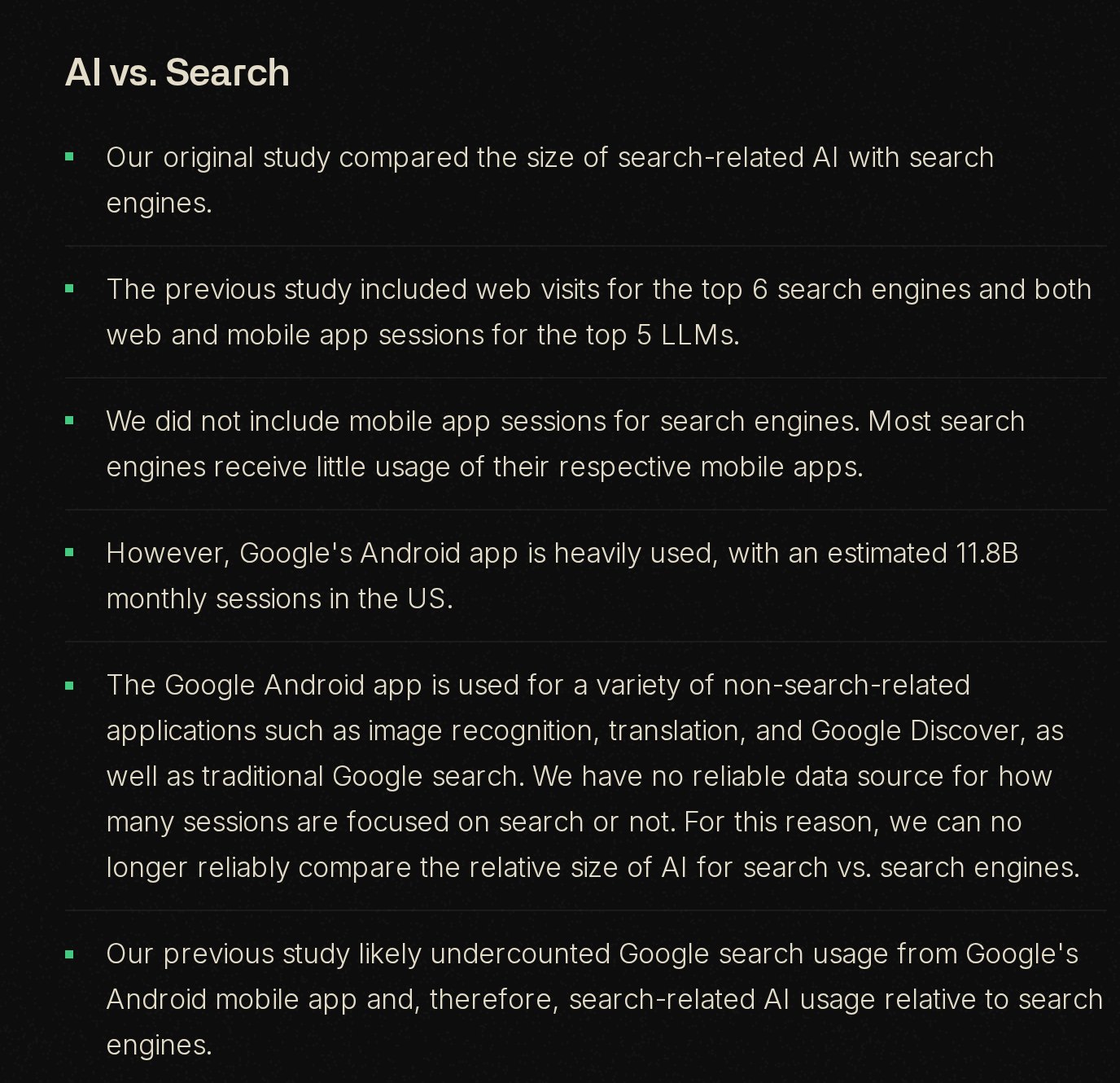
Google’s Android app was missing from the March study
The March study, “AI Is Much Bigger Than You Think,” compared two numbers measured in different ways. For search engines, it counted only visits to the websites of Google, Bing, Yahoo, DuckDuckGo, Yandex and Baidu. For the five assistants it covered at the time, it counted both web visits and mobile app sessions.
According to the new report, that choice left out Google’s Android app, which is “heavily used.” People open it for regular searches as well as image recognition, translation and the Google Discover news feed. “We have no reliable data source for how many sessions are focused on search or not,” the authors write. “For this reason, we can no longer reliably compare the relative size of AI for search vs. search engines.”
Graphite adds that its March study “likely undercounted Google search usage.” It does not publish a corrected ratio.
On November 9, the March page still showed its headline numbers: AI sessions at 56% of search engine sessions worldwide and 34% in the US. It also still put search-related AI usage at 28% of search worldwide and 17% in the US. ChatGPT’s share of search-related traffic, with search engines and AI counted together, was still 20% worldwide.
The page carries no correction note, but a link to the new report sits at the top. Search Engine Journal, a news site that covers the search industry, also noted that link.
Yearly growth in AI assistant sessions fell from 396% to 37%
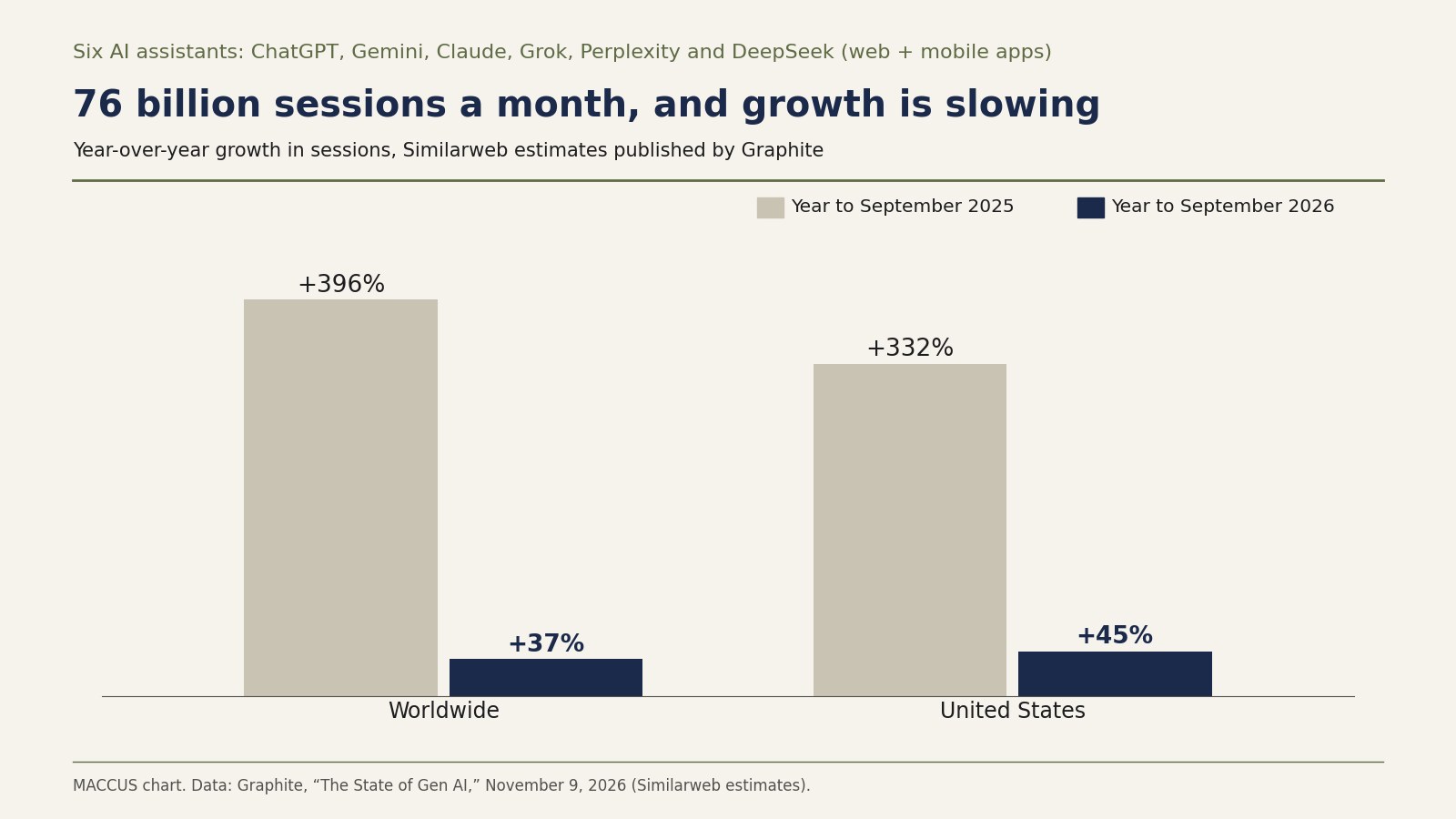
The six assistants Graphite measures are ChatGPT, Gemini, Claude, Grok, Perplexity and DeepSeek. Worldwide, their sessions grew 396% in the year to September 2025, then 37% in the year to September 2026. In the US, they logged 6.6 billion sessions in September 2026, and growth fell from 332% to 45% over the same two periods. “Growth has slowed sharply,” Graphite writes.
The report also describes what it calls a “little-reported plateau” in the second half of 2025. From July to December 2025, worldwide sessions grew only 2.3%, while US sessions grew 10%. Growth picked up again in 2026. From January to September, worldwide sessions rose 19%, from 64 billion to 76 billion a month.
Most of this use happens on phones and tablets. In the third quarter of 2026, 86% of worldwide sessions took place in mobile apps, and 89% when mobile web browsers are included. In the US, those shares drop to 74% and 78%. In September 2026, the US accounted for only 8.8% of the sessions measured, so more than nine in ten came from the rest of the world.
ChatGPT holds 81% of the six assistants’ sessions
In September 2026, ChatGPT held 81.2% of the six assistants’ sessions worldwide and 80.7% in the US. No competitor has reached even 10%, according to Graphite. ChatGPT’s share fell by about one percentage point a month from January to June 2026, then regained 0.27 percentage point a month from July to September. Its worldwide sessions in September 2026 were up 24% from a year earlier.
Claude, Anthropic’s assistant, grew fastest over the year: up 1,901% worldwide and 862% in the US, from a small base. Google’s Gemini followed at 182% worldwide, then xAI’s Grok at 123%. In absolute numbers, ChatGPT still drove most of the growth. It accounted for 58.9% of the sessions added worldwide over 12 months, compared with 26% for Claude and 12% for Gemini.
Perplexity, an AI-powered search engine, is the only one of the six to shrink: down 27% year over year worldwide. Its sessions have fallen 38% since their October 2025 peak.
The AI features built into Google Search are not among the six, and the report measures them separately, for the US only. AI Overviews, the AI-written summaries at the top of Google’s results, appeared on 23% of Google searches in September 2025 and 64% in August 2026. AI Mode, the conversational version of Google Search, drew 491 million web visits in August 2026, compared with 360 million for Gemini. Our guide explains how Google’s AI Overviews and AI Mode work.
AI sends websites under 1% of their traffic on average
Graphite also measured the visits that assistants send to websites. Its sample is the top 43,000 sites among those with at least 100,000 US visits a month. To qualify, a site had to reach that level in six or more months between July 2023 and July 2026.
On those sites, visits from AI grew 92% year over year worldwide and 75% in the US. In July 2026, ChatGPT sent 60% of those visits worldwide, Gemini 14% and Claude 10%.
The volume is still small. “Our data suggest that AI accounts for less than 1% of traffic on average to websites,” Graphite writes.
Search Engine Journal read a chart in the report on US traffic for the second quarter of 2026. By its reading, organic search, meaning unpaid search results, sent 49 times as many visits as AI. Paid search, meaning search ads, sent eight times as many.
On October 21, SEO consultant Marie Haynes published numbers that pointed the same way. They came from 100 sites tracked in Google Analytics 4, Google’s tool for measuring website traffic. On those sites, ChatGPT traffic equaled 0.62% of their Google organic visits.
Graphite argues that those visits miss part of AI’s influence. Citing what it calls anecdotal evidence, it says many people who see a brand mentioned by an AI then go straight to the brand’s site or search for it in a search engine.
Graphite’s example is a June 2026 case study with n8n, a company that makes workflow automation software. The study looked at conversions, the actions a business wants from visitors, such as a sign-up or a purchase. Conversions from visits sent by AI made up only 10% of the conversions that customers themselves credited to AI. Graphite says this single case is not enough to draw conclusions about the whole market.
Graphite’s early analysis also suggests that traffic from searches for brand names is “relatively flat” year over year. It says a full study is coming.
Similarweb estimates from an agency that sells AEO
The report’s session, visit and share figures are all Similarweb estimates. Similarweb is a company that measures web and app audiences, partly through a panel of users whose activity it tracks. Search Engine Journal points out that Graphite sells SEO and AEO services and that Similarweb sells the data.
Graphite’s March page already acknowledged this: “It is in the financial interest of the author to argue that SEO and AI are large and growing.”
The report flags one blind spot itself: it does not measure the Claude and ChatGPT desktop apps, which have grown quickly. As a result, total AI usage and the desktop share are both undercounted. Its session counts also leave out other assistants, such as Microsoft’s Copilot, Meta AI and Mistral’s Le Chat. It gives no numbers for France or Belgium.
OpenAI’s and Google’s own figures appear in the report only as public statements, and the gaps with Similarweb’s estimates are large. At the end of March 2026, OpenAI claimed more than 900 million weekly ChatGPT users, while Similarweb estimated 476 million after removing duplicates. Graphite says OpenAI’s number can be reached by counting users without removing duplicates, and that people logging in from several devices likely explain the gap. In August 2026, Google said the Gemini app had passed 1 billion monthly users, compared with 648 million in Similarweb’s data even with duplicates counted.
What it means
The authors of the 56% figure now say they cannot reliably compare AI used for search with search engines. That figure compared AI sessions counted on the web and in apps with search engine visits counted on the web only. The report does not say what a corrected comparison would show, and Graphite offers no new calculation. Slide decks and posts that still cite the number rest on a comparison the agency says it can no longer make reliably.
The rest of the report describes a market that ChatGPT still dominates. Worldwide, yearly growth in assistant sessions fell from 396% to 37%. Websites still get few visits from AI, under 1% of traffic on average across Graphite’s US sample. Graphite argues that this measure misses part of AI’s total effect, but its only quantified example is the n8n case study.
A screenshot published on November 6, and the description that came with it, suggest that OpenAI is building a dashboard showing businesses their mentions and clicks in ChatGPT. OpenAI has not confirmed it. Such a tool would directly count mentions that never produce a click.
These numbers come from an agency that sells AI optimization. They rest partly on a panel, leave out desktop apps and say nothing about France. Two things are worth watching: the study of searches for brand names that Graphite has announced, and any update to the March page. On November 9, that page still showed the 56% figure.
Sources
- The State of Gen AI, Graphite (Ethan Smith, José Luis Paredes), November 9, 2026
- AI Is Much Bigger Than You Think, Graphite (Ethan Smith), March 5, 2026
- Report Puts AI At 76B Monthly Sessions, Drops Search Engine Comparison, Search Engine Journal (Matt G. Southern), November 9, 2026
Header image: MACCUS chart. Data: Graphite, “The State of Gen AI,” November 9, 2026 (Similarweb estimates)