On November 5, 2026, Ahrefs previewed DR4, the fourth version of its Domain Rating (DR). Ahrefs makes one of the most widely used tools among search engine optimization (SEO) professionals. DR is a score from 0 to 100 that measures the strength of the links a site gets from other sites. DR4 will replace the current version, DR3, in the Ahrefs interface on December 1, 2026.
DR4 changes the calculation in two ways. Links count for more when they come from sites that get organic traffic, meaning free visits from search engines. Subdomains, such as help.ahrefs.com under ahrefs.com, get their own score instead of inheriting the score of their main, or root, domain. Ahrefs says DR4 will score about half as many sites as DR3.
Google says it doesn’t use this kind of score to rank pages. DR still matters in the market for buying links, where some platforms list it next to each site’s price.
How DR is calculated and used
DR measures only backlinks, the links on other sites that point to a given site. Our complete backlink guide covers them in detail. Ahrefs has always said DR gives no weight to a domain’s age or the quality of its content.
Ahrefs’ help center says the score compares the strength of a site’s links with those of the other sites in its database. Each domain splits its own score equally among the domains it links to. So, according to Ahrefs, a domain rated 10 linking to three sites can give each of them more weight than one rated 80 linking to a million.
The score is also relative and logarithmic: the higher it gets, the harder each point is to earn. Going from 84 to 85 is harder than going from 54 to 55.
Ahrefs presents DR as a good way to choose where to get links. Some French link-building platforms, marketplaces that sell links placed in sponsored articles, display DR. Linksclub shows it next to each site’s price and its Trust Flow, a rival score from the SEO tool Majestic. Netlinking.fr lets buyers choose sites by several metrics, including DR.
More weight on traffic, half as many sites scored
DR4 gives more weight to links from sites that get organic traffic, using Ahrefs’ own traffic estimates. Glen Allsopp, Ahrefs’ head of marketing strategy and research, wrote the announcement. He says DR4 scores about half as many sites as DR3.
SaaSCity, a software directory that tested the preview, counts 132 million sites with a DR4 score, compared with 287 million under DR3. With fewer sites scored, a smaller group of domains can influence everyone else’s score, Allsopp writes.
Subdomains no longer take on the score of their root domain
Until now, a subdomain usually took on the score of its root domain. According to Ahrefs, that meant a free site on a platform’s subdomain could display a very high score without strong links of its own. This could happen on the blogging platform Blogspot, on a popular website builder or on GitHub Pages, GitHub’s free hosting service. Under DR4, each subdomain is scored on its own links.
In Ahrefs’ examples, its help center, help.ahrefs.com, drops from 91 under DR3 to 75 under DR4, while the main domain, ahrefs.com, is rated 92 under DR4. Samsung’s blog, insights.samsung.com, falls from 92 to 74.
Some platform subdomains fall to zero or close to it. A notion.site subdomain, where the note-taking tool Notion publishes pages, drops from 92 to 0. A site on hostingersite.com, an address the web host Hostinger provides, goes from 92 to 1.9. Ahrefs says these cases are real but not representative of all subdomains on those platforms.
The github.io domain behind GitHub Pages loses 32 points between DR3 and DR4. Some of its subdomains keep a high score: facebook.github.io is rated 86 under DR4.
Spam-labeled domains fall, most big sites gain
Domains labeled as spam fall the most in Ahrefs’ data. Ahrefs has shown a “Spam” label next to some links in its reports since 2025. At first it came from a list kept by hand. Since January 2026, a machine learning model has flagged these domains.
Spam-labeled domains rated between 30 and 70 under DR3 take the biggest hit. Their median drop is about 15 to 20 points, meaning half of them lose more than that and half lose less. For domains without the label, the median change stays close to zero in most score ranges, according to Ahrefs.
Ahrefs also looked at the 1,000 sites it estimates get the most organic traffic. Under DR4, 64.3% of them gain points compared with DR3, 15.8% stay the same and 19.9% lose points. For those that lose points, the drop is small: 7.3 points on average and 4 points at the median.
A score closer to Google rankings, except for root domains
Ahrefs says DR4 tracks sites’ Google rankings more closely than DR3 does. Its evidence is a correlation, a measure of how closely two numbers move together. A correlation of 0 means no relationship, and 1 means a perfect one.
Ahrefs compared each site’s score with the number of top 10 rankings it holds in Google results. Across 10 million domains and subdomains, the correlation rises from 0.140 under DR3 to 0.359 under DR4.
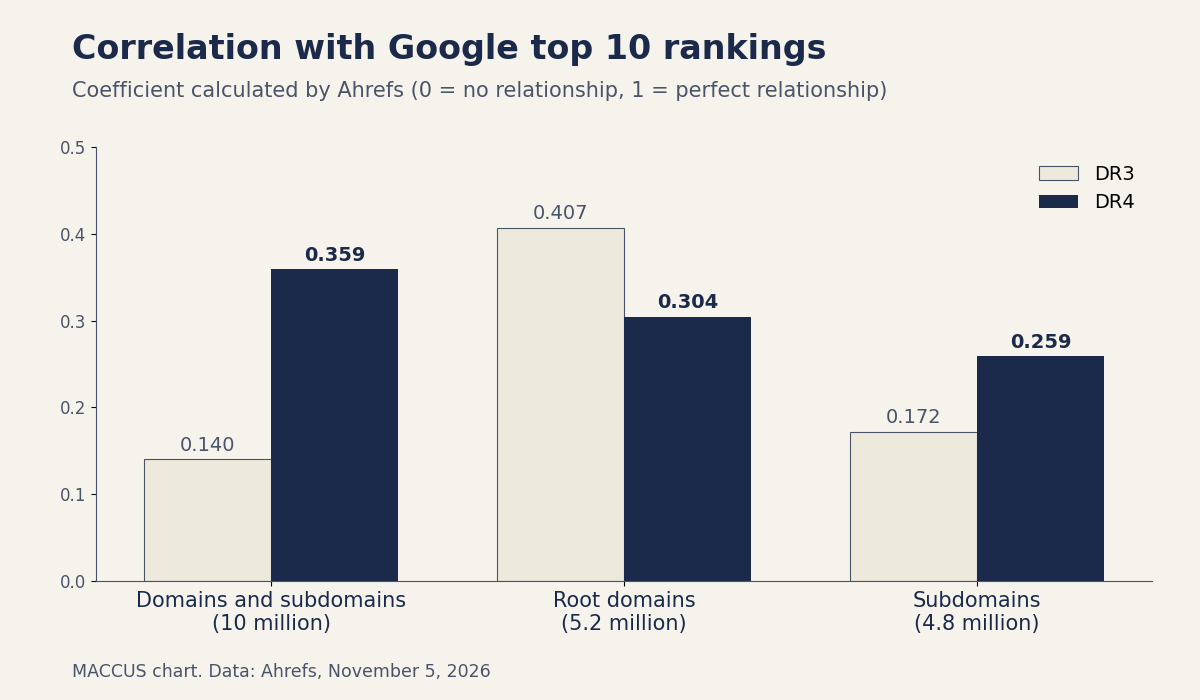
For the 5.2 million root domains alone, the correlation moves the other way. It falls from 0.407 under DR3 to 0.304 under DR4. Ahrefs attributes this to how each version was built: DR3 was designed around root domains, while DR4 scores each site on its own links.
The company doesn’t say how it calculated these correlations, what period it studied or where the rankings came from. Separately, on October 22, Ahrefs reported that Google was serving distorted search results pages to automated programs it suspects of collecting its results. Ahrefs said it was cleaning up the affected records, as our October 28 article explains.
“We don’t use domain authority at all in our algorithms,” John Mueller of Google’s Search team wrote on February 24, 2020. He was referring to Domain Authority, the comparable score from the competing SEO tool Moz.
First independent checks: launch directories plunge
Ahrefs’ free application programming interface (API), which lets software look up DR, already returns the DR4 score on request. On November 5, SaaSCity checked 2,405 directories, sites that list companies or products. Their score fell by a median of 2 points between DR3 and DR4.
Launch directories, sites where companies announce a new product, fell much further. For the 123 that SaaSCity tracks most closely, the median score went from 61 under DR3 to 32 under DR4.
Some directories list a site, or link to it, only if that site displays their badge, a small logo that links back to the directory. Among directories on SaaSCity’s list rated 30 or higher under DR3, those that require a badge lost a median of 31 points. The others lost a median of 3. SaaSCity notes that it sells paid listings itself, so it has an interest in directories looking useful.
On November 9, the maker of Pingsold, a startup directory, posted a DR4 check of 44 launch sites on DEV Community, a blog platform for developers. Several sites rated between 40 and 57 under DR3 fall to 0, or close to it, under DR4.
Caveats from Ahrefs and the early testers
DR4 is still a preview, and its numbers may change before December 1, SaaSCity and the maker of Pingsold both warn. After the switch, the Ahrefs API will still allow comparisons with DR3 for a short period, and Ahrefs doesn’t say how long.
The published figures don’t always match. The FAQ on a demo page set up by Glen Allsopp gives blogs.microsoft.com a score of 87, while the Ahrefs announcement gives it 89.
Ahrefs also stresses that a drop in DR “is not a judgment on the quality of your content or website.” A drop means only that Ahrefs sees too few quality links pointing to the site to rate it higher. The company advises site owners to compare their score with those of their closest competitors, which may see similar changes.
What it means
On December 1, one of the main numbers in the link market changes how it is calculated. A high DR built on links from sites with no organic traffic is unlikely to hold up. That includes links traded for badges and links from directories without visitors. Sellers whose score relied on those links, or on a platform’s subdomain, may see it drop without losing a single link.
For buyers, a site listed at DR 50 on November 30 could be rated much lower the next day. Still, the first checks show the drops are concentrated in a few types of sites, and most sites barely move. SEO agencies that report a client’s DR may see it change for reasons unrelated to their work.
Nothing changes on Google’s side, since the company says it doesn’t use these scores. The closer match with Google rankings comes from Ahrefs’ own testing, and the method isn’t published. For root domains, such as company.com, the kind of address most business websites use, that match even gets weaker.
Two questions remain open. One is whether link-building platforms will update the DR column in their catalogs on December 1, and whether their prices will follow. The other is how long the old score will remain available.
Sources
- Introducing a Preview of DR4: Our New Domain Rating Model for Scoring Backlink Profiles, Ahrefs, November 5, 2026
- What is Domain Rating (DR)?, Ahrefs Help Center, September 3, 2026
- Domain Rating Feedback, Detailed, accessed November 10, 2026
- Ahrefs DR4: We Checked 2,405 Directories. Who Held, Who Fell, SaaSCity, November 5, 2026
- I checked 44 launch sites on Ahrefs’ new DR4. Most of them drop to zero on 1 December., DEV Community, November 9, 2026
- Google Still Uses PageRank & No, Google Does Not Use Domain Authority, Search Engine Roundtable, February 25, 2020
- Plateforme de backlinks et marketplace d’éditeurs, Linksclub, accessed November 10, 2026
- Netlinking : La plateforme d’achat de liens thématiques, Netlinking.fr, accessed November 10, 2026
Header image: MACCUS chart, data from Ahrefs (“Introducing a Preview of DR4,” November 5, 2026)