Google kept the homepage of VLC, the free media player, in its index even though the site was returning an error to Google. The index is the database of pages behind Google’s search results. Google’s own documentation says an indexed page that returns this kind of error is removed from the index, with no exception for important pages. A Google analyst said the company made a temporary exception because of how important VLC is.
Gary Illyes, an analyst at Google, gave that explanation in a LinkedIn comment posted on November 5, 2026. “Because VLC is arguably one of the most important pages on the internet,” he wrote, “Search temporarily protected the URL from falling out of the index right away.” The URL is the page’s web address. Search Engine Roundtable, a news site that covers search engines, reported the comment the same day.
The server behind videolan.org, VLC’s website, had been returning HTTP status code 418, “I’m a teapot.” An HTTP status code is the three-digit number a web server sends back with every page. A 200 code means everything is fine, and a 404 means the page can’t be found.
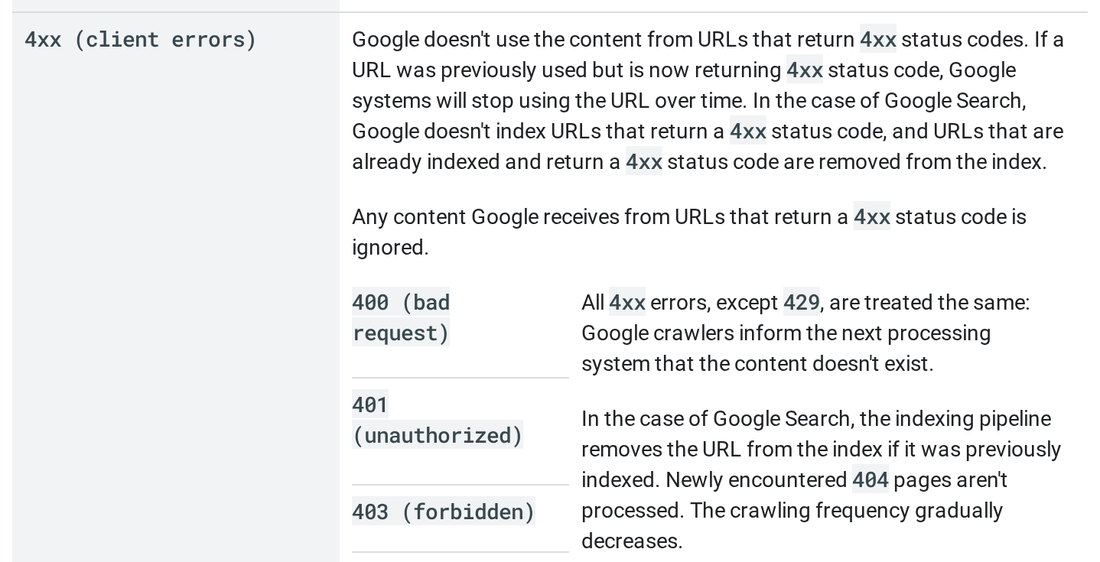
Code 418 belongs to the 4xx family of errors, the codes that start with 4. Google treats a page that returns it like a page that doesn’t exist.
VideoLAN asked for help on LinkedIn
The story starts with a post from VideoLAN, the France-based nonprofit behind VLC. According to its website, VideoLAN began in 1996 as a student project at École Centrale Paris, a French engineering school.
On the evening of November 3, 2026, VideoLAN asked on LinkedIn for help with its SEO and with Search Console. SEO (search engine optimization) is the work of ranking well in search results. Search Console is Google’s free tool that shows site owners how the search engine handles their pages.
VideoLAN said “something weird” had been showing up in its Google results for some time and was confusing its users, though it had changed nothing.
VLC’s favicon, the small icon shown next to a site’s name, had disappeared from Google’s results. A screenshot published by Search Engine Roundtable shows a generic globe icon in its place. The screenshot also shows the homepage ranking second in a search for “vlc,” below the player’s download page.
Starting that evening, several comments under the post offered explanations: a favicon that was too small, a capital letter in the meta description tag (the line of code that holds a page’s summary), or a cache of saved pages mixing up the site’s language versions. By November 9, the post had 44 comments.
Illyes pointed to the 418 code
Illyes ruled out the capital-letter theory. He said Google reads HTML tags, the building blocks of a web page’s code, the same way whether they use capitals or not. “Our HTML parser handles tags and attributes case-insensitively, just like the HTML standard says,” he wrote. He pointed instead to a choice made at VLC: “someone over at VLC decided the server should declare itself a teapot (HTTP 418).”
Google treats that code “like most other 4xx errors: basically ‘not found,'” Illyes added. Under that rule, Google should have dropped the page from its index. It held off, he said, because of VLC’s importance.
Illyes also described a side effect of the protection. Because Google no longer knew what was on the page, he wrote, “we have nothing left to show: no snippet, no favicon, no nothing.” A snippet is the short text shown under a result’s title. All that was left, he added, was “the link itself and the last good title we had.”
By the time he posted, the site was again returning a normal 200 code. “It’s returning 200 OK with content again now, so this should sort itself out soon,” he wrote.
Google’s written rule for 4xx errors
Google’s documentation on HTTP status codes makes no exception for important pages. The English version, last updated on February 4, 2026, says that “URLs that are already indexed and return a 4xx status code are removed from the index.” It adds that when a previously used URL starts returning a 4xx code, “Google systems will stop using the URL over time.” It gives no time frame.
According to the documentation, “all 4xx errors, except 429, are treated the same.” The outcome is the same for a page that can’t be found (404), a page that is gone (410) or a forbidden page (403). Code 429 follows the rules for server errors instead.
The documentation also says that for these URLs, “the crawling frequency gradually decreases.” Crawling means visits by Google’s bots, the programs that browse the web to read pages. Search Console lists these pages under reasons such as “Not found (404),” and our guide to Search Console indexing statuses explains each one.
Server errors follow a different rule. These are the codes that start with 5, such as 503. With a 5xx code or a 429 (“too many requests”), Google slows down its crawling and keeps pages that are already indexed for a while. Those pages are “preserved in the index, but eventually dropped.”
That difference explains what Google asked of sites taken offline over the PHP2Shell security flaws. On October 21, it asked them to serve a 503 code rather than a 404.
The documentation does mention 418, but only to say it doesn’t cover it. It describes “the top 20 status codes that Google encounters on the web,” and states that “more exotic status codes, such as 418 (I’m a teapot), aren’t covered.”
A status code born as an April Fools’ joke
Code 418 started as a joke. On April 1, 1998, computer scientist Larry Masinter published RFC 2324, a mock protocol, or set of technical rules, for controlling coffee pots remotely. RFCs are the documents in which the internet’s technical standards are published. Under RFC 2324, any attempt to brew coffee with a teapot was supposed to return the error “418 I’m a teapot.”
The current version of the HTTP standard, RFC 9110 from June 2022, lists 418 as unused. It notes that the code has been deployed as a joke so often that it can’t be used for anything else. For that reason, it stays reserved in the official registry of HTTP status codes.
Open questions about Google’s explanation
Illyes didn’t say which pages get this protection or how Google decides that a page is “important.” He also didn’t say how long the protection lasts. His comment only describes a temporary safeguard that keeps the URL from dropping out of the index “right away.”
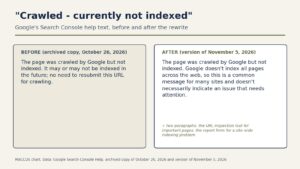
We found no Google page that describes this mechanism. Google did rewrite its definition of the “Crawled ‑ currently not indexed” status in Search Console this fall, but we found nothing about the protection there either.
Search Engine Roundtable’s undated screenshot also doesn’t fully match Illyes’s description. The favicon is missing, but the homepage result still shows a description under its title.
VideoLAN’s site still sends 418 to some AI bots
Why VideoLAN’s server returned 418 to Google is unknown. As of November 9, we had found no public explanation from VideoLAN, and Illyes didn’t give one.
Our own checks on November 9, 2026, show that videolan.org returns the code to some AI bots. We sent requests posing as three bots run by OpenAI, the company behind ChatGPT: GPTBot, OAI-SearchBot and ChatGPT-User. All three got a 418 error. So did a request identifying itself as PerplexityBot, the crawler of the Perplexity search engine.
Requests posing as Googlebot or Bingbot, the crawlers of Google and Bing, got the normal page. So did one posing as a regular web browser. The test shows the site uses 418 to turn away certain AI bots.
The test has a limit. It only changes the name a visitor gives the server, known as its “user agent.” The requests still came from our own machine’s IP address, the number that identifies a computer on the internet. So the test can’t tell us what the real Googlebot received during the incident.
What it means
Google’s written rule on 4xx errors applies to every page, however important it is. According to Illyes, Google can still keep a page it considers very important in its index for a while despite such an error. Without that protection, VLC’s homepage would have dropped out “right away.” The documentation itself only says Google stops using such URLs “over time,” with no time frame.
Illyes gave a single example, a site known around the world, and no criteria. Nothing suggests the exception covers most websites. For those sites, the published rule is still the only one anyone can check.
Our checks also show that a server can return an error to some bots while showing visitors the normal page. In that case, an owner who visits the site sees nothing wrong. VideoLAN first noticed the problem in how its site appeared on Google.
A page dropped from the index because of an error can stay out for weeks after the fix. According to internal estimates Illyes presented on October 2, 2026, Google returns to a page it already knows after about 30 days. Google’s documentation also says it crawls a URL that returns a 4xx error less and less often.
Two things are worth watching. One is whether Google describes this protection in its documentation or says which pages qualify for it. The other is whether VLC’s favicon returns to Google’s results, which Illyes said on November 5 should happen soon.
Sources
- Help 🙂, VideoLAN (LinkedIn), November 3, 2026
- Google Can Temporarily Protect Important URLs From Being Deindexed, Search Engine Roundtable, November 5, 2026
- How HTTP status codes affect Google’s crawlers, Google, February 4, 2026
- RFC 9110, HTTP Semantics, RFC Editor, June 2022
- RFC 2324, Hyper Text Coffee Pot Control Protocol (HTCPCP/1.0), RFC Editor, April 1, 1998
- VideoLAN, a project and a non-profit organization, VideoLAN, accessed November 9, 2026
Header image: MACCUS chart, data from Google’s documentation on HTTP status codes (February 4, 2026) and Gary Illyes’s comment as reported by Search Engine Roundtable (November 5, 2026)