Meta, Facebook’s parent company, has let search engines into millions of Facebook pages written by its artificial intelligence. The pages appear to draw growing traffic from Google, and they may break Google’s spam rules.
The pages sit in a directory at facebook.com/fb-answers/, which specialists in search engine optimization (SEO) call Facebook Answers. Each page uses public posts to summarize a topic.
On November 5, 2026, the trade site Search Engine Roundtable reported that Google had indexed more than 6 million of these pages. Indexing means Google has stored them in the catalog it draws its results from, and these pages now appear in its search results.
By one estimate, the pages drew 40.6 million visits from Google in October, up from about 1 million in July. The figures come from Semrush, a tool that calculates a site’s likely traffic from its Google rankings. Saul Westbrook, an SEO specialist and the founder of the data analysis site Peripheral, published them on November 4.
Glenn Gabe, a consultant quoted by Search Engine Roundtable, calls the directory a “massive” example of scaled content abuse. Google’s spam rules ban this practice of mass-producing pages to manipulate its rankings. Neither Meta nor Google has commented publicly.
AI summaries built from public posts
On November 7, MACCUS opened the page Westbrook used as his example, “Using American Express for Travel,” which loads without a Facebook account. Below the title are the label “Summarized by Meta AI,” which refers to the company’s assistant, and a counter reading “53 people talking about this.” Next comes a short summary of American Express cards for travel, then a series of themed sections.
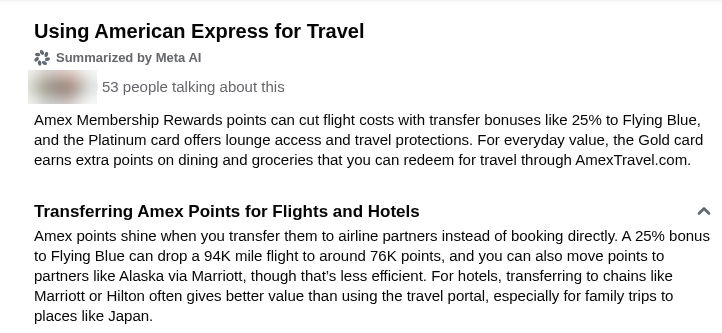
The summary draws on public posts, which appear between its paragraphs. They come from individuals, groups and Facebook Pages, the public profiles of businesses and public figures. Each post shows the author’s name and the number of reactions. Some are old: Westbrook found one from 2010, posted in a group with six members.
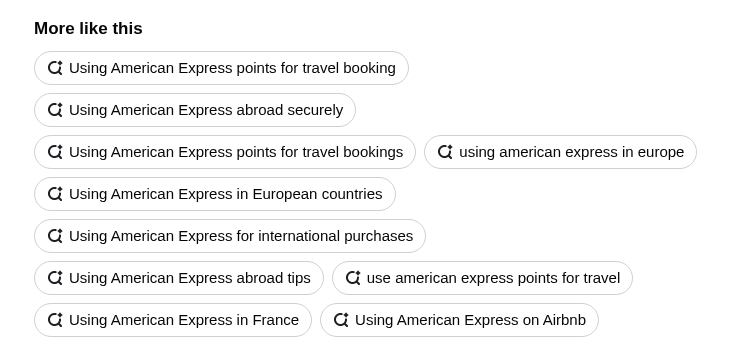
At the bottom of the page, a “More like this” box links to ten other pages in the directory, all with similar titles. Some differ by a single word, such as “Using American Express points for travel booking” and “… bookings.” Others differ only in phrasing, such as “using american express in europe” and “Using American Express in European countries.” Westbrook says he counted more than 180 English-language pages on one topic alone, the racket sport padel.
According to Westbrook, the directory appeared after Facebook launched “AI Mode,” a search tab that Meta announced on June 15, 2026. Meta says that in this tab, Meta AI answers questions based on “what people are saying publicly across our apps like in Groups and Reels.” Westbrook thinks the fb-answers pages are fixed copies of those answers, built to rank in search engines. Meta has not confirmed this.
It is unclear when the directory started. Semrush data shows the first visits in May, while Glenn Gabe says Facebook began adding pages to it in July.
From 1 million to 40 million visits a month, according to Semrush
Westbrook’s table of Semrush estimates puts most of the growth in August and September. The first visits appear in May 2026, about 130,000 worldwide. Monthly visits then reach 1 million in July, 12.2 million in August, 36.4 million in September and 40.6 million in October. The August jump came after a wave of pages entered Google’s index.
Semrush also counts keywords: the searches for which at least one page from the directory shows up in Google. That count rose from 4 million to 53 million worldwide between July and August. In the United States, more than 39 million of the directory’s pages reportedly rank for at least one search.
Some pages rank at the top of Google for common US searches. Westbrook found one in second place for “Amex Travel,” a query that gets 368,000 searches a month, according to Semrush. Another ranks first for “LAS Airport Location,” a query about the Las Vegas airport that gets 22,200 searches a month.
By these estimates, US visits are already falling, from 23.1 million in September to 21.1 million in October, a drop of about 9%. The worldwide total still grew, from 36.4 million to 40.6 million, thanks to other countries. The UK went from 2.0 million to 2.9 million, and the countries the table does not list separately gained about 5 million visits. The table gives no figure for France or other French-speaking countries, and the pages Westbrook and MACCUS looked at are in English.
For comparison, Westbrook estimates from Semrush data that Reddit, the discussion site, gets 1.8 billion visits a month from Google. The Facebook directory’s October traffic was about 2% of that. In late October, Reddit reported a sharp drop in its traffic from search engines.
Facebook lets Google’s search crawler in and keeps AI bots out
On November 7, MACCUS checked Facebook’s robots.txt, the file that tells crawlers (programs that browse the web) what they may visit. It keeps crawlers from several AI companies off the entire site, including OpenAI’s GPTBot, Anthropic’s ClaudeBot and Perplexity’s PerplexityBot.
The file also blocks Google-Extended, which covers Google’s AI. The same goes for __usage_ai-training, the shared name that comes from the industry-wide rule against model training announced on October 30.
Googlebot, the crawler for Google’s search engine, has its own rules. They bar it from a folder named /meta-ai-answers/, but no line covers /fb-answers/. Google can therefore crawl these pages and add them to its index.
This split between Googlebot and Google-Extended matches Google’s documentation. According to Google, Google-Extended controls whether a site’s content can be used to train future Gemini models, Google’s own AI. It also controls whether Gemini apps can use that content from the search index to back up their answers. The same documentation says Google-Extended “does not impact a site’s inclusion in Google Search.”
Westbrook found many fb-answers pages cited in AI Overviews, the AI-written summaries at the top of Google’s results. Glenn Gabe also spotted them in Google’s AI Mode, a chat-style search separate from Facebook’s tab of the same name. Rival AI assistants could not read the pages when Westbrook tried.
Do the pages break Google’s spam rules?
Google’s spam policies say that “scaled content abuse is when many pages are generated for the primary purpose of manipulating search rankings and not helping users.” The first example on the list is “using generative AI tools or other similar tools to generate many pages without adding value for users.”
In its February 2023 guidance on AI-generated content, Google wrote that “appropriate use of AI or automation is not against our guidelines.” This fall, though, consultants have reported a rise in manual actions for scaled content, including against sites run by established businesses. A manual action is a penalty decided by a person at Google.
Glenn Gabe says the Facebook directory is scaled content abuse “for sure.” Barry Schwartz, the founder of Search Engine Roundtable, wrote: “I suspect this stuff won’t be indexed too much longer, now that it is out there publicly.”
Westbrook is more cautious. He thinks the pages could escape a penalty because they draw on Facebook’s own data, which Google might see as useful. He notes that they survived Google’s September 2026 spam update, the latest one Google lists on its status dashboard.
Westbrook also points out that many pages look alike. He cites another Google rule, on doorway pages: pages created to rank for closely related searches.
Shaky numbers and open questions
The traffic figures are estimates from Semrush, an outside tool. The page counts also disagree. Search Engine Roundtable reports 6 million indexed pages, while Semrush sees 39 million pages ranking in the US alone. No source explains the gap.
Westbrook doubts that most users know their posts are used as sources. He found no way to remove a post from a summary once the summary is live. As of November 3, Meta had not answered his request for comment.
What it means
Facebook is turning its members’ posts into AI-written pages by the millions and opening them to Google, the way a publisher would. Westbrook sees no sign that any editor reviews them. By Semrush’s estimates, the directory’s traffic is only about 2% of Reddit’s, but it has grown nearly fortyfold since July.
Publishers that depend on practical searches, such as travel, sports and personal finance, are the first affected. They now compete with these summaries for space in Google’s results.
Brands face a different problem. A page can describe a product based on customer posts, and the company has no say over the text. Westbrook suggests tracking these mentions with a search limited to the directory: site:facebook.com/fb-answers followed by the brand name.
On November 7, MACCUS confirmed that the directory exists and that several of its pages carry near-identical titles. It also confirmed the directory is open to Googlebot and closed to training crawlers and other companies’ AI bots.
The rest is unconfirmed. The traffic and page counts are still estimates, and the link to Facebook’s AI Mode is a hypothesis. The spam label is still the consultants’ view, since Google has not weighed in.
Google’s next move matters most. If these pages suddenly lose ground at Google’s next update, that would signal a response. Any explanation from Meta and the traffic estimates for November will also matter. If French-language pages start showing up on google.fr, Google’s French site, French publishers would compete with these summaries too.
Sources
- Facebook made one quiet change, and increased organic traffic by over 40 million visits a month, Saul Westbrook, Peripheral, November 4, 2026
- Facebook Answers AI-Generated 6 Million Pages Is Google Scaled Content Abuse, Search Engine Roundtable, November 5, 2026
- Using American Express for Travel, Facebook (fb-answers directory), accessed November 7, 2026
- robots.txt, Facebook, accessed November 7, 2026
- New AI Tools to Help You Make Things Happen on Facebook, Meta, June 15, 2026
- Spam policies for Google web search, Google Search Central, updated August 28, 2026
- List of Google’s common crawlers, Google for Developers, updated October 30, 2026
- Google Search’s guidance about AI-generated content, Google Search Central, February 8, 2023
Header image: MACCUS chart. Data: Semrush estimates published by Saul Westbrook (Peripheral), November 4, 2026.