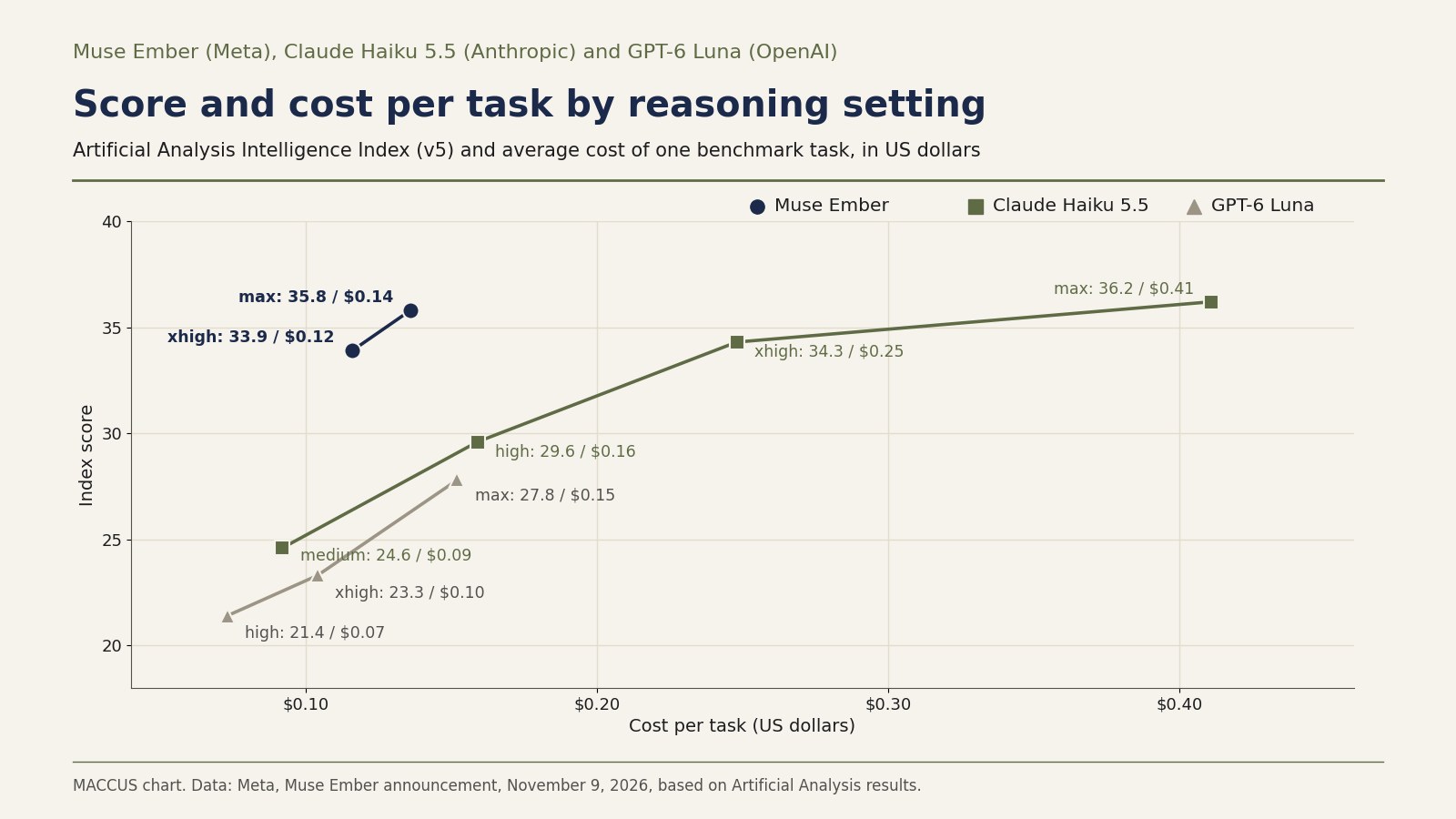

On November 9, 2026, Meta released Muse Ember, which it calls the smallest and most efficient of its AI models. For short requests, Ember charges the same rates as the small models from Anthropic and OpenAI, Claude Haiku 5.5 and GPT-6 Luna. Even so, Meta says Ember matches Haiku 5.5’s best score at about a third of the cost per task. It also says Ember delivers “more intelligence per dollar” than Luna at every one of Luna’s settings.
Those figures come from Artificial Analysis, a company that tests AI models and ranks them on an overall index. AI models count and bill text in tokens, which are fragments of words. With per-token prices equal, the difference comes down to the total bill for each task.
Ember is available through Meta’s API, the interface developers use to plug Meta’s models into their own software. There it costs $0.10 per million tokens sent to the model and $0.50 per million tokens it generates.
Meta Superintelligence Labs, an AI lab inside Meta, built Ember for AI agents, programs that carry out a series of actions on their own. Meta pitches Ember as the workhorse for Muse Wonder, its top-tier model released October 12. It sums up the split this way: “Muse Wonder plans, Muse Ember handles the volume.”
A model for small, repetitive jobs
Meta aims Ember at the work agents repeat all day: calling software tools, handling coding subtasks, directing requests to the right place, extracting data and reading long documents. In the example its documentation gives, Ember files a customer support ticket under billing, bug or feature request.
In the split Meta describes, a bigger model breaks the work down and hands each piece to a subagent, a secondary agent that handles only that piece. Our guide to organizing work across several agents explains how this works.
Meta’s documentation also explains how to run its models inside Claude Code, Anthropic’s coding tool, in place of Anthropic’s own. The swap goes tier by tier: Muse Wonder stands in for Opus, and Muse Spark, Meta’s mid-tier model, stands in for Sonnet. Muse Ember takes Haiku’s place and is also the model for subagents.
Ember reads text, images, audio, video and PDFs, and replies in text. Its context window, the amount of text it can take in at once, is one million tokens. Six reasoning levels, from “minimal” to “max,” set how much it thinks before answering, and “max” is the default. According to Meta, Ember is the first model trained with the help of Muse Wonder Full, the high-end version of Wonder.
Prices match on short prompts and diverge on long ones
The prices separate input, the text sent to the model, from output, the text it generates. All three models charge the same for both as long as the prompt, the text of the request, stays short. Past a certain length, each moves to a higher rate, and that threshold varies by company.
| Model | Input | Cached input | Output | Higher rate above |
|---|---|---|---|---|
| Muse Ember (Meta) | $0.10 | $0.004 | $0.50 | 200,000 tokens |
| Claude Haiku 5.5 (Anthropic) | $0.10 | $0.01 | $0.50 | 100,000 tokens |
| GPT-6 Luna (OpenAI) | $0.10 | $0.01 | $0.50 | 272,000 tokens |
Prices per million tokens, before tax, for prompts below the threshold. Sources: Meta’s and Anthropic’s price lists, and developer Simon Willison’s November 10, 2026, price table for GPT-6 Luna.
Cached input is the part of a request that repeats from one request to the next, such as the fixed instructions of an automation. Ember charges $0.004 per million tokens for it. Haiku 5.5 and Luna charge two and a half times as much, $0.01.
On long prompts, Ember’s prices fall between those of its two rivals, by Simon Willison’s count. Once a prompt passes 200,000 tokens, Ember charges $0.30 per million input tokens and $1.50 per million output tokens. That higher rate then applies to the whole request.
Haiku 5.5 rises to $0.50 and $2.50 above 100,000 tokens. Luna rises to $0.20 and $0.75 above 272,000 tokens, according to Simon Willison, a developer who covers AI language models on his blog.
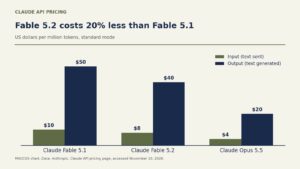
Haiku 5.5 got its current $0.10 and $0.50 prices on October 7. On short prompts, that priced it at 90% less than Haiku 4.5, an earlier version. At the other end of the range is Claude Fable 5.2, which Anthropic launched the same day, November 9. It costs $8 per million input tokens and $40 per million output tokens, 80 times Ember’s price, Willison notes.
Cost per task is Meta’s main argument
Artificial Analysis runs models through nine tests and combines the results into an overall score, its Intelligence Index. It also calculates the average cost of one task in those tests, at each model’s list price. Meta reused these results, published November 9. They cover several reasoning levels: two for Ember, four for Haiku 5.5 and three for Luna.
At the maximum reasoning level, Ember and Haiku 5.5 tie once the scores are rounded, at 36 points each, compared with 28 for Luna. Before rounding, Ember scores 35.8 points for $0.136 per task. Haiku 5.5 scores 36.2 points for $0.411, three times Ember’s cost per task for 0.4 more points. GPT-6 Luna tops out at 27.8 points for $0.152.
Since per-token prices are equal, the gap in cost per task depends on how many tokens each model uses. A model that reasons longer before answering uses more of them and costs more. Ember’s cheaper cache may also play a part, as may its higher long-prompt threshold: 200,000 tokens, compared with 100,000 for Haiku. Neither Meta nor Artificial Analysis says how much each factor weighs.
Artificial Analysis’s own page on Ember confirms the figures Meta reused: 36 points and $0.14 per task. It also clocks Ember at 3.2 minutes per task, compared with a median of 7.5 minutes for comparable models. But the same page calls the model “somewhat verbose.” Ember generated 115 million tokens to complete the index, where the median is 90 million.
Meta’s announcement also compares Ember with its mid-tier Muse Spark 1.3 on the same index. Spark scores one point higher, 37 to 36, but costs $2.39 per task, versus $0.14 for Ember.
Meta’s results table, test by test
Meta’s results table includes several Artificial Analysis tests, all run at the maximum reasoning level. Ember leads clearly on AutomationBench-AA, which simulates business workflows from start to finish. Its success rate there is 37.8%, compared with 20.2% for Luna and 13.9% for Haiku 5.5. On the index for coding agents (AI agents that write software), Ember scores 46 points, versus 37 for Haiku and 31 for Luna.
Haiku 5.5 comes out ahead on FrontierCode 2.0, a test that judges whether code written for real projects would be accepted into them. Haiku scores 34.9% there, versus 27.2% for Ember. On GDP.pdf, a test of professional work on long documents, Ember and Luna tie at 22.8%, ahead of Haiku at 20.8%.
Ember beats both rivals on the four tests Meta ran itself. The margin is thin on OSWorld 2.1, a test of how well a model can operate a computer: 69.5% for Ember, 68.9% for Haiku. Its scoring gives partial credit, so a task done halfway still earns points.
Terminal-Bench 4.0 tests programming at the command line, where a computer is run by typed commands. Ember scores 40.9% there, versus 39.2% for Haiku and 16.4% for Luna. Meta shows each model in the agent software behind its best published result, so the setups differ. Ember runs in mini-swe-agent, Haiku in Claude Code and Luna in Codex, OpenAI’s coding tool.
Early tests outside Meta
Meta quotes five companies that tested the model before its release. At Cloudflare, a web infrastructure provider, chief technology officer Dane Knecht says Ember ran up to 30% faster on the slowest requests. He compares it with “the comparable model we tested,” which he doesn’t name.
At You.com, an AI-powered search engine, Chak Pothina leads inference, the step where a model computes its answers. He says 95% of requests got an answer within 2.2 seconds. He describes Ember as about 4 to 13 times faster than leading open-weight models, with 36% to 48% fewer output tokens. Open-weight models have public weights, the parameters that make up the model, so anyone can run them on their own hardware.
Willison had Ember draw a pelican riding a bicycle at each of the six reasoning levels. Higher levels didn’t clearly improve the drawing. He still rates its quality as comparable to Muse Wonder’s, a model that costs 40 times as much.
Availability and data use
Muse Ember has been available since November 9 through Meta’s API and in Muse Code, Meta’s coding tool. Developers call it by the model ID muse-ember-1.0. Meta also lists Ember, Spark and Wonder on Google Cloud and Oracle Cloud. Ember is a closed model: Meta hasn’t published its weights, unlike Muse Spark Open, whose weights have been public since October 15.
On the API, Ember runs only in Standard mode. According to Meta’s price list, content sent in that mode isn’t used to train Meta’s models. Contributor mode, which gives a discount in exchange for the right to train on that content, isn’t offered for Ember on the API.
In a Muse Code subscription, by contrast, Meta’s policy turns on Contributor mode by default, whatever model is selected. Users can change the setting in their account.
Meta’s geographic use policy lists the territories where the API can’t be used. It was last updated October 12. France and Belgium aren’t on that list. The policy notes that the service isn’t available everywhere, and it doesn’t mention Muse Ember.
The announcement’s own caveats
Meta’s own chart leaves unclear which prices its costs rest on. Its caption calls Ember’s costs “estimates at proposed pricing.” But the chart’s source line and the footnote refer to list pricing.
Four of the ten rows in the results table come from Meta’s internal tests. The partner quotes, too, describe tests that Meta chose to highlight.
In its safety section, Meta says Ember stays below the high-risk thresholds of its own evaluation framework. Those thresholds cover chemical and biological risks, cybersecurity and loss of control over the model. Meta also says it tested how well the model resists instructions hidden in web pages or documents. It published no figures for that.
What it means
With Muse Ember, three major AI companies now sell a small model at the same per-token price on short prompts. Competition between them is moving to other ground: how many tokens a task takes, the price of cached input, and the point at which a long prompt costs more. OpenAI had already made the cost-per-task argument on October 26. That day it pitched GPT-6.1 Terra as about nine times cheaper per task than Claude Opus 5.5 on one of its tests.
The shift matters most to companies that run AI agents through an API. According to Meta, an agent spends most of its tokens on small, repeated steps.
The independent Artificial Analysis page confirms Ember’s score and its cost of $0.14 per task. The rest of Ember’s lead, as Meta presents it, rests on tests Meta selected, four of them run in-house.
For users in France and Belgium, three questions remain open: whether they can actually reach the API, how well Ember handles French, and how it does on independent tests beyond Artificial Analysis. The announcement gives no figures for French.
Meta writes that it has “even more efficient models in training.” The next thing to watch is whether Anthropic and OpenAI respond on price or on token use.
Sources
- Introducing Our Smallest, Most Efficient Model: Muse Ember, Meta, November 9, 2026
- Muse Ember, Meta Model API documentation, accessed November 10, 2026
- Choose a model, Meta Model API documentation, accessed November 10, 2026
- Pricing and rate limits, Meta Model API documentation, accessed November 10, 2026
- Meta Model API Model Designation and Geographic Use Policy, Meta, October 12, 2026
- Muse Ember (Max) Intelligence, Performance & Price Analysis, Artificial Analysis, accessed November 10, 2026
- Pricing, Anthropic, accessed November 10, 2026
- Introducing Our Smallest, Most Efficient Model: Muse Ember, Simon Willison’s Weblog, November 10, 2026
Header image: MACCUS chart. Data: Meta, Muse Ember announcement, November 9, 2026, based on Artificial Analysis results