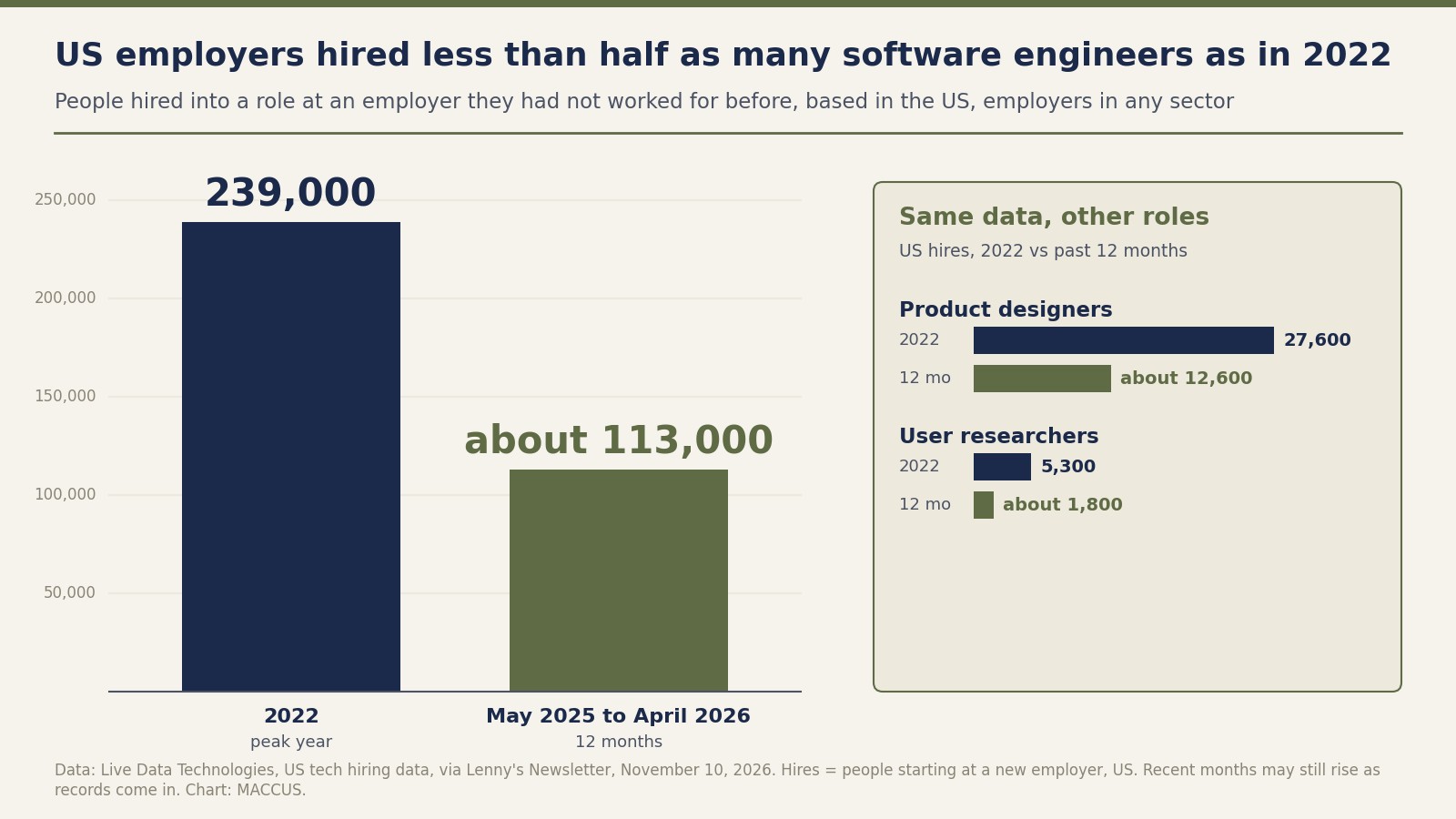

US employers hired about 113,000 software engineers in the 12 months to April 2026, less than half the 239,000 they hired in 2022. For engineers looking for a new job, that is about one hire for every two in 2022. The count comes from Live Data Technologies (LDT), a company that tracks job changes using public information on the web, and it has fallen every year since 2022. Lenny Rachitsky, who writes Lenny’s Newsletter on product and career topics, published the figure on November 10, 2026, in his latest job market report.
At tech companies worldwide, openings for front-end and mobile engineers roughly halved in a year. Front-end engineers build what people see on a website or app. Openings for forward deployed engineers, who work inside client companies to get AI systems running, grew 4.6-fold. Rachitsky reads the shift as AI letting smaller engineering teams own more of the work.
OpenAI and the freelance marketplace Upwork published a study on the same day, November 10. Kinds of work people often use ChatGPT for tended to lose share of freelance job posts, while clients set bigger budgets for broader projects that use AI.
Fewer software engineers hired every year since 2022
Rachitsky’s report draws on two datasets that measure different things: one counts hires, the other job openings. Hires come from Live Data Technologies, which compiles the work histories of about 124 million professionals. It counts a hire when someone starts a job at an employer they had not worked for before. The figures cover people based in the US, at employers in any sector, and leave out promotions, internal moves, interns, contractors and freelancers.
Product designer hiring fell about as much as engineer hiring: about 12,600 US hires over the past 12 months, against 27,600 in 2022. User researchers, who study how people use a product, saw the steepest drop of any role in the report. About 1,800 were hired in the US over the past year, down 66% from 5,300 in 2022.
Earlier in the pipeline, other counts point the same way. US colleges count about 12% fewer computer science undergraduates this fall. At the AI company Anthropic, juniors fell from 27% to 9% of technical hires since early 2025, according to its own study.
Front-end openings halved while forward deployed engineer openings grew 4.6-fold
Openings data comes from TrueUp, a company that tracks job listings at more than 9,000 tech companies worldwide. Engineering openings have stalled. They grew 29% through 2024, 15% through 2025 and 2.5% over the past year. Tech companies now list fewer open engineering roles than in March 2026, according to the report.
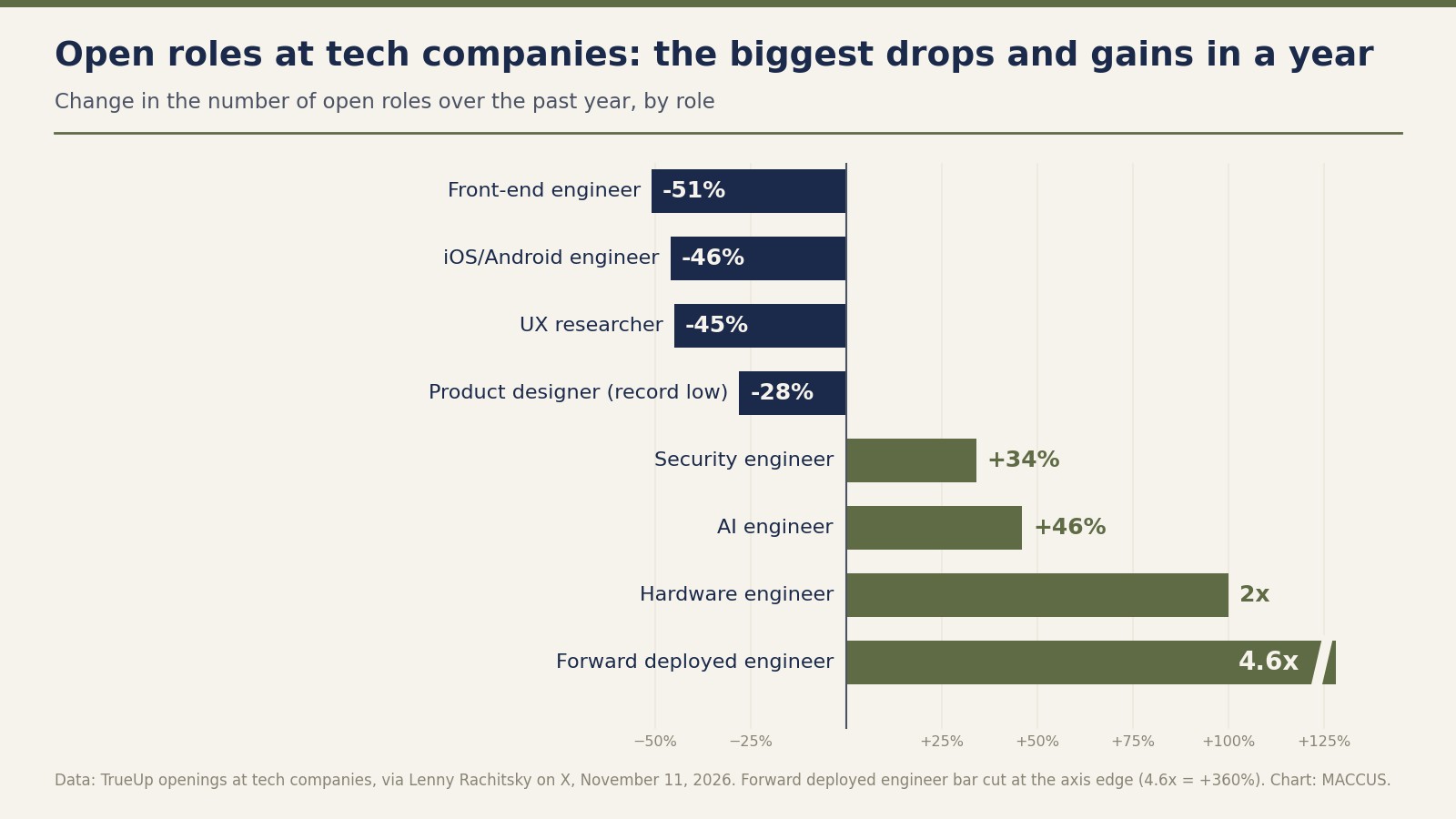
In a post on November 11, Rachitsky listed how openings changed over the past year, role by role. Openings fell 51% for front-end engineers, 46% for iOS and Android app engineers and 45% for user researchers. Product designer openings fell 28%, to a record low of about 1,900.
Openings grew 4.6-fold for forward deployed engineers and doubled for hardware engineers. They rose 46% for AI engineers and 34% for security engineers. About 1,500 forward deployed engineer roles are open. Rachitsky writes that part of the jump likely comes from other jobs, such as “sales engineer,” being renamed.
The software company Palantir used to hire about half of all forward deployed engineers, LDT says. So far in 2026, other employers have hired more than 2,400 of them. Google is second only to Palantir, with 122 US hires against 151. We covered the rise of this job in US job ads in October.
Rachitsky writes that he sees “the collapse of specialized/siloed engineering disciplines, with smaller eng teams having broader ownership (thanks to AI).” Product managers, who decide what a team builds, have gained ground. Their openings are up 75% from a low in March 2023. Their share of hiring among the five core product roles rose from 16% in 2021 to 21% today.
“LLM,” short for large language model, the kind of AI behind ChatGPT, is now the skill most often named in product manager job ads. “Claude,” Anthropic’s AI assistant, ranks third. In designer job ads, “Claude” became the second most named skill this spring, ahead of the web styling language CSS.
Tech job openings are growing mostly outside software
Total openings at tech companies are rising. Rachitsky counts more than 281,000 open roles, up 17% from a year earlier and 73% above the March 2023 low. Openings in product, engineering and design together grew only 2%.
The growth is elsewhere. Hardware engineering openings doubled, supply chain openings rose 63% and business operations added about 4,200 openings. Many of the fastest-growing jobs are physical: data center technicians, installers and field service engineers. “The AI boom is creating jobs, but mostly in building and running the physical infrastructure (chips, data centers, hardware), not building software,” Rachitsky wrote.
Freelance clients set bigger budgets for AI projects
OpenAI and Upwork studied how AI is changing freelance work. Their study, published on November 10, compares what people do in ChatGPT with what clients hire freelancers for on Upwork. Content writing makes up 14.5% of sampled ChatGPT conversations but about 1.3% of Upwork job posts. Over two years from early 2023, content-writing postings fell more than twice as fast as all Upwork postings, while video and animation postings grew by about a third relative to the marketplace.
In 43 of the 63 types of work studied, postings moved the way ChatGPT use would predict. Types common in ChatGPT lost share on Upwork, and less common ones gained. The other 20 moved the opposite way. OpenAI writes that “ChatGPT use alone does not explain changes in freelance demand.”
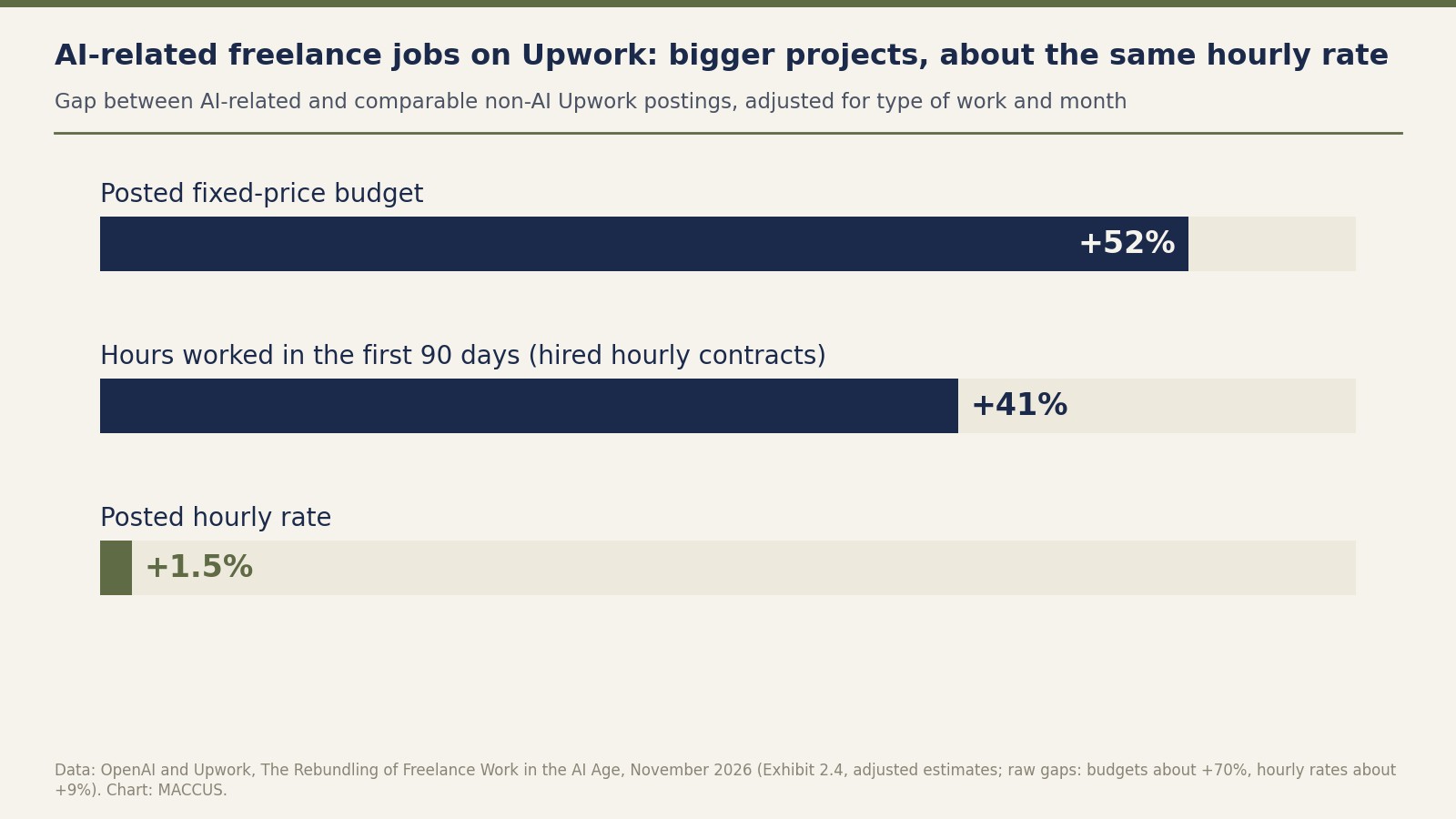
By late 2025, clients were asking for AI in more kinds of work. They also combined tasks that rarely went together, such as AI-generated video with editing and motion graphics. The full report finds fixed-price budgets about 52% higher for AI-related postings than for comparable non-AI work.
Posted hourly rates are only about 1.5% higher. But AI-related hourly contracts log about 41% more hours in their first 90 days. The authors conclude that AI-related work “is associated with greater demand for labor and larger projects, rather than primarily with a higher price for each hour of worker time.”
What the data does not show
The hiring count alone cannot say how much of the drop comes from AI and how much from other causes. Software engineer hiring peaked in 2022, the year ChatGPT launched in late November, and has fallen every year since. The counts themselves do not measure a link to AI; it comes from Rachitsky’s reading of which roles shrink and which grow.
LDT says job changes take months to show up online, so its counts for the latest months keep rising after the data is pulled. A narrower slice of LDT’s data looks different. At 30 to 80 large US tech companies, software engineer hiring started to come back after 2023, while intern hiring kept falling, an LDT analyst told The Pragmatic Engineer, a software engineering newsletter, in June.
Engineering is still the largest category of tech hiring. The report counts more than 120,000 US engineering hires in calendar year 2025, a separate tally from the 113,000 software engineers of the 12 months to April, and tech companies worldwide list more than 65,000 open engineering roles. Rachitsky also flags open roles for tech recruiters, up nearly 300% since mid-2023. He says that rise “may be a leading indicator of a reacceleration of eng hiring.”
The freelance study says it finds associations, which do not prove cause and effect. Its ChatGPT and Upwork datasets are not matched, and neither covers the whole labor market. OpenAI, which sells ChatGPT, wrote it with Upwork.
What it means
The data points to software work being regrouped around fewer, broader roles, with front-end, mobile and user research losing ground. Rachitsky sees the rest of the team taking that work over, with AI in engineering and better tools in research. The roles gaining ground, such as forward deployed engineer and product manager, combine building with AI and working with customers. The freelance study points the same way: kinds of work common in ChatGPT tend to lose share, and AI projects combine tasks that rarely went together, under bigger budgets.
For a specialist engineer or researcher, the US hiring market has narrowed sharply since 2022. Tech companies post 17% more openings than a year ago, but much of that new demand is in hardware, data centers and operations, outside software. How much of the hiring drop AI explains is still open. The timing fits other causes too, while the role-by-role pattern fits Rachitsky’s reading.
Three signs are worth watching: whether the jump in recruiter openings turns into engineering hires in 2027, how far LDT’s latest months rise as late records come in, and whether intern hiring recovers. This was Rachitsky’s second report of 2026, and his next one should update the recruiter and LDT figures.
Sources
- State of the tech job market: late 2026, Lenny’s Newsletter (Lenny Rachitsky), November 10, 2026
- Who’s hiring in tech in 2026: the data behind Lenny’s job market report, Live Data Technologies, November 10, 2026
- The tech job market is in its best shape in years. But almost none of the growth is coming from software jobs., Lenny Rachitsky on X, November 11, 2026
- What’s most changing in tech jobs right now, Lenny Rachitsky on X, November 11, 2026
- Work at the Frontier: AI’s effect on freelance work, OpenAI, November 10, 2026
- The Rebundling of Freelance Work in the AI Age, OpenAI and Upwork, November 2026
- State of the software engineering job market in 2026, part 2, The Pragmatic Engineer (Gergely Orosz), June 9, 2026
Header image: chart by MACCUS from Live Data Technologies hiring data published in Lenny’s Newsletter, November 10, 2026