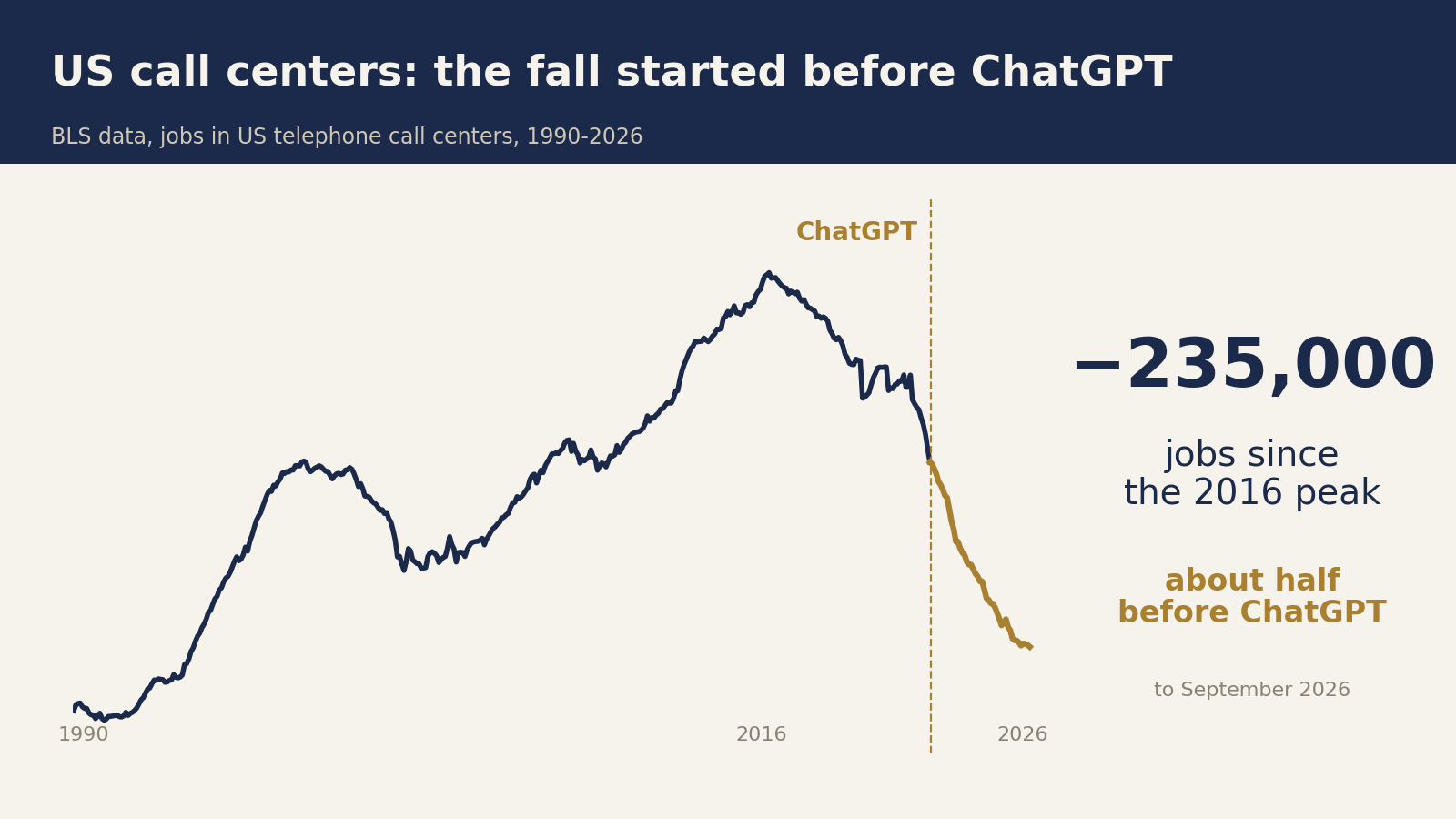

American call centers employ fewer people than at any time since 1994. By the government’s preliminary count for September, they have lost about 235,000 jobs since their peak in 2016.
About half of those jobs were already gone when OpenAI released its chatbot, ChatGPT, in November 2022. AI arrived in an industry that had been shrinking since 2017.
I went through the industry’s monthly job counts back to 1990, from the Bureau of Labor Statistics, the federal agency behind the jobs report. Then I checked them against the bureau’s census of employers, its estimates of customer service jobs in every industry, and postings on the job site Indeed. The September figure is preliminary, and the yearly revision due in February 2027 will most likely make the loss a little bigger.
The fall began years before ChatGPT
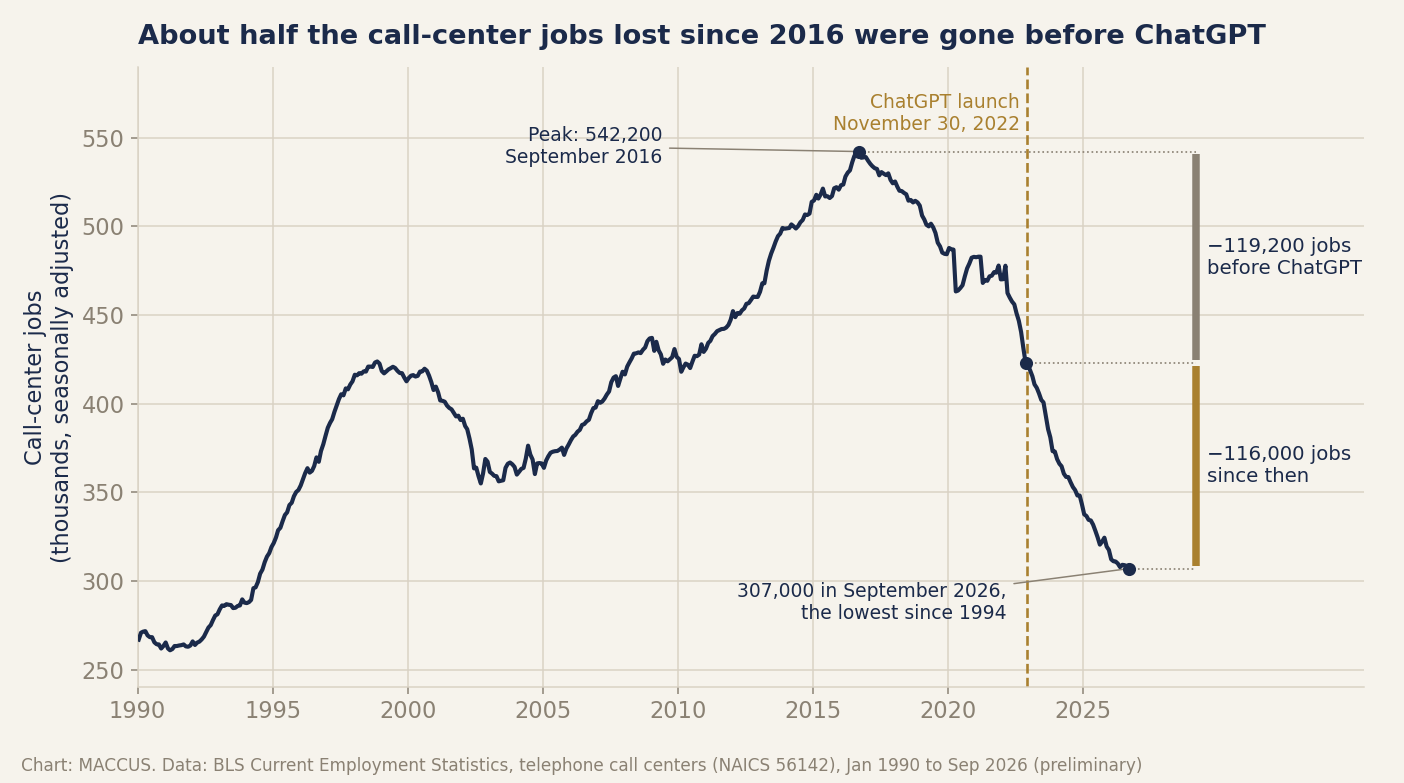
Call-center employment grew from 1990 until September 2016, with occasional dips, and has fallen every year since 2017. The government calls the industry telephone call centers. It covers companies that answer calls, take orders or sell by phone for other businesses, plus the stand-alone centers that large companies run for themselves.
The steep fall started early in 2022. Between January and November of that year, before the public had ever used ChatGPT, the industry lost one job in ten. The pandemic year was not the break: employment ended 2020 almost where it began.
The steepest losses came in 2022 and 2023 and have eased since
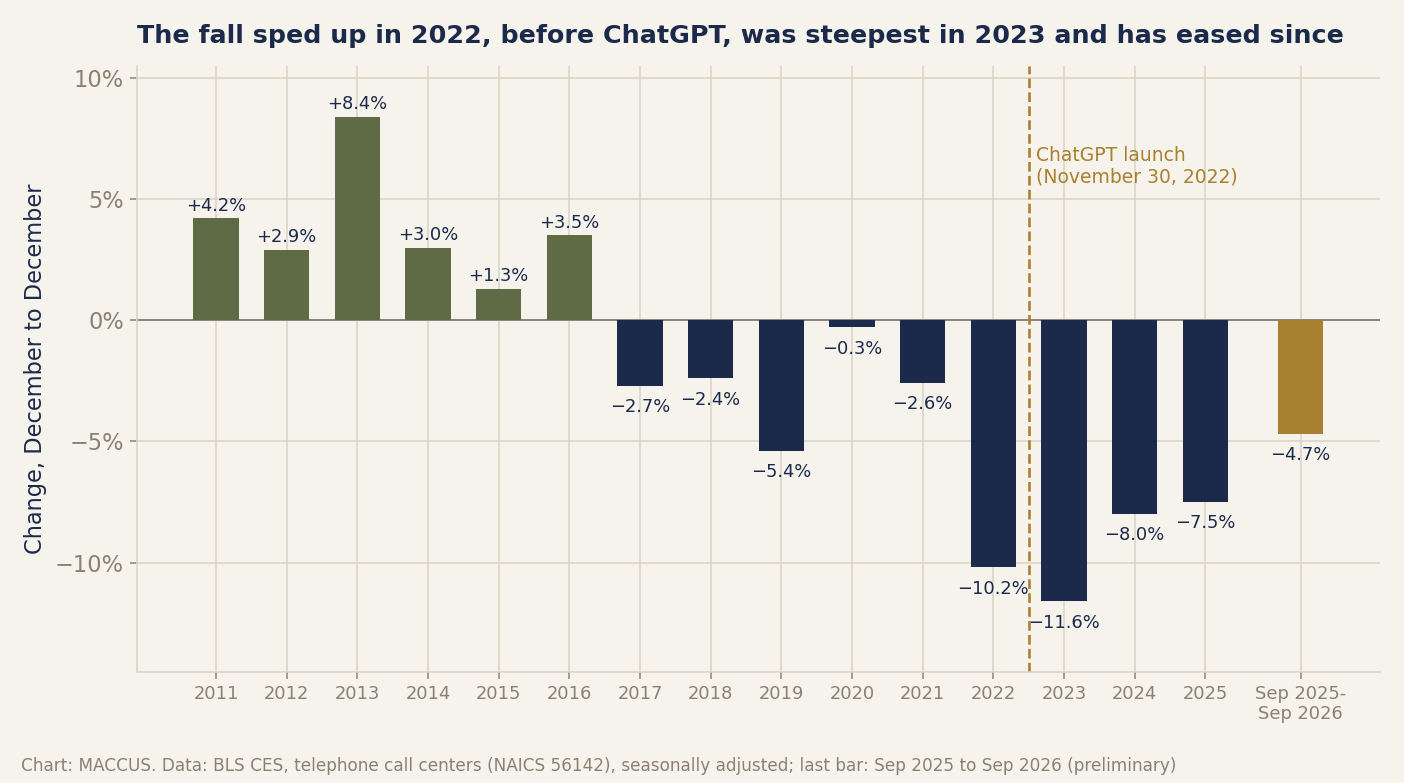
The industry’s worst years since the count began in 1990 were 2022 and 2023. The losses of 2023 fit the AI explanation best, because 2023 was the first full year with ChatGPT on the market.
The losses have eased since 2023, at least in the monthly survey. In the year through September, the industry lost less than 5 percent of its jobs.
The rest of the economy went the other way. Since the start of 2022, call centers have lost more than a third of their jobs, while private employment as a whole kept growing.
Almost every state lost call-center jobs, and average pay rose
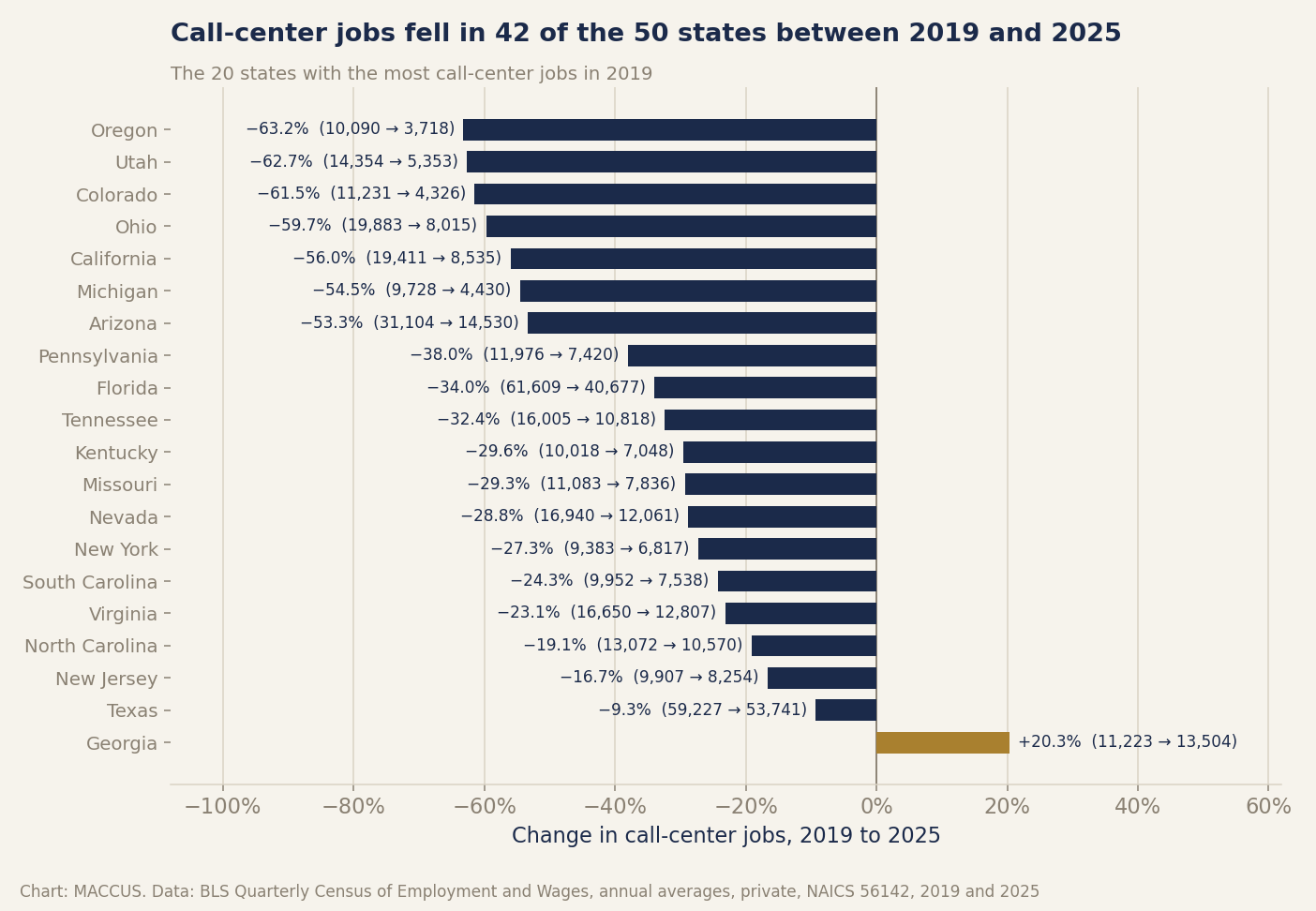
Between 2019 and 2025, call-center employment fell in almost every state, and Arizona, Ohio and California lost more than half of theirs. Florida, the biggest call-center state in 2019, lost the most jobs. Texas, the second biggest, lost far less, and Georgia was the only large call-center state to grow.
Average pay rose while jobs fell. The people still working in the industry earn much more than in 2019, and their pay rose faster than the private-sector average. These averages cannot say whether the same jobs now pay more, or whether the lowest-paid jobs were the ones that went.
The job is shrinking outside call centers too
The industry figures leave out the help desks that banks, airlines and retailers run in their own offices. The bureau’s occupation estimates count workers by the job they do, in every industry, so they include those desks. In May 2025 they showed about 280,000 fewer customer service representatives than in May 2022, while total employment grew.
| Measure | Then | Now | Change |
|---|---|---|---|
| Call-center jobs, BLS monthly survey (CES) | November 2022: 423,000 | September 2026: 307,000 (preliminary) | −27% |
| Call-center jobs, census of employers (QCEW, annual average) | 2022: 443,316 | 2025: 327,577 | −26% |
| Customer service representatives, all industries (occupational estimates, May) | 2022: 2,879,840 | 2025: 2,595,750 | −10% |
| Indeed customer service job postings (February 2020 = 100) | November 30, 2022: 124 | November 6, 2026: 87 | −29% |
| For comparison: all private-sector jobs (CES) | November 2022 | September 2026 | +3% |
Job postings point the same way. On Indeed, postings for customer service jobs are below their level of early 2020. Postings for all jobs are above their own early-2020 level.
I don’t think anyone decided to close the American call center. A bank moves balance checks into its app. A cable company puts a phone menu in front of its agents, then a chat window, then signs a contract with a center abroad, and now tests a chatbot.
Each choice makes sense on the budget of the company that makes it. My guess is that thousands of choices like these, added up, shrank the industry back to its 1994 size.
What it means
The years since 2022 fit two stories at once. In one, generative AI, the technology behind ChatGPT, took over the simple calls. In the other, older forces did most of the work: apps, self-service and offshoring.
These figures cannot separate the two, but they do settle the order of events. The industry was in decline long before ChatGPT, and its sharpest fall started before the launch.
Other counts of AI and jobs are just as hard to read. Software engineer hiring peaked in 2022 and has fallen every year since. The hiring data alone cannot say how much of that is AI. Announced US job cuts attributed to AI peaked in May and fell to their lowest level of the year in October.
The break is clearest where the answers were already text on a screen. Questions on Stack Overflow, a help forum for programmers, halved within a year of ChatGPT’s launch. Phone work looks more like a long slide, with AI as the newest of several cheaper ways to answer a customer.
If AI is now doing to phone work what the apps did, only faster, the yearly loss should grow again. My bet is that it won’t. The bureau’s figures for the year through September 2027, due in November 2027, will show a smaller loss in jobs than the year through September 2026. If I’m wrong, that will be the first clear sign in this data that AI is doing something the apps and the offshore contracts did not.
The industry figures count payroll jobs at companies whose main business is answering calls. They leave out contractors paid per call, help desks inside other companies and agents abroad. None of these sources can say why a given job disappeared.
Method and numbers
Employment comes from the Bureau of Labor Statistics Current Employment Statistics, its monthly payroll survey: series CES6056142001 (telephone call centers, industry code NAICS 56142, seasonally adjusted), retrieved November 14, 2026. The series peaked at 542,200 in September 2016. It stood at 307,000 in September 2026, its lowest since August 1994. The September figure is preliminary; the final figure for August is 308,200. The industry lost 119,200 jobs between the peak and November 2022, the last survey month before ChatGPT’s launch on November 30. It has lost 116,000 since. December-to-December changes: 2022, -10.2%; 2023, -11.6%; 2024, -8.0%; 2025, -7.5%; the 12 months through September 2026, -4.7%. From January 2022 to September 2026, the industry fell 34.7% while total private employment rose 6.1%. The bureau’s census of employers, the Quarterly Census of Employment and Wages, agrees with the survey within 2% in early 2026. It counted 327,577 jobs on average in 2025 and 443,316 in 2022. The state figures compare its 2019 and 2025 averages. Average annual pay rose from $40,313 to $58,411 between 2019 and 2025 (+45%), against +34% for all private jobs. In the bureau’s occupational estimates for May, customer service representatives in all industries fell from 2,879,840 in 2022 to 2,595,750 in 2025. Indeed’s customer service postings index stood at 87 on November 6, 2026 (February 2020 = 100), against 105 for all postings. The census count confirms the easing through 2025 but not yet in early 2026: it fell 8.6% from March 2025 to March 2026. In March 2026 the survey stood 1.9% above the census count, so the February 2027 revision will most likely lower recent months and enlarge the loss. About half holds under every split tested: 50.7% with November 2022 as the last month before the launch, about 47.5% on census counts. The full dataset is available here.
Sources
- Telephone call centers, all employees (CES6056142001), US Bureau of Labor Statistics, retrieved November 14, 2026 (archived copy)
- QCEW open data, NAICS 56142, annual averages 2025, US Bureau of Labor Statistics, retrieved November 14, 2026 (archived copy)
- Occupational Employment and Wage Statistics, national estimates, May 2025, US Bureau of Labor Statistics, retrieved November 14, 2026 (archived copy)
- CES benchmark article, US Bureau of Labor Statistics, retrieved November 14, 2026 (archived copy)
- Job postings tracker (US, by sector), Indeed Hiring Lab, retrieved November 14, 2026 (archived copy)
- 2022 NAICS definition: 56142 Telephone Call Centers (archived copy), US Census Bureau, captured November 22, 2025
- Introducing ChatGPT (archived copy), OpenAI, November 30, 2022
Header image: chart by MACCUS, data from the US Bureau of Labor Statistics (CES, telephone call centers), September 2026.