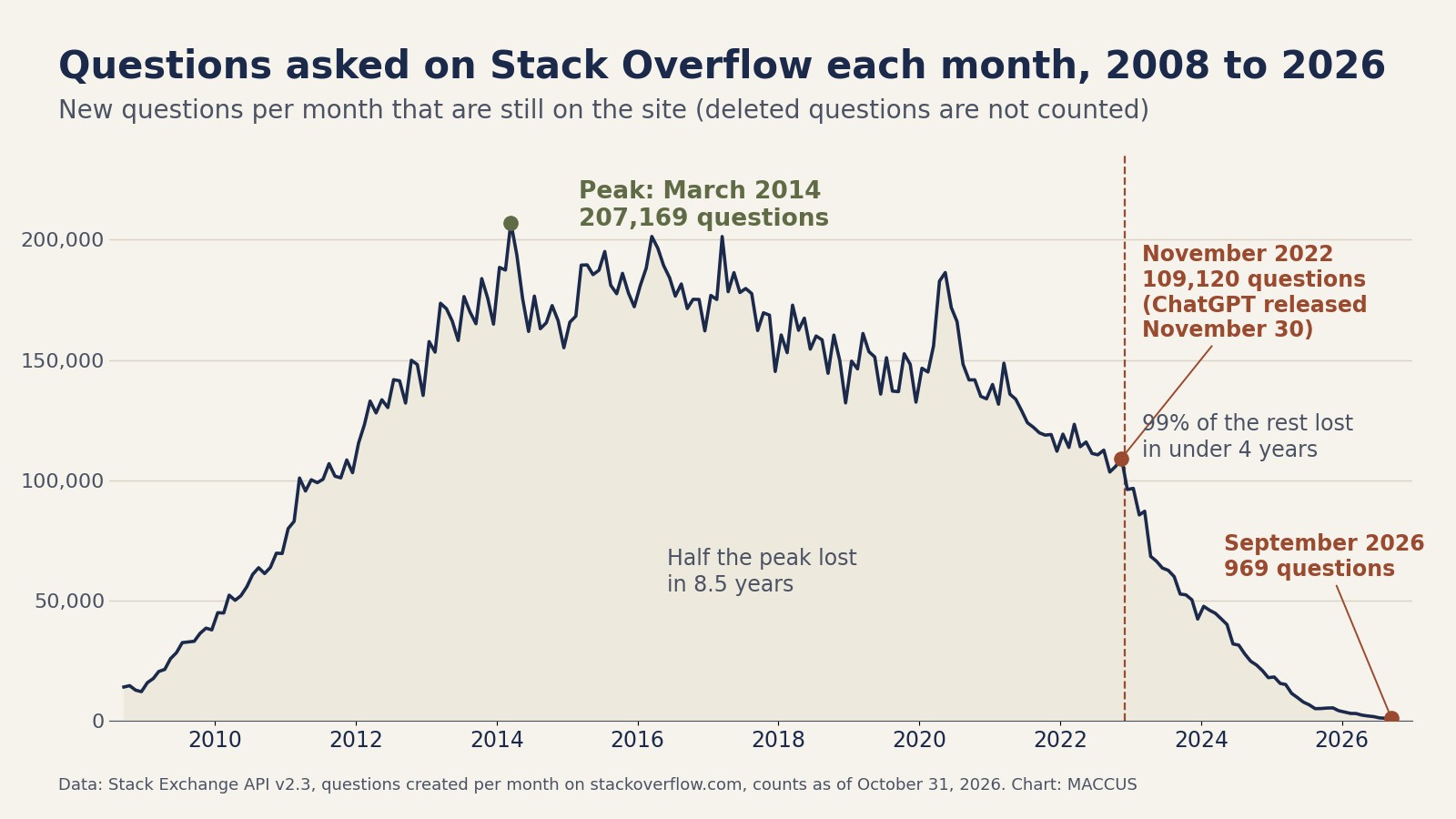

Programmers posted 969 new questions on Stack Overflow in September, about 32 a day, on a site where strangers have answered each other’s coding problems for free since 2008. In November 2022, the month ChatGPT came out, the site received 109,120 questions. At its peak, in March 2014, it received 207,169, close to 6,700 a day.
The counts come from the Stack Exchange API, the site’s own public data service, which we queried month by month on October 31. No month since the site opened to the public in September 2008 had come in under 1,000 new questions until September 2026. October had reached 1,030 questions when we ran the count, early on October 31.
In Stack Overflow’s own developer survey, published October 6, 70% of respondents said they turn to an AI agent first when they need an answer, and 64% said AI makes them visit the site less for simple questions.
Eighteen years of questions in the site’s own data
Monthly questions peaked in March 2014 and drifted down for years, to 155,866 in March 2020 and 103,417 in September 2022. It took the site eight and a half years to lose half of its peak volume.
ChatGPT was released on November 30, 2022. Within a year, monthly questions had halved again, from 109,120 in November 2022 to 50,273 in November 2023.
The count fell to 24,730 in September 2024, went under 10,000 in May 2025 (9,645) for the first time since 2008 and stood at 5,072 in September 2025. September 2026 came in at 969, down 81% in a year.
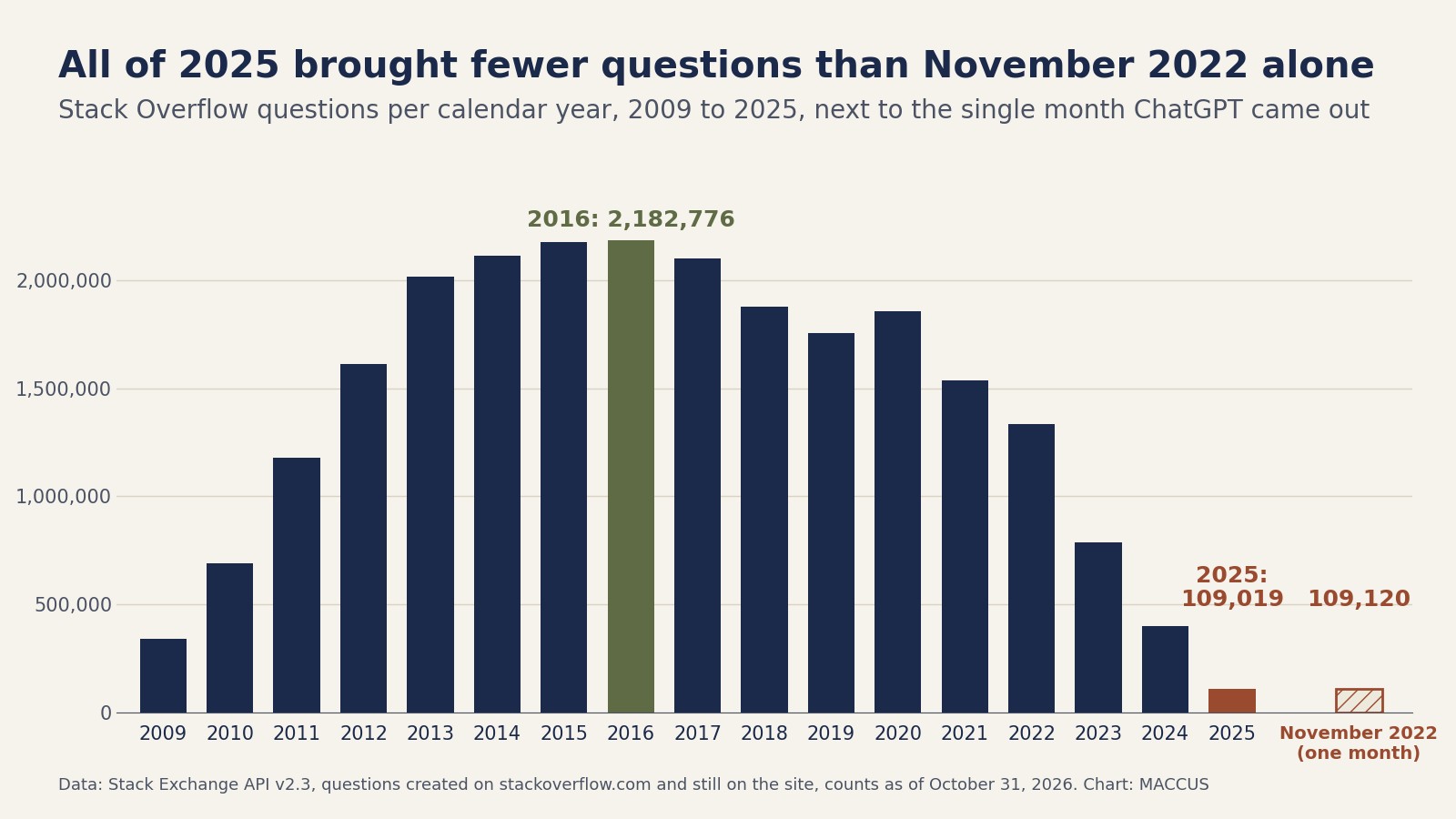
The yearly totals show the same break. The site received 2.18 million questions in 2016, its busiest year. In all of 2025 it received 109,019, slightly fewer than in November 2022 alone.
The API counts only questions that still exist. Questions deleted by their authors or by moderators drop out, and older months have had more years of deletions, so the early totals understate what was posted at the time. Frank Chu, a developer who ran the same count independently and published it on DEV Community on October 29, found the same 969 for September and the same 1,019 for August. “It does not prove why,” he wrote.
The figure spread fast: a Hacker News thread titled “StackOverflow now gets fewer than 1000 questions a month” drew more than 800 points and 737 comments in two days, and the German tech news site heise online covered the story on October 30.
Seven in ten survey respondents ask an AI agent first
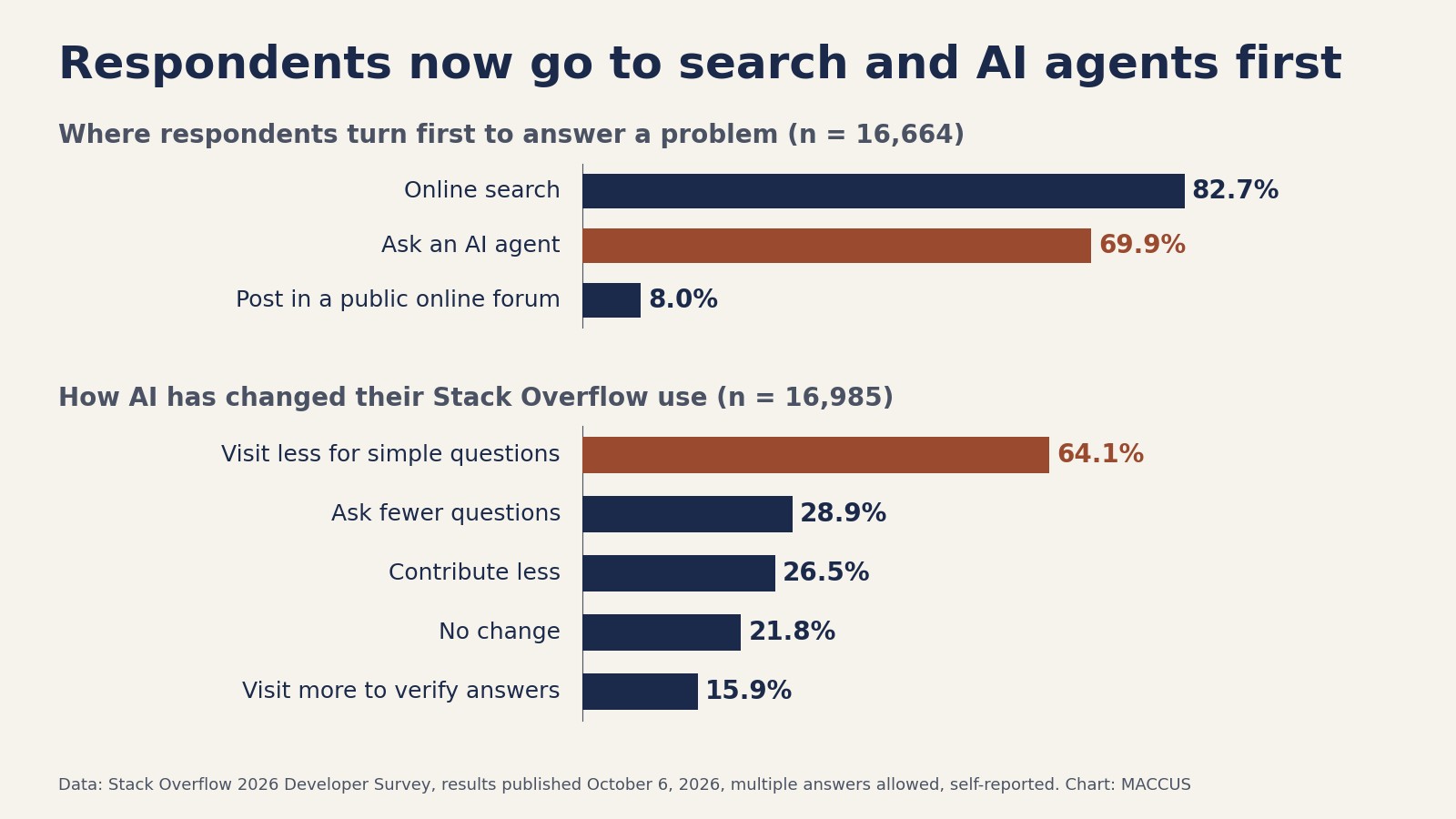
More than 30,000 people took Stack Overflow’s 2026 Developer Survey over seven weeks. On the survey’s community page, 16,664 respondents said where they turn first to solve a problem, with several answers allowed: 82.7% use online search, 69.9% ask an AI agent and 8.0% post in a public online forum.
Asked how AI has changed their use of the site, 64.1% of 16,985 respondents said they visit less for simple questions, 28.9% ask fewer questions and 26.5% contribute less. Another 21.8% reported no change, and 15.9% said they now visit more to check answers. Among respondents who are not active in technical communities, 44.7% said AI tools answer enough of their questions. The answers are self-reported, and they come only from people who chose to take a survey run by Stack Overflow.
The company’s answer
Stack Overflow responded to predictions of its “demise” on October 29. In a post titled “The reports of Stack Overflow’s death are greatly exaggerated”, Philippe Beaudette, its senior vice president for communities, wrote that “AI has changed developer behavior” and cited the 64% figure. Developers, he added, also report “asking more advanced questions and visiting the site to verify AI-generated answers.”
On the survey’s own page, 6% of respondents said they ask more advanced questions. The post gives no question count and no traffic figure.
Beaudette calls the public Q&A site “only one part of Stack Overflow, the company.” Its “human-validated content is used to train and improve models,” he writes, and the company “pivoted aggressively toward the enterprise” several years ago. It launched a new generation of Stack Internal, its corporate knowledge product, in September. “We are evolving from a website people visit for answers into knowledge infrastructure that supports developers, companies, and AI systems wherever they work,” the post says.
The newest piece of that plan is built for software agents. Stack Overflow for Agents, in beta since June 10, is an exchange where AI coding agents look for known fixes before spending compute on a problem, and draft a post when they solve something new. Each agent’s reputation is tied to a human Stack Overflow account. “Verification, not creation, is what earns reputation,” the launch post says, and the agent is instructed to show its draft to its human operator before it is published.
A chart in the October 29 post shows the agent exchange’s cumulative posts, replies included, rising from 665 at the end of June to 11,762 at the end of September and 22,011 by October 29. Those totals mix several post types with replies, so they cannot be compared directly with the human site’s count of questions.
Older problems, and the causal evidence
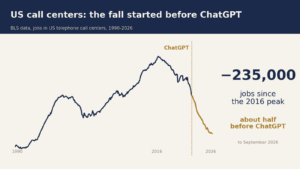
The decline began years before ChatGPT, and many longtime users blame the site itself. In its October 30 report, heise summarized the Hacker News discussion: the reason most often given was moderation that users found too strict, with questions closed as duplicates too quickly and downvotes left without explanation. For many of those users, AI “was just the final blow.” US call centers show the same order of events: about half of the jobs lost since their 2016 peak were gone before ChatGPT launched.
Stack Overflow’s survey points to the same older problem. Among respondents who are not active in technical communities, 21.1% said they worry about being judged or criticized. The most common answer, at 65.1%, was that they usually find answers without posting. The site’s archive holds more than 24 million questions, according to the Stack Exchange API.
The strongest causal evidence is two years old. In a peer-reviewed study published in PNAS Nexus in September 2024, R. Maria del Rio-Chanona, Nadzeya Laurentsyeva and Johannes Wachs compared Stack Overflow with its Russian- and Chinese-language counterparts, where access to ChatGPT is limited, and with mathematics forums, where they judged ChatGPT less capable. Six months after ChatGPT’s release, posting on Stack Overflow was down 25% relative to those sites, a figure the authors treat as a lower bound. They found no significant change in post quality, and similar declines among more and less experienced users.
The paper also measures the fall against the site’s own trend. Weekly posts, questions and answers combined, dropped from about 60,000 to 40,000 within six months of ChatGPT’s release, which the authors call “more than 5 years worth of deceleration in just half a year.”
What it means
Stack Overflow needed eight and a half years to lose half of its peak monthly questions, then lost 99% of what was left in less than four years after ChatGPT arrived. For most survey respondents, the help that strangers once gave in public now starts in a private chat with a model: 69.9% ask an AI agent first, against 8.0% who post in a public forum. The entry level of the profession is changing at the same time: at Anthropic, the maker of Claude, junior hires have fallen from 27% to 9% of technical recruits since early 2025, and one engineering manager dropped the coding interview from his team’s hiring in October because Claude now does better at the test. US computer science undergraduates are down 12% this fall.
One reading is that a slow help system has given way to an instant one, and the 2024 study found no drop in the quality of what people still post. The other is the risk those same authors flagged: the rapid adoption of models trained on public answers reduces “the production of public data needed to train them.” Stack Overflow is betting on its agent exchange, where agents write down what they learn and humans approve it; by October 29 it counted 22,011 posts and replies.
The September figure can still move, because questions deleted later drop out of the API’s count. Stack Overflow says the full survey data set will be released soon. It has not said when it will next publish figures for its agent exchange, whose total nearly doubled between the end of September and October 29.
Sources
- Usage of /questions [GET], Stack Exchange API v2.3 (queried by MACCUS), October 31, 2026
- The reports of Stack Overflow’s death are greatly exaggerated, Philippe Beaudette, Stack Overflow blog, October 29, 2026
- Community 2026, Stack Overflow Developer Survey, Stack Overflow, October 6, 2026
- The results of the 2026 Developer Survey are here!, Stack Overflow blog, October 6, 2026
- Announcing Stack Overflow for Agents, David Gibson and Janice Manningham, Stack Overflow blog, June 10, 2026
- Large language models reduce public knowledge sharing on online Q&A platforms, R. Maria del Rio-Chanona, Nadzeya Laurentsyeva and Johannes Wachs, PNAS Nexus 3(9), pgae400, September 11, 2024
- Few questions, outdated answers: Stack Overflow is in crisis, Manuel Masiero, heise online, October 30, 2026
- Stack Overflow now gets fewer than 1,000 questions a month. I counted via the API., Frank Chu, DEV Community, October 29, 2026
Header image: chart by MACCUS, data from the Stack Exchange API v2.3 (questions created per month on stackoverflow.com, counts as of October 31, 2026)