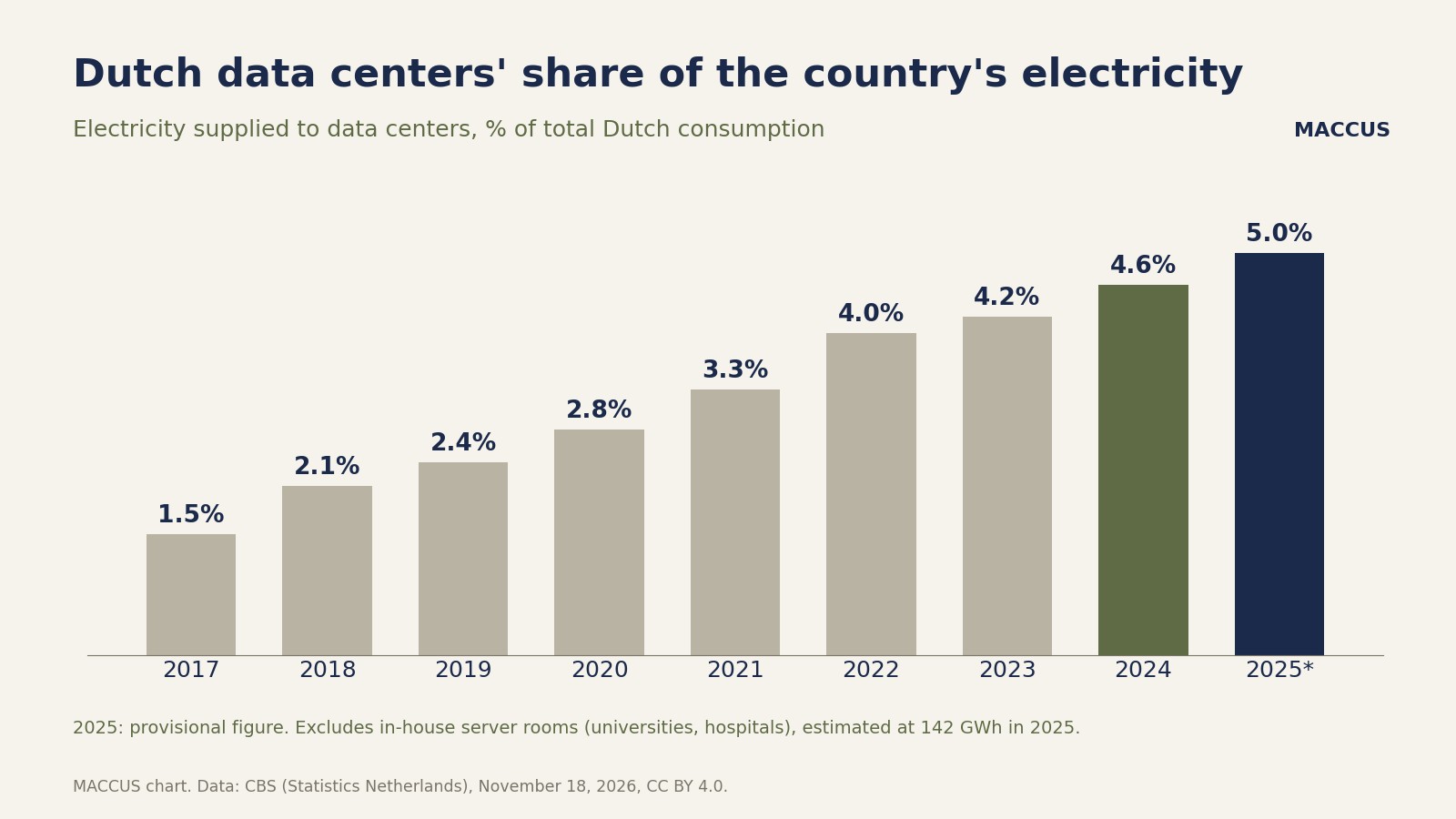

One kilowatt-hour in every 20 used in the Netherlands in 2025 went to a data center. Statistics Netherlands (CBS), the country’s official statistics office, reported on November 18, 2026, that Dutch data centers were supplied 5,664 gigawatt-hours (GWh) of electricity in 2025. A gigawatt-hour is one million kilowatt-hours. That total, still provisional, is 5.0% of all the electricity used in the country, up from 4.6% in 2024 and 1.5% in 2017.
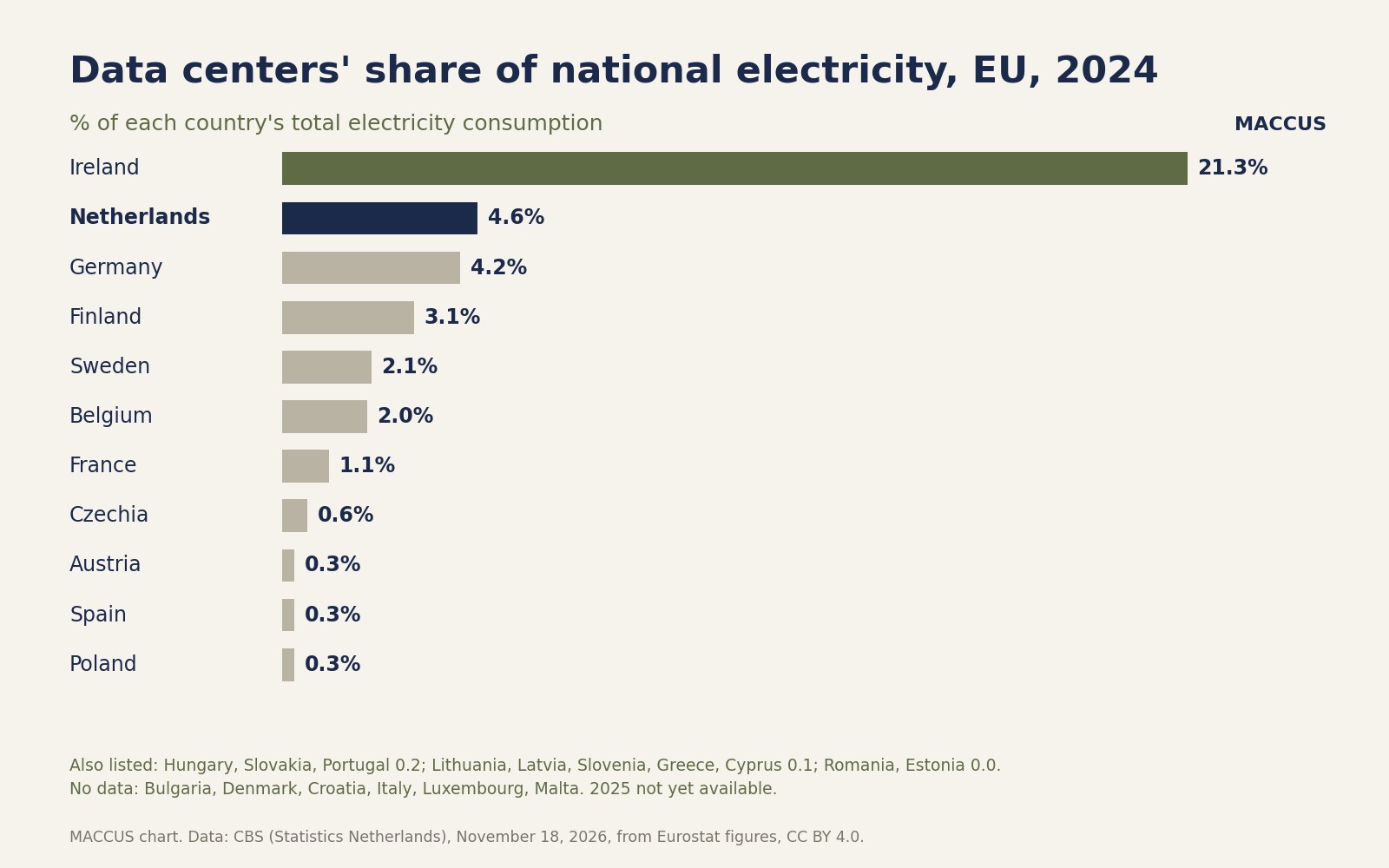
Within the European Union, only Ireland’s data centers take a larger share of their country’s electricity, CBS said, comparing 2024 figures from Eurostat, the EU’s statistics office. That ranking covers only the countries with data. There is no figure for Denmark or Italy, among others.
Data centers grew while total Dutch power use barely changed
The Netherlands has about 200 data centers, according to CBS. Their users include tech companies and large cloud providers, which rent out computing power and storage over the internet. Together, the data centers were supplied 12% more electricity in 2025 than in 2024.
The rise in the data centers’ share comes from their own growth. Total Dutch electricity use barely changed between 2017 and 2025, by our arithmetic from CBS’s figures. Over the same years, the electricity supplied to data centers went from 1,653 GWh to 5,664 GWh, 3.4 times as much.
The pace of growth has varied. In December 2025, CBS reported that supply to data centers rose 58% from 2018 to 2021, then 37% from 2021 to 2024. That second figure works out to about 11% a year, by our arithmetic, close to the 12% rise in 2025.
About 50 large sites take almost all of it
Nearly all of the power goes to the biggest sites. About 50 of the roughly 200 data centers each draw 10 GWh or more a year. Together they accounted for “meer dan 90 procent” (more than 90%) of the electricity supplied to data centers in 2025, the Dutch version of the release says. The English version rounds it to around 90%.
The growth since 2017 came almost entirely from data centers of that size, by our arithmetic. Those drawing 10 GWh or more took 5,289 GWh in 2025, about four times the 1,295 GWh that sites of that size took in 2017. The smaller ones, taken together, have used between 336 and 398 GWh a year since 2017. CBS says the number of large data centers has stayed about the same in recent years, while the electricity supplied to them as a group has kept rising.
Most Dutch data centers are located around Amsterdam, CBS said in its previous release, in December 2025. In that release, it said their 2024 consumption, 5,100 GWh, equaled the yearly electricity use of nearly 2 million households.
Germany leads in total use, Ireland in share
In absolute terms, Germany’s data centers used the most electricity in the EU in 2024, about 20,000 GWh, CBS said. Ireland came second with 7,000 GWh and the Netherlands third with 5,100 GWh.
As a share of each country’s electricity, the order changes. Ireland’s data centers used 21.3% of the country’s power in 2024, more than four times the Dutch share of 4.6%. Germany came next at 4.2%. In the other countries listed, data centers took a smaller share: 3.1% in Finland, 2.1% in Sweden, 2.0% in Belgium, 1.1% in France, and 0.3% in Spain, Austria and Poland.
Ireland’s Central Statistics Office (CSO), the national statistics agency, measures on a different basis from Eurostat: it counts metered electricity, the power recorded by meters. The CSO found that data centers used 23% of Ireland’s metered electricity in 2025, or 7,663 GWh, up from 5% in 2015. In 2025, their use rose 10% from the year before, compared with 2% for all other users. All Irish homes together used 28% of metered electricity in 2025.
What the numbers do not show
The figures cover only companies whose main business is running data centers. They leave out the in-house data centers of other organizations, such as universities and hospitals. CBS estimates those in-house sites used 142 GWh in 2025.
CBS does not say what the electricity was used for. The release names cloud providers and tech companies as users but gives no breakdown for artificial intelligence (AI) or any other kind of computing. The figures cannot show how much of the growth came from AI.
CBS’s numbers can still change. The 2025 figures are provisional, and CBS revises earlier years. In December 2025, it put the 2024 supply to large data centers at 4,720 GWh. The new release gives 4,662 GWh for the same year.
Amsterdam and Dublin hit grid limits as protests grow
Power shortages have already forced Amsterdam and Dublin to pause some new data-center projects, and investors are looking elsewhere, Euronews reported on November 19. In the Italian region of Puglia, local authorities have received 29 requests to connect potential data centers to the grid. The property consultancy CBRE expects Milan to overtake Dublin as Europe’s fifth-largest data-center market by 2028. It also expects Europe’s data-center capacity to grow 20% in 2026 alone.
Opposition is growing along with the projects. In October, more than 1,000 people from about 40 local committees protested in Milan against Italy’s data-center expansion. Less than a month later, activists broke into a Microsoft construction site in Amsterdam, climbed a crane and clashed with police, according to Euronews.
In November, the Stop Dirty Data Centres coalition held protests in 15 countries, Euronews reported. The coalition brings together more than 100 environmental, digital-rights and community groups. They demanded a freeze on new sites until governments address the effect of data centers on utility bills, housing and resources. In the United States, voters blocked or slowed new data centers in 40 of 41 local ballot measures on November 3, by the unofficial count of Ballotpedia, an online encyclopedia of American politics.
What it means for Europe
In April 2025, the European Commission said it would propose a law, the Cloud and AI Development Act, with the goal “to at least triple the EU’s data centre capacity in the next five to seven years.” The case for building rests on Europe’s dependence on foreign infrastructure. Only 20% of European digital services run on European infrastructure, Arthur Mensch, chief executive of the French AI company Mistral AI, said on November 13, though the reports of his remarks give no method for the figure, as we reported. Data centers can also heat homes: in Helsinki, the city’s energy company plans to warm about 70,000 apartments a year with waste heat from a new data center, Euronews reported.
The Dutch and Irish figures show the cost side: from 2017 to 2025, the share of Dutch electricity going to data centers more than tripled, to one kilowatt-hour in 20. In Ireland, data centers used 23% of metered electricity in 2025, compared with 28% for all homes combined. The International Energy Agency (IEA), an intergovernmental energy organization, expects data centers to account for 10% of the growth in the EU’s electricity demand through 2030, Euronews noted. In the summer of 2026, solar was the EU’s largest source of electricity for four months running.
Data centers used about 4.4% of US electricity in 2023, the US Department of Energy reported, close to the Dutch share of 4.6% in 2024. In absolute terms, Europe is far behind. The IEA projects that between 2024 and 2030, data-center demand will grow by about 240 terawatt-hours (TWh), or 240,000 GWh, in the US and 175 TWh in China, compared with more than 45 TWh in Europe. CBS’s next annual figure will show whether the Dutch share keeps rising at the 2025 pace, and Eurostat’s 2025 data will show whether the Netherlands is still second in the EU.
Sources
- Data centres consume 5 percent of the Netherlands’ electricity, Statistics Netherlands (CBS), November 18, 2026
- Datacenters verbruiken 5,0 procent van de elektriciteit, Statistics Netherlands (CBS), November 18, 2026
- Data centres consume 4.6 percent of the Netherlands’ electricity, Statistics Netherlands (CBS), December 15, 2025
- Data Centres Metered Electricity Consumption 2025: Key Findings, Central Statistics Office Ireland, July 7, 2026
- Commission sets course for Europe’s AI leadership with an ambitious AI Continent Action Plan, European Commission, April 9, 2025
- The dark side of AI: US data centres emit more carbon than all of Denmark, Euronews, November 19, 2026
- DOE Releases New Report Evaluating Increase in Electricity Demand from Data Centers, US Department of Energy, December 20, 2024
- Energy demand from AI (Energy and AI), International Energy Agency, April 10, 2025
Header image: MACCUS chart. Data: CBS (Statistics Netherlands), November 18, 2026, CC BY 4.0.