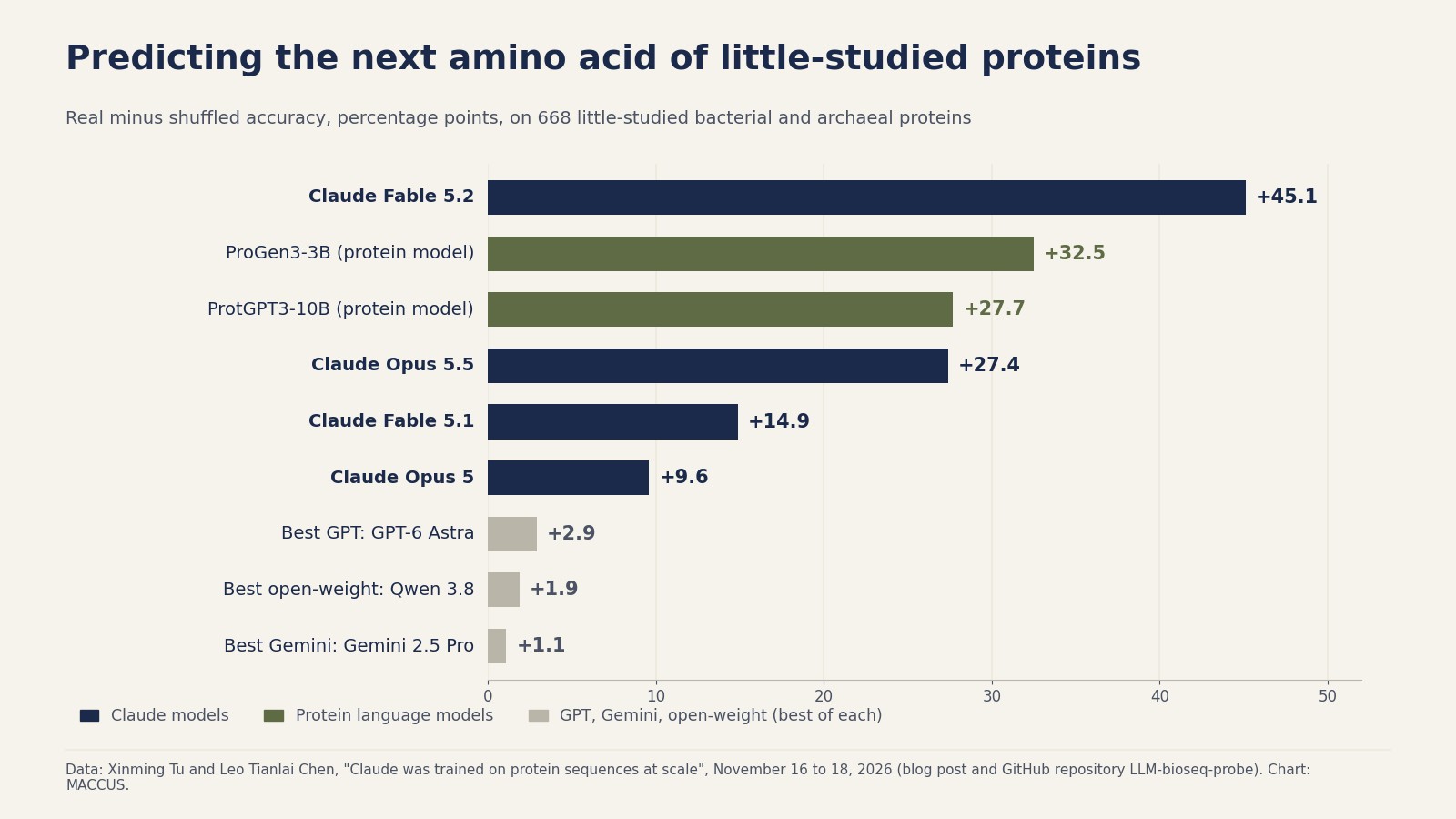

Two researchers gave 22 AI language models the start of 668 proteins from bacteria and archaea, both single-celled microbes, that almost nobody has studied. Each model had to predict the next amino acid, the next letter in the protein’s chain. Anthropic’s Claude Fable 5.2 got it right 54% of the time, against 9% on shuffled copies of the same proteins. Every OpenAI GPT, Google Gemini and downloadable open-weight model in the test stayed within 3 percentage points of its shuffled score.
Xinming Tu published the test on his blog on November 16, 2026, with Leo Tianlai Chen. Tu is a final-year PhD student at the University of Washington’s Allen School. He is also a founding member of technical staff at Phylo, a lab that builds AI agents for biomedical research.
Their conclusion is the title of the post: “Claude was trained on protein sequences at scale”. Anthropic’s launch page for Fable 5.2 does not mention protein sequences, and the post cites no statement from the company.
Fable 5.2 also beat specialist AI built only for proteins: every open protein language model the authors ran. It still led in a November 18 update on newer proteins, made public after the training cutoff the authors assume.
A test built on proteins almost nobody writes about
Proteins are chains of amino acids, written as strings of letters, one for each of the 20 standard amino acids. Specialist protein language models learn the patterns in those strings from sequence databases, the way chatbots learn patterns from text.
The authors wanted to know whether a chatbot’s protein knowledge comes from those databases or from what people write about them. Famous proteins cannot settle it. GFP, the green fluorescent protein, appears in countless papers, and most leading AI models can recite its sequence.
The test instead uses 668 proteins from 167 families in Pfam, a database that sorts proteins into families. All 167 families are labeled “of unknown function,” and none has a solved 3D structure or more than three papers. No protein in the set has a close relative in UniProt, the main public protein database.
Each protein is cut at five random points. At each cut, the model writes the next 10 amino acids, and the first one is scored.
The baseline is the same protein with its letters shuffled. Shuffling keeps the mix of amino acids but destroys their order. So the gap between the two scores, in percentage points, measures what a model knows about real sequences beyond which letters are common. The code, the test sets and every model reply sit in a public GitHub repository under the open-source MIT license.
How the chatbots and the protein models scored
Claude Fable 5.2 scored 54.1% on real proteins and 9.0% on shuffled ones, a gap of 45.1 points. Claude Opus 5.5, another recent Anthropic model, scored 34.9% and 7.5%, a gap of 27.4 points.
The five GPT models in the test, up to GPT-6.2, all had gaps under 3 points, the best being GPT-6 Astra at 2.9. Gemini’s gaps were 1.1 points or less.
The seven open-weight models, among them DeepSeek V4.1 Flash, Qwen 3.8 and Kimi K3.1 Pro, stayed under 2 points, even when given the raw text format of sequence databases.
The protein language models are the yardstick. Profluent, a biotech company, says its ProGen3 models were trained on “over 3.4 billion protein sequences”. ProGen3-3B, the largest public version, scored 43.7% on real proteins against 11.1% shuffled, a gap of 32.5 points. ProtGPT3-10B, the largest open protein model in the comparison, had a gap of 27.7.
Fable 5.2 beat both by more than 12 points, and Opus 5.5 was level with ProtGPT3-10B. “Fable 5.2 beats every open protein language model we ran,” the authors write.
From noise to 45 points in a year
The gap grew across Claude releases, with two small dips. Claude Opus 4.5, released on November 24, 2025, had a gap of 1.9 points and Opus 4.6 had 0.9, both close to random noise. The gap reached 8.9 with Opus 4.7, 7.7 with Opus 4.8 and 9.6 with Opus 5. Then came 14.9 for Fable 5.1, 27.4 for Opus 5.5 and 45.1 for Fable 5.2, launched on November 9, 2026.
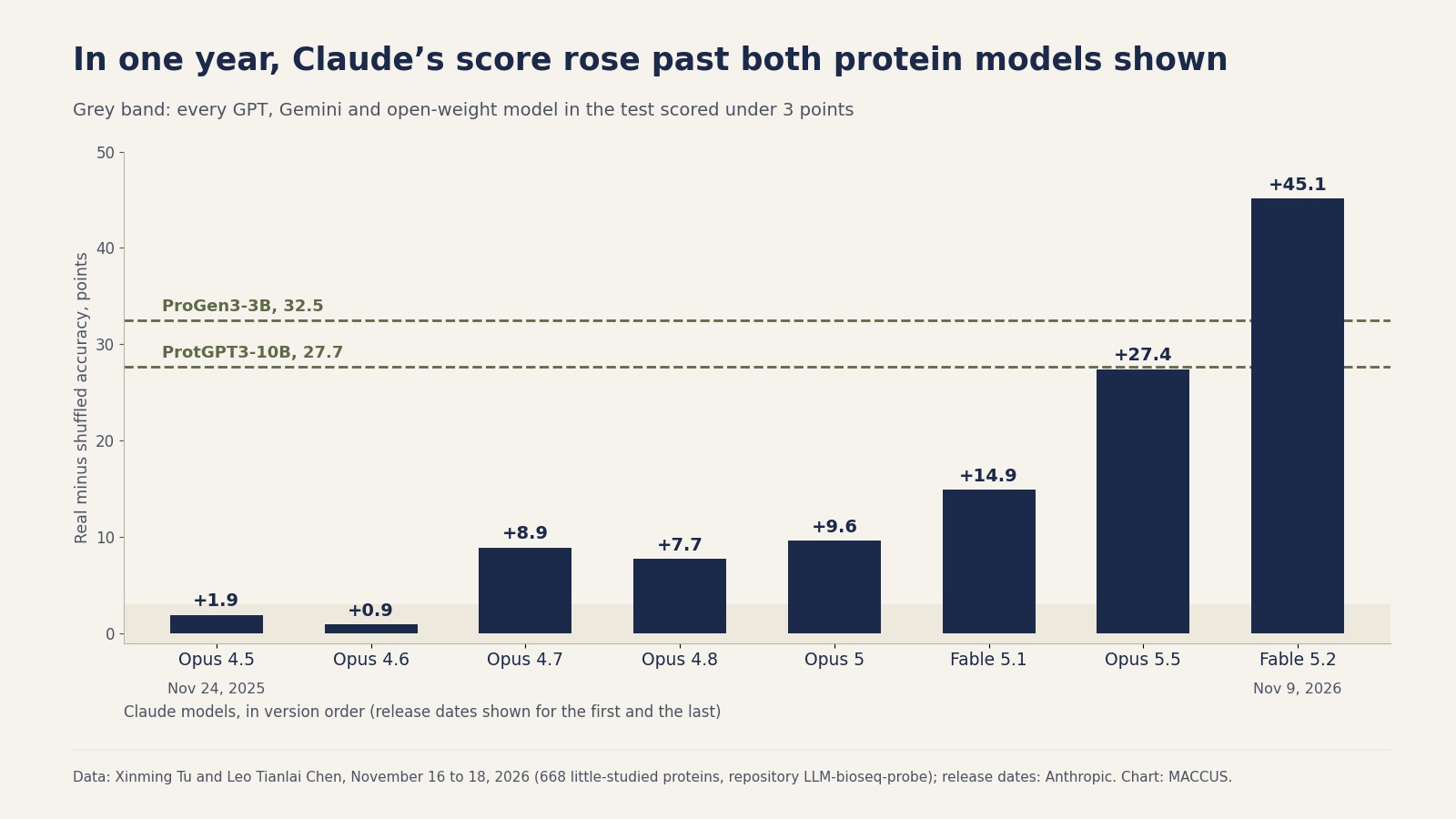
“It appears in Opus 4.7, jumps in Opus 5.5, and jumps again in Fable 5.2,” the authors write. Fable 5.2 also got all 10 requested amino acids right at 88 cut points in real proteins. If each letter were guessed independently, about 16 would be expected. It never did so on a shuffled protein.
Why the authors point to training data
The first clue is family size. Proteins from Pfam families with more known members are easier for the newest Claude models. The same holds for protein language models, which learn from sequences alone. Opus 5.5’s score rises with family size in step with ProGen3-3B and ProtGPT3-10B.
Papers do not explain the result. In the 128 families with no papers, the gap was 45.9 points for Fable 5.2 and 26.8 for Opus 5.5. That is about what both scored across all 167 families.
Reasoning does not explain it either. The models’ developer interfaces reported thinking tokens, the hidden reasoning written before an answer, on only 9% of Fable 5.2’s answers and 36% of Opus 5.5’s. Answers given without thinking were just as accurate.
The knowledge is also specific to proteins. On DNA, Opus 5.5 predicts human and mouse coding sequences, the stretches of genes that spell out proteins, but not the rest of the genome. “It learned proteins, not genomes,” the authors write.
The November 18 update tests whether Claude only memorized sequences it saw in training. Chen built a set of 56 proteins first made public in August 2026, after July 1, the training cutoff the authors assume. None has an earlier relative that shares 50% or more of its sequence.
On the 31 families these proteins come from, Fable 5.2’s gap fell from 40.2 points in the main set to 22.1 on the new proteins. Opus 5.5 fell from 27.1 to 13.4. ProGen3-3B reached 12.0, and GPT-6.2 Sol stayed at zero.
The authors write that every model kept about half its main-set score on the same families, as expected for proteins this distant from known relatives. Their reading: what Claude learned carries over to new members of a family.
What the test does not show
The work is a blog post that has not been peer reviewed, and the training-data conclusion is the authors’ inference. For GPT and Gemini, the test shows no sign of this knowledge on this task, which is narrower than saying they never saw a protein sequence.
The set of newer proteins is small. With 56 proteins, the authors write, the test reliably detects only gaps of about 14 points or more. Fable 5.2’s lead over ProGen3-3B on that set, 22.1 points against 12.0, sits within overlapping error margins, so it may come down to chance.
The comparison also stops at the open models the authors could run. Profluent describes a larger, 46-billion-parameter ProGen3 that was not tested. Structure tools such as AlphaFold, which predict a protein’s folded 3D shape, do a different job.
The post drew more than 170 points on the tech forum Hacker News, and Tu’s announcement on X has passed 1,000 likes. One Hacker News commenter questioned the task itself, asking when anyone would need to guess an unknown protein from a fragment.
The authors close on an open question: “Could Claude fold a protein, or rank its variants, the same way?” On November 18, Sergey Ovchinnikov, an assistant professor of biology at MIT, posted that a short prompt got Fable 5.2 to “predict fold of ubiquitin correctly.” Ubiquitin is one of the most studied proteins there is. Tu and Chen’s own post shows that models recite famous proteins, so one fold of one protein is a first try.
What it means
A general-purpose chatbot now holds what looks like the knowledge of a dedicated protein model. On little-studied proteins, Fable 5.2 beats ProGen3-3B, a model trained only on protein sequences. It still leads on proteins published after its assumed training cutoff, though within overlapping error margins.
The change came over a single year of Claude releases, while rival models stayed near zero. That pattern points to a training-data choice by one lab more than to an ability every large model develops on its own. Only Anthropic could confirm it.
The finding fits what Anthropic shows elsewhere. Claude Mythos 5.2 runs on the same underlying model as Fable 5.2. Anthropic’s launch page says Mythos 5.2 accurately modeled 28 of the 34 virus capsids it attempted, building on two open protein folding models. A capsid is a virus’s protein shell.
Claude has also turned up in an enzyme discovery checked in the lab, in a one-person biotech’s drug programs and in mapping the 3D structure of a hollow protein shell called a vault.
A next test is already in the authors’ repository: whether the models can predict contact maps, the list of amino acids that touch once a protein folds. The post reports no result yet. Replications by other groups, a peer-reviewed version and any statement from Anthropic on its training data would show how far the finding goes.
Sources
- Claude was trained on protein sequences at scale, Xinming Tu and Leo Tianlai Chen, November 16, 2026 (updated November 18)
- LLM-bioseq-probe, GitHub (Xinming Tu), November 18, 2026
- Introducing ProGen3, Profluent, April 16, 2025
- Introducing Claude Fable 5.2 and Claude Mythos 5.2, Anthropic, November 9, 2026
- Introducing Claude Opus 4.5, Anthropic, November 24, 2025
- Claude was trained on protein sequences, at scale, Xinming Tu on X, November 17, 2026
- Given Claude Fable 5.2 can predict protein sequence, I was curious if it can predict structure, Sergey Ovchinnikov on X, November 18, 2026
- Claude was trained on protein sequences at scale (discussion), Hacker News, November 18, 2026
Header image: chart by MACCUS, data from Xinming Tu and Leo Tianlai Chen (November 16 to 18, 2026)