When Google shows an AI Overview, the AI-written answer that usually sits above the links, clicks to outside websites drop by 39.8%. Two researchers measured this in an experiment with US users in early 2026. They hid the AI answers from a randomly chosen group and compared its clicks with those of users who saw Google as usual.
In August 2025, Google said the total number of clicks it sends to websites was relatively stable year over year.
The researchers are Saharsh Agarwal of the Indian School of Business and Ananya Sen of Carnegie Mellon University. Their paper was presented at an online seminar run by CEPR, a European network of economists. On November 20, 2026, the US outlet Tech Policy Press published an op-ed about the study by Courtney Radsch, who had discussed it at that seminar. Radsch is with the Open Markets Institute, a US anti-monopoly think tank.
In France, Google launched AI Overviews on July 22, 2026, together with AI Mode, a chat-style version of its search engine.
How the researchers hid AI Overviews
The authors recruited 1,065 US internet users through Prolific, a platform that supplies participants for research studies. Each had to search mainly with Google and browse only with Chrome, Google’s web browser, on a desktop computer. They installed a Chrome extension built for the study, a small add-on that recorded their browsing. Each was followed for two weeks; data collection ran from January 7 to February 10, 2026.
Participants were split at random into three groups. The first, the control group, saw Google as usual. In the second, the extension removed AI Overviews in real time and moved the next results up, leaving no gap on the page. In the third, every search was redirected to AI Mode.
Few participants noticed anything different. In the control group and the group without AI Overviews, more than 95% said they saw no difference or weren’t sure.
On January 6, 2026, the day before data collection began, the researchers filed their study plan in the American Economic Association’s registry of controlled trials. Filing in advance locks in the outcomes to be measured. That makes it harder to pick the most favorable numbers afterward. The study was funded by grants from the Indian School of Business.
An AI Overview cuts clicks from 0.62 to 0.37 per search
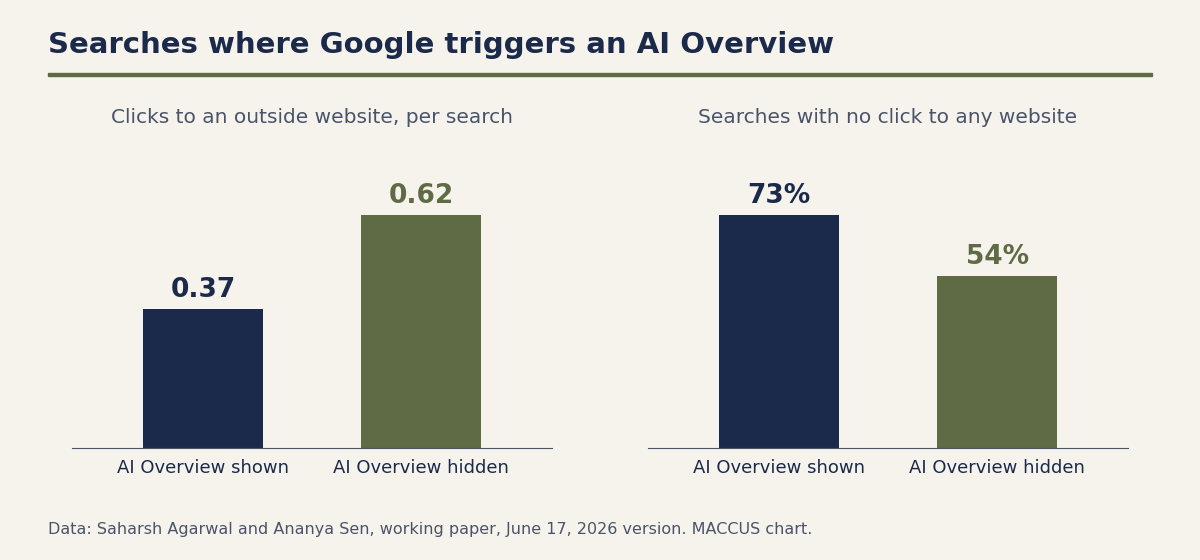
Google was set to show an AI Overview on about 41% of the searches recorded, whether or not the extension then hid it. On those searches, the group without AI Overviews made 0.62 clicks per search to outside websites, on average. The control group, which saw them, made only 0.37. The authors conclude that AI Overviews cut those clicks by 39.8%.
Searches that end without a click to any website, known as zero-click searches, also become more common. On those same searches, their share rises from 54% without the AI Overview to 73% with it. That is a jump of 19 percentage points, or a 34.5% relative increase by the authors’ calculation. Averaged over all searches, including those where Google shows no AI Overview, clicks to websites fall by about 18.5%.
Three other measures showed no measurable change: clicks on paid ads (rare in the sample), clicks to other Google pages and the number of searches. On searches where Google had no AI Overview to show, the first two groups behaved the same way. In the authors’ view, the AI Overview replaces visits to websites, and no other part of Google’s results page picks up the slack.
The drop in clicks is concentrated where the AI Overview sits at the very top of the page, above the first result. That is its position in more than 87% of the searches where it appears. There, clicks to websites fall from 0.60 per search without the AI Overview to 0.32 with it. When it appears lower on the page, the gap nearly disappears: 0.75 clicks per search with the AI Overview and 0.77 without.
The highest-ranked links are hit hardest. Results in the first, second and third positions win back the most clicks when the AI Overview is hidden. The authors note that comparing results by the AI Overview’s position does not prove cause and effect, because that position was not assigned at random.
The lost clicks were as good as the rest
Google tells a different story. On August 6, 2025, Liz Reid, the vice president who heads Google Search, wrote that total organic clicks to websites had been “relatively stable” year over year. Organic clicks are clicks on the regular, unpaid results.
Reid added that Google was sending “slightly more quality clicks” than a year earlier, meaning visits where users don’t quickly click back to the results page. Outside reports of steep traffic declines, she wrote, were often based on flawed methods, isolated examples or drops that began before Google added AI features to Search.
The experiment measured that quality directly, visit by visit. The authors compared three signals: returns to the results page with the Back button, bounces and time spent on the site. A bounce, in their definition, is a visit of under 10 seconds with no other action on the site.
None of these signals differed between the control group and the group without AI Overviews. The authors conclude that the clicks websites regain when AI Overviews are hidden are comparable in quality to the ones Google already sends. They call this result suggestive, because it covers only searches that ended in a click.
No measurable gain for users
At the end of the study, 90% of the participants who were asked to fill out a survey did so. They rated three things on a scale of 1 to 5: their satisfaction with Google, the quality of the information they found and how easy it was to find. The group without AI Overviews gave the same ratings as the control group, about 4 out of 5.
The group sent to AI Mode rated Google about one point lower than the control group on all three questions. Many of its members dropped out of the study or found ways around AI Mode. Those who stayed clicked through to websites even less than the control group. The authors present this part of the study as exploratory, because the dropouts skew the comparison.
Limits of the experiment
The study covers only US users on desktop computers using Chrome, each followed for two weeks. It says nothing about searches on mobile devices or in other countries. The data was collected in January and February 2026, more than five months before AI Overviews reached France.
The study is a working paper, a draft that has not yet been published in a peer-reviewed journal. According to Saharsh Agarwal’s research page, the journal Marketing Science has asked the authors for a revised version. An earlier draft was already circulating in April 2026, when the industry news site Search Engine Journal reported a 38% drop in clicks. This article is based on the version dated June 17, 2026.
The roughly 40% figure applies to the people in this study. It does not predict what any single website will lose. That depends on which searches bring visitors to the site and on where the AI Overview appears on those searches.
What it means
The authors point to a gap: there was little evidence that AI Overviews themselves cause a drop in clicks. The evidence that did exist came mostly from surveys, industry reports and Google’s own statements. Their experiment compares two groups of users assigned at random, one with AI Overviews and one without, on the same kinds of searches. On searches with an AI Overview, websites lose two in five of the visits they would otherwise get.
Going by these results, the most exposed websites appear to be those ranked in the top three on searches where the AI Overview sits above the first result. Google, by contrast, has published no detailed figures to back its claims of stable, higher-quality clicks.
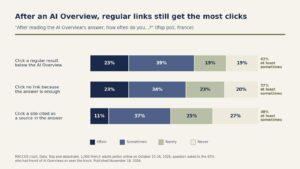
In France, the polling firm Ifop’s November 18 poll on AI Overviews recorded what users say they do. The US experiment observed what they actually do. Our guide to AI Mode and AI Overviews explains where the two features sit in Google’s results.
The study comes as Google faces several legal and regulatory cases. Since December 2025, the European Commission, the EU’s executive arm, has been investigating how Google uses publishers’ content in its AI answers. Five French publisher groups filed a complaint with the Commission on October 29.
In her op-ed, Radsch argues that the study supplies the evidence Judge Amit Mehta lacked in the US antitrust case against Google. In September 2025, citing a lack of evidence, he declined to order Google to let publishers keep their content out of its AI products.
In the UK, the Competition and Markets Authority, the competition regulator, requires Google to give publishers detailed audience statistics, including how many clicks its AI Overviews send to their sites. The requirement takes effect on December 3, 2026 (details in our article on measuring Google traffic). Those statistics could let each publisher compare the study with its own traffic. Radsch notes, however, that as far as she knows, the data will not be available to independent researchers.
Several questions are still open: whether the journal version of the paper will confirm the numbers, whether a similar experiment will be run on mobile devices or in Europe, and whether Google will publish its own measurements.
Sources
- The Impact of Google AI Overviews on Publisher Traffic and User Experience: Evidence from a Field Experiment, Saharsh Agarwal and Ananya Sen, working paper, June 17, 2026
- AI Summaries and Online Search Behavior: Evidence from a Field Experiment on Google Search (AEARCTR-0017393), AEA RCT Registry, January 6, 2026
- No Cure Without Evidence? AI Overviews Cut Clicks 40% and Give Users Nothing, Tech Policy Press, November 20, 2026
- AI in Search is driving more queries and higher quality clicks, Google, The Keyword, August 6, 2025
- Lancement des Aperçus IA et du Mode IA dans la Recherche Google en France, Google France, July 22, 2026
- Study Confirms Google AI Overviews Cut Organic Clicks 38%, Search Engine Journal, April 27, 2026
Header image: MACCUS chart based on data from Saharsh Agarwal and Ananya Sen, working paper, June 17, 2026 version