The French polling firm Ifop published a survey on Google’s AI Overviews on November 18, 2026. AI Overviews are answers written by artificial intelligence (AI) that appear at the top of Google’s search results, above the regular links. More than half of French adults (55%) say they have seen one, but only 18% know exactly what AI Overviews are.
The survey also asked about clicks, which are how websites get visitors from Google. Those questions went only to the 65% of respondents who have heard of AI Overviews or have seen one. In that group, 62% say they click a regular link below the AI answer at least sometimes. For the websites the AI cites as its sources, the figure drops to 48%, and only 11% say they click those often.
An online poll taken in mid-October
Ifop Opinion polled 1,000 people online on October 15 and 16, 2026, a sample representative of French adults aged 18 and older. Ifop used quotas by sex, age and occupation so the sample matches the population. It also balanced the sample by region and by size of town or city. Ifop lists account director François Legrand and research officer Margot Renard as the study’s contacts.
Ifop ran the study with datashake, a digital marketing agency based in Paris and New York. The agency’s logo appears on Ifop’s study page, and its name is on the slide presentation of the results. Its services include search engine optimization (SEO), which helps sites rank higher in search results, and GEO, short for generative engine optimization. GEO means optimizing content for search engines that answer with AI.
Google launched AI Overviews in France on July 22, 2026, under the French name Aperçus IA. It launched AI Mode, a chat-style version of Google Search, in France the same day. Google had begun its global rollout of AI Overviews in May 2024. Our guide to AI Mode and AI Overviews explains both features and how they affect a site’s traffic.
Seen more often than understood
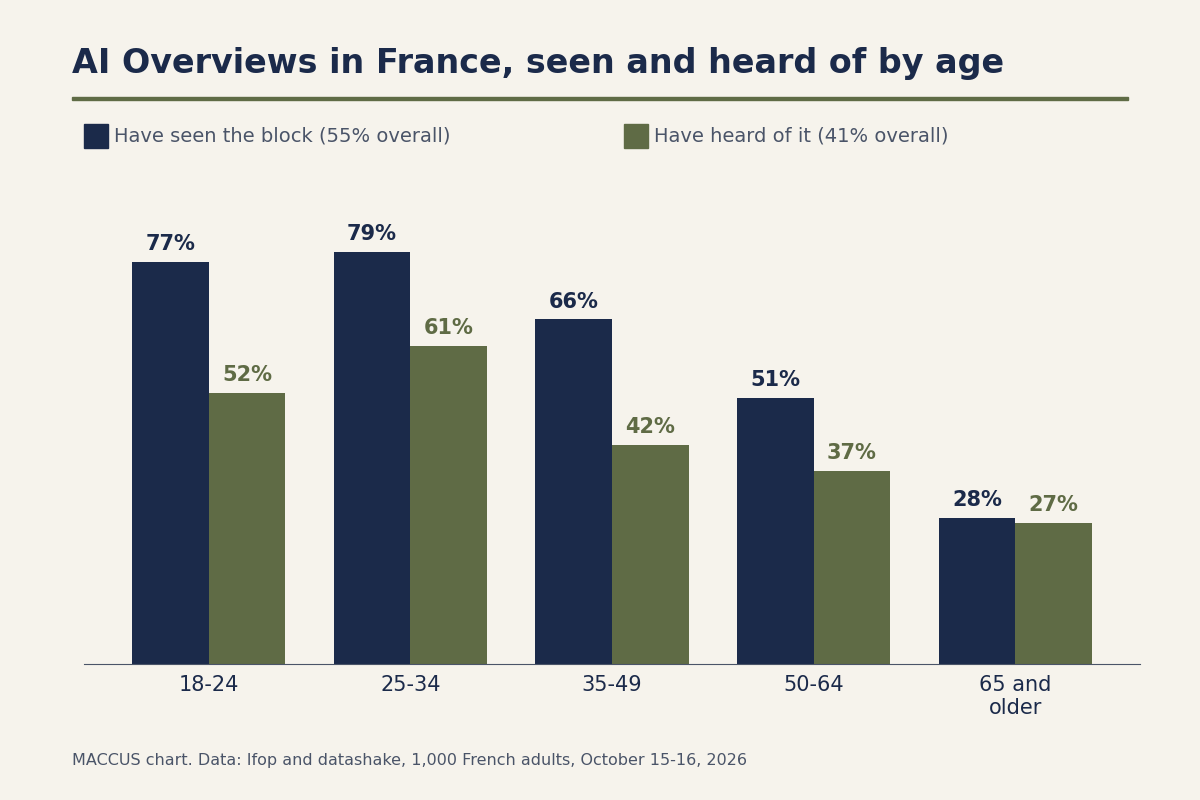
Ifop showed respondents an example of an AI Overview to find out who had already seen one. Of all 1,000 people polled, 55% say they have seen one during a Google search. Fewer know the name: 41% have heard of AI Overviews, and 18% know exactly what they are.
Some people see these answers without knowing what Google calls them. Among respondents who had never heard of AI Overviews, 41% had still seen one.
Young adults and college graduates are far more likely to have seen one. Some 77% of 18-to-24-year-olds and 79% of 25-to-34-year-olds have seen an AI Overview, compared with 28% of people 65 and older. The figure is 83% for college graduates and 30% for people with no diploma. Younger people also know the name better: 61% of 25-to-34-year-olds have heard of AI Overviews, compared with 27% of people 65 and older.
Reported clicks go mostly to regular links
Only respondents who have heard of AI Overviews or have seen one answered the questions about clicks: about 650 people, or 65% of the sample. After reading the AI answer, 62% of that group say they click a regular link below it at least sometimes, and 23% do so often.
The websites cited as sources in the answer get fewer clicks. In the same group, 48% say they click one of them at least sometimes, 11% say often and 27% say never. Many also stop at the answer: 57% say they at least sometimes settle for it and click nothing, including 23% who do so often.
People under 35 and people who use generative AI tools that write text, such as ChatGPT, click regular links more often than average. They also settle for the AI answer more often. Among people under 35, 72% click a regular link at least sometimes and 67% settle for the answer, compared with 62% and 57% for everyone asked. Among generative AI users, the figures are 76% and 70%, compared with 33% and 30% for people who don’t use these tools.
Ifop concludes that AI Overviews don’t replace regular links. For some people, the firm writes, the AI Overview is becoming “a first step that can be enough.” Ifop adds that few people click the cited sources often.
Regular links earn more trust than AI answers
Regular links also come out ahead on trust. Among the same 65% of the sample, 77% trust the regular results, compared with 66% for the AI answer. Strong trust in AI Overviews is rare: only 8% trust them a lot, and a third (34%) don’t trust them.
Older people trust AI Overviews much less. Trust ranges from 75% to 78% among people under 50, then drops to 56% among 50-to-64-year-olds and 46% among people 65 and older. It also depends on AI use: 81% of generative AI users trust AI Overviews, compared with 36% of non-users.
Across the group, regular links lead AI Overviews on trust by 11 percentage points. The gap grows to 23 points among people who don’t use generative AI and shrinks to 5 points among those who do. Ifop also says college graduates seem more critical: 65% of them trust AI Overviews, and 83% trust the regular results.
When the AI answer falls short
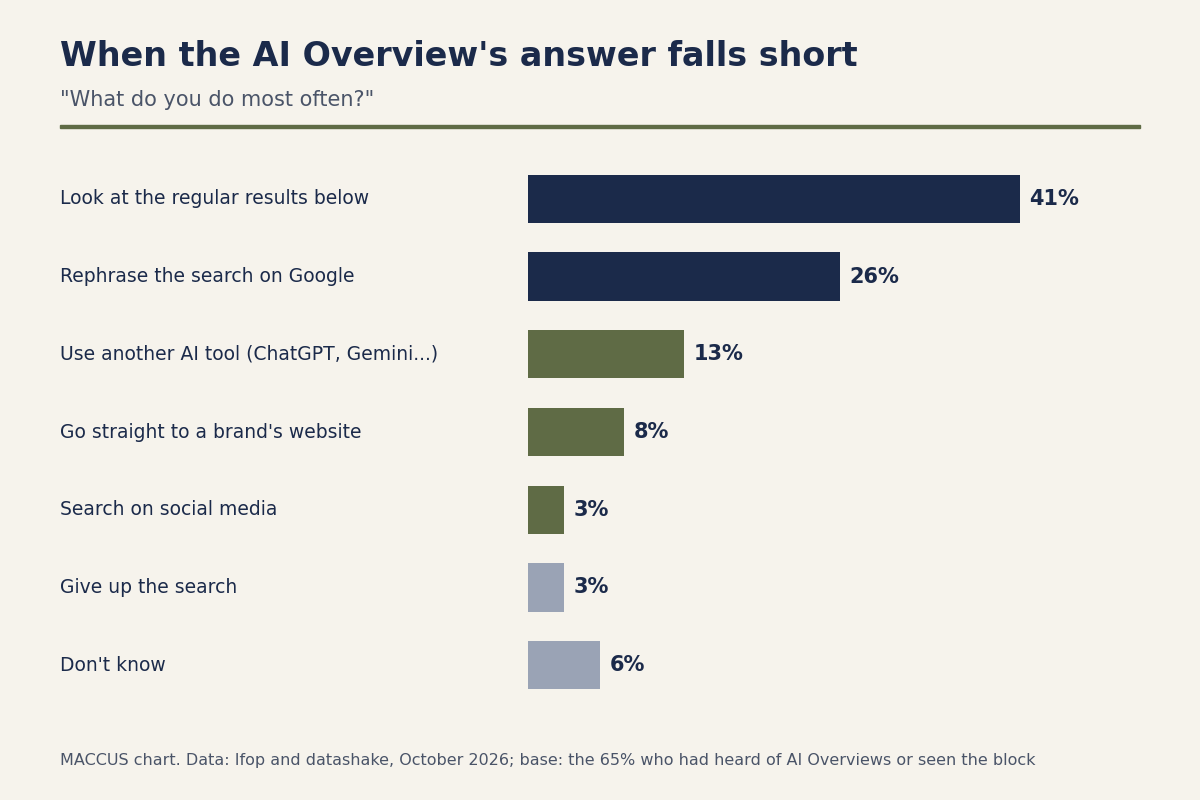
Ifop asked the same group, 65% of the sample, what they do most often when an AI Overview doesn’t satisfy them. Two in three (67%) stay on Google: 41% look at the regular results below the answer, and 26% rephrase their search.
A quarter (24%) go elsewhere: 13% to another AI tool such as ChatGPT or Google’s Gemini, 8% straight to a brand’s website and 3% to social media. The rest give up (3%) or don’t know (6%).
People under 35 (18%) and generative AI users (17%) are more likely to switch to another AI tool, compared with 13% overall. People 65 and older more often go straight to a brand’s website: 17%, compared with 8% overall.
Self-reported answers versus measured clicks
The poll records what people say they do. An answer such as “often” or “sometimes” doesn’t show what share of their searches end with a click. Ifop also publishes no breakdown by type of search, such as health, shopping or news, or by device. Other studies measure actual clicks.
The Pew Research Center, an American research organization, studied the March 2025 browsing histories of 900 U.S. adults and published the results in July 2025. Pew calls AI Overviews “AI summaries.” When a Google results page showed one, users clicked a regular link on 8% of visits, compared with 15% without one. They clicked a link inside the summary on 1% of visits with a summary.
Ahrefs, a company that sells SEO software, published a study on France in August 2026. It covers 963 of the 1,000 websites that got the most clicks from Google in France from April to July. It compares the 28 days before the July 22 launch with the 9 days after it.
Ahrefs measured click-through rate, the share of a site’s appearances in Google results that lead to a click. For the most exposed sites, those where more than 20% of searches trigger an AI Overview, click-through rate fell by a median of 23.1%. Ahrefs notes that this figure applies to a minority of sites. Across all the sites studied, the median drop was 5.7% for click-through rate and 8.8% for clicks.
What it means
The Ifop poll gives figures on how the general public in France uses AI Overviews. The other figures here come from a U.S. panel (Pew) and an SEO software company (Ahrefs). That behavior matters to every site that relies on Google traffic in France, such as publishers, online stores and freelancers.
Five French publishers’ groups are also challenging AI Overviews and AI Mode. They filed a complaint on October 29 with the European Commission, the European Union’s executive arm.
What people told Ifop about their clicks doesn’t necessarily contradict the drops that Pew and Ahrefs measured. A person can click a regular link “sometimes” and still click less often than before AI Overviews arrived. The poll mostly measures who has seen these answers and who trusts them. It doesn’t put a number on the visits websites lose.
The poll’s clearest finding is about the websites cited as sources. Only 11% of people who have heard of AI Overviews or seen one say they often click a cited source, compared with 23% for a regular link. Getting a site cited in these answers is exactly what GEO aims to do. The study’s partner, datashake, sells GEO services itself.
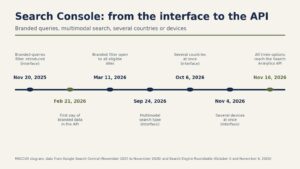
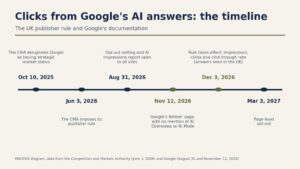
Websites also have no way to separate clicks from these answers in their own data. Google’s documentation says Search Console, the free reporting tool Google offers site owners, counts these clicks together with clicks from other web results. Search Console’s generative AI report, rolled out to all sites on August 31, 2026, shows only impressions: the number of times a site appeared in these answers. Google’s November 12 page on how to spot Google traffic in analytics tools doesn’t isolate them either.
Two trends are worth watching. The first is the generation gap: people under 35 see AI Overviews more, settle for them more often and are more likely to move to another AI tool. The second is the share of searches in France that show an AI Overview, which the poll doesn’t measure.
Sources
- Connaissance et usage des AI Overviews en France, Ifop, November 18, 2026
- Connaissance et usage des AI Overviews en France, présentation graphique (n° 122 845), Ifop and datashake, November 18, 2026
- Lancement des Aperçus IA et du Mode IA dans la Recherche Google en France, Google France, July 22, 2026
- Google users are less likely to click on links when an AI summary appears in the results, Pew Research Center, July 22, 2025
- 1 mois d’AI Overviews en France et déjà -23,1% de taux de clics : qui est concerné ?, Ahrefs, August 17, 2026
- AI features and your website, Google Search Central, updated December 10, 2025
- Generative AI performance report (Search), Search Console Help, accessed November 19, 2026
- Identify Google Search Traffic in Analytics and Logs, Google Search Central, updated November 12, 2026
Header image: MACCUS chart, data from Ifop and datashake, October 2026