In 2,313 court decisions since 2023, a judge found or signaled that someone had filed legal material invented by AI. Examples include court rulings that do not exist and quotes that real rulings never contained. The count comes from a public database kept by Damien Charlotin, a researcher at the HEC Paris business school. Most are recent: 1,370 date from 2026. By his count, 894 come from the first half of the year alone, almost five times the 183 from the first half of 2025.
On November 18, 2026, the European Court of Human Rights announced a case of its own. Its President had decided on November 13 to bar an unnamed Romanian lawyer from representing anyone before the Court for two years. Her written arguments, known as observations, cited “hallucinated” cases that do not exist and paragraphs that real judgments do not contain. The Court was set up in Strasbourg in 1959 by the member states of the Council of Europe, and it is separate from the European Union’s courts.
Why the Strasbourg court excluded the lawyer
The Court’s press release says the Chamber handling the case, a panel of the Court’s judges, found numerous errors of three kinds in her observations. She cited cases that do not exist. She cited “fictitious paragraphs in genuine judgments and decisions of the Court.” She also cited real case law that was irrelevant or “plainly contradicted” the points it was meant to support.
The lawyer acknowledged that she had used AI tools to draft the observations. She called the mistakes “inaccuracies” and “citation errors,” and admitted she had not checked all the case law thoroughly enough. The Chamber instead found “a pattern of numerous, repeated, substantive errors rather than isolated citation mistakes.”
The Chamber called her admission an understatement, because she had not checked some references at all. The Court keeps its case law in a public online database called HUDOC. The Chamber said many errors “would have been easily detectable by a cursory check of HUDOC.”
The President acted under Rule 44D of the Rules of Court, the Court’s rules of procedure. Added in 2004, Rule 44D allows a representative to be excluded “in exceptional circumstances,” and the Chamber said this case met that bar.
Checking the errors had cost the Court “considerable time.” It also had to open exclusion proceedings and ask the Romanian government and the Romanian National Bar Association for comments. The Chamber called that work “incompatible with the Court’s real functions.”
She was one of two representatives for the applicants, the people who brought the case, and the other was not excluded. She can ask the Court to restore her right to represent applicants. The release names no AI tool and does not say whether this is the Court’s first exclusion of this kind.
Some legal AI products now offer this kind of check. On October 28, the AI company Anthropic added ready-made legal tools to Claude, including a citation checker. It compares a document with its sources and flags quotes that do not match. Anthropic has not said what the tool flags when a cited decision does not exist at all.
From a few cases a month to about five a day
Charlotin keeps the AI Hallucination Cases database on his personal website. It lists decisions in which a court or tribunal “explicitly found (or implied)” that a party relied on content made up by AI. The full table is free to reuse under CC BY 4.0, a Creative Commons license that allows reuse with credit. He also markets PelAIkan, an automated reference checker he built on the database.
The copy MACCUS downloaded on November 21, 2026, lists 2,313 decisions dated from April 14, 2023, to November 17, 2026. In 1,780 of them, the court found at least one case that does not exist. Most of the others involve false quotes, distorted rulings or other invented material. In 122 entries, the type of error is not recorded.
The yearly totals rise steeply: 16 decisions from 2023, 61 from 2024, 866 from 2025 and 1,370 so far in 2026. In a FAQ he edited in February 2026, Charlotin wrote that before 2025 “we maybe had two or three cases a month.” He also wrote that the “daily average is now five per day.” In the table, the first quarter of 2026 fits that figure, with 460 decisions in 90 days.
Most decisions involve people without a lawyer
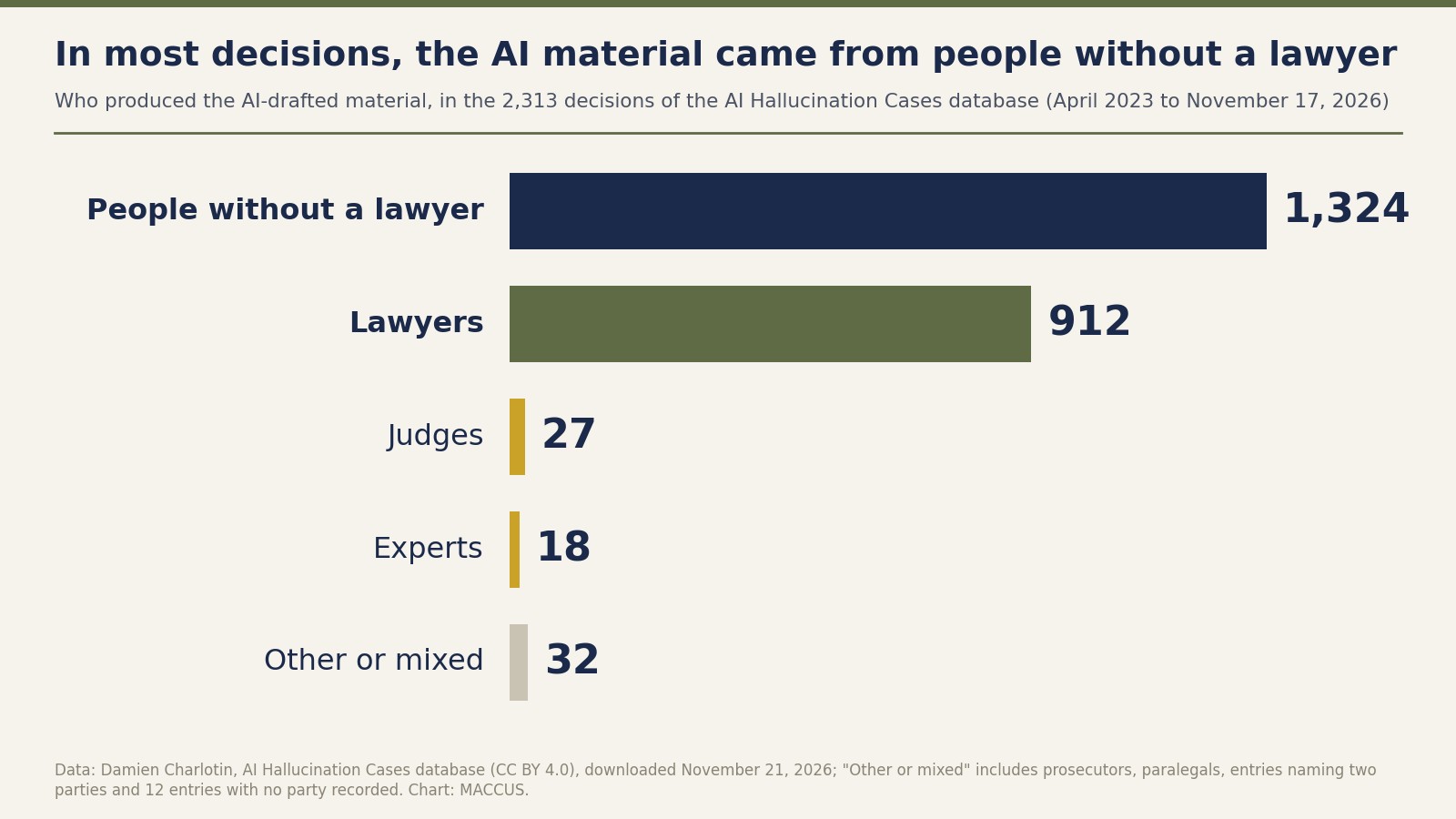
People who went to court without a lawyer, known as self-represented litigants, are the largest group in the table. The AI-drafted material came from one of them in 1,324 of the 2,313 decisions. Lawyers account for 912 decisions, judges for 27 and expert witnesses for 18.
One of the two most recent decisions in the table shows what such a case looks like. On November 17, 2026, a California appeals court could not find six cases that a self-represented litigant had cited. The volume and page numbers in those citations led to other rulings. The court treated the related arguments as forfeited, according to the database.
The table leans heavily American. Of the 2,313 decisions, 1,569 come from the United States, 244 from Canada, 112 from Australia and 91 from the United Kingdom. Charlotin’s FAQ gives several reasons, starting with access: US court records are easy to search.
In many European countries, he wrote, legal data “is hoarded by legal editors,” meaning legal publishers, or is hard to reach because of anonymization rules. He describes the United States as “a very litigious society with many avenues for self-represented litigants to participate.” He also suspects that US judges are quicker to call out such errors, while civil law judges “would likely prefer to ignore the matter entirely.” Civil law is the legal tradition of most of continental Europe.
Other courts face AI both in the filings they receive and in their own work. In Britain, employment tribunal judges, who hear workplace disputes, have flagged signs of AI drafting in a surge of urgent claims. In the Chinese city of Shenzhen, a system drafts judgments that judges then check.
What the count leaves out
Charlotin calls his database “necessarily an undercount.” It includes only cases where a judge found or implied that a party relied on invented material. A fake citation that nobody spotted never enters it. Twenty-six entries record AI use that was alleged but not confirmed.
Part of the growth also comes from how the table is built. Charlotin started the database in April 2025 and added earlier cases after the fact. Counts for past periods keep rising as late entries come in.
The French tech news site Next reported the database’s count of 161 cases in July 2025. At that point, the table held 43 decisions from 2024 and 40 from May 2025. By November 21, 2026, those figures had risen to 61 and 46.
The table shows 434 decisions in the second quarter of 2026 and 374 in the third, against 460 in the first. Because recent months are still filling in, those lower counts do not necessarily mean a decline. Charlotin himself wrote in February that the pace might now be slowing.
Continental Europe is thin in the data: France has 14 of the 2,313 decisions so far and Belgium 8, a gap Charlotin links to the reasons above.
The 1,324 self-represented entries record a court catching errors. They cannot show whether AI helped those litigants in other ways.
What it means
More than three years after the first decisions in the database, courts catch AI-invented legal material about five times a day, by Charlotin’s count. Europe’s human rights court has now barred a lawyer from representing applicants before it for two years because she failed to check such material. She was expected to check every AI-generated reference against authoritative sources such as HUDOC before filing, and some she never checked at all. In her case, the check would have been cheap: the Chamber said a quick search of HUDOC would have exposed many of the errors.
People without a lawyer are the largest group in the data, involved in 1,324 of the 2,313 decisions. For many of them, AI already drafts their filings, and courts are responding case by case. Strasbourg dealt with a lawyer under a 2004 rule. Courts that see thousands of self-represented litigants have not said what checks they can expect from people with no legal training.
Anthropic, which added a citation checker to Claude in October, published no detection rate for it. The next figure to watch is the database’s count for the second half of 2026, once late entries are added. It will show whether the rise has slowed or kept going.
Sources
- Romanian lawyer barred for two years from representing applicants before the Court over unverified AI-generated citations, European Court of Human Rights, November 18, 2026
- Romanian lawyer barred for two years from representing applicants before the European Court of Human Rights over unverified AI-generated citations (press release ECHR 290 (2026)), European Court of Human Rights, November 18, 2026
- Rules of Court, European Court of Human Rights, September 15, 2025
- AI Hallucination Cases database, Damien Charlotin, updated November 20, 2026
- Hallucinations Case Database – FAQ, Damien Charlotin, Artificial Authority, November 14, 2025, edited February 2026
- Il génère des plaidoiries par IA, et en recense 160 ayant « halluciné » depuis 2023, Next (Jean-Marc Manach), July 1, 2025
Header image: MACCUS chart. Data: Damien Charlotin, AI Hallucination Cases database (CC BY 4.0), downloaded November 21, 2026