
On November 20, 2026, TikTok opened a public online checker for files made with artificial intelligence (AI). Anyone can upload an image, a video or an audio file, without a TikTok account. The checker says whether the file was created or edited with the AI features of TikTok or of four sister apps, including the CapCut video editor. It is meant for files posted somewhere else, or edited to remove their AI label.
The same day, TikTok began a worldwide rollout of a second tool, called Likeness Detection. Eligible creators and public figures who sign up for it are alerted when AI-generated content on TikTok appears to use their likeness without their consent.
TikTok describes both tools in a post on its newsroom site. Agence France-Presse (AFP), the French news agency, reports that a TikTok executive discussed Likeness Detection at a company event in London on safety and innovation.
A public checker that reads two kinds of marks
The checker is a web page linked from TikTok’s Transparency Center. It carries a “Preview” label, meaning it is an early version. Users upload one file at a time.
Images can be up to 20 megabytes (MB), in JPEG, PNG or WebP format. Videos and audio files can be up to 100 MB, in common formats such as MP4, MOV, MP3 and WAV. The page’s list of frequently asked questions (FAQ) says each file is deleted as soon as the result appears. It adds that files are never used to train AI models.
The checker looks for two kinds of marks that show where a file came from. The first sits in the file’s metadata, the technical information attached to it. These marks are called Content Credentials and follow a technical standard called C2PA. They record how the file was made, and other platforms can read them.
TikTok adds Content Credentials automatically to AI content made with its tools. It says it became the first video platform to adopt the standard, in 2024.
The second mark is VeraDura, an invisible watermark that TikTok developed. It is embedded in the image, video or sound itself. TikTok says this watermark is more durable and harder to remove.
The checker gives one of two results. “Signals detected” means it found a mark. If the signal is intact, the page also names the app that was used. “No signals detected” means it found none.
The five apps covered, and why AI labels get lost
Euronews, the European news channel, reports that the four other apps covered belong to ByteDance, TikTok’s parent company. CapCut is a video editor with AI features. Hypic is a photo editing app published on Apple’s App Store by Bytedance Pte. Ltd.
Dreamina bills itself as an AI creative suite for video, images and audio. Pippit describes itself as an AI platform for creating videos, images, ads and avatars, meaning virtual characters.
The checker’s FAQ notes that AI-made content usually carries a label when it is viewed on TikTok or those apps. That is why the checker targets files posted elsewhere or stripped of their label.
TikTok’s post describes the problem. Content Credentials only work if the platform that receives the file reads them. They can also be lost when a file is downloaded, reshared or edited.
TikTok says it has labeled more than 5 billion AI-generated videos on its platform so far. AI-made characters also appear in ads on TikTok. In October, the US tech news site Futurism described TikTok accounts that use crying AI-generated women to sell apps.
Likeness Detection, an alert for copied faces
TikTok limits Likeness Detection to eligible creators and public figures, including accounts run by governments, politicians and political parties. Another option is open to everyone, whether or not they use TikTok. Through the company’s privacy reporting form, anyone can report AI-generated content posted without their consent.
According to TikTok, the tool works in three steps. First, an eligible creator signs up by having an outside partner verify their ID, and TikTok says it does not keep ID documents. Next, the creator is notified when content or accounts appear to use their likeness, and reviews them inside the tool. Finally, the creator can report that content to TikTok’s safety teams, which remove anything that breaks the platform’s rules.
AFP reports that Likeness Detection is aimed at politicians and accounts with large followings. It arrives ahead of a series of 2027 elections in Europe, including in Italy, France and Greece. Francesca Scapolo, TikTok’s government relations lead for European elections, spoke at the London event. “Protecting the integrity of the elections is one of the most critical responsibilities that we have at TikTok,” she said, as quoted by AFP.
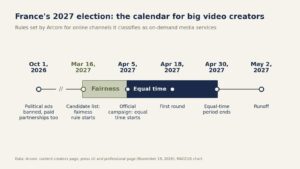
In France, large news and politics channels on video platforms will have to follow TV election rules for the 2027 presidential race.
YouTube launched a system similar to Likeness Detection in 2025. According to the tech news site TechCrunch, YouTube first opened it to about 4 million creators in its Partner Program. On March 10, 2026, YouTube extended it to a pilot group of government officials, political candidates and journalists, TechCrunch reported. On November 17, Instagram gave its creators a tool that alerts them when their videos are copied.
The limits TikTok acknowledges
TikTok itself warns that the checker only spots the marks its own apps leave. When the checker finds no signal, the file may simply not have been made with those apps, or not with AI at all. It may also be a file made with those apps whose mark is missing or weakened. The metadata may have been stripped, the watermark degraded, or the file created before these marks existed.
A positive result from the checker has limits too. If the file was later modified on another platform, the checker cannot identify those changes. The FAQ concedes that no AI detection tool is 100% foolproof. The page’s terms say results are provided for informational purposes only and may not always be accurate.
TikTok has not published the checker’s detection rate, meaning how reliably it finds its marks. It has published no independent test of its watermark either. For Likeness Detection, the post gives no minimum follower count and no country-by-country schedule. AFP describes the rollout as gradual.
Every figure in the announcement comes from TikTok itself, including the 5 billion labeled videos. The company also says its AI literacy hub, launched in July, has helped more than 4 million people learn to spot AI-generated content.
What it means
Public tools could already read C2PA metadata. For content from other platforms, the checker’s own FAQ points to one such tool, verify.contentauthenticity.org. TikTok’s checker also reads VeraDura, the watermark the company says is harder to remove. Customers, competitors and journalists can all upload files to it.
The change affects creators, brands and small businesses that make their ads or visuals with these apps. As long as the watermark holds, anyone can check where their images came from, even after they are reposted on Instagram, YouTube or a website.
European law points the same way. According to the European Commission, providers of generative AI tools must make the content those tools produce identifiable. Deepfakes, meaning realistic fake content made with AI, must be labeled clearly and visibly. The Commission says these transparency rules, part of the European Union’s AI Act, have applied since August 2026.
France already has a labeling rule for influencers. Article 5 of its June 9, 2023, law on influencer marketing covers influencer content that shows a face or body produced by AI. Such content must carry the words “Images virtuelles” (virtual images) or an equivalent notice. The checker now lets anyone verify how content made with ByteDance’s tools is marked.
The checker’s reach is narrow. It only recognizes files made with ByteDance’s apps, so a negative result proves nothing. A file made with another AI generator gets through without a flag.
With Likeness Detection, the tool itself alerts the people being imitated when it finds a copy. How much that helps will depend on eligibility criteria that TikTok’s post does not spell out.
Several questions remain open. For Likeness Detection, TikTok’s post does not say what it takes to qualify or when the tool reaches France. It is also unclear how the tool will be used during Europe’s 2027 election campaigns. For the checker, the question is whether TikTok will extend it to AI tools from companies other than ByteDance.
Sources
- More tools to provide clarity and control around AI-generated content, TikTok, November 20, 2026
- Identify AI-Generated Content, TikTok, accessed November 23, 2026
- TikTok launches tool to help public figures detect deepfakes globally, Arab News (AFP), November 20, 2026
- TikTok rolls out deepfake detection tool for public figures to fight back against disinformation, Euronews, November 20, 2026
- YouTube expands AI deepfake detection to politicians, government officials, and journalists, TechCrunch, March 10, 2026
- AI Act, European Commission, accessed November 23, 2026
- Article 5, loi n° 2023-451 du 9 juin 2023 visant à encadrer l’influence commerciale et à lutter contre les dérives des influenceurs sur les réseaux sociaux, Légifrance, version in force since November 8, 2024