On October 19, 2026, the U.S. news site Futurism described several TikTok accounts that use AI-generated women to promote GLP-1 tracking apps and “wellness” apps. The script repeats from one carousel to the next: a crying selfie, a screenshot of a long text attributed to a sister, a daughter or a father, then a notification from the app being promoted. According to Futurism, nothing in the GLP-1 posts disclosed that they were ads or that they were made with AI.
A carousel from an account called “Ashley Miller,” the only one for which Futurism gives numbers, drew more than 240,000 likes and over 1,000 comments. It showed a character in tears in front of a shimmering Eiffel Tower, holding an engagement ring up to the camera, followed by a message attributed to her future mother-in-law warning her about her son. The post promoted Zenit, a subscription mental wellness app whose independent developer told Futurism the visuals were AI-generated and said he had deleted the account.
In France, the commercial influence law of June 9, 2023, in the version in force since November 8, 2024, requires the mention “Images virtuelles” (virtual images), or an equivalent, on influencer content that shows a face or a figure produced by AI. It also requires a clear disclosure of commercial intent, such as “publicité” (advertising) or “collaboration commerciale” (commercial collaboration), when that intent is not already clear from the context, alongside other rules that govern influencer marketing in France and Belgium. The posts Futurism quotes are in English, and its report mentions no action by any authority.
The secret GLP-1 script
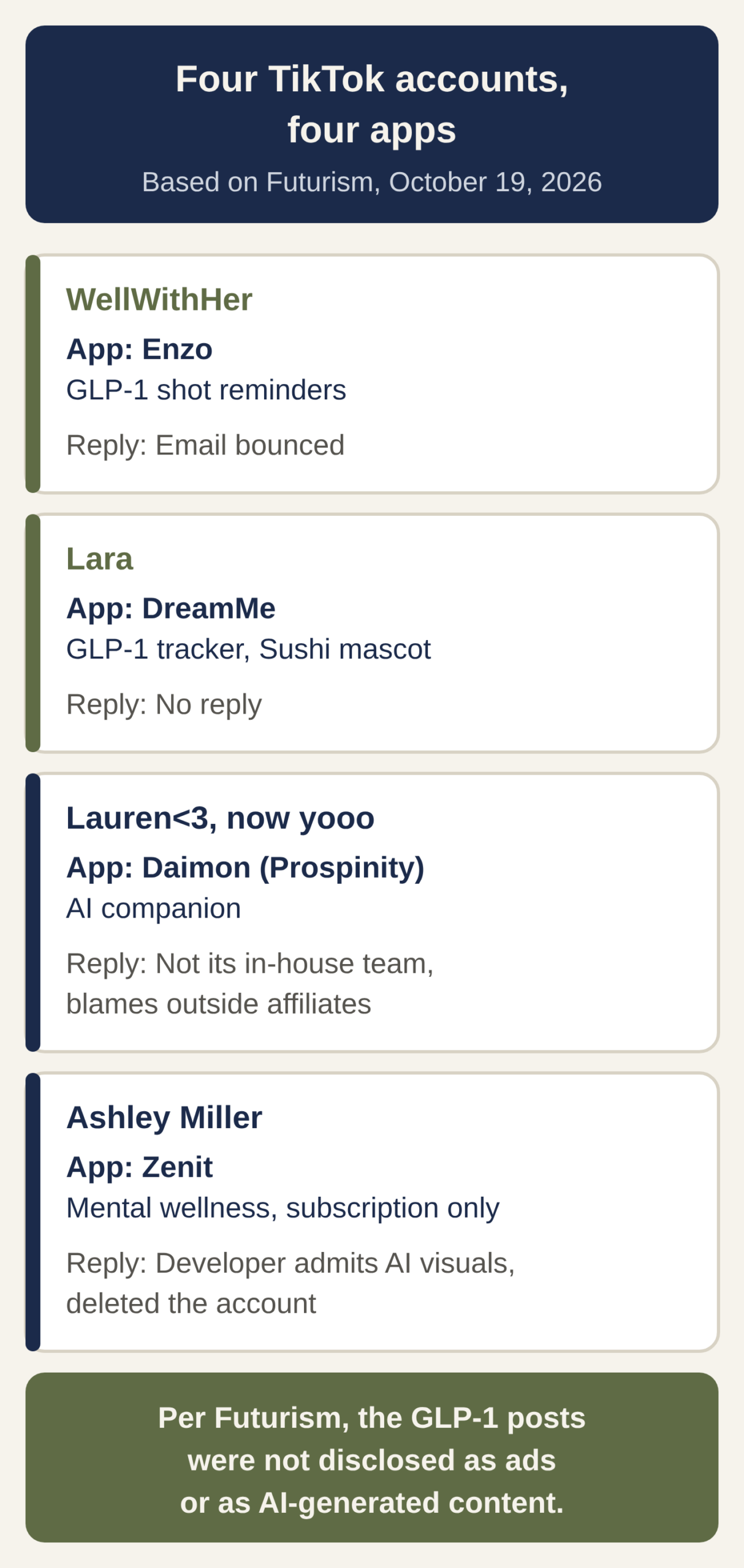
The account “WellWithHer” posted an image in which a woman Futurism calls “obviously AI-generated” sits in bed, crying. The overlay reads “I hid my GLP-1 from my sister for 6 months… she just sent me this,” then “I cried.” The next slide shows a locked iPhone screen with a long text from a contact saved as “Sis,” who says she saw the pens in her sister’s bag and writes: “I’m so proud of you.”
Below that message sits a notification from Enzo, an app with a cartoon cat mascot: “Time for your GLP-1 injection!” followed by “Log your dose to keep the streak.” Another carousel from the same account shows a character crying in a cubicle after a text from “Emma,” presented as her daughter, who says she found the medicine “in the fridge.”
A second account, “Lara,” has promoted a different tracker, DreamMe. According to Futurism, it mixes AI-generated images of young women with photos stolen from real influencers. Over one crying selfie, the text reads: “I started GLP-1s without telling my father. Today he wrote this to me…” The text from “Dad,” whose profile picture also appears to be AI-generated, sits above a DreamMe notification.
Some posts look so alike that, from one account to another, different characters have nearly the same phone wallpaper: a dog with a Croc on its head, Futurism notes.
DreamMe’s “real members”
DreamMe’s website pitches the app as “Your new GLP-1 best friend”: Sushi, a cartoon fish that helps users track shots, meals and side effects.
Further down, a section titled “DreamMe members” shows three testimonials, each with a first name, the drug taken and the pounds lost, under this text: “Real journeys. Real members. The numbers are theirs. The words are theirs. We just built the fish.” According to Futurism, the women the page presents as customers are AI-generated. The section was still online on October 20, 2026.
A breakup, a divorce and a proposal in Paris
The same playbook sells other apps too. The account “Lauren<3” featured a character, a young blonde woman Futurism calls “clearly AI-generated,” crying in a bathtub, in bed or in a car as she went through a breakup. The crying selfies alternated with texts attributed to her ex and with chats with Daimon, an AI companion app. “Someone told me about this app called Daimon and it changed everything,” one caption said.
The “Ashley Miller” account told stories of divorce, cheating and regretted engagements, each with an AI-generated selfie in tears. The Eiffel Tower carousel read “He proposed in Paris last night,” then “This morning his mom sent me this…” Under the message from “Diane” came the Zenit notification: “Your heart’s been racing” and “I’m here whenever you need me.” Every post on the account showed a Zenit notification, which gave the staging away, yet many commenters believed the story, according to Futurism.
One developer owns it, one company blames its affiliates
The account tied to Zenit was deactivated very quickly after Futurism reached out. The app’s developer, who describes himself as independent, says he ran the account personally, with no third party or marketing agency: “The visuals were AI-generated and the posts promoted my app, so they should have been labeled as such.”
He says he tried to add TikTok’s AI-generated and commercial content labels, but that the platform doesn’t allow adding them to videos that are already published, “so I’ve deleted the account.” He adds that transparency matters, “especially for a wellness app.”
Prospinity, the company behind Daimon, says the account was “absolutely not operated by our internal marketing team” and blames “external affiliate programs,” saying some affiliates were publishing on their own. The company says it identified those responsible and shut those activities down. After Futurism reached out, the account was wiped and its handle changed from “Lauren<3” to “yooo.”
DreamMe did not respond to Futurism, and the email sent to Enzo bounced. The report says the accounts that promoted Enzo and DreamMe were still posting when it came out: the first for a peptide-tracking app, the second for a phone-locking app.
TikTok’s labeling rule
On its help page about AI-generated content, checked on October 20, 2026, TikTok says it requires creators to label all AI-generated content that contains realistic images, audio or video. Creators can disclose it in the post itself or turn on the “creator labeled as AI-generated” label. TikTok says it may remove unlabeled AI-generated content.
The page explains how to turn on that label before posting but says nothing about adding it to a video that is already live, so it cannot settle the Zenit developer’s claim. Futurism does not cite any response from TikTok.
The open questions
The report gives no reach figures for the GLP-1 carousels (the only numbers published, more than 240,000 likes and over 1,000 comments, are for Zenit), no download numbers for the apps and nothing on who posts for Enzo and DreamMe. Whether the images are AI-generated is Futurism’s assessment, except for Zenit, whose developer confirmed it.
Enzo and DreamMe track or remind users about their shots; nothing in the report suggests they sell the drugs.
What it means
The fake customer testimonial is an old advertising trick. What is new is how it gets made: synthetic characters with synthetic families that look alike from one account to the next, and a Zenit carousel that passed 240,000 likes without an ad label. Made-up identities are a concern elsewhere too: Google now calls fake author profiles with AI-generated portraits “a form of deception.” Invented names have passed for real before, in another setting: Harvard slipped two of them into a survey about AI, and 53% of the men polled said they knew who each one was.
Responsibility remains spread thin. Of the four apps, only Zenit’s developer owns the posts; Prospinity blames its affiliates, DreamMe did not respond and Enzo could not be reached. On TikTok’s side, the only testimony available says the AI label cannot be added after the fact. In France, the 2023 law covers commercial influence done for payment or other benefit, and none of the sources we read says how it would apply to an app maker who runs a fictional character to promote its own app.
TikTok’s position and the fate of the accounts now posting for other apps are still unknown. As of the morning of October 20, no other outlet had published its own reporting on these accounts, as far as we could find.
Sources
- GLP-1 Apps Are Using Sobbing AI-Generated Women To Market Their Products, Futurism, October 19, 2026
- DreamMe homepage (Internet Archive copy), DreamMe, October 19, 2026
- Zenit, Wellness Habits, App Store, accessed October 20, 2026
- About AI-generated content, TikTok, accessed October 20, 2026
- Loi n° 2023-451 du 9 juin 2023 visant à encadrer l’influence commerciale et à lutter contre les dérives des influenceurs, Légifrance, version in force accessed October 20, 2026
Header image: the TikTok app on a phone screen. Photo: Solen Feyissa, “TikTok app,” Wikimedia Commons, CC BY-SA 2.0, cropped