On November 17, 2026, Instagram made its “content protection” tool available to eligible creators. The tool constantly scans Instagram and Facebook for copies of an enrolled creator’s original videos. Until now, a video posted only on Instagram had no such protection.
Each time the tool finds a copy, the creator gets an alert and decides what happens to it, for example hiding it. Meta, which owns both apps, launched the tool on Facebook a year earlier.
Instagram will also test a way to catch copies remade with artificial intelligence (AI). The tool will flag videos that reuse the spoken words of an original video, even when AI has replaced the visuals. The test starts in the coming weeks with a small group of creators. Instagram announced both changes in a November 17 post on its creators blog, published in English and French.
Facebook has had the tool since November 2025
Meta launched content protection on Facebook on November 17, 2025. The tool protected reels (short vertical videos) posted directly to Facebook. It already searched both Facebook and Instagram for copies of those reels.
An Instagram video was covered only if its creator also posted it to Facebook. Crossposting it with the “Share to Facebook” option, for example, was enough. A video posted only on Instagram was left out.
On Facebook, creators got access automatically if they were in Facebook’s content monetization program, which lets them earn money from their posts. Those creators also had to meet “enhanced integrity and originality standards,” Meta wrote in its 2025 post. The company was also rolling out the tool to users of Rights Manager, a Meta service that helps rights holders find reuploads of their content.
How creators sign up and get alerts on Instagram
Not every Instagram creator can use the tool. Access depends on criteria “largely based on meeting our originality and integrity standards,” Instagram writes. The post sets no minimum follower count and lists no countries.
Eligible creators get a notification in their activity feed. They can also check their access in their dashboard: on the Home tab, tap Tools, then look under “Your professional tools.” Creators who haven’t been notified can apply for access online.
Once a creator enrolls, every original video they post to Instagram from then on is protected automatically. They can also protect older videos manually, if those videos are eligible.
The tool keeps comparing videos posted on Instagram and Facebook with the protected ones, using the same matching technology as Rights Manager. Each time it finds a copy, the creator gets a notification. The creator can see how many views the copy has and how many followers the account that posted it has.
Creators choose what happens to each copy
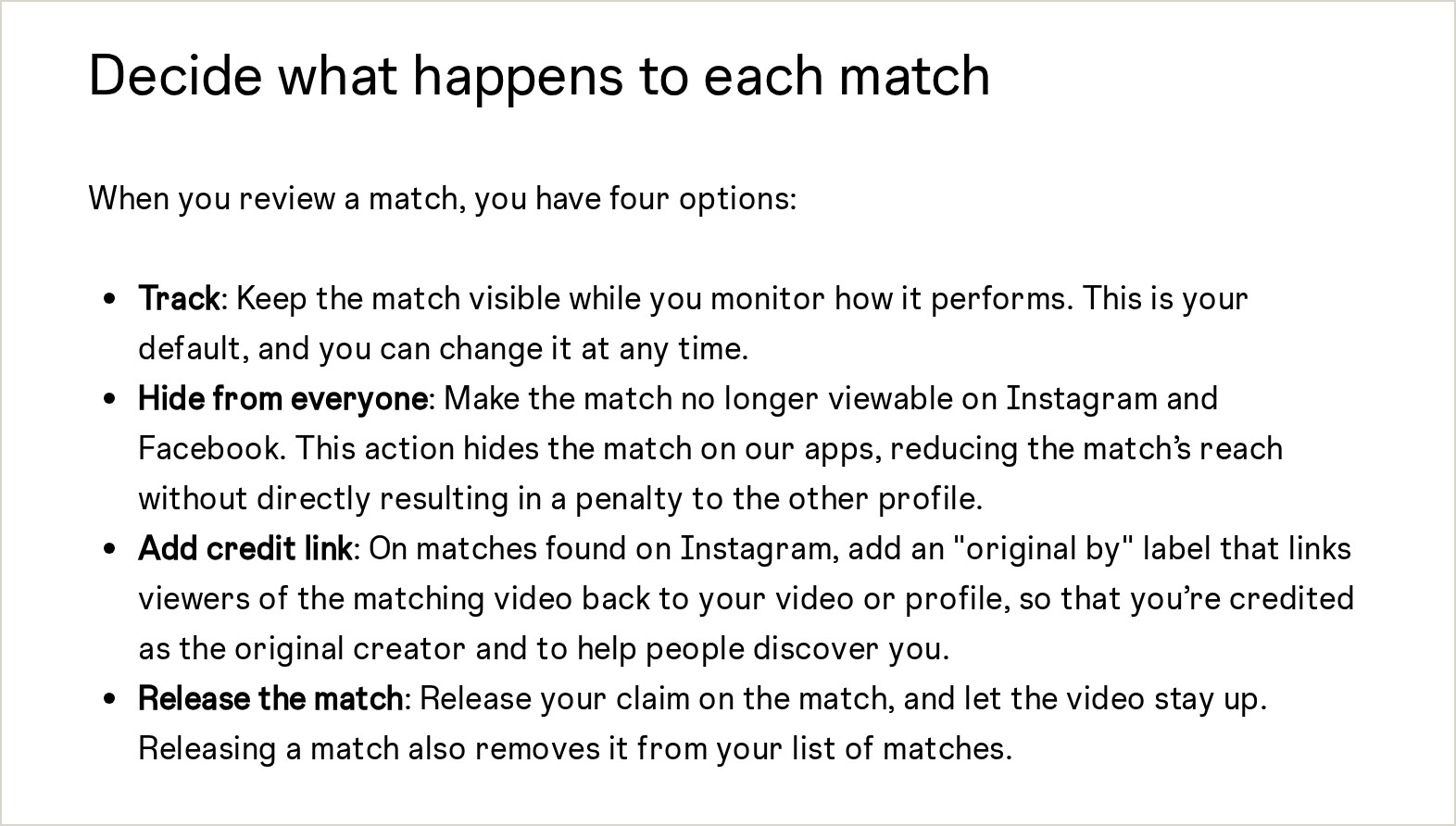
The creator picks one of four options for each copy. The first, “Track,” is the default: the copy stays up, and the creator can watch how it performs. The creator can change this setting at any time.
The second option, “Hide from everyone,” means no one on Instagram or Facebook can see the copy. Instagram says hiding a copy cuts its reach “without directly resulting in a penalty to the other profile.” In other words, the account that posted the copy is not directly penalized.
The third, “Add credit link,” works only for copies found on Instagram. It adds an “original by” label to the copy. The label sends viewers to the creator’s video or profile.
The fourth, “Release the match,” drops the creator’s claim. The copy stays up and comes off the creator’s list of matches, the copies the tool has found.
Creators can also set up an allow list to avoid unnecessary alerts. The list holds the accounts that have permission to use their videos, such as a second account they manage, a collaborator or a brand.
If another account posts and protects a creator’s video first, the creator can file an ownership dispute directly in the tool. They can also submit a copyright report through Instagram’s Intellectual Property Reporting Center.
Instagram will test a way to catch AI remakes
Matching videos by how they look doesn’t catch every copy. AI-generated content can use elements of an original work without necessarily looking like it. Instagram says it has heard “growing concern” about this kind of content.
Social Media Today, a news site that covers social platforms, points to an example highlighted by BBC News. It involves AI-generated versions of the “Hotel Lobby” video by musicians Quavo and Takeoff.
Instagram head Adam Mosseri said in October that he was “very worried” about the trend, according to Social Media Today. In a post on Threads, Meta’s text-based social app, he said copyright claims were not enough. His reason: many comedians and dancers likely haven’t registered copyrights for their work. “We need a way to help those creatives without letting bad actors make more fake claims,” he wrote, as quoted by Social Media Today.
Instagram’s answer is to match spoken words. The tool will start showing creators videos that “match the spoken words in your original video, even when the visuals have been replaced by AI.” The test starts in the coming weeks with a small group of creators. Instagram plans to expand it to creators enrolled on Instagram and Facebook “as soon as we can,” but has given no date.
Instagram is also looking at ways to reduce the reach of these copies and of accounts that repeatedly post them using AI tools. It compares the idea to the limit it already puts on the reach of unoriginal content, meaning posts that add no unique perspective and no material edits.
Meta’s earlier moves, and similar steps at LinkedIn and Spotify
The Instagram tool builds on earlier moves by Meta. On March 13, 2026, the company said it had removed more than 20 million accounts impersonating major creators in 2025. According to Meta, impersonation reports involving those creators dropped 33%. At the time, Meta was testing improvements to content protection on Facebook to help creators spot impersonators faster.
Instagram also has a rule for accounts that mostly repost other people’s work, known as aggregators. Since 2024, the rule has kept them out of recommendations for reels. On April 30, 2026, Instagram extended it to photos and carousels, which are posts with several images.
Recommendations are the posts Instagram shows people from accounts they don’t follow. Our guide to Instagram’s algorithm explains how that system works. According to Instagram, original posts made up 75% of recommendations in the US at the time of the April change.
Other platforms are also limiting low-quality content produced in bulk. LinkedIn reduces the reach of posts it classifies as “AI slop,” a term for low-effort content churned out with AI. Spotify pulled more than 50 million tracks from its recommendations as AI-generated songs flood in. It classified those tracks as spam or slop.
Instagram shares no figures, and the tech press weighs in
Instagram’s post gives no figures on the tool. It doesn’t say how many creators have access, or how many copies the tool found on Facebook over the past year. It doesn’t say how often the tool gets it wrong, either. Nor does it name any countries.
The eligibility rules are also vague. Instagram says they are “largely” based on originality and integrity, and gives no further detail. The spoken-word test covers only a small group of creators, and no date has been set for a wider rollout. The tool scans only Instagram and Facebook, so a copy posted on another platform goes undetected.
Journal du Geek, a French tech news site, sums up what’s at stake for creators: publishing a video can take hours of work, while copying it to repost on another account takes far less time. Andrew Hutchinson of Social Media Today wonders how eager Meta will be to crack down on AI use, given that the company has gone all in on the technology.
What it means
The change affects two groups: creators who post their own videos, and accounts that repost other people’s. Before November 17, Meta’s tool protected a video automatically only if it was posted on Facebook. Creators who post only on Instagram can now enroll in the Instagram app, if they meet the criteria.
The tool leaves the decision to the creator. Hiding a copy stops it from spreading without directly penalizing the account that posted it. Aggregators, the accounts built mostly on reposts, still face the separate rule that keeps them out of Instagram’s recommendations.
None of the four options lets a creator earn money from a copy. YouTube offers that through Content ID, its copy-matching system, but only to copyright owners who meet specific criteria. For those owners, a video that reuses their content can carry ads that pay them. On Instagram, the most a creator gets is the “original by” label, which points viewers from the copy back to the original.
Meta has published no figures, so the tool’s effectiveness is still unproven. Copies remade with AI, the trend that worried Adam Mosseri, are covered only by a limited test.
The next thing to watch is the spoken-word test: its results, and when it expands. Another is whether Instagram will cut the reach of accounts that keep posting AI copies. The last is which countries actually get access, since Instagram has named none.
Sources
- Introducing content protection: a new way to protect your original videos on Instagram, Instagram, November 17, 2026
- Content protection: Your new creative guardian on Facebook, Facebook for Creators (Meta), November 17, 2025
- Rewarding Original Creators on Facebook, Meta, March 13, 2026
- Rewarding original creators on Instagram, Instagram, April 30, 2026
- Meta expands content protection to Instagram, Social Media Today, November 17, 2026
- Copier des vidéos sur Instagram va devenir un peu moins facile, Journal du Geek, November 18, 2026
- How Content ID works, YouTube Help, accessed November 19, 2026
Header image: MACCUS diagram. Data: Meta and Instagram (November 17, 2025, March 13, April 30 and November 17, 2026)