Intuit is selling Mailchimp to Bending Spoons, an Italian company, for about $3.68 billion. That is less than a third of the $12 billion Intuit paid for Mailchimp in 2021. Intuit, the US maker of tax and accounting software, announced the sale on November 19, 2026.
Mailchimp is a tool for sending newsletters and automated email campaigns. Spam Resource, a blog about whether email reaches the inbox, calls it one of the most widely used email marketing platforms among small and midsize businesses.
Bending Spoons, based in Milan, buys well-known software and online services. It already owns the note-taking app Evernote, the file-sharing service WeTransfer, the video platform Vimeo and the event-ticketing site Eventbrite. Several of those deals were followed by large job cuts.
The sale is expected to close in early 2027, once regulators sign off. So far, no changes to Mailchimp’s prices or plans have been announced.
Deal terms and timing
Intuit announced the sale alongside its results for the quarter that ended October 31, 2026. That was the first quarter of Intuit’s 2027 fiscal year, which began in August 2026.
The two companies describe the payment differently. Intuit’s press release splits the price into $3.31 billion in cash and $368 million in Bending Spoons stock. Bending Spoons calls it an all-cash deal, in which Intuit reinvests $368 million in newly issued Bending Spoons shares.
Bending Spoons is buying 100% of The Rocket Science Group LLC, the company that runs Mailchimp. The purchase also covers the business’s other assets and liabilities (what it owns and what it owes). The Bending Spoons board approved the agreement unanimously. Closing still requires regulatory approval and other standard conditions.
Intuit plans to use the cash portion of the price to buy back its own shares after the deal closes, before its 2027 fiscal year ends. In the Bending Spoons press release, Intuit senior vice president Jack Tam said his company is focused on a smooth transition for Mailchimp’s customers, partners and employees.
Mailchimp has stopped growing
Intuit’s figures show Mailchimp stalling. In the quarter that ended October 31, Intuit’s total revenue rose 12% from a year earlier, to $4.4 billion. Mailchimp’s revenue fell 1% on the same comparison, to $313 million.
For the full 2027 fiscal year, Intuit expects Mailchimp revenue of $1.256 billion to $1.266 billion. That would be flat or down as much as 1% from the year before.
Since August 2026, Intuit has reported Mailchimp as a separate segment, with its results on their own line. Chief financial officer Sandeep Aujla explained the change at a briefing in September, CNBC reported. It was meant to give investors more visibility while Intuit managed the unit with profitability in mind.
In August, Aujla said Intuit expected higher effective prices at Mailchimp to offset rising churn. Churn is the share of customers who cancel. The effective price is the average price customers actually pay.
The churn problem is not new. In November 2024, Aujla told analysts that Intuit was seeing higher churn among Mailchimp’s smaller customers, according to the tech news site SiliconANGLE.
The $12 billion Intuit paid for Mailchimp in 2021 was, at the time, the largest deal in Intuit’s history, SiliconANGLE notes.
Bending Spoons, a buyer of established brands
Bending Spoons is an Italian company founded in 2013. Its shares have traded on the Nasdaq stock exchange since July 2026. According to CNBC, Berkshire Hathaway, Warren Buffett’s holding company, invested $600 million in Bending Spoons when it went public. Berkshire added another $330 million in October 2026.
Bending Spoons’ main businesses include the email provider AOL, Evernote, Vimeo, WeTransfer, the collaborative database tool Airtable and the online whiteboard Miro. At $3.68 billion, Mailchimp costs more than the Airtable and Miro deals combined. SiliconANGLE puts the Airtable purchase at $1.285 billion and the Miro purchase at $1.355 billion. CNBC reports that Bending Spoons bought Airtable in September 2026 for a tenth of what Airtable had once been worth.
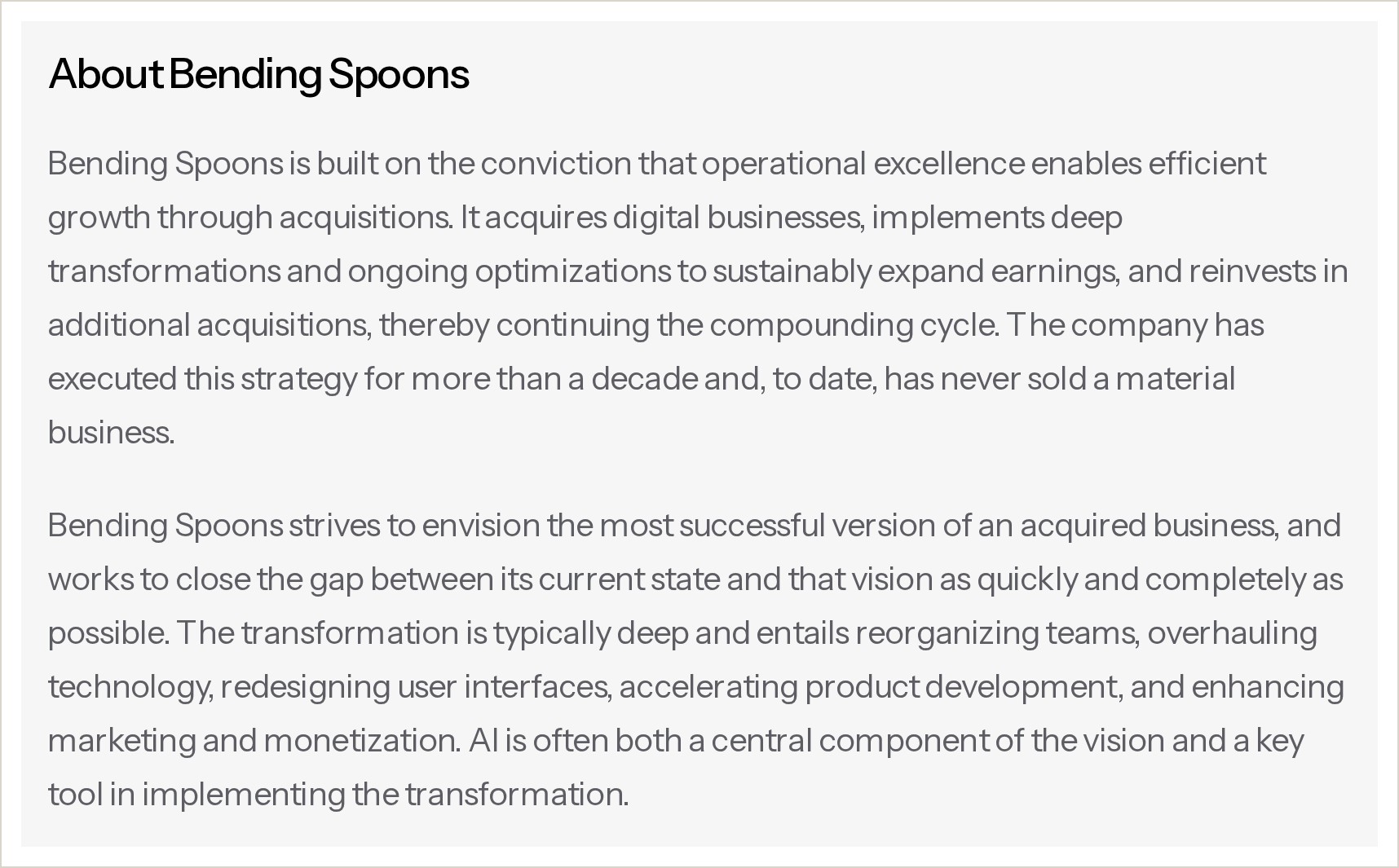
Bending Spoons’ press release spells out its method. The company pictures the best possible version of each business it buys. It then works to close the gap between that version and the business as it found it, “as quickly and completely as possible.”
The release calls the transformation “typically deep.” It involves reorganizing teams, overhauling technology, redesigning user interfaces (the screens customers use) and speeding up product development. It also covers enhancing marketing and monetization, meaning how the service makes money.
The release says artificial intelligence (AI) is often both a central part of the plan and a key tool for carrying it out. It adds that, to date, Bending Spoons has never sold a material business, meaning a significant one.
Layoffs after the Evernote, WeTransfer, Vimeo and Eventbrite deals
Bending Spoons announced its purchase of Evernote in November 2022. In February 2023, 129 Evernote employees were laid off. Starting December 4, 2023, Evernote’s free plan was capped at 50 notes and a single notebook, TechCrunch reported. The cap applied to all free users, new and existing.
Bending Spoons bought WeTransfer, a Dutch company, in July 2024. In September 2024, Bending Spoons confirmed to TechCrunch that it planned to lay off 75% of WeTransfer’s staff. According to Dutch media cited by TechCrunch, WeTransfer had more than 350 employees at the time. Bending Spoons CEO Luca Ferrari said he wanted a “smaller, more sharply focused” WeTransfer.
Bending Spoons bought Vimeo in 2025 for $1.38 billion in cash. In January 2026, layoffs hit a “large portion” of Vimeo’s staff, according to a former Vimeo vice president quoted by TechCrunch. Bending Spoons confirmed the cuts to Business Insider without giving a number.
Bending Spoons announced its $500 million purchase of Eventbrite in December 2025, and the deal closed in early March 2026. A few weeks later, Bending Spoons announced layoffs affecting a large part of Eventbrite’s staff, the German tech site heise online reported. Eventbrite had 636 employees at the end of 2025. Andrea Parodi, Eventbrite’s new head, said a smaller team could roll out changes more efficiently.
Investment promised, no word on prices
Ferrari, the Bending Spoons CEO, is promising to invest in Mailchimp. “After closing, we’ll invest substantially in the business, building on the powerful, easy-to-use tools customers already value and rely on,” he said in the press release. The release gives no figure for that investment. It also says nothing about prices, the free plan, jobs or Mailchimp’s Atlanta headquarters.
For now, Mailchimp users keep the contract they accepted. As of November 20, 2026, Mailchimp’s terms of use name The Rocket Science Group LLC as the company that signs the agreement with each user. That is the same company Bending Spoons is buying. The current version, dated November 19, 2026, still describes Mailchimp as part of the Intuit group of companies.
The same terms let Mailchimp change them by posting a new version. That version applies from its effective date to anyone who keeps an account open. Meta, the parent company of Facebook and Instagram, has used the same approach for its new commercial terms: continuing to use the service counts as acceptance.
Al Iverson, who writes the Spam Resource blog, says Mailchimp will operate as usual until the deal closes. He also notes that Bending Spoons will then own AOL, a major consumer email provider, and Mailchimp, one of the largest platforms for sending business email. In his view, Mailchimp’s future under its new owner is still a matter of speculation.
What it means
Mailchimp is moving from an owner that bought it to expand to an owner that transforms what it buys. Intuit bought Mailchimp in 2021 to push beyond its core tax and accounting businesses, CNBC notes.
For businesses that send newsletters through Mailchimp, the company named in their contract stays the same before and after the deal closes, which is expected in early 2027. The owner changes: after closing, Bending Spoons will decide Mailchimp’s prices and plans.
Bending Spoons’ record shows what it did at the other companies it bought. At WeTransfer, Vimeo and Eventbrite, large job cuts came weeks or months after the deal. At Evernote, the free plan was sharply reduced.
Bending Spoons also added or promised features. TechCrunch reported share links that last longer at WeTransfer, and heise online reported faster load times at Eventbrite. Nothing in the November 19 announcements says which of these paths Mailchimp will take.
Mailchimp’s numbers point to the same lever that Bending Spoons’ method names: monetization. The business is no longer growing. Intuit was already counting on higher effective prices to offset lost customers.
For a small business, a newsletter is one of the few marketing channels where it owns its contact list. It pays for that channel through a subscription to a sending tool such as Mailchimp. Paid channels such as advertising are already getting more expensive. In the third quarter of 2026, the average price of an ad across Meta’s apps rose 14% year over year, according to Meta.
Three milestones come next. The first is the closing date, which depends on regulatory approvals. Next come Bending Spoons’ first announcements on how it will organize Mailchimp. Then comes the first update to Mailchimp’s terms of use and pricing since the sale.
Sources
- Intuit Reports First-Quarter Results and Enters Agreement to Sell Mailchimp to Bending Spoons, Intuit, November 19, 2026
- Bending Spoons has entered into a definitive agreement to acquire Mailchimp, Bending Spoons, November 19, 2026
- Intuit to sell Mailchimp to Bending Spoons for $3.68 billion, CNBC, November 19, 2026
- Intuit sells Mailchimp to Bending Spoons for $3.68B, less than a third of what it paid, SiliconANGLE, November 19, 2026
- Bending Spoons to Acquire Mailchimp from Intuit, Spam Resource (Al Iverson), November 19, 2026
- Mailchimp’s Standard Terms of Use, Mailchimp, version of November 19, 2026, accessed November 20, 2026
- Vimeo starts layoffs after acquisition by Bending Spoons, TechCrunch, January 22, 2026
- Event platform Eventbrite lays off a large part of its employees, heise online, April 14, 2026
Header image: MACCUS chart. Data: Intuit and Bending Spoons (November 19, 2026), SiliconANGLE and CNBC (November 19, 2026)