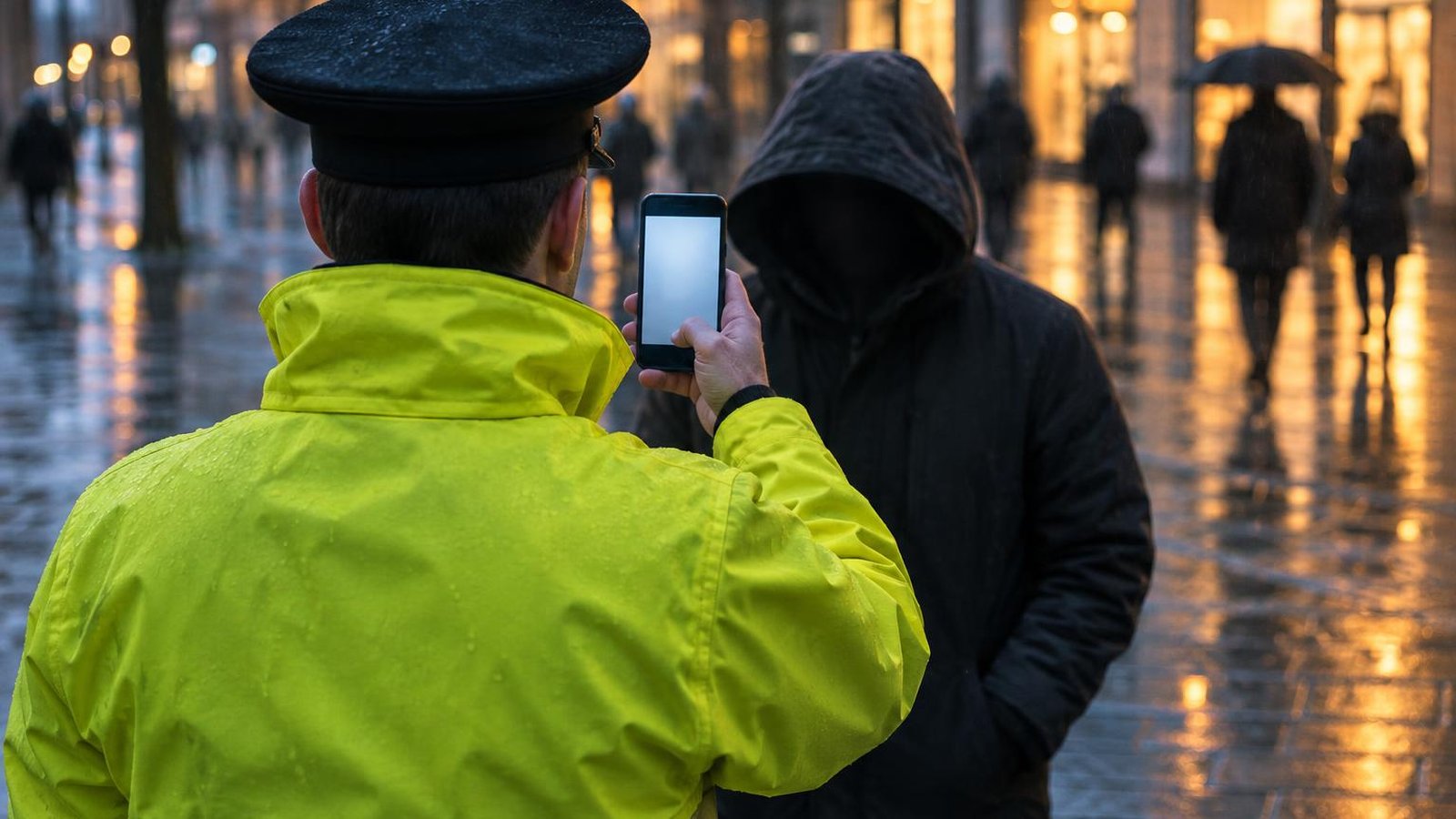

London’s Metropolitan Police has given 100 officers a phone app that checks a person’s face against the force’s custody photos, the pictures taken of people held in police custody. The force, known as the Met, began the six-month trial on November 17, 2026, and announced it in a release on November 20. It calls the tool Operator Initiated Facial Recognition (OIFR). An officer takes a photo with a Met-issued phone, and the app searches a database of around one million custody images, the Evening Standard reported.
The Met says officers can use the check in two situations. The first is a person unknown to the officer who is believed to have committed a recordable offense, meaning one serious enough to go on police records. That person must also refuse to give their details or seem to give false ones. The second is a person who has already been arrested or detained.
Scotland Yard, the Met’s headquarters, said officers must tell people before taking the photo but do not need their permission, according to the Standard. Officers will not use force if someone covers their face, and the pilot will not be used on anyone under 18.
How the phone check works
Face recognition software measures the features of a face in a photo and compares them with faces already on file. In the Met’s version, the app returns a result only when a match scores above a set threshold. “If no sufficiently strong match is found, no result is returned,” the release says. It adds that the threshold was “informed by independent testing” but does not name the test or give error rates.
A trained officer reviews every possible match, according to Commander Nick John, the Met’s lead for the tool. Human checks were also part of a different AI system, a school gun detector that is now the subject of a US lawsuit. In the complaint, filed in Maryland on November 17, four teenagers say police handcuffed them at gunpoint after staff had already canceled the detector’s alert, set off by a bag of chips.
The trade site Biometric Update reported on November 20 that the matching software is NeoFace, made by the Japanese tech company NEC. According to the site, police in South Wales, Gwent (also in Wales) and Cheshire tested it in 2023. The site also says the same algorithm runs in Mobile Fortify, the face-matching app used by US Immigration and Customs Enforcement (ICE).
Britain’s National Physical Laboratory tested NeoFace in a March 2023 study for the Met and South Wales Police. It ran phone photos of volunteers against a database of 178,400 images, and the right person came back as the top match every time. That test used no match threshold; with one set at 0.66, five searches, hurt by reflections on glasses or shadows over the eyes, would have returned nothing. The volunteers were not people stopped by police, and the Met’s custody database is more than five times the size of the test one.
Biometric Update also read the Met’s 32-page policy for the tool. According to the site, the policy gives officers no new power to photograph people or make them cooperate. Officers should seek consent where practicable, but may take the photo without it when an existing legal power allows.
Photos taken for a search are deleted within 31 days after the search is completed, the site reports. Once the pilot ends, the Met plans to also search a database it calls the “Unsolved Crime Cache.”
Officers uploaded 15 photos in the first 24 hours. Nick John told the Press Association, Britain’s national news agency, that the number was “more than I was expecting.” On the first day, officers were called about a drunk woman who was walking into traffic and could not say who she was. The Met says the app identified her, and she got medical care without delay.
A different tool from the camera vans
OIFR is separate from the Met’s two older face recognition systems. Live facial recognition mostly uses camera vans that scan every face walking past. The Met credits it with more than 3,000 arrests since 2024, and the British government has promised a law and a watchdog to govern it. Retrospective facial recognition searches security camera footage and other images after the fact.
With OIFR, an officer picks one person and photographs them up close. According to Biometric Update, the policy requires the officer to take the photo openly, be clearly identifiable as police, and stand close enough to talk with the person.
The plan for the trial first became public in February, when London Mayor Sadiq Khan confirmed it. He did so only after repeated questions from Zoë Garbett, a Green Party member of the London Assembly. He said the pilot involved around 100 devices and about £763,000 (roughly $1 million) allocated to the program, according to Garbett’s release of February 26 on the London Assembly site. At the time, the Met’s website said the force did “not presently use Operator Initiated Facial Recognition.”
The regulator’s audit and the promised law
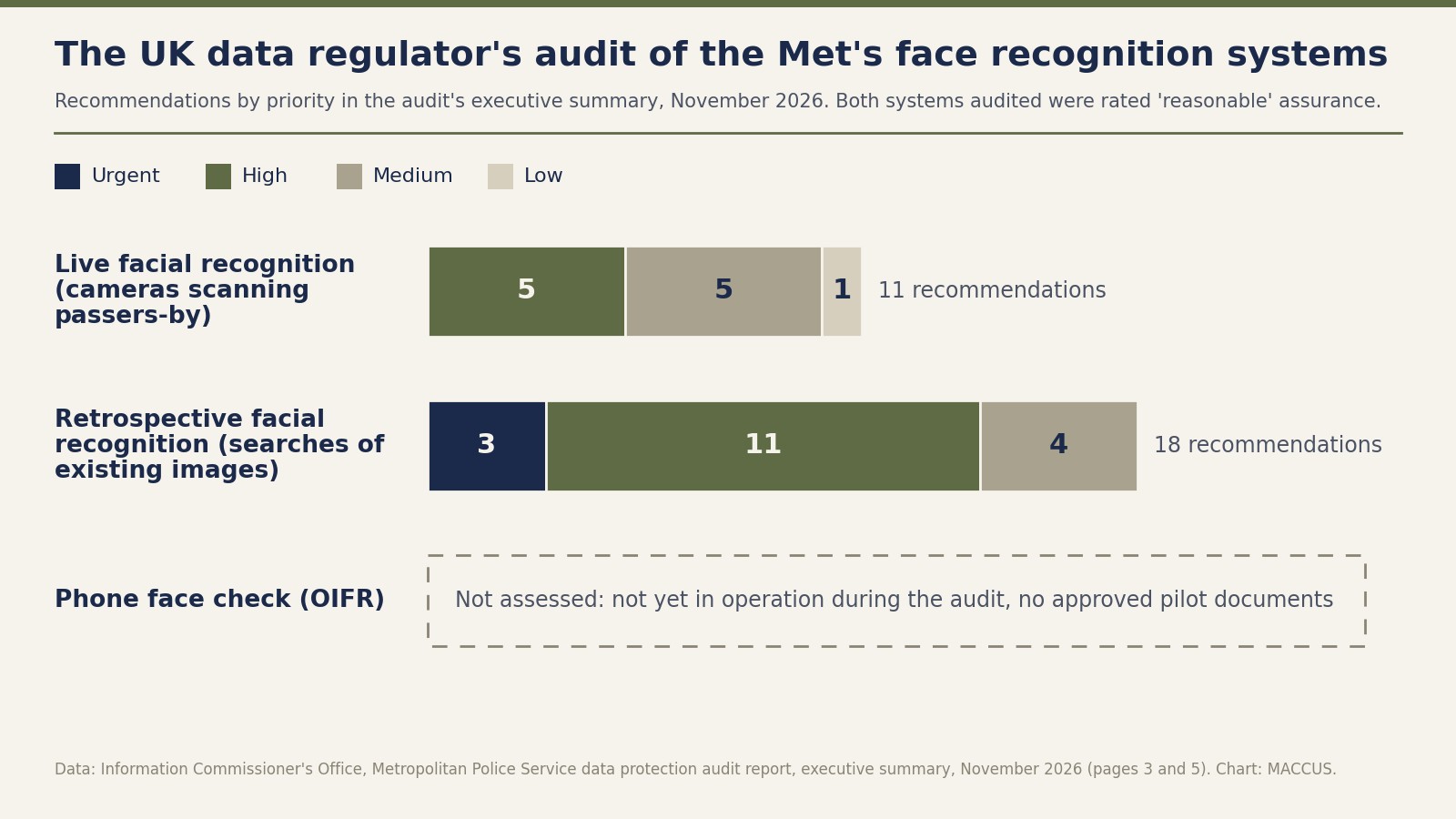
This month, Britain’s data protection regulator, the Information Commissioner’s Office (ICO), published the summary of its audit of the Met’s face recognition. Biometric Update reported it on November 23. The audit covered live and retrospective facial recognition and rated both “reasonable.” In the ICO’s terms, that means processes are in place and are delivering compliance with data protection law, with some scope for improvement.
The audit made 29 recommendations: 11 for live facial recognition and 18 for retrospective searches. All three recommendations marked urgent concern retrospective searches.
On retrospective searches, the ICO found that the Met’s data protection officer “appears to be detached” from oversight of the system. A data protection officer’s job is to monitor an organization’s compliance with data protection law. Auditors also “could not gain assurance” that investigators keep probe images, the photos submitted for a search, only as long as the rules allow.
Auditors looked at the Met’s plans for the phone tool but did not assess how it works in practice. OIFR “was not operational at the time of the audit,” the ICO writes, and “no approved pilot documentation, operational procedures or finalised OIFR-specific governance documentation were available for review.”
The audit was consensual, meaning the Met agreed to it, and its findings take the form of recommendations. Under section 146 of the Data Protection Act 2018, the ICO can also order a compulsory audit. Data protection regulators can impose fines, too. On November 14, Italy’s data protection authority fined Meta €805 million over the Facebook app’s access to photo galleries on Android phones, a decision Meta says it will appeal.
On November 4, the Home Office, Britain’s interior ministry, said existing legal requirements for police facial recognition are set out across “a vast patchwork system.” It promised a specific law and an independent watchdog that could, in extreme cases, seek a court order to stop a police force from using the technology. Neither exists yet. Until they do, the specific limits on the phone check, from the minimum age to the match threshold, are Met policy.
What it means
For civil liberties groups, the tool is an identity check that needs no consent. “The police are handing themselves a technology with the power to turn us into walking ID cards,” said Jasleen Chaggar of Big Brother Watch, a privacy campaign group. Her group says its own research found that in South Wales, Black and Asian people accounted for almost 1 in 4 uses of handheld face checks while making up 7% of the population. Akiko Hart, director of the rights group Liberty, said the tool “combines all of the problems of stop-and-search with those of facial recognition.”
The Met argues the tool is fast and tightly limited. Nick John says officers must first “exhaust other reasonable ways of establishing a person’s identity.” He told the Press Association: “We are not going to be going around London taking photos of people from a distance who aren’t suspected of being involved in any offending.” The force says a check on the street saves time in custody and warns officers about risks such as a history of carrying a knife.
Chaggar’s statement allows one exception: “Generally, you don’t have to hand over your identity to the police, unless you’ve broken the law.” The Met’s first use case is a person officers believe has committed an offense. The force says it will track performance, accuracy, usage and “any evidence of disproportionality” over the six months, but its release does not say whether those figures will be made public. The next steps to watch are the promised law that would create the watchdog and whether the Met adds the “Unsolved Crime Cache” to the search once the trial ends.
Sources
- Met launches new technology to speed up identity checks, Metropolitan Police, November 20, 2026
- Met Police pilots facial recognition technology on phones to identify suspects, Evening Standard, November 20, 2026
- London Met pilots NEC facial recognition on handheld devices, Biometric Update, November 20, 2026
- The Metropolitan Police Service: data protection audit report, executive summary, Information Commissioner’s Office, November 20, 2026
- Facial Recognition Technology in Law Enforcement: Equitability Study, Final Report (NPL Report MS 43), National Physical Laboratory, March 2023
- ICO flags urgent oversight gaps in Met Police retrospective facial recognition, Biometric Update, November 23, 2026
- Big Brother Watch responds to Met Police use of on-the-spot handheld facial recognition tech, Big Brother Watch, November 20, 2026
- Stronger laws for police using facial recognition technology, Home Office, November 4, 2026