

Cloudflare launched Search for Agents on November 25, 2026. Any site on Cloudflare can now switch on a search endpoint for AI agents, a web address on its own domain (/.well-known/search) where they can search the site instead of crawling it page by page. Every plan can use it, and usage is billed to the site owner’s account from December 1, 2026. Limits depend on the account’s plan for Workers, Cloudflare’s developer platform, whose free tier caps daily crawling.
Cloudflare’s network sits between websites and their visitors to speed sites up and protect them. An AI agent is software that uses an AI model to carry out tasks for a person, such as looking up facts across websites. Celso Martinho and Gabriel Massadas announced the feature in a Cloudflare blog post.
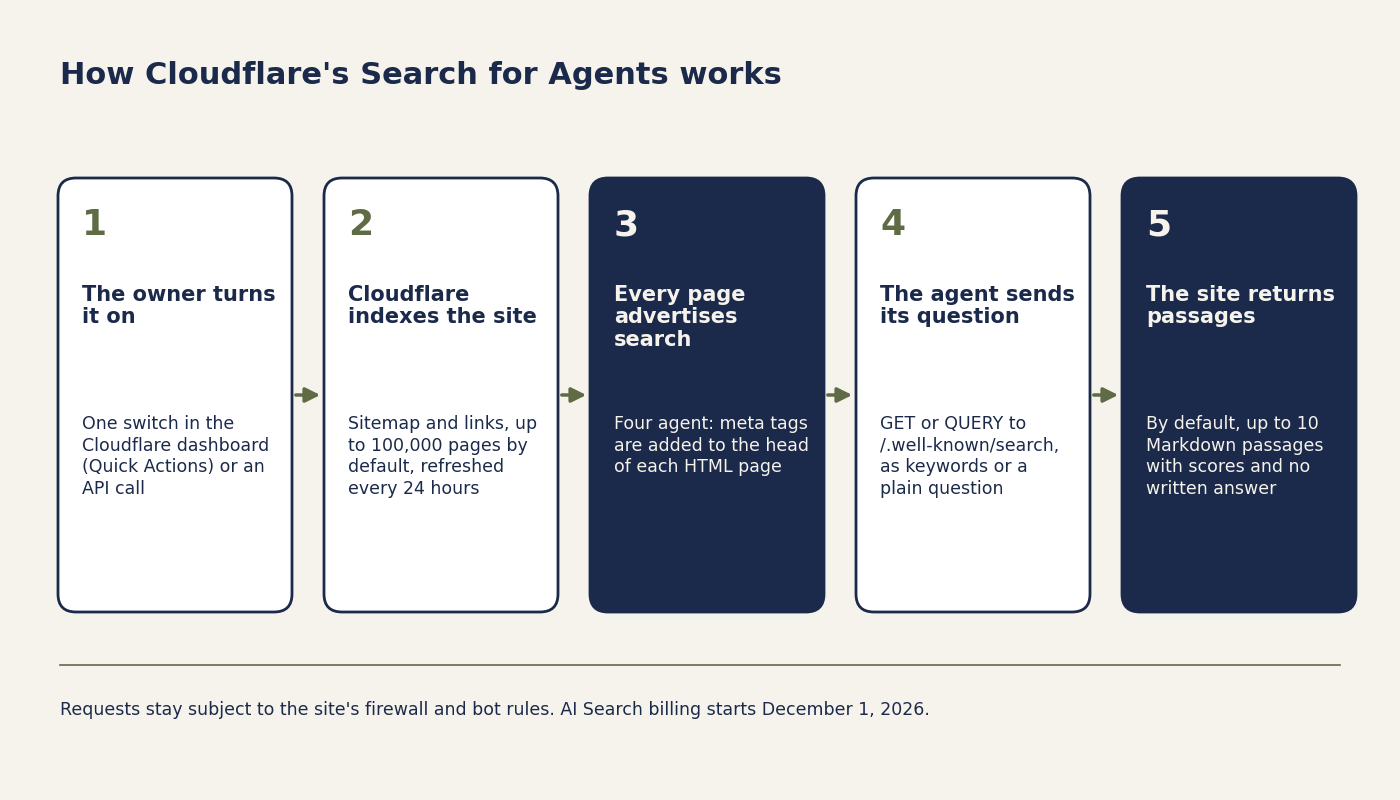
Once the feature is on, Cloudflare builds a search index of the site and adds hidden tags to every page to point agents to the endpoint. The endpoint returns scored passages of the site’s text and writes no answer of its own.
A dashboard switch replaces manual setup
Search for Agents runs on AI Search, Cloudflare’s existing service that indexes content so developers can add search to an app or an agent. AI Search could already index a website, but the owner had to set it up, handle the integration and tell agents where to find it.
The new feature puts that setup behind one switch. The owner turns it on in the dashboard, under Quick Actions on the domain’s Overview page, or by code through Cloudflare’s API. The owner then reviews the default settings and a pricing notice and confirms. The Search for Agents documentation says searches work once AI Search has crawled and indexed the site.
By default, the AI Search crawler finds pages through links and the site’s XML sitemap, the file that lists a site’s pages for search engines. A sitemap is optional. The crawl covers up to 100,000 pages, follows links up to five steps from the home page and refreshes every 24 hours.
Searches are hybrid, matching both the meaning of a question and its keywords. By default, each query returns at most 10 passages, and results for similar questions are reused for 48 hours. Owners can change most of these settings later.
Agent traffic still passes through the site’s defenses. Cloudflare says agents can use the endpoint “subject to your domain settings.” Those include bot management, the web application firewall and AI Crawl Control, Cloudflare’s tool for managing AI crawlers. The documentation adds a warning: “Only index content that you intend to make publicly searchable.”
The same bot and firewall rules apply to the AI Search crawler, so a site that blocks bots may first have to let it through. On November 17, Google published its own guidance on letting its AI agents through firewalls and bot filters.
Four meta tags on every page
“Search isn’t much use if the agents don’t know it’s there,” the Cloudflare post says. Its fix is to add four hidden meta tags to the head of every HTML page: agent:instructions, agent:endpoint, agent:method and agent:documentation.
The instructions tag reads, in full: “Use this search API to find relevant content across this site with keywords or natural-language queries, instead of crawling individual pages. Results are returned in Markdown.” The endpoint tag gives the address, https://<domain>/.well-known/search?q={query}. The method tag says GET, the usual type of web request, and the documentation tag links to Cloudflare’s docs.
Sites that also use Markdown for Agents get a second pointer to the endpoint. That earlier Cloudflare feature, announced on February 12, 2026, converts HTML pages into Markdown, a plain-text format that AI models read more easily. An agent that requests a page in Markdown gets the four instructions as labeled fields at the top.
On October 15, Cloudflare said a pilot with OpenAI, running since July, had helped ChatGPT discover hundreds of millions of new pages.
The endpoint returns scored passages
An agent sends a GET request with its search after “q=” in the address. Depending on the settings, the search can be keywords or a full question in plain language. The reply comes back in Markdown: passages from the site’s pages with their sources and relevance scores.
“The agent already has an AI model and a conversation with the user; all it needs is the relevant information from your site, not another AI model’s attempt to answer on its behalf,” the post says.
The endpoint also accepts QUERY, a new HTTP method (the type of request a client sends to a server, such as GET or POST). The IETF, the body that writes the internet’s core protocols, published QUERY in June 2026 as RFC 10008, a Standards Track document. Cloudflare’s James Snell co-wrote it with authors from greenbytes and Akamai.
Like POST, QUERY carries the search inside the request rather than in the web address, but it changes nothing on the server. A client can repeat or restart a QUERY request “without concern for partial state changes,” the RFC says. Cloudflare says adoption is “underway,” with major browser makers discussing the RFC and request tools such as curl and undici adopting it.
Who pays for the searches?
Search for Agents is billed at AI Search prices, which cover adding the site’s content to the index, storing it and answering queries. Cloudflare’s limits and pricing page states that “AI Search billing begins on December 1, 2026.”
Each account gets a monthly allowance of 5 million ingestion tokens, 10 GB-month of storage, 1,000 semantic queries and 1,000 full-text queries. A token is a unit of text that AI models count, often part of a word. A GB-month is one gigabyte stored for a month.
Past the allowance, ingestion costs $0.75 per million tokens and storage $2.00 per GB-month. Queries that match meaning (semantic, vector and hybrid) cost $0.75 per 1,000, and keyword-only full-text queries cost $0.10 per 1,000. Hybrid search is the default for Search for Agents.
AI Search crawls at most 500 pages a day on Workers Free, the free tier of Workers, Cloudflare’s developer platform, and has no daily cap on Workers Paid. The documentation calls the 500-page limit “the binding one” on Workers Free. At that pace, a 10,000-page site cannot be fully indexed in under 20 days, and the documentation does not say how long it actually takes.
Cloudflare’s evidence so far
Cloudflare turned the feature on for its developer documentation site, developers.cloudflare.com, before the launch. “We’ve found that agents do a good job of discovering the search API and using it during their tasks,” the post says.
Its demonstration uses OpenCode, an AI coding agent, and a question about Artifacts, a Cloudflare service for storing and versioning files: “What is the maximum push size for Cloudflare Artifacts?” The agent found the endpoint on the documentation’s home page and sent the question to /.well-known/search. “The answer comes back a few seconds later and it’s correct,” Cloudflare writes. The answer shown is 64 MiB, the most data one upload, or push, can carry.
For traffic, the post shows a screenshot captioned “Sample of Search for Agents requests in our developer documentation.” It logs 14 GET requests to /.well-known/search in 41 seconds, between 14:56:05 and 14:56:46 UTC on November 24, the day before the launch. All 14 got “200 OK,” the success code.
The post gives no overall request count or rate. Apart from OpenCode, it does not say which agents read the tags.
The post and the documentation disagree on the feature’s status. The post says Search for Agents “is available to all customers” and never uses the word beta. The documentation says it “is available in beta on all plans.”
The post cites no standard for the agent meta tags. IANA, the body that keeps the internet’s technical registries, holds the official list of addresses reserved under /.well-known/. On November 26, the list (last updated October 26, 2026) held 107 entries, and none was named “search.”
On November 26 at 00:09 UTC, the home page of developers.cloudflare.com carried the four tags. GET and QUERY requests to its /.well-known/search address both returned HTTP 200, with Markdown results and scores.
What it means
Search for Agents gives AI agents a shortcut to a site’s content, and the owner decides whether to open it and which bots reach it. Agents that follow the tags read passages from an index instead of fetching pages one by one. That could cut page fetches by agents, but Cloudflare has published no measurement of it.
The launch came two days after Google documented 12 more of its crawlers and user-triggered fetchers that ignore robots.txt. Robots.txt is the file sites use to set rules for bots, and a user-triggered fetcher loads a page when a person asks for it. A search endpoint reduces crawling only if agents choose to use it.
That choice is the open question. The tags and the /.well-known/search address remain Cloudflare’s own convention. How much the endpoint gets used will depend on whether agents built by OpenAI, Anthropic or Google look for the tags.
Beyond the monthly allowance, the site owner pays for searches that feed an agent’s answer. That answer may never send a visitor to the site. Publishers already face that trade-off with AI answers in search engines. Here, the site opts in and pays the bill.
Nobody yet knows what a typical site will pay or whether owners will see fewer crawler requests. The AI Search bills issued after December 1 will give a first answer on cost. Other signals to watch are agents from OpenAI, Anthropic or Google reading the tags, “search” registered as a well-known address, and adoption numbers from Cloudflare.
Sources
- Introducing Search for Agents, Cloudflare Blog, November 25, 2026
- Search for Agents · Cloudflare AI Search docs, Cloudflare Docs, accessed November 26, 2026
- Limits & pricing · Cloudflare AI Search docs, Cloudflare Docs, accessed November 26, 2026
- Website · Cloudflare AI Search docs, Cloudflare Docs, accessed November 26, 2026
- Introducing Markdown for Agents, Cloudflare Blog, February 12, 2026
- RFC 10008: The HTTP QUERY Method, IETF, June 2026
- Well-Known URIs, IANA, accessed November 26, 2026