
On Tuesday, November 24, 2026, Google announced its December 2026 core update, which has not started yet. A core update is a broad change to how Google ranks search results, and it can move a site up or down. The industry site Search Engine Roundtable notes that Google had said several times that it does not announce core updates ahead of time.
The announcement gives no start date and no expected length. It says only that the update is “scheduled to be released in December 2026.” When Search Engine Roundtable asked, a Google spokesperson said the launch is “not imminent.”
Google names two goals for the update. The first is to better understand and rank relevant content, including for longer and more complex questions. The second is to improve personalized results, the ones Google tailors to each user.
Google had declared its November core update complete about an hour earlier, at 14:03 UTC (9:03 a.m. Eastern). That update started on November 10, as we reported in our story on its launch. Like every core update, it did not target any particular site.
The November core update took almost two weeks
Google posts its ranking updates on the Google Search Status Dashboard, a public page where it also reports outages. The “November 2026 core update” entry opened there on November 10 at 18:06 UTC. Its first message announced a global rollout, in all languages, that “may take up to 2 weeks to complete.”
On November 24, Google added a single line to the entry: “The rollout was complete as of November 24, 2026.” The dashboard’s history page puts the rollout at 13 days and 20 hours, just short of the two-week maximum Google had announced. The rollout ended three days before Black Friday, November 27.
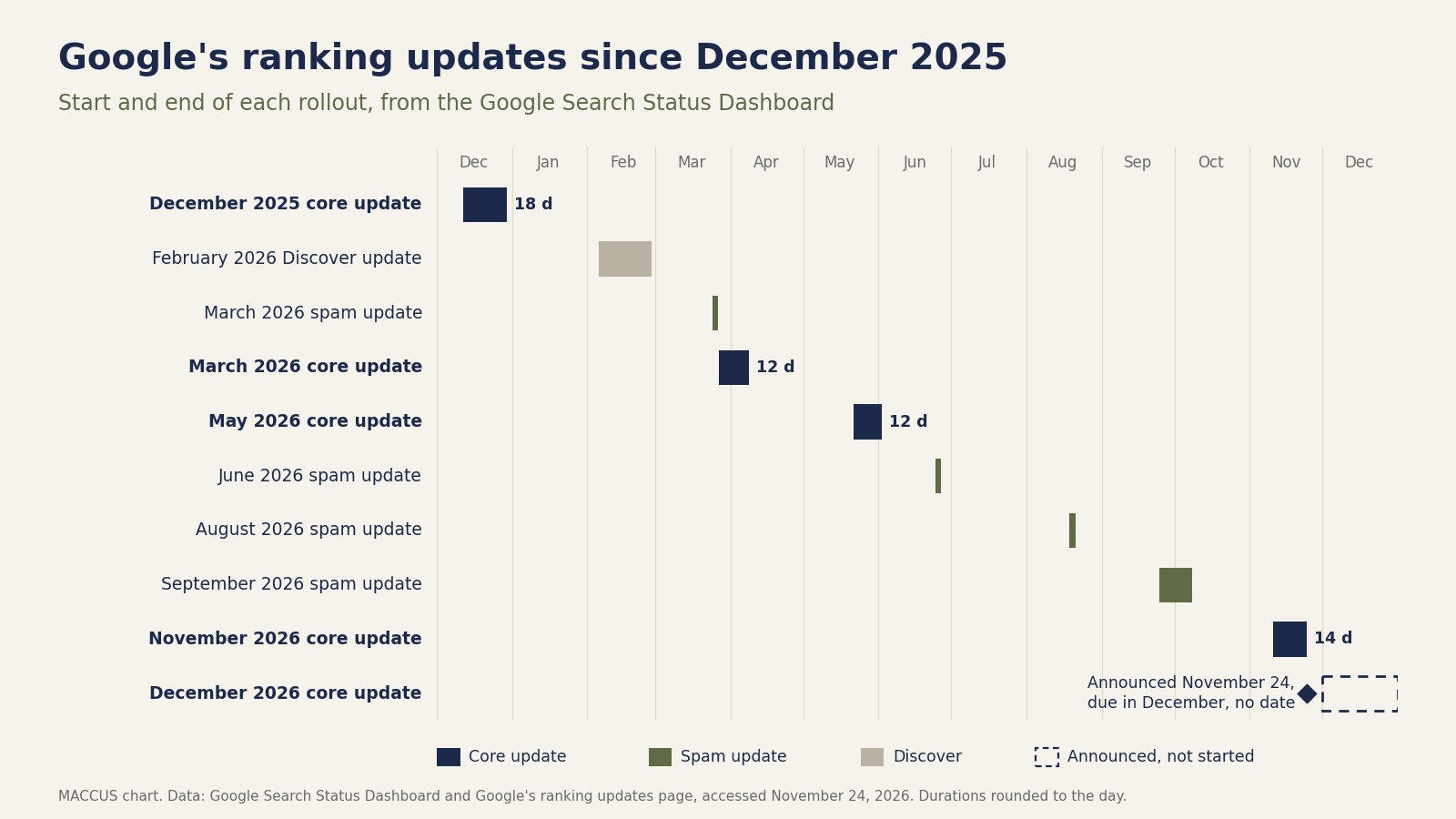
That length is in line with the three core updates before it. According to the same history page, the December 2025 update lasted 18 days, the March 2026 update 12 days and the May 2026 update just under 12 days.
The November update started 161 days, more than five months, after the May update ended on June 2. In that stretch, Google released three spam updates, which target sites that break its spam policies. One of them was the September 2026 spam update.
An announcement posted before the launch
The “December 2026 core update” entry appeared on the dashboard on November 24 at 15:03 UTC, 59 minutes after the line that closed out the November update.
Its text opens with the word “Preannounced” and ends with “This update is scheduled to be released in December 2026.” Google says the update will apply in all locations and languages where Google Search is available.
Since December 2025, the dashboard has listed ten ranking updates, counting the December 2026 one. The December 2026 entry is the only one of the ten that starts with “Preannounced.”
The entries for the four previous core updates to Google Search all start with “Released.” That line goes up on the day the rollout begins. It gives a maximum length (“up to 2 weeks” or “up to 3 weeks”) and names no target. The February update is not counted: it covered only Discover, Google’s feed of recommended articles.
On the dashboard, the December entry looks like an update in progress: it is listed as an open incident with no end time. Barry Schwartz, the founder of Search Engine Roundtable, writes that Google confirmed to him three times that the update is not live and not active. The spokesperson told him that Google does not “have a date yet” and “will announce it as usual the day it starts rolling out. It’s not imminent.”
The two areas the update targets
The first part of the update is broad. Google describes it as “multiple improvements to how our systems understand and rank relevant content (including for longer and more complex questions).” The announcement mentions longer and more complex questions only in parentheses, as an example.
The second part covers personalized results, and only “for people who have personalization turned on.” This part will not affect people who have turned personalization off. According to Google’s help page, personalization tailors results using information in a person’s Google Account, such as their search history. It does not apply to every result, and sometimes it only changes the order of results.
The December entry names no type of site, no industry and no specific language. It does not say what share of searches will be affected either. It points to Google’s general guidance on core updates, which has not changed since December 2025.
A UK rule that requires advance notice
The same day, Google published a documentation page on when it announces changes in advance, titled “How to stay informed on Google Search ranking updates.” It says Google gives site owners advance notice of changes that may significantly shift rankings for users in the UK. Google cites the “fair ranking” requirements of the CMA, the Competition and Markets Authority, the UK’s competition regulator.
On June 17, 2026, the CMA imposed this fair ranking requirement on Google. It had earlier designated Google as having “strategic market status” in general search. That status lets the CMA set rules of conduct for the company.
According to a summary the CMA published on August 4, Google must announce some changes at least 15 business days in advance, about three weeks. The rule covers changes that may cause significant ranking shifts, where Google can also explain what is changing and why. The notice rises to 30 business days, about six weeks, when publishers could take steps to reduce the impact. Google has until December 17, 2026, to comply.
Barry Schwartz writes that Google “seems” to be preannouncing some core updates because of the UK requirements. Google’s own document names the CMA.
Google’s guidance on feedback and measurement
On a page dated November 24, Google also described how to send feedback on an update. Site owners can send it from Search Console, Google’s free tool for tracking how a site performs in search, once they have verified the site there. They add the update’s hashtag to the message, for example #NovemberCoreUpdate2026. Google says its teams review this feedback as a whole and do not adjust the ranking of individual pages on request.
The “How to stay informed” page says to wait before measuring an update’s effect: first until the update is marked complete, then for at least a week of data. For the November update, which ended on November 24, that means waiting until December 1. Another Google page explains how to tell which traffic comes from its search engine, as covered in our story on spotting Google search traffic.
Date, length and scale are still unknown
Google has not given the launch date, the expected length of the rollout or the expected scale of the changes. The December entry gives no maximum duration, while the entries for the four previous core updates each did. The spokesperson promised only an announcement on launch day, “as usual.”
Google also has not said which notice period it is applying to this announcement. If Google applied the CMA’s minimum of 15 business days, the launch would not come before mid-December, by our count. That period is only a minimum, and Google has not tied this entry to any specific notice period.
What it means
Site owners now know two things: a core update is planned for December, and Google has said what it targets. They still do not know when it will start or which sites it will affect. The timing matters because December is a busy month for online stores and for publishers that depend on advertising. Google’s guidance on core updates is still the version from December 2025.
Two core updates a few weeks apart have happened before. In 2024, according to Google’s history, the November core update started on November 11 and lasted more than 23 days. The December one started on December 12. Compared with the four previous core updates, two things are new: the advance notice and the named targets.
Google ties its advance notices to the CMA’s requirements, which cover changes that significantly affect rankings in the UK. Its dashboard, however, is the same for every country: a publisher in France or Belgium reads the same information as one in London.
The next step is the “Released” line Google will add to the December entry when the update starts. It should give the launch date and the maximum length of the rollout. A longer-term question is whether Google will also preannounce its spam updates and its 2027 core updates after the CMA’s December 17 deadline.
Sources
- December 2026 core update, Google Search Status Dashboard, November 24, 2026
- November 2026 core update, Google Search Status Dashboard, November 10 and 24, 2026
- History for Ranking, Google Search Status Dashboard, accessed November 24, 2026
- How to stay informed on Google Search ranking updates, Google Search Central, November 24, 2026
- Submit feedback about ranking changes in Google Search, Google Search Central, November 24, 2026
- Fair ranking conduct requirement, Competition and Markets Authority, August 4, 2026
- Personalization & Google Search results, Google Search Help, accessed November 24, 2026
- Google December 2026 Core Update Preannounced – Complex Queries & Personalization, Search Engine Roundtable (Barry Schwartz), November 24, 2026