
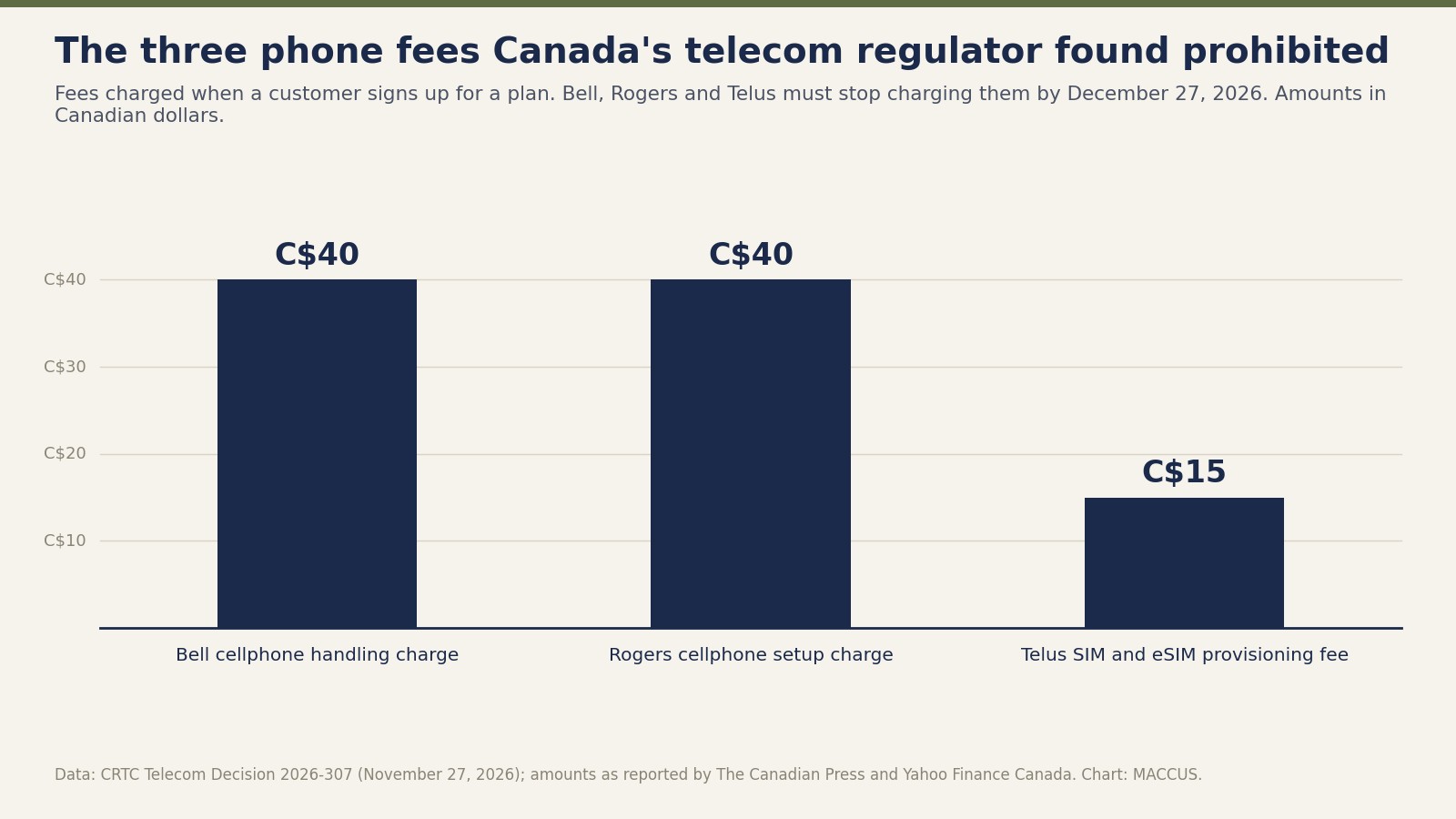
Customers of Bell, Rogers and Telus, Canada’s biggest phone carriers, should no longer pay three sign-up fees, one per carrier, from December 27, 2026, at the latest. The fees are Bell’s C$40 cellphone handling charge, Rogers’ C$40 cellphone setup charge and Telus’ C$15 SIM and eSIM provisioning fee. The country’s telecom regulator, the Canadian Radio-television and Telecommunications Commission (CRTC), found them prohibited on November 27 and ordered the carriers to stop charging them.
The fees appeared after the CRTC banned charges for activating, changing or canceling a plan. That ban was decided on March 12 and took effect June 12. Bell introduced its handling fee in May, according to The Canadian Press. Customers who have already paid get no refund under the decision. The CRTC said the Telecommunications Act gives it no power to order refunds for fees already charged.
Three fees found prohibited
The decision, Telecom Decision CRTC 2026-307, came after a public proceeding. “Based on the record of the proceeding, the Commission finds that the cellphone handling charge from Bell Canada, the cellphone setup charge from Rogers, and the SIM and eSIM provisioning fee from TELUS are prohibited,” the CRTC wrote, as quoted by MobileSyrup. In its news release, the regulator said the fees it is ending include “fees for providing and setting up cellphones when signing up for a service plan.”
Bell’s C$40 charge applies when a customer buys a device with a wireless plan, The Canadian Press reported. The CRTC found that Rogers charges its C$40 setup fee to every customer who buys a phone in a store while activating a new plan. Customers pay it whether or not they ask for or get any extra help. Telus charges C$15 for a SIM card, which connects a phone to a mobile network, or for an eSIM, its built-in version.
The three carriers held roughly 86% of Canada’s wireless subscribers in 2024. CBC News cited the figure from a CRTC report released in February.
The regulator found that Rogers’ and Telus’ fees to replace a broken or lost SIM card are allowed, as is Rogers’ hardware shipping fee. It encouraged Rogers to consider whether its shipping fee is “truly optional” for customers who cannot pick up a phone in a store, The Canadian Press reported. Those customers include people with accessibility needs or in rural or remote areas.
The decision carries no fine (in CRTC terms, an administrative monetary penalty). The regulator said it would not impose one at this time and would keep monitoring fees, MobileSyrup reported.
If the carriers miss the deadline, they could face penalties of up to C$10 million, and the managers responsible up to C$25,000, according to The Canadian Press. “The commission will be watching very closely to make sure they do so, and if they don’t, we’ll be ready to start enforcement action immediately, which could very well include an administrative monetary penalty,” said Sheehan Carter, the CRTC’s acting vice-president of consumer, analytics and strategy.
How the new fees followed the ban
The March rules define a banned “activation or modification fee” as any fee charged for activating a new plan or changing an existing one. There are two exceptions: reasonable fees for physically installing a service at a customer’s premises, and fees for “additional products or services the customer has explicitly chosen to purchase.” The rules cover individual and small-business customers of every wireless provider in Canada.
After the ban, the major carriers introduced SIM card and other hardware charges that the CRTC flagged as possible activation fees in disguise, CBC News reported. Over the summer, the regulator warned the three companies and asked them to show the fees complied with its rules.
“We identified a number of fees charged by certain of the largest telephone companies that appeared to be prohibited,” Carter said at a briefing on November 27. “Since these companies chose to continue those fees, and they argued that they were not prohibited, we immediately took action to decide the issue.”
Carter said the ruling is also meant as guidance on how the regulator applies its test for banned fees. He said it comes “with the expectation that companies, now that they better understand how the test is applied, will not be charging these types of fees in the future.” “Canadians should be able to easily activate, change or cancel a cellphone plan,” CRTC chair Vicky Eatrides said in the release.
The carriers’ answer
Rogers disagrees with part of the decision. “These charges help recover real costs and we’re pleased the CRTC’s decision on the shipping charge and SIM replacement fee clearly reflect this,” spokesperson Zac Carreiro said. “We disagree with the commission’s position on the device setup charge, which recovers costs associated with helping customers set-up their device as the CRTC noted, and we’re considering next steps.”
Telus is reviewing the decision and considering its next steps. “Every SIM card and e-SIM comes with real costs associated with providing it to customers, and we believe those costs should be reflected in the price of the product, rather than requiring carriers to provide it free of charge,” spokesperson Martin Nguyen said. Bell spokesperson Ellen Murphy said the company is reviewing both rulings, on the fees and on phone locking.
Rogers’ chief financial officer, Glenn Brandt, told analysts on a third-quarter earnings call that the company was taking a hit from the ban, The Canadian Press reported. He added that Rogers was looking for new ways to recover some of that lost revenue.
Phone locking, decided the same day
The CRTC also ruled twice on phone locking that day. A locked phone works only with the carrier that sold it. In the first, the regulator found that Bell failed to comply with the Wireless Code, its consumer rules for cellphone service. The finding concerns Bell’s practice of locking phones to its network for up to 60 days after purchase, which MobileSyrup says began in April 2025.
The regulator said it holds the “preliminary view” that a penalty of up to C$10 million may be appropriate. Comments are due by January 15, 2027, and Bell can reply by January 22. Bell argued that locking protected staff and customers from theft and fraud.
In the second, the CRTC denied a Telus request to lock phones for 60 days. Carter said the regulator had seen no evidence that Telus actually sold locked phones.
Limits of the order
Anyone who pays one of the three fees before December 27 gets no refund under the order unless a carrier gives one. That includes Black Friday and Boxing Day (December 26) buyers. MobileSyrup raised the refund question on the day of the decision. No carrier had announced refunds by November 28. Carter pointed customers who have already paid to the Commission for Complaints for Telecom-television Services (CCTS), an independent complaints body, iPhone in Canada reported.
Rogers and Telus said they are considering next steps, but no challenge had been reported by November 28.
Matt Hatfield, executive director of the advocacy group OpenMedia, worries the carriers will tweak their fees again. “This is just one round of whack-a-mole in a game customers always lose,” he said. Keldon Bester, executive director of the Canadian Anti-Monopoly Project, called SIM charges an activation fee in disguise. “You really cannot access telecom services without access to a SIM card,” he said.
The ruling covers Canada only, but fees and hurdles attached to a purchase are drawing attention elsewhere too. In Germany, a consumer center has sued OpenAI over the hurdles to canceling ChatGPT. The European Commission has proposed a Digital Fairness Act aimed at fake urgency and free-trial traps. In the United States, Tesla’s Cybercab will not operate without a monthly subscription.
What it means
From December 27, a Canadian who buys a phone with a Bell, Rogers or Telus plan should no longer pay a handling, setup or SIM provisioning charge at checkout. In our reading, that is what the March rules promised: the decision treats getting a phone working on a new plan as part of the service, so a separate charge for it counts as an activation fee. A phone bought with a plan could cost up to C$40 less at the counter, if the carriers do not move that cost into the price of the phone or the plan.
People who pay one of the fees before the deadline get no refund under the decision, because the regulator says the law does not let it order one. The carriers have until December 27 to stop charging. Rogers’ shipping fee and the SIM replacement fees stay legal, and Rogers and Telus may still contest the decision.
The next test is whether the carriers remove the fees on time, and whether new charges appear under new names. The CRTC has ruled once on fees introduced after its ban, and Carter said it will be ready to start enforcement action immediately if the deadline is missed.
Sources
- CRTC takes action to eliminate extra cellphone fees, Canadian Radio-television and Telecommunications Commission, November 27, 2026
- CRTC says Bell, Rogers, Telus violated junk fee rules, MobileSyrup, November 27, 2026
- CRTC orders Bell, Rogers, Telus to stop charging prohibited wireless fees by Dec. 27, CBC News, November 27, 2026
- CRTC says Bell, Telus, Rogers violated ban on junk fees, Global News (The Canadian Press), November 27, 2026
- CRTC tells Rogers, Bell and Telus to stop charging modification fees within 30 days, Yahoo Finance Canada, November 27, 2026
- CRTC eliminates fees to make it easier to switch Internet and cellphone plans, Canadian Radio-television and Telecommunications Commission, March 12, 2026
- Telecom Regulatory Policy CRTC 2026-43: Prohibition of fees that are a barrier to switching cellphone and Internet plans, Canadian Radio-television and Telecommunications Commission (Internet Archive copy), March 12, 2026
- CRTC Orders Bell, Rogers and Telus to Drop Extra Cellphone Fees, iPhone in Canada, November 27, 2026