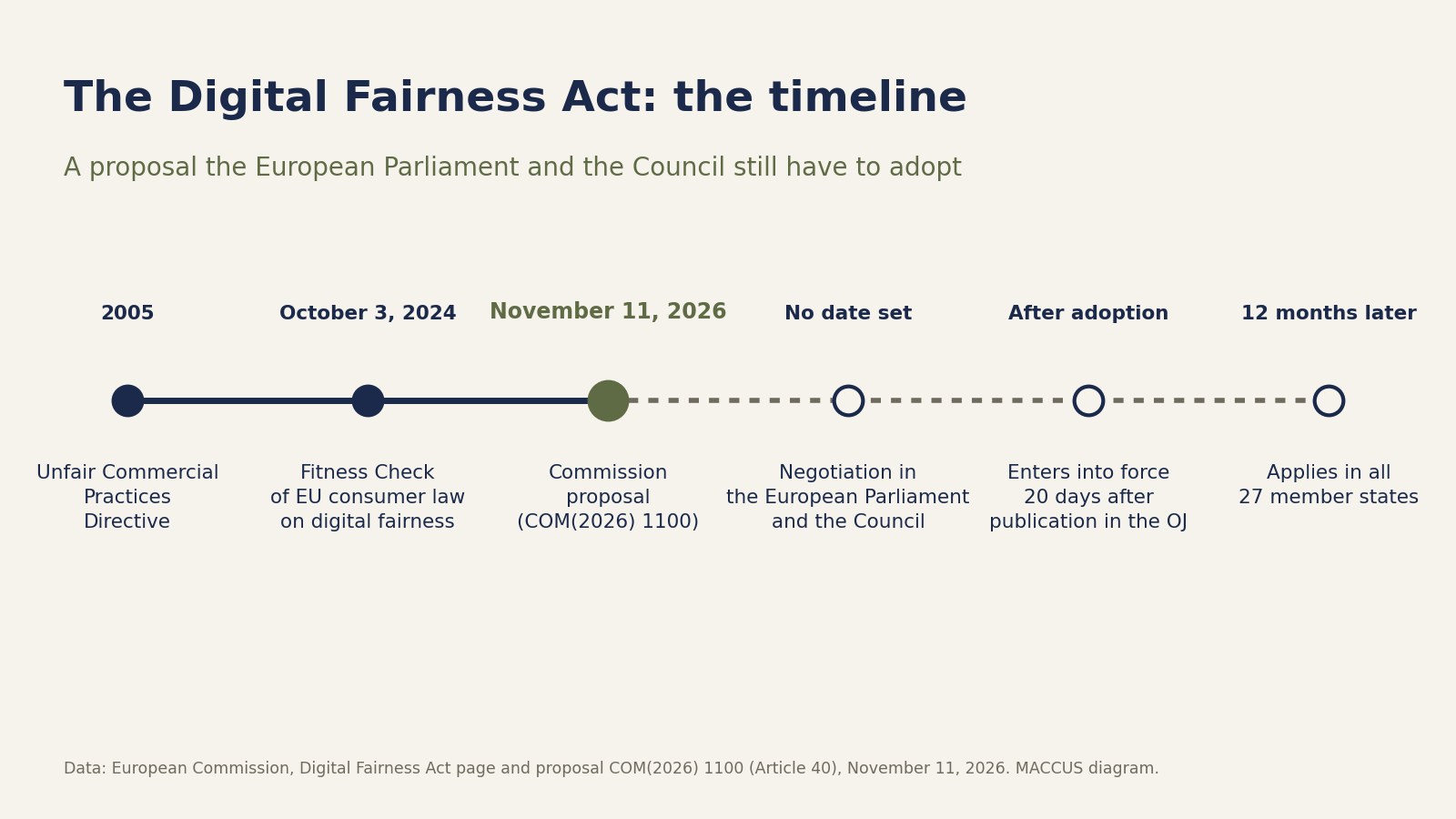

On November 11, 2026, the European Commission, the EU’s executive branch, proposed a new consumer protection law. The Digital Fairness Act (DFA) would bar every seller from showing fake low-stock alerts such as “only 1 left.” It would also require a cancel button for contracts signed online and an ad label on every paid influencer post.
Executive Vice President Henna Virkkunen and Commissioner Michael McGrath presented it in Brussels. The DFA comes with a revision of the rules on cooperation between national consumer authorities. McGrath called the two texts “the most significant reform of EU consumer protection rules in more than 20 years.”
The European Parliament and the Council, which represents the 27 national governments, still have to adopt the proposal. The law would then enter into force 20 days after publication in the Official Journal, the EU’s record of new laws. Its rules would apply 12 months later.
Before the presentation, the law firm CMS did not expect the DFA to be in force before the end of 2028.
One set of rules for 27 countries
The DFA would replace the 2005 Unfair Commercial Practices Directive, which each EU country wrote into its own law. The DFA is a regulation, so it would apply as written in all 27 member states.
According to the law firm Freshfields, the rules would apply online and offline. They would cover any business selling to consumers in the EU, regardless of size. Penalties would take a company’s size into account.
A third text in the package, a “simplification” directive, would adjust the rules for online purchases. The Commission says the three texts would save EU consumers up to €13.7 billion a year.
Fake urgency and pre-checked boxes go on a blacklist
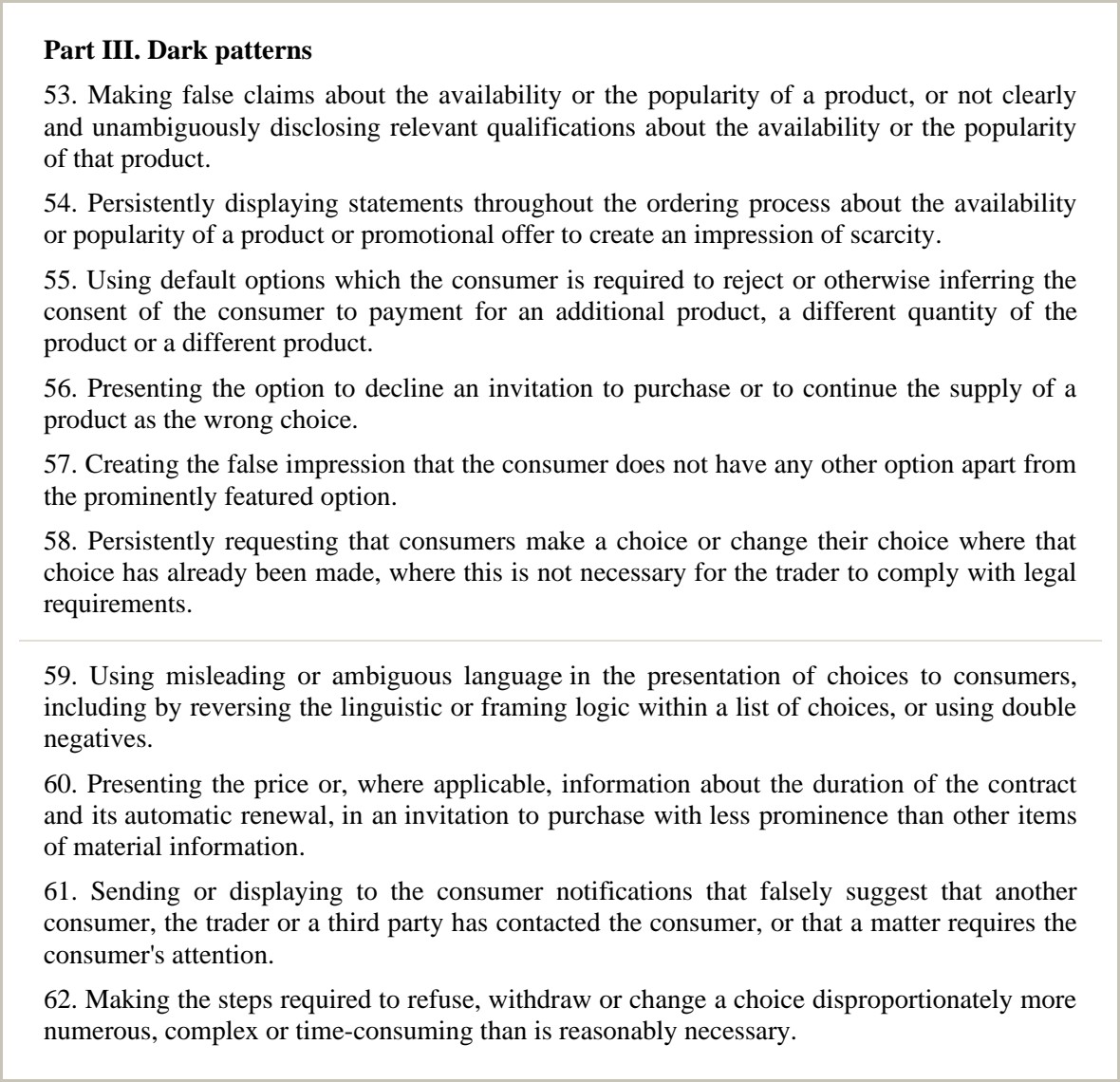
Article 10 of the DFA would ban website and app designs that are “likely to deceive or manipulate” consumers. These designs are known as dark patterns. Ten of them go on the proposal’s blacklist, an annex of practices banned in all circumstances.
The ten include false claims about stock or popularity, and scarcity messages repeated throughout checkout. They also cover defaults the customer has to undo, such as a pre-checked box or an item added to the cart automatically. Presenting “no” as the wrong choice is banned too. The Commission’s example is the message “We’re sad to see you go.”
The list also covers fake notifications and opt-out processes that are longer or more complicated than necessary. The Commission could add to the list later through “delegated acts,” rules it adopts on its own. The Parliament and the Council could only object or take that power back.
Rules for crossed-out prices and added fees
Sellers could no longer base a crossed-out price or a percentage discount on a manufacturer’s suggested retail price. They could still use a named competitor’s current price. For used or refurbished goods, they could also use the price of a new one. Discounts against the seller’s own earlier price would stay under the current rules.
The first price shown would have to include every unavoidable fee known in advance. Fees that depend on the order, such as shipping based on the customer’s address, could still be added later.
A “limited-time” offer would have to state how long it lasts. Two new blacklist entries target dropshipping, where a supplier ships the order straight to the seller’s customer. A dropshipper could not claim to have the item in stock, or tell customers they have no recourse against it.
Reminders before renewals and a button to cancel
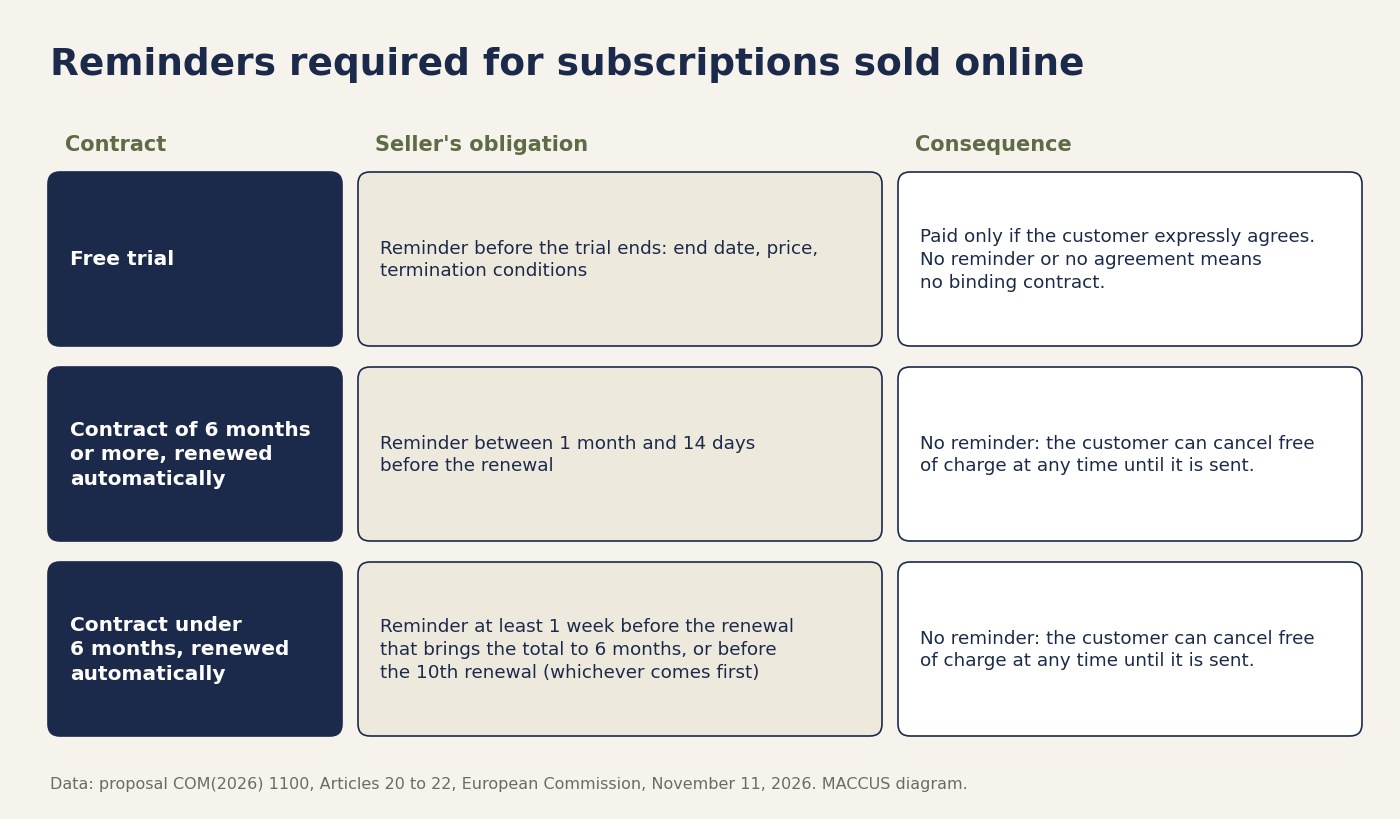
When a customer starts a free trial online, the seller would have to remind them before it ends. The reminder would give the end date, the price and how to cancel. The customer would be bound only if the seller sent that reminder and the customer expressly agreed to keep paying.
Contracts of six months or more that renew automatically would need a reminder between one month and 14 days before renewal. Without it, the customer could cancel free of charge at any time until the reminder is sent.
Shorter contracts, such as monthly plans, would need one too. It would be due at least one week before the renewal that brings the total length to six months, or the tenth renewal if sooner.
Any site that lets customers sign up online would have to offer a cancellation feature labeled “terminate the contract here,” or an equally clear phrase. A confirmation button would follow. The seller would then have to acknowledge the cancellation within a week.
France already has a similar rule. Since 2023, contracts that can be signed online must be cancelable in “3 clicks” (in French). The rule comes from a cost-of-living law dated August 16, 2022.
After a sale, customers could also demand to speak with a human when other customer service channels fail to solve their problem.
Influencers and the brands that pay them
The DFA would give the EU a legal definition of influencer marketing. It covers any business or creator who uses their popularity to promote products in exchange for payment. Payment can be money, gifts, invitations or any other non-cash benefit.
Every commercial post would have to carry the label “advertisement” or “commercial collaboration.” In France, the influencer law of June 9, 2023 already requires the French equivalents, “Publicité” or “Collaboration commerciale.” The DFA would extend a similar requirement to the whole EU.
Influencers could not directly urge minors to buy, or promote products that are dangerous or banned from advertising. Brands and agencies would be responsible for compliance, however they pay the creator and however much creative freedom they give. They would have to write the rules into the contract. If they only send a gift, they would have to take other steps, such as briefing the influencer and checking the label.
The text does not mention affiliate marketing, where creators earn a commission on each sale. Since November 4, YouTube Shopping has let French creators earn commissions on products from Amazon and the French retailers Cdiscount and Leroy Merlin.
Targeted ads and email marketing
The Digital Services Act (DSA), the EU law that governs online platforms, already bars them from showing personalized ads to minors. It also bars them from targeting ads based on sensitive data, such as health or ethnic origin. The DFA would extend both bans to all websites and apps.
Sellers could not personalize prices based on a customer’s profile when that could harm a customer they know to be a minor or vulnerable.
The rules on marketing by email, text message and automated calls would move from the ePrivacy Directive, the EU’s electronic privacy law, into consumer law.
Prior consent would remain the rule, with one exception: a seller could email its own customers about similar products. Customers would need a free way to opt out when they give their email address and in every message.
Fines of up to 6% of global revenue
The revised rules on cooperation between consumer authorities would let the Commission investigate on its own, except against small and medium-sized businesses. That power would cover cases likely to affect at least two-thirds of EU countries, with at least two-thirds of the EU population between them. In those cases, fines could reach 6% of a company’s annual global revenue.
Backed by consumer groups, criticized from both sides
BEUC, the European federation of consumer groups, said it supported the proposal on November 10, the day before the presentation. “If someone is promoting products on social media, it should be clearly stated,” said Agustín Reyna, BEUC’s director general.
On November 9, advertising industry groups wrote to the Commission. Among them were IAB Europe, the sector’s European federation, and the French trade association Alliance Digitale. The letter asked the Commission to drop two ideas: a new right to refuse personalized ads, and a concept of “dynamic vulnerability” that, they argued, could make almost anyone count as vulnerable at a given moment.
The published proposal leaves out a general right to refuse targeted ads. According to Freshfields, it does broaden who counts as a vulnerable consumer, for example someone in financial distress.
The letter cites a study by ECIPE, a Brussels think tank. The study puts possible economic losses at €10 billion to €29 billion a year, depending on the scenario.
The signatories asked the Commission to enforce existing laws first. A study done for the Commission and posted online on October 29 had already found that the Digital Markets Act (DMA), which regulates the largest tech platforms, had made little progress on ad transparency.
The German Startup Association fears the text will raise the cost of growing a business in Europe, according to the site Trending Topics. It notes that the Commission itself puts the cost to businesses at €678 million to €1.2 billion a year.
The digital rights group European Digital Rights (EDRi) says the text does not go far enough. It points out that addictive features such as video autoplay would remain legal, and users could only switch them off.
What it means
The DFA would cover tools many small business owners and creators use every day: countdown timers, low-stock banners, crossed-out suggested prices, free trials, newsletters and sponsored posts. Several are already regulated in France.
Small and medium-sized businesses would be exempt only from investigations run by the Commission itself. The obligations would apply to every seller.
Both headline figures are projections. The Commission expects consumers to save up to €13.7 billion a year. The ECIPE estimate of €10 billion to €29 billion in yearly losses was calculated before the text was published.
The proposal and its annexes exist only in English so far, so the influencer labels and the cancel-button wording have no official translation yet.
Freshfields expects the proposal to change during the negotiations. Four points are worth watching: the right to reach a human, what happens to suggested retail prices, affiliate marketing in the influencer rules, and the Commission’s power to ban more dark patterns.
Sources
- Commission strengthens consumer protection laws, making them fit for the digital age, European Commission, November 11, 2026
- Questions and answers on the Consumer Package, European Commission, November 11, 2026
- Proposal for a Regulation on promoting fair business-to-consumer practices (Digital Fairness Act), COM(2026) 1100, European Commission, November 11, 2026
- Annexes to the Proposal for a Digital Fairness Act, European Commission, November 11, 2026
- EU’s plan to tackle manipulative digital practices will benefit consumers, BEUC, November 10, 2026
- DFA: Prioritising Simplification to Preserve User Access to Digital Content and Services, IAB Europe and co-signing associations, November 9, 2026
- Digital Fairness Act: Start-Ups Warn of Costly New E.U. Obligations, Trending Topics, November 11, 2026
- Digital Fairness Act: the EU’s new consumer protection rulebook takes shape, Freshfields, November 11, 2026
Header image: MACCUS diagram, data from the European Commission (November 11, 2026)