Since October 2026, some advertisers have seen Google’s Performance Max campaigns shift a growing share of their budget to Discover, a feed in the Google app. That spending brings in very few sales. Google’s documentation shows that Performance Max offers no setting to cap Discover on its own.
Performance Max is a campaign type in Google Ads, Google’s advertising platform. Google’s AI splits the campaign’s budget among Google’s own channels and two outside networks. Google’s own channels include Search (with Shopping product ads), YouTube, Gmail, Maps and Discover. The outside networks are the Display Network of partner websites and apps, and search partners, other sites that show Google’s search ads.
On November 4, 2026, the US digital marketing agency JumpFly put numbers on the problem at one of its clients. In seven days, Discover’s share of that client’s daily budget went from about 20% to 63%. On November 9, an advertiser on Reddit described a similar shift in one campaign, and other users said they were seeing it too.
At one JumpFly client, Discover went from about 20% to 63% of the budget
JumpFly’s blog post is by Alyssa Abraham, a paid search account manager at the agency. For months, she writes, her client’s Performance Max campaigns had brought in sales worth about 10 times their ad spend. Advertisers call this ratio ROAS, for return on ad spend.
On Search and Shopping, about 3% of clicks led to a sale, a figure known as the conversion rate. Each of those sales cost about $27 in advertising, or roughly €24 at the European Central Bank’s reference rate for November 9, 2026.
According to Abraham, results weakened in October, a few days after Amazon’s Prime Big Deal Days sale. The channel performance report, which breaks down a campaign’s spending by channel, then showed money moving to Discover. In one of the client’s four campaigns, Discover’s share of spending went from 10% to 44% in a matter of days.
On Discover, clicks were cheap but rarely turned into sales. A click there cost $0.10, and 8.89% of ad views led to a click, a figure known as the click-through rate. But only 0.09% of those clicks turned into a sale, compared with about 3% on Search and Shopping. A sale from Discover cost $113 in advertising on average (about €101), versus $27 on Search and Shopping.
Abraham says she reviewed every change made to the account and found no explanation. She checked budgets, excluded keywords and creative assets, meaning the images, videos and text in the ads. “We may never know exactly why Discover began spending so aggressively here,” she writes.
On Reddit, other advertisers report the same shift
On November 9, an advertiser started a thread on r/PPC, a Reddit forum about pay-per-click advertising, with a title that begins “GAds switched Pmax traffic to Google Discover.” GAds and Pmax are common shorthand for Google Ads and Performance Max.
The poster’s figures cover one campaign over the week of November 2 to 8, compared with an earlier period the poster doesn’t specify. Discover clicks rose from 45 to 4,621. They took $1,243.58 (about €1,110) of the budget and brought in zero conversions. On Google Search, clicks fell from 878 to 44, and impressions, the number of times the ad was shown, fell from 20,280 to 786.
In the replies, one user wrote that “a lot of accounts” saw Discover jump starting in October. Another said they had “the exact same problem” and were moving budget to Standard Shopping campaigns, the classic campaign type that runs only product ads.
A third user suggested blocking Discover for the whole account. The original poster replied that the only options were priority settings for Search, search partners and Display. Setting “Google channels” to low priority with 0% of the budget looked like it would work, the poster added, but it would also shut off Search.
Google’s new settings keep Discover bundled with Search
On October 14, 2026, Google announced two new settings, covered in our article on Google Ads channel prioritization. The first, channel prioritization, lets advertisers rank each channel as high or low priority. The second, budget allocation, lets them cap a low-priority channel at a maximum percentage of the daily budget.
Google’s help page says both settings are rolling out gradually, starting October 15. They apply to Search, Shopping, Performance Max and Demand Gen campaigns, though Demand Gen doesn’t get budget allocation. Demand Gen is a campaign type that lets advertisers pick some of the channels their ads run on.
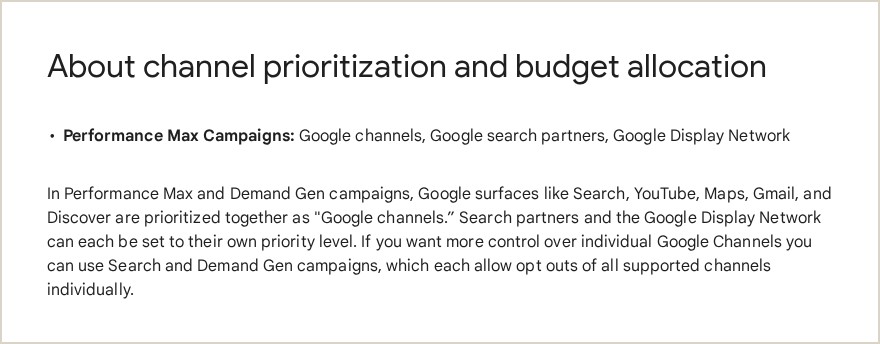
In Performance Max, Discover can’t be ranked separately. The help page offers only three options there: “Google channels,” search partners and the Display Network. “Google surfaces like Search, YouTube, Maps, Gmail, and Discover are prioritized together as ‘Google channels,'” the page says. For channel-by-channel control, Google points advertisers to Search and Demand Gen campaigns, “which each allow opt outs of all supported channels individually.”
Even the budget cap isn’t guaranteed. Google’s AI “will aim to limit the spend on that channel to within the percentage of budget that you specified, but this isn’t a guarantee,” the help page says. Daily spend on a channel “may occasionally exceed your budget allocation,” it adds.
The same page notes that channel prioritization “has no effect when your campaign isn’t limited by budget.” In other words, priorities only apply when a campaign could spend more than its budget allows.
Google’s reports, by contrast, do separate Discover. Its help page defining Performance Max channels lists Discover as a channel of its own. The page says these channel definitions will come to standard Search and Shopping reports in 2027. Search Engine Roundtable, a search marketing news site, reported that addition on November 5.
The Search Engine Roundtable article also cites Hana Kobzová of PPC News Feed, a paid search news site. According to her, analytics tools now receive new placement codes, the short labels that say where an ad ran. They include “dsc” for Discover and replace the old “x” code.
JumpFly cut Performance Max budgets and built other campaigns
JumpFly says it first cut the Performance Max budgets to a fraction of their usual level, rather than pause the campaigns. According to Abraham, Discover spending stopped right away. The little budget left went to Search and Shopping, at a much lower volume.
On October 15, Tal Akabas, director of product management at Google Ads, said that changing the budget of a stable campaign doesn’t trigger a new learning period. The learning period is the phase in which Google’s algorithm recalibrates its bids. Akabas gave no threshold for the size of the change.
Abraham rejects another fix suggested online: removing the images and videos that let a campaign run on Discover. In her view, that doesn’t guarantee the campaign will stay on Search and Shopping.
The agency then built Standard Shopping campaigns and separate Search campaigns, two formats that don’t run on Discover, Abraham notes. She also points to a Google rule on exact-match keywords, which target searches with the same meaning as the keyword. When an eligible exact-match keyword matches a search, it takes priority over Performance Max.
A separate Google help page, changed without an announcement and spotted by PPC News Feed on November 2, also says Performance Max may leave brand searches to dedicated Search campaigns. Brand searches include the advertiser’s own name.
According to JumpFly, the new campaigns brought in sales within days, though still below the client’s profitability target. The agency also describes Demand Gen as one way to test Discover separately.
The cause and the scale remain unknown
The public evidence is thin, and we found no figure on how many advertisers are affected. The JumpFly case covers a single client and four campaigns. The Reddit numbers come from one anonymous advertiser, cover one week and can’t be verified.
The cause is also unclear. Abraham notes that Performance Max works toward the campaign’s overall ROAS goal. It can move budget to any channel where its algorithm predicts a better return. She can’t explain why the algorithm kept funding Discover when sales didn’t follow.
As far as we know, Google had said nothing publicly about these cases as of November 10.
The Reddit thread also shows confusion about the new settings. The user who wrote about “a lot of accounts” suggested setting Discover to low priority. Google’s documentation offers no such option in Performance Max.
What it means
Google’s October settings targeted two outside networks: the Display Network and search partners. Many specialists have treated both with suspicion, according to PPC Land, an online advertising news site. The cases reported since then point to a possible budget leak inside Google’s own channels, which the settings treat as one block.
To rein in Discover within Performance Max, an advertiser has two choices. One is to lower the priority of all “Google channels,” Search included. The other is to move part of the budget out of Performance Max.
Black Friday falls on November 27, 2026, a little over two weeks away. Online retailers that make most of their sales through Performance Max are the most exposed.
In the JumpFly case, the drift didn’t raise alarms at first. Impressions and clicks looked healthy. Sales are recorded with a delay, so the agency expected them to catch up as usual. A high click-through rate on Discover can hide a drop in sales.
The first cases date from October, the month the new settings began reaching accounts. No source links the two.
The open questions are whether Google will respond and whether it will separate Discover from the other “Google channels” in Performance Max. Channel reports from the weeks after Black Friday will show whether the shift lasted.
Sources
- How to Protect High-Intent Traffic When Performance Max Blows Your Budget on Google Discover, JumpFly (Alyssa Abraham), November 4, 2026
- GAds switched Pmax traffic to Google Discover, clicks up 600% conv. value now $0, r/PPC thread, November 9, 2026
- About channel prioritization and budget allocation, Google Ads Help, accessed November 10, 2026
- Guide your campaign spending with new priority and allocation features, Google (Tal Akabas), October 14, 2026
- Definition: Performance Max channel, Google Ads Help, accessed November 10, 2026
- Google Ads PMax Channel Report Definitions Coming To Search & Shopping, Search Engine Roundtable (Barry Schwartz), November 5, 2026
- Google Ads lets advertisers limit Display and partner spend by percentage, PPC Land (Luis Rijo), October 14, 2026
Header image: MACCUS chart, data from JumpFly (November 4, 2026)