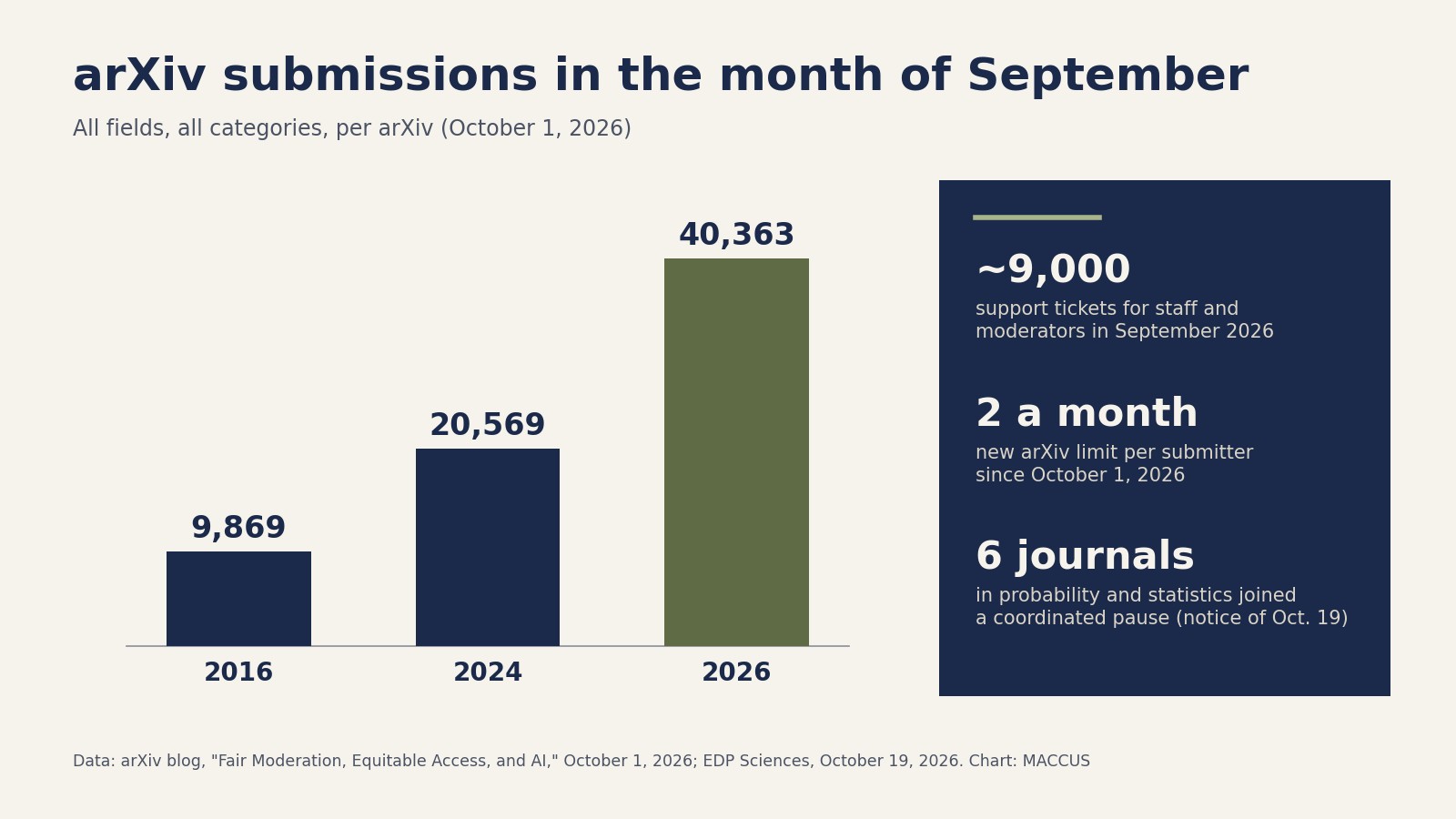

Six probability and statistics journals have stopped taking new manuscripts in a coordinated pause. EDP Sciences announced on October 19, 2026, that one of them, its journal ESAIM: Probability and Statistics, accepts no new submissions from October 19 to November 8 and reopens on November 9. The publisher cites “a substantial increase in manuscript submissions across the discipline, driven largely by the rapid development of artificial intelligence.”
The pause follows a month of rule changes. On October 1, arXiv said it had received 40,363 submissions in September, nearly twice as many as two years earlier, and limited each submitter to two a month. Machine learning conferences now cap the number of papers one author can send. Over the same weeks, OpenAI withdrew three machine-written manuscripts after a sign error, two mathematicians traced that error to its source, and two others rewrote a machine proof for human readers.
A coordinated pause in probability
The six titles named in the EDP Sciences notice are ESAIM: Probability and Statistics, the Electronic Journal of Probability, Electronic Communications in Probability, Stochastic Processes and their Applications, Bernoulli, and the Annales de l’Institut Henri Poincaré, Probabilités et Statistiques. The notice gives exact dates only for ESAIM, and there the pause covers new papers alone: authors can still send revisions, and reviews already underway continue.
According to the notice, the volume puts “considerable pressure on editorial boards and reviewers” and makes it harder to keep peer review “thorough and fair.” The ESAIM board will use the three weeks to review its aims and scope and its guidance on how authors and reviewers may use AI. It will also look for practical ways to handle the number of submissions.
arXiv’s intake doubled in two years
arXiv is the open preprint server used across physics, mathematics and computer science. In a blog post on October 1, Kat Boboris gave the September counts: 9,869 submissions in 2016, 20,569 in 2024 and 40,363 in 2026, “a new record.” That one month generated almost 9,000 support tickets for staff and moderators. Submissions to cs.AI, the artificial intelligence category, grew more than sixfold in two years, and other categories doubled.
arXiv credits AI tools with part of the growth, saying they make “certain aspects of research faster and easier.” Its volunteer moderators also report more “thin papers of narrow scope,” more “salami” papers that split one piece of work into several, and “a marked increase in dense, AI-written papers.”
Thomas Dietterich, who chairs arXiv’s Editorial Advisory Council, says that “a relatively small proportion of authors are submitting a large number of low-quality papers,” and that everyone else’s papers “can be delayed for days or weeks as a result.” Since October 1, each submitter may send up to two papers per calendar month, on top of the existing limit of three active submissions. arXiv calls the rule “a stopgap” while it works out new practice and improves its moderation tools.
Conferences cap submissions per author
The number of submissions to ICLR 2027, a major machine learning conference, “looks set to exceed 62,000, up from 490 a decade ago,” Nature reported on October 13. ICLR will take at most 20 submissions per author. Authors who have never had a paper accepted at a major AI conference get one, unless a co-author meets that bar. The program chair, Jacob Andreas of MIT, told Nature that the conference wants to discourage “very large numbers of, usually AI-generated, papers.”
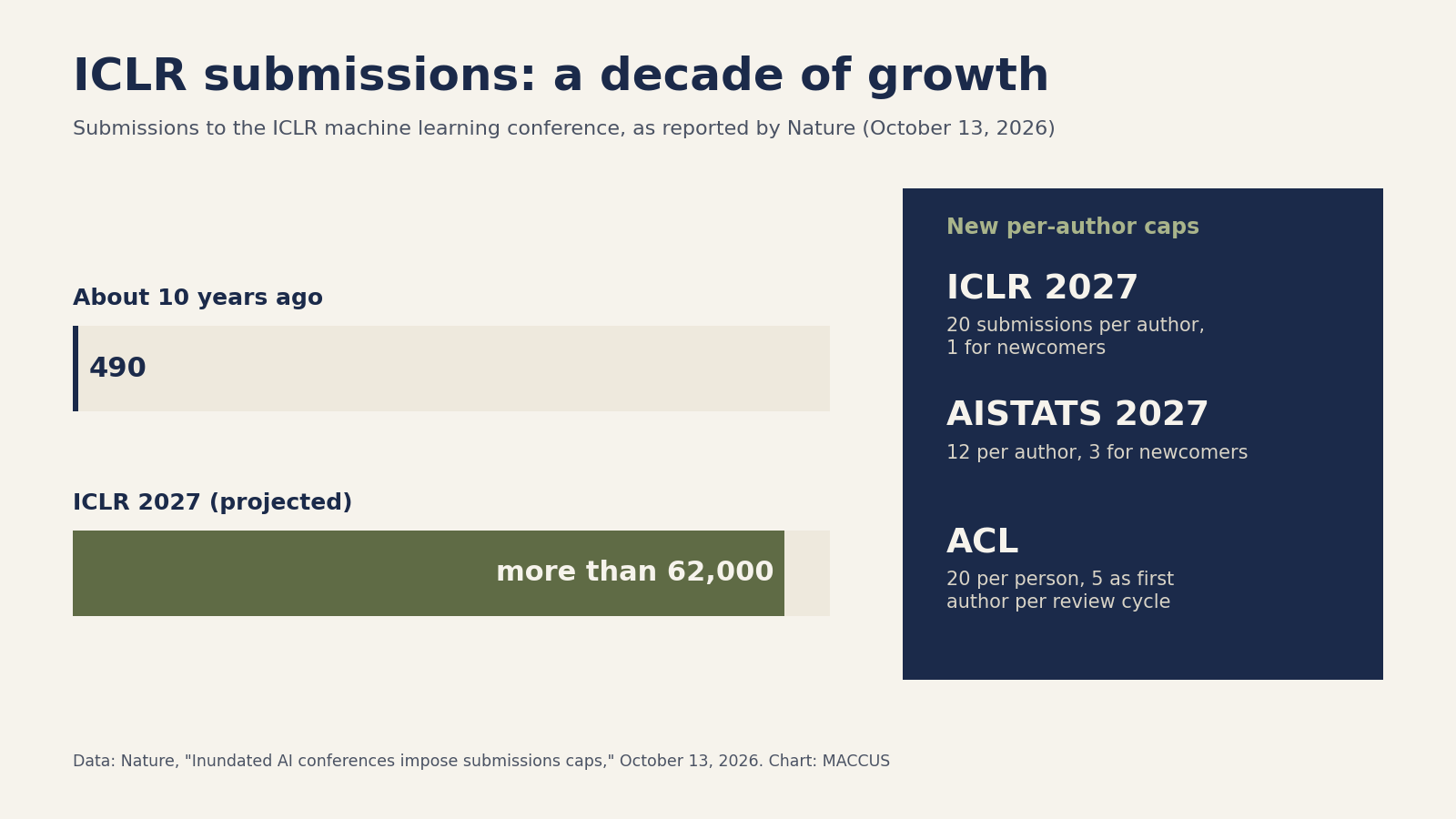
AISTATS 2027 caps authors at 12 submissions, or 3 for newcomers. The Association for Computational Linguistics allows 20 per person and 5 as first author per review cycle, citing an “unsustainable rate of submissions.” The journal Transactions on Machine Learning Research set quotas in June after its submissions tripled in a year, with single-author submissions up 13-fold.
Human experts audit machine mathematics
OpenAI keeps a public collection of 719 manuscripts produced by an unreleased internal model. The company says it posed about 4,000 problems to the model and that each result took about three hours of ChatGPT Pro thinking compute on average.
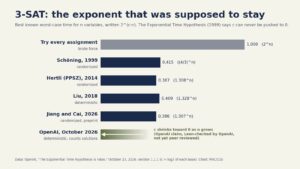
Its change log for October 7 records three manuscripts withdrawn after “a sign error” broke an argument they shared, 14 others revised with proof repairs and corrected statements, and 13 more updated to cite the new versions. By OpenAI’s count, 300 of the 719 top-line results, about 42%, now have formal proofs in Lean, a proof assistant that checks every step by machine. On October 26, OpenAI released a paper by an internal model that claims to refute the Exponential Time Hypothesis, with a Lean proof attached.
On October 22, Yanki Lekili and Nick Sheridan posted a nine-page paper that explains where the three withdrawn documents went wrong. The documents claimed to prove cases of the Hodge conjecture, and all three broke down at the same step. They computed the signs of certain intersection points with the standard convention, while the 2013 result they relied on uses the opposite one without saying so. The two mathematicians also write that the approach the documents proposed “is interesting and worth pursuing.”
Nine days earlier, Sang-hyun Kim and Yash Lodha had posted “a human written exposition of OpenAI’s recent proof that Thompson’s group F is nonamenable.” Their note restates the machine’s argument for group theorists to read.
On October 23, Terence Tao, the Fields medalist who teaches at UCLA, told The Observer that AI companies are “generating these terrible proofs. Great results, but they don’t care how elegant the solutions are, or who understands them, or what to do next.”
In August he had sketched the problem in a toy model whose numbers he called “made up.” If AI cuts the time to solve a problem from six months to a day while a careful write-up drops only from a month to three weeks, “90% of the literature will now be poorly written,” and traditional peer-review journals “would become overwhelmed.”
The caveats in the sources
None of these institutions says how many of the new papers were written with AI. arXiv says AI tools help drive the increase and that moderators see more AI-written papers. The journals call the rise “driven largely” by AI’s development and publish no figures. The 40,363 count covers every field on arXiv, and the 62,000 for ICLR is a projection.
By arXiv’s account, a small share of authors sends a large number of low-quality papers and takes up a disproportionate part of moderators’ time, yet the caps apply to everyone. Aylin Yener of Ohio State, quoted by Nature, asked why “a productive PhD student” with two papers should be stopped while a lab with prior conference papers can send 20.
Formal proofs exist for about 42% of OpenAI’s top-line results, so the other 58% still depend on human readers. Tao wrote that more automated filtering by journals “may help somewhat.” He still expects the well-curated part of the literature to become “an increasingly small fraction of a much larger ocean of lower-quality (though often technically correct) results.”
What it means
Writing a paper has become the cheap step. arXiv’s monthly intake doubled in two years, ICLR 2027 looks set to receive more than 62,000 submissions against 490 a decade ago, and six established journals paused new submissions, one of them to review its rules on AI use. The scarce input is now the time of the people who referee, moderate and formalize, and several of October’s mathematical papers were that kind of checking.
If review and formal proof scale the way generation did, the next gain in research speed will come from verification, and AI tools are already being aimed at it. In a Harvard working paper posted October 22, three former journal editors preferred AI-written peer reviews to strong human ones in 26 of 30 blind judgments. The same week, Anthropic reported that Claude had written machine-checked no-crash proofs across 123 open-source libraries. When three teams posted AI-assisted proofs of the Kannan-Lovász-Simonovits conjecture in early October, a Lean formalization appeared on GitHub within days.
ESAIM: Probability and Statistics reopens to new papers on November 9, after its board reviews its guidance on AI use by authors and reviewers. arXiv says it will monitor the effect of its limits and “modify as needed.” OpenAI’s change log will show whether the formalized share of its top-line results keeps rising.
Sources
- ESAIM: Probability and Statistics takes action to address increasing manuscript submissions, EDP Sciences, October 19, 2026
- Fair Moderation, Equitable Access, and AI: arXiv’s Updated Rate Limit Policy, Kat Boboris, arXiv blog, October 1, 2026
- Inundated AI conferences impose submissions caps, Dalmeet Singh Chawla, Nature, October 13, 2026
- openai/math (README and History), OpenAI, GitHub, change log entry of October 7, 2026
- Rigidity, flexibility, and a sign error, Yanki Lekili and Nick Sheridan, arXiv:2610.30976, October 22, 2026
- A note on the proof of nonamenability of F, Sang-hyun Kim and Yash Lodha, arXiv:2610.18360, October 13, 2026
- Terence Tao: AI turns beautiful mathematics into ‘toxic waste’, James Tapper, The Observer, October 23, 2026
- Thread on a variant of Simpson’s paradox (toy model, 4 posts), Terence Tao, Mathstodon, August 27, 2026
Header image: chart by MACCUS, data from the arXiv blog (October 1, 2026) and EDP Sciences (October 19, 2026)