
On November 19, 2026, HD Moore, chief research officer at cybersecurity firm Dragos, published the results of a five-month experiment. His team sent nearly two million booby-trapped requests to artificial intelligence (AI) services. Some of the planted secrets were stolen from three hacked companies that run AI models. Others were read by resellers or collected despite privacy settings that forbade it.
A secret handed to an AI service can be read along the way.
On November 21, OpenRouter customers posted an email from the company. OpenRouter gives access to many companies’ AI models through one interface. The email warns that requests sent to models from MiniMax, a Chinese AI company, “may have been read” by a third party.
Two million requests seeded with bait
Moore created Metasploit, a tool security testers use to simulate attacks. His team planted bait in prompts, the text users send to AI models. The bait existed nowhere else: passwords, secret web addresses and references to private code repositories.
The prompts also carried real access keys for Amazon Web Services (AWS), Amazon’s cloud computing service. They were tied to empty cloud accounts that logged every action.
The bait items are known as “canaries.” They have no other use, so if one is used, someone, somewhere, has read the prompt that contained it. Each canary belonged to a single prompt, with a known provider, model, intermediary and privacy setting.
Routers, the middlemen that see everything
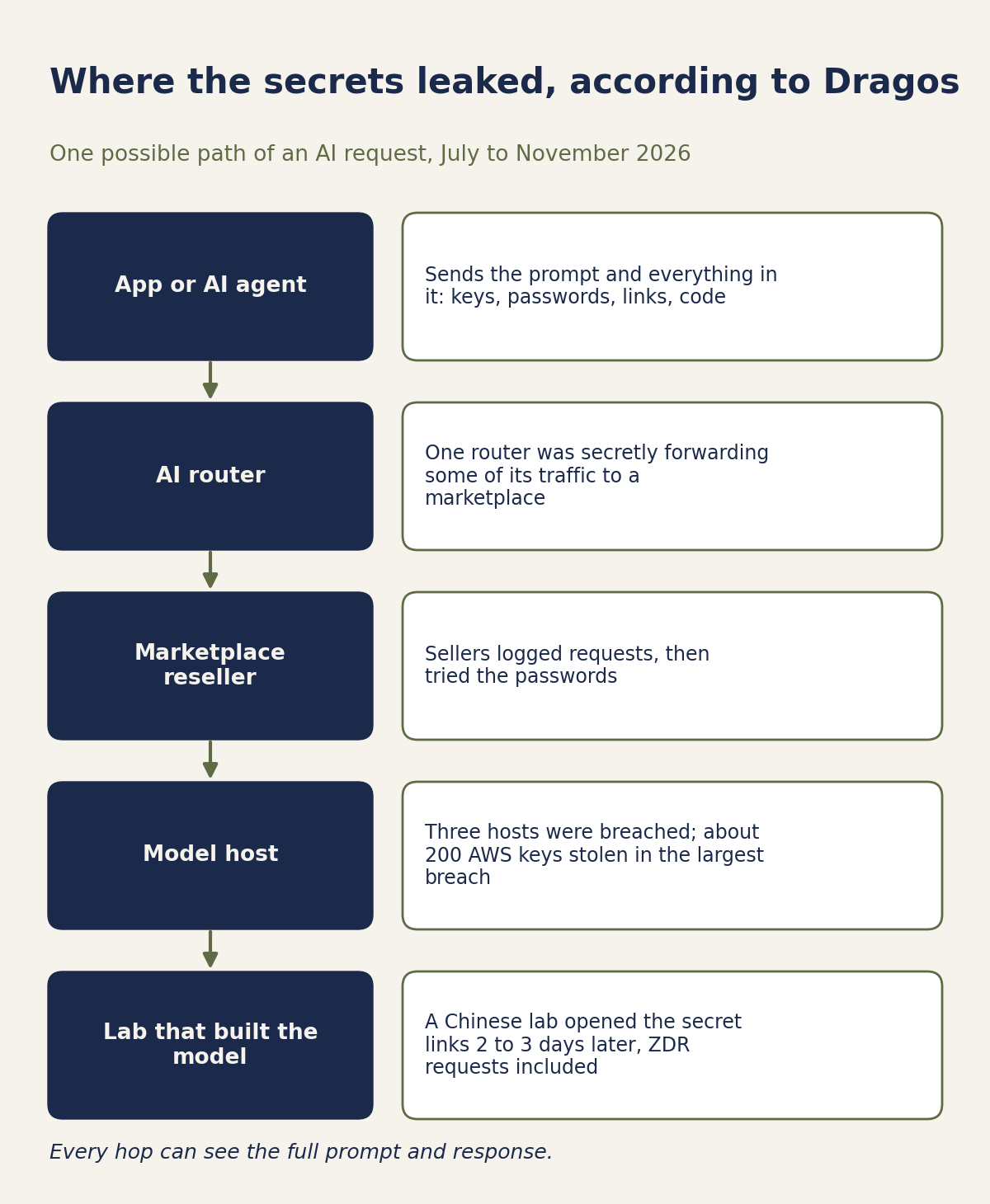
AI routers sit between an app and the models it uses. They offer one access point and one bill, then pass each request to a hosting provider, a company that runs AI models on its servers.
Ars Technica, a technology news site, cites OpenRouter and Vercel as examples. On November 16, AI platform Hugging Face handed OpenRouter the routing of its customers’ requests to language models.
A request can pass through several routers, and each stop can see the full prompt and response. Dragos traced roughly 2,000 routes, and several hundred went through a system it could not identify.
Some routers work as marketplaces, where several sellers offer the same model and the cheapest gets the request. On the shadier marketplaces, Dragos writes, requests are commonly billed to stolen AWS keys.
The strictest privacy setting is called Zero Data Retention (ZDR). Under ZDR, neither the request nor the response may be stored after processing. ZDR is not the same as the setting that keeps your chats out of model training in consumer chatbots.
Three hosts breached without their knowledge
In the most serious finding, attackers had broken into three hosting providers and were copying incoming requests. The earliest breach dates to mid-July. None of the three knew it had been breached until Dragos told it, according to the report. Real customer requests handled alongside the bait were “almost certainly” copied too, the report adds.
In the largest breach, the attacker copied every request Dragos sent during a few brief periods in late October. That haul included about 200 AWS keys. Some copied requests had been rejected before reaching a model, a sign the attacker was copying them as they arrived. In the other two breaches, some stolen requests were marked ZDR, which forbids storing them.
The attackers tested the stolen keys, sometimes within hours of the request. They searched AWS for stored secrets and tried to set up access of their own. In all, the bait keys were used for tens of thousands of requests to AWS. On November 1, one attacker started using ARTEX, an AI-driven tool for simulating attacks.
Phala reports a breach on the same dates
Dragos says one of the breached hosts has already put out a preliminary notice, but not which one. On November 10, Phala, a company that rents out “confidential” virtual machines, published a preliminary incident report. Virtual machines are computers simulated in software.
Phala’s warning covers requests that OpenRouter routed to it for the DeepSeek V4 Flash 0731 model from October 21 to November 8, 2026. Phala asks customers to treat them as exposed. An attacker had taken over the virtual machine running that model. The machine ran on a new server that went live without all of the planned protections.
Phala thanks an unnamed outside researcher whose credentials, planted in requests on October 21 and 22, were reused. The dates and the method match the Dragos report, but neither document cites the other.
Phala is not the first behind-the-scenes AI provider to be hacked. Notion AI chats were exposed in an earlier breach at Fireworks AI, a supplier to the workspace app Notion.
Resellers who read the requests
The second Dragos finding involved no hacking. On one marketplace, sellers listed a model at the lowest price, turned on logging to record requests and waited. According to Dragos, they were individuals working from what looked like home internet connections and personal computers.
In one case, two prompts went through a single seller’s listing. About a day and a half later, someone opened both secret web addresses and started guessing usernames. The bait in prompts sent to the same model through another seller was never touched.
In another case, a Mac on a home internet line in France took the passwords from two prompts. From that Mac, someone tried by hand to log in to a server as administrator, then tested AWS keys, including one sent through a different router. That router, which had been quietly forwarding some of its traffic to the marketplace, told Dragos it had stopped.
Privacy settings ignored
A Chinese AI lab that Dragos does not name opened the secret web addresses in more than half the prompts sent to its models from July to October. Among requests marked “no data collection” or ZDR, the share was about two-thirds. The lab’s crawler, a program that visits web pages automatically, usually showed up two or three days after the request.
Prompts sent through US hosts that resell the lab’s models drew the same crawler, which means they were flowing back to the lab. One large US provider was also still visiting a secret address more than two months after a single request to its search service.
Twenty-four days after a prompt marked ZDR was sent, the secret link inside it was posted in Feishu, a Chinese workplace messaging app. Within two minutes, the link was opened from three computers and three phones in Beijing and Shanghai. “In practice, these prompts were retained, shared with other companies, and read by people,” Moore writes.
OpenRouter points to MiniMax
OpenRouter’s email, posted on the tech forum Hacker News, is titled “Requests you sent to MiniMax models may have been read.” It says an unnamed security researcher placed unique test web addresses in prompts sent to MiniMax models from July to October 2026.
A third party opened them 40 to 130 hours later. This happened with requests MiniMax handled itself and with those that the hosts AtlasCloud, Novita and StreamLake forwarded to it. None of the test AWS keys were used.
OpenRouter says the problem lies with MiniMax and those hosts rather than with OpenRouter. MiniMax’s only explanation so far went to StreamLake, and OpenRouter passes it on. Content moderation was switched on before October 22, MiniMax said, and ZDR has been on since. OpenRouter is still waiting for MiniMax’s own account and has removed the ZDR label from the affected listings while it investigates.
As of 1:10 a.m. Paris time on November 22, OpenRouter’s public list of hosts for the MiniMax M3 model no longer showed any of those four companies, including MiniMax itself. All four had been among the 13 hosts listed in September, according to PrivacyAffairs, a website that covers online privacy.
Unnamed providers, no raw data
Dragos does not name the breached hosts, the Chinese lab or the marketplace where sellers read requests. Neither Dragos nor OpenRouter has said publicly that the unnamed lab is MiniMax. The connection comes from the press. PrivacyAffairs, for one, notes that the delays before the links were opened match: two to three days in the Dragos report and 40 to 130 hours in OpenRouter’s email.
The Dragos report is a blog post with no raw data and no list of the providers tested. It ends with a trial offer for one of the company’s own products.
Phala says the outside researcher’s tests covered only a sample of requests. Such tests can detect misuse, Phala adds, but cannot show every affected request. MiniMax has not commented publicly.
What it means
The study tests whether a request’s privacy setting still holds down the chain. In Moore’s words, “a privacy flag only binds the first hop,” meaning the first company a request reaches. On OpenRouter, PrivacyAffairs notes, the ZDR label comes from the provider, and the router cannot see what happens to a request once it leaves.
The risk goes beyond developers who connect to a router themselves. According to Ars Technica, many AI apps rely on these middlemen. AI agents, programs that act on their own for a user, “will happily send whatever they can read, including credentials,” Moore notes.
Hosting models in-house is expensive. Short of that, Moore recommends going directly to a first-tier provider, with “one company, one contract, and one privacy policy to read.” He also advises staying away from reseller marketplaces.
Still missing are the names of the breached hosts, the full report Phala has promised, MiniMax’s own version of events and a public notice from OpenRouter. The open question is whether and how routers will check the privacy labels they display.
Sources
- Three breaches, endless leaks: Your AI supply chain needs canaries, Dragos (HD Moore), November 19, 2026
- Phala November Preliminary Incident Report, Phala, November 10, 2026
- Tell HN: OpenRouter prompts to Minimax may have been read (text of OpenRouter’s email), Hacker News, November 21, 2026
- Zero Data Retention, OpenRouter (documentation), accessed November 22, 2026
- Researcher plants 2m canaries into the AI supply chain. A privacy disaster surfaced., Ars Technica (Dan Goodin), November 20, 2026
- OpenRouter Warns Prompts Sent to MiniMax Models May Have Been Read, PrivacyAffairs (Laura Bede), November 21, 2026