

Since August 31, 2026, businesses based in France or Belgium have been able to buy ChatGPT ads themselves, without an agency and with no minimum budget. In early October, three German data protection authorities warned that OpenAI is preparing personalized ads in Europe, based on users’ past conversations. On October 5, OpenAI announced a visual ad format and new measurement tools. If you run your own advertising, a few things need setting up before your first campaign, starting with the measurement pixel on your website.
OpenAI’s timeline since February
OpenAI started testing ads in ChatGPT in the US on February 9, 2026, according to its help center. On August 18, the company announced that ads were coming to 31 European countries, France among them. The French outlet Blog du Modérateur reported that the 31 are the countries of the European Economic Area plus Switzerland, Belgium included. Ads went live there on August 24, with advertiser access initially limited to partner agencies and OpenAI’s sales team, the same outlet added.
On August 31, OpenAI opened its self-serve Ads Manager in those 31 countries. Blog du Modérateur says the minimum commitment of $200,000 required at the start of the pilot was cut to $50,000, then scrapped. On October 9, 2026, the help center listed 63 countries open to self-serve, including France, Belgium, Luxembourg, Switzerland and Canada. The legal entity that advertises and is billed must be based in one of them.
On October 5, OpenAI unveiled several updates, three of which matter directly to advertisers. The first is a visual ad format, to be tested initially during image generation. The trial is due to start in the US in October, with a first group of advertisers.
Integrations with Hightouch, Tealium and LiveRamp make it easier to send conversion data from the tools you already use. Qualifying advertisers can now use “Negative Phrases” to exclude certain contexts.
Who sees the ads
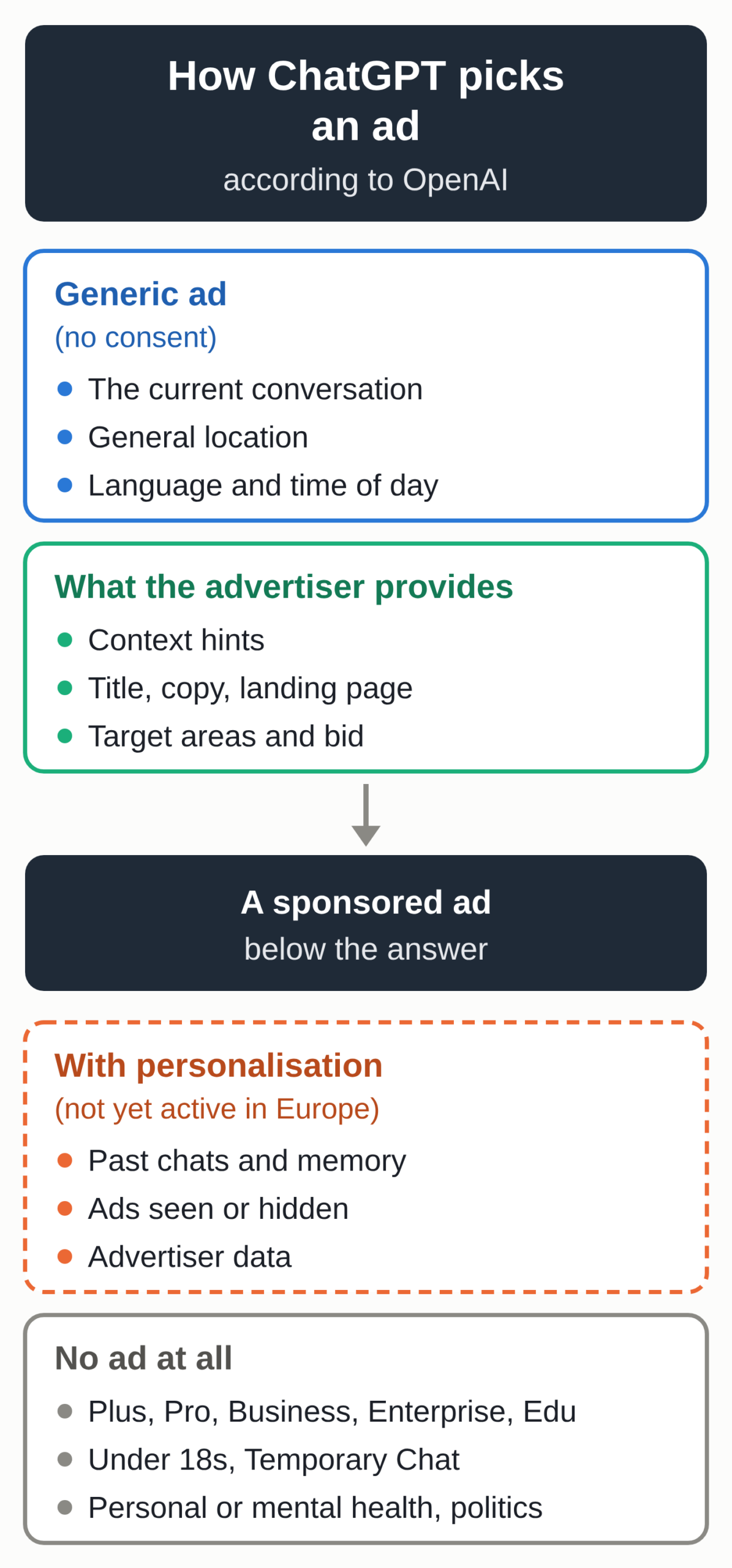
Ads appear below ChatGPT’s answer and are labeled as sponsored. Only Free and Go accounts see them. The Plus, Pro, Business, Enterprise and Edu plans stay ad-free, as do temporary chats.
OpenAI excludes accounts identified as belonging to people under 18. No ads appear next to sensitive topics such as personal health, mental health or politics, and political advertising is not allowed for now. Advertisers receive aggregated figures, such as numbers of views and clicks, with no access to conversations.
Targeting in Europe today
There are no keywords to buy in ChatGPT. The system picks an ad based on the current conversation, the ad’s title and text, the landing page and the “context hints” the advertiser writes for each ad group. You also choose which geographic areas to target.
Context hints describe the conversations you want to appear in. The logic is similar to search intent in SEO: you start from what the user says they need.
OpenAI’s help center states that personalization is not active in the European Economic Area or Switzerland. Its European privacy policy describes “generic” ads, which use limited information such as the context of the conversation, location and time of day. Their legal basis is legitimate interest.
Planned personalization and the German warnings
The same privacy policy provides for personalized advertising, which requires the user’s consent. Once users agree, ads can draw on their past conversations, ChatGPT’s memory, their interactions with ads and information supplied by advertisers. As of October 9, OpenAI had not announced a date for Europe.
On October 1, Lower Saxony’s data protection commissioner warned of a “considerable risk” to data protection and personality rights. On October 2, the Hamburg authority spoke of “hyper-personalized” advertising, and the Berlin commissioner, Meike Kamp, of a “new intensity of interference” (quotes translated from German). All three authorities advise users to refuse consent, switch off memory and use temporary chats for sensitive topics.
For advertisers, personalization will only reach people who accept it, and nobody knows yet how many that will be. The issue will be watched closely in Europe. The data controller for the European Economic Area is OpenAI Ireland Limited, which in principle makes the Irish regulator the lead authority.
What this means for a small business
In practice, you gain another acquisition channel, open to small budgets. You pay per thousand impressions or per click. With the “conversions” objective, the system optimizes delivery towards a purchase or a quote request, and you are still billed per click or per impression.
In late August, Blog du Modérateur put the market cost per click at $3 to $5, and OpenAI’s help center recommends starting with a maximum bid in that range. That is roughly €2.70 to €4.50 at the European Central Bank rate of October 8, 2026.
To measure conversions, OpenAI provides a pixel for your website and a Conversions API. The pixel’s documentation says it treats consent as granted by default, unless you set it to “false” before initialising it. Installed as is, it can therefore drop its cookies before the visitor has agreed. In France, the data protection regulator, the CNIL (page in French), states that any tracker not strictly necessary for the service the user asked for requires prior consent, and gives cookies used for personalized advertising as an example.
On Reddit, an advertiser describes running a campaign twice for an IT services company. The tool asked for the website address and optional context hints. The advertiser checked ChatGPT personally about half a dozen times and never saw the ad, even though the dashboard showed thousands of impressions. Spot checks like this tell you little: judge the channel on measured conversions instead.
What to do now
- List the questions your customers ask before they buy, in their own words. These will become your context hints, and the exercise will show whether your offer belongs in a conversation.
- Check that your landing page answers those questions above the fold: the system reads it when choosing an ad. Our content marketing guide explains how to match each search intent to a target page.
- Put measurement in place before you spend your first euro. Set the pixel to “false” by default and let your consent banner switch it on, then add the Conversions API if your website or CRM supports it. Pick a single standard event, such as a purchase or a quote request: it cannot be changed once a conversion-optimized campaign has been created.
- Run a short test with a capped daily budget, then compare the cost per lead with your Google or Meta campaigns over the same period. On the Meta side, see the AI tools Meta announced on October 6, 2026. On the Google side, review Google Ads automated promotions, which can add your offers to your ads.
- Design your ads for today’s contextual targeting. Personalization may come, but there is no guarantee that a large share of users will accept it.
A few caveats
The published performance figures come from OpenAI and its measurement partners. According to DV Rockerbox, cited by OpenAI, WeightWatchers’ attributed cost per acquisition on ChatGPT was 15.3% lower than its blended paid-search benchmark. OpenAI presents these results as examples of strong performance. They tell you nothing about how the average advertiser fares.
The $1 billion annualised revenue figure announced at the end of August is a projection: as Digiday points out, it is monthly revenue multiplied by twelve. Ads Manager is still in beta, and OpenAI can change the rules at any time.
At the end of August, Blog du Modérateur pointed out that there was no native CRM connector. OpenAI’s help center now describes a HubSpot connection that adds leads from the ads straight into that CRM. The October 5 integrations also make it easier to send conversion data. Check your account to see what is available in Europe.
What to watch next
Three milestones still have no date. The channel’s real reach will depend on two of them: the arrival of personalization in Europe, with the consent message users will see, and the launch of the visual format outside the US. The third, a formal position from the Irish authority or the CNIL, would set the rules.
In the meantime, ChatGPT ads stop the moment the budget does. If you want visibility that lasts without bidding, an organic marketing plan is still the foundation. To discuss it with us, see our organic marketing services.