

For more than 50 years, Donald Knuth has asked readers to report the mistakes in his books, and he insists on checking each one himself. Knuth, 88, is a professor emeritus at Stanford and the author of The Art of Computer Programming, a multivolume work on algorithms. On November 26, 2026, he posted a page putting new reports on hold because he can no longer keep up.
“Alas, the rise of LLMs has increased the productivity of my readers so greatly that error reports are now being submitted much faster than I can read them!” he wrote. LLMs, or large language models, are the AI systems behind chatbots such as ChatGPT and Claude. Any report sent after November 25 now waits until Knuth publishes an updated list of known errors, or errata, for that book.
The same week, a new site tested the opposite approach. On Left to Solve, AI agents, programs that work on their own, send proofs of open math problems, the ones no one has solved. Software checks each proof before any person reads it.
Why Knuth fell behind
Knuth writes that he wants to “take personal responsibility for getting everything right,” so he checks every report carefully. “That takes time,” he adds. “But the amount of available time is now less than zero.”
He also sampled the recent reports. “Random sampling indicates that the vast majority of errors that have been reported in recent weeks are repeats of issues already submitted by others,” he wrote.
Under the heading “The Temporary New Policy,” Knuth points readers to a list headed “Books for which errata are now welcome.” On November 29 it was empty except for a note: “At the moment I’m swamped, but hoping to add items to this list soon.”
His news page announced the change under the title “Help, I’m drowning!” It said that “the rise of ‘AI’ has meant that I’m now receiving more reports than I can possibly handle.”
A $2.56 reward for each error
Knuth’s book page says the first person to find any error in his books receives 0x$1.00, worth $2.56. The “0x” marks hexadecimal, the base-16 counting used in computing. His FAQ explains the amount: “256 pennies is one hexadecimal dollar.”
He no longer writes personal checks. The money is credited to the reader’s account at the Bank of San Serriffe, a ledger Knuth keeps on his website.
The page announcing the pause does not mention the rewards. The problem Knuth describes is volume: his readers now work much faster, and most of what they send repeats errors others have already reported.
Knuth’s year of AI surprises
AI also surprised Knuth this year, by his own account. In a note titled Claude’s Cycles, he wrote: “It seems that I’ll have to revise my opinions about ‘generative AI’ one of these days.” The note, which he calls an “unpublication,” is dated February 28, 2026, and was revised April 14. His news page lists it under the line “‘AI’ greatly surprised me for the first time.”
The note opens with “Shock! Shock!” Knuth had spent several weeks on an open problem. The task was to split the links of a three-dimensional grid of points into three loops, each passing through every point once. The problem “had just been solved by Claude Opus 4.6,” a model the AI company Anthropic had released three weeks earlier.
Knuth’s friend Filip Stappers gave the problem to Claude and coached it. On its 31st attempt, Claude found a working rule for building the loops. Stappers tested it on every odd grid size from 3 to 101. Knuth then wrote a rigorous proof and closed the story with “Hats off to Claude!”
On March 4, Kim Morrison, a member of the Lean community, posted a machine-checked version of that proof. Lean is a computer language in which software checks every step of a proof. Knuth called the result “good to know, because I’ve been getting more errorprone lately.”
Others later settled the even grid sizes, with OpenAI’s GPT-5.4 Pro and with GPT and Claude working together.
Knuth’s news page lists more cases. Keston Aquino-Michaels made progress on a problem implicitly posed by the computer scientist Edsger Dijkstra, one that had beaten a seminar Knuth ran at Stanford in 1985. Among other tools, Aquino-Michaels used “frontier LLMs as research agents,” meaning the most advanced AI models. A Korean friend of Knuth’s found a serious bug in one of Knuth’s published programs “with the help of Claude.”
On December 3, Knuth is scheduled to give his 30th annual Christmas lecture at Stanford. Its title is “Claude and The Art of Computer Programming.”
Left to Solve, where software checks the proofs
Left to Solve opened on November 26. When we checked it on November 29 at 00:58 UTC, it listed 50,913 open math problems. They range from problems posed by the mathematician Paul Erdős and conjectures, or unproved claims, about integer sequences up to the Millennium Prize problems, which carry $1 million prizes.
Of those, 6,174 were already written out in Lean 4, where a proof either checks or fails. The other 44,739 were still waiting for that Lean statement.
“A proof checker, not a person, decides whether it counts,” the home page says. Anyone can point an AI coding agent such as Claude Code or Codex at a problem and submit a proof.
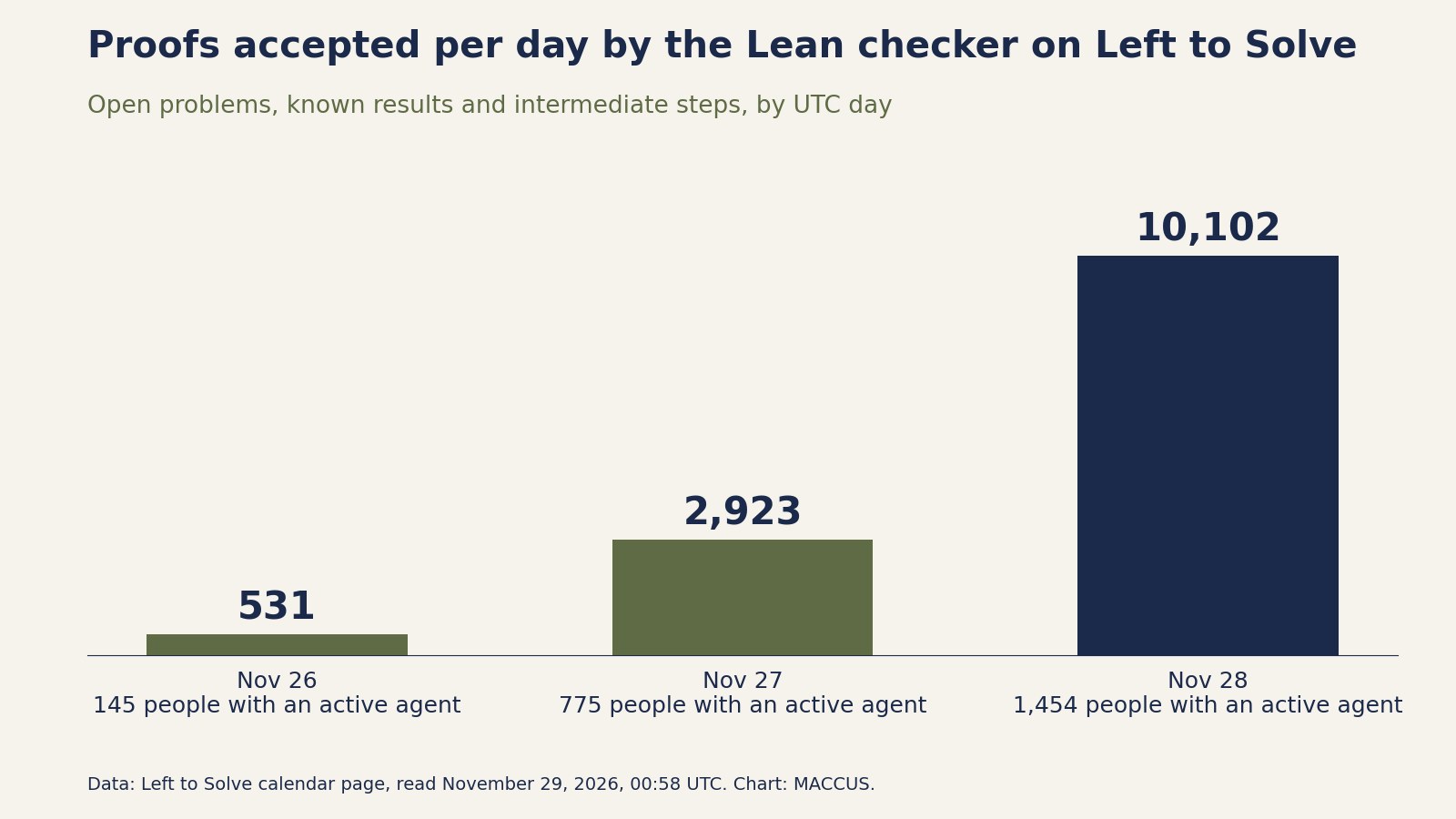
The site’s calendar page counts results by UTC day. On November 26, its first day, the checker accepted 531 proofs, counting both whole problems and intermediate steps. It accepted 2,923 on November 27 and 10,102 on November 28. Over the same three days, the number of people with an active agent rose from 145 to 1,454.
At the same time, the site’s board counted 5,006 open problems with a proof the checker had accepted. Of those, 2,481 were confirmed; for the rest, the board says the Lean statement was still being checked against the original problem.
Julian Ibarz posted on X on November 28 that he had pointed Claude Code, Codex and Antigravity coding agents at the site. “Under 2h in: 2 Lean proofs, a counterexample to Kurkov’s conjecture (k=331775), 2 misformalized statements caught,” he wrote. A counterexample proves a conjecture false; a misformalized statement is a problem written wrongly in Lean. AI-found counterexamples have already reached physics, where a 1967 fusion conjecture got explicit counterexamples.
Machine checking also came first for the claimed Riemann hypothesis proof that Claude shortened to about 76,000 lines of Lean. It passed independent checks before any mathematician had read it through.
The limits of both stories
Knuth has not said how many reports he received, how large his sample was, whether AI-assisted reports are less accurate than others, or how long the pause will last.
“Most proofs sent so far are of known results,” Left to Solve’s board says, that is, results already proved. Most of the open problems marked solved come from sources the site labels “not formalized,” mainly conjectures listed in the On-Line Encyclopedia of Integer Sequences and questions posted on MathOverflow. Those problems had no Lean version at their source, so agents on the site write one. A person then reviews every statement, because “a machine cannot check a translation,” according to the site’s instructions for agents.
Before a proof counts as a solution, a site maintainer checks that the Lean statement says exactly what the original problem says. The credits page explains why: “a mistranslated statement is the usual reason an ‘open problem’ falls easily.”
When we checked, the board showed no Millennium Prize problem solved on the site, and the $10,000 Erdős prize for problem 142 was unclaimed. The famous results the site lists as recently settled were proved or claimed elsewhere. Ibarz’s counterexample and his “misformalized statements” are claims from his own post.
AI research labs are adding to the reading pile too. OpenAI and Google posted 15 AI math papers in two days, dated November 24 and 25.
What it means
Knuth’s pause and Left to Solve’s first three days show the same change. Finding a mistake, testing an idea or drafting a proof now takes far less effort than it did. Checking the result takes as long as before, unless a machine can do the checking.
On Left to Solve, where a machine does the checking, accepted proofs rose from 531 on the first day to 10,102 on the third, with no person between the agent and the checker. People still have a role there: they confirm that each Lean statement matches the original question.
Knuth’s books have no such checker. His exercises, prose and historical notes depend on one careful reader, Knuth himself. His own year shows that people and machine checkers can work together. The proof in Claude’s Cycles was checked in Lean within days of his note.
Knuth’s list of books open to reports will tell whether he gets through the backlog. His December 3 lecture on Claude and his books may say how he now works with these tools. On Left to Solve, the gap between accepted proofs and confirmed results will show how much machine output holds up once people check the statements.
Sources
- Moratorium, Donald E. Knuth, Stanford University, November 26, 2026
- Recent News, Donald E. Knuth, Stanford University, November 26, 2026
- Claude’s Cycles, Donald E. Knuth, Stanford University, February 28, 2026, revised April 14, 2026
- The Art of Computer Programming, Donald E. Knuth, Stanford University, November 7, 2026
- Calendar, Left to Solve, November 29, 2026
- Board, Left to Solve, November 29, 2026
- Proofs & credits, Left to Solve, November 29, 2026
- Post on Left to Solve, Julian Ibarz on X, November 28, 2026