

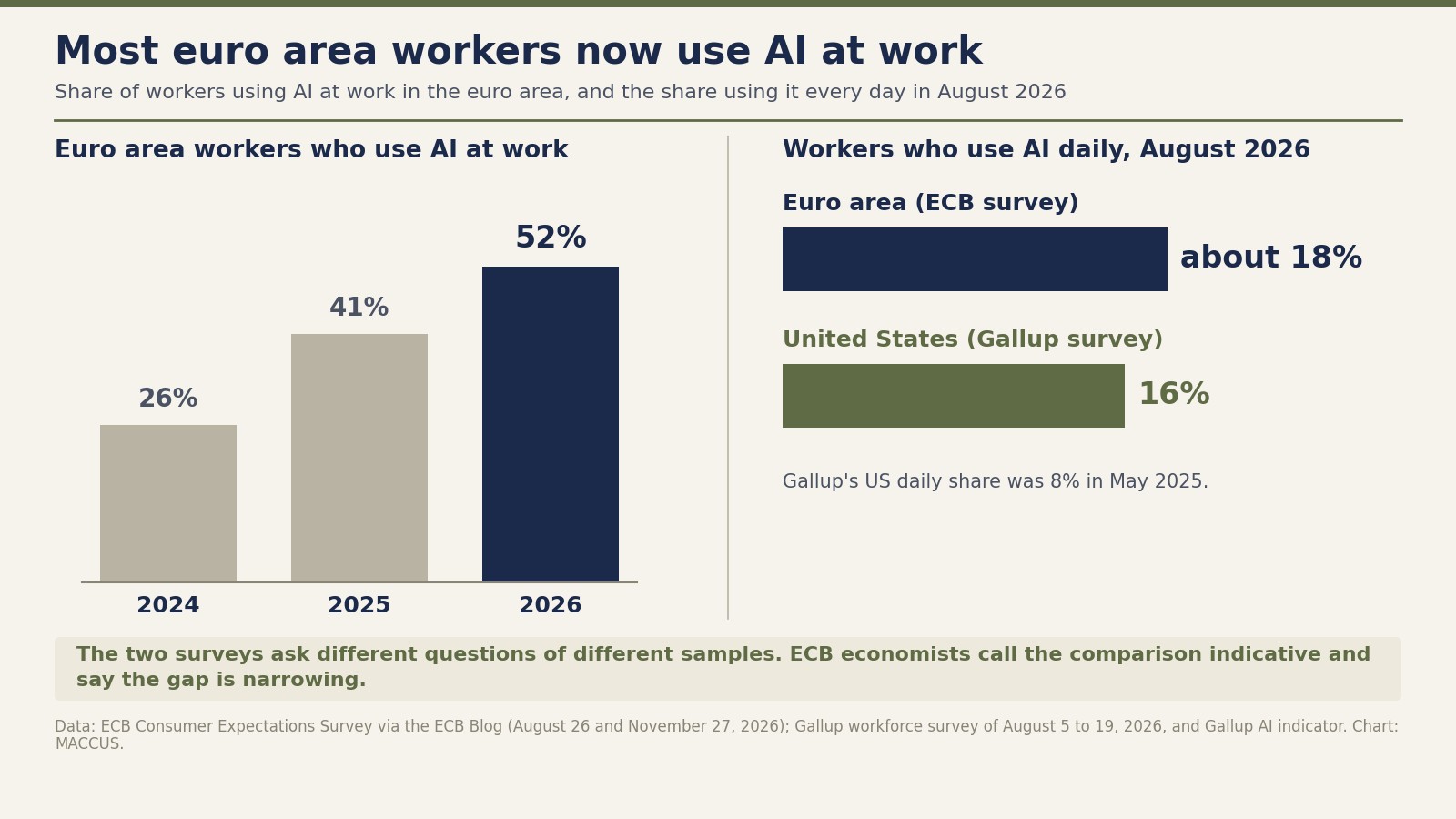
About 18% of employed people in the euro area, close to one in five, said they used AI at work every day in August 2026, according to a survey by the European Central Bank (ECB), the central bank of the EU countries that share the euro. In the United States, 16% of employees told the polling company Gallup they used AI daily the same month. The ECB economists who published the figures in a November 27 blog post called the gap striking and said it is narrowing, but warned that the two surveys ask different questions, so the comparison is only indicative.
Their concern is what comes after adoption. An outside estimate they cite projects business investment to grow about 40% in the US between 2021 and the end of 2027, compared with about 12% in the euro area. Weaker investment, they say, could leave Europe more dependent on AI technology and infrastructure from abroad. In the ECB survey, users who report no extra output from AI most often blame the time it takes to check or correct what it produces.
A rough comparison between two surveys
The euro area figures come from the ECB’s Consumer Expectations Survey, which polls roughly 20,000 people a month in 11 euro area countries. Economists Dimitris Georgarakos, Geoff Kenny and Justus Meyer presented them on November 27 in a post on the ECB Blog. In August, they report, 44% of employed people aged 18 to 64 said they used AI at work at least weekly, and around 18% said they used it daily.
Daily use “has increased steadily over the past year,” they write. “Overall, AI adoption in the euro area is similar to that in the United States. Strikingly, a larger share of consumers in the euro area report using AI daily, although this gap is narrowing.”
The US numbers come from Gallup, which surveyed 21,648 American employees from August 5 to 19, 2026. Of those, 16% said they used AI daily in their role, 32% a few times a week or more, and 53% at least a few times a year. In Gallup’s tracker, the share of US employees who say they use AI daily doubled in 15 months, from 8% in May 2025 to 16% in August 2026.
In a note under their chart, the ECB authors write that the two surveys “use different survey questions and samples,” so the comparison should be read “as indicative of trends rather than fully harmonised estimates.” For the same reason, the euro area’s 44% weekly figure and Gallup’s 32% cannot be ranked against each other.
Workplace use doubled in two years
In an August 26 post, three other ECB economists reported that the share of euro area workers who say they use AI on the job rose from 26% in 2024 to 41% in 2025 and 52% in 2026. In a March 23 speech, ECB Executive Board member Philip R. Lane put the 2025 share at 40%. The rise from 26%, he said, was “a much faster rate than the adoption of the internet or personal computers, which took about a decade to reach similar levels.”
Use is uneven. In the August post, 61% of highly educated workers said they used AI, compared with 37% of those with less education. Younger workers were about 20 percentage points more likely than older colleagues to report using it.
The typical user reported saving three hours a week, about 7.7% of working time. Only 48.8% of all workers report both using AI and saving time with it, so the economists put the saving for the economy as a whole closer to 3.8% of working hours.
Fast adoption, weaker investment
The November 27 post sets that fast uptake against weaker investment in the euro area. “A recent estimate projects that investments by firms will rise by around 40% in the United States between 2021 and the end of 2027, compared with about 12% in the euro area,” the authors write. AI-related investment accounts for a significant part of the US rise, they add, though the estimate covers all business investment. Their footnote points to Financial Times reporting from August 24.
“Combined with high and rising AI adoption, weaker domestic investment could also increase Europe’s dependence on foreign AI-related technologies and infrastructure,” the economists write. Two weeks earlier, the head of Mistral, a French maker of AI models, put a number on Europe’s wider reliance on foreign digital infrastructure. He said only 20% of European digital services run on European infrastructure, Politico Europe reported, with no method given; Mistral sells a European alternative.
The obstacles non-users cited most often in June 2025 were gaps in skills and knowledge and worries about privacy and security. Social norms and existing regulations came up less often. The authors point to measures across the whole euro area: training, clear employer rules on safe use and better access to approved tools. Privacy concerns, they add, suggest that trusted tools, “such as European solutions,” could bring more workers on board.
Output gains and checking time
In the June 2026 round, the November 27 post reports, around 56% of workers who already use AI said it increases the amount of work they complete, and 47% said it improves the quality of what they produce. Of those who say they get more done, 62% credit AI’s help with finding or processing information, and 51% say it reduces the effort their work takes.
“Among users who reported no increase in output, the most commonly cited reason is the time needed to check or correct AI-generated results,” the authors write. Other reasons include tasks AI is not suited for and concerns about keeping control. They say some of these limits may ease as workers learn where AI helps most and as companies adapt how work is organized. They call the move to higher productivity “a gradual process of experimentation and adjustment.”
American workers report a broadly similar mix. In a Gallup report published November 16, 21% of frequent US users of AI, those using it a few times a week or more, said they spend more time reviewing and correcting work since they started using it, while 23% said they spend less. A survey by South Korea’s central bank found a similar gap between time saved and output: workers there who saved the most time did not report proportionally more work.
Workers expect more AI and want rules for it
In August, employed respondents said they expected 46% of workers in their own sector to use AI within five years, up from 34% a year earlier. In the June 2026 round, more respondents expected AI to raise their risk of losing a job over the next 12 months than expected it to lift their household income or improve their job prospects.
Bloomberg, the financial news service, reported on November 26 that SAP is weighing at least 10,000 job cuts as the German software maker reorganizes around AI. SAP says no decisions have been made on further measures.
Support for regulating AI is strong among regular users and among those who use it less often or not at all, the survey found. It tends to be higher in countries where workers see a bigger risk of losing their jobs to AI. The authors say that link “does not establish causality.”
What the survey does not show
Every survey figure here is self-reported: the surveys record what people say about their use and their output, and the comparison with the US rests on two differently designed polls. The 40% and 12% investment figures are projections from an outside estimate. The November 27 post’s text gives no percentages for the reasons users cite when AI adds no output, and its charts show them only as bars. The working paper behind that post is not out yet, and ECB Blog posts give their authors’ views, which do not necessarily represent those of the ECB.
What it means
By these numbers, the euro area is adopting AI fast. Half of its workers now say they use AI on the job, compared with about a quarter in 2024. Lane called the first year of that climb much faster than the spread of the PC or the internet. The ECB economists say the euro area’s lead over the US in daily use is narrowing, though they call that comparison indicative only.
The weak point the economists name is business investment, projected to grow much more slowly in the euro area than in the US. They warn that this could leave Europe relying more on AI technology and infrastructure from abroad. At work, the main brake is more ordinary: users who report no gain in output most often cite the time spent checking AI results. That cost depends on how reliable the tools get and how fast people learn where to use them.
The first release to watch is the ECB working paper behind the November 27 post. Gallup’s next quarterly survey will show whether US daily use keeps climbing at the pace of the past year. Later rounds of the ECB survey will show whether fewer users name checking time as the reason AI adds no output.
Sources
- AI, jobs and prices: what euro area consumers expect, European Central Bank, November 27, 2026
- AI adoption and the productivity promise: what workers report, European Central Bank, August 26, 2026
- AI and the euro area economy, European Central Bank, March 23, 2026
- How AI Is Changing the Way Employees Spend Time at Work, Gallup, November 16, 2026
- Indicator: Artificial Intelligence, Gallup, updated November 24, 2026