

On November 25, 2026, a much shorter version of a claimed proof of the Riemann hypothesis, a famous math problem, appeared on GitHub, the code-sharing site. Anthropic mathematician Levent Alpöge had released the original five days earlier as 17 million lines of computer-checked code, too long to read. The new version comes in two editions: a “readable” one of about 300,000 lines of code with a reading guide, and a “compact” one of about 76,000. Its README files say Claude, Anthropic’s AI model, wrote the code and the documents, with direction from Anthropic colleagues.
Within a day, independent checks at the University of Waterloo and MIT accepted the new code. On November 25, a community project cleaning up the original code switched to the readable edition. No mathematician has read the proof through yet, and no paper comes with it. maccus.fr covered Alpöge’s original claim on November 21.
A proof too big to read
On November 20, Alpöge posted a four-page note saying he had found a proof “working with Claude.” He released the proof only in Lean, a programming language in which software checks every step of a mathematical argument. The hypothesis is about where a function called the zeta function equals zero, and through it about how prime numbers are spread out. The proof also covers the generalized version for Dirichlet L-functions, a family that extends the zeta function.
The rh-trim project, an outside effort to measure and shrink the release, counted 17,374,242 lines in 175,188 files. That is about seven times the size of Mathlib, Lean’s whole shared math library. The release had a single docstring, or explanatory comment. By rh-trim’s count, building the proof, which is how Lean checks it, takes about 21 hours on a large Amazon cloud machine.
Posting a human-readable version would have meant a “massive unreadable travesty of ‘slop’,” Alpöge wrote, as Quanta Magazine reported, so “I decided to only present Lean.” He also predicted: “My intuition insists it will be massively simplified, likely immediately.”
Outside efforts to shrink and read it
rh-trim’s attempt to shrink the proof achieved little. Its automated loop deleted unused code, rebuilt the proof, read the errors and put back what was needed. The loop ran 71 rounds over 38 hours and 27 minutes, on November 22 and 23. Its best round still had 17 errors, and no trimmed version ever built cleanly.
The project stopped with a cut of “about 8%,” leaving 15.95 million lines, and calls that figure an upper bound, “not a result.” Its explanation: “The proof is big because of what it uses.” Real savings, it wrote, would need “a shorter route through the math.”
By November 22, Michael Rubinstein, a mathematician at the University of Waterloo, had posted a 265-page working draft explaining the proof for the zeta function. He used three AI tools as study aids: Claude, Codex and Gemini. In the draft, the key step comes down to thirteen numbered hypotheses, “none of which is proved outright” in the text itself, his page says.
Two editions, written by Claude
The shorter version went up at 20:42 UTC on November 25, in a GitHub code repository named lsernau/grh-lean. The account shows no name, but Rubinstein’s Waterloo page identifies the poster as Luke Sernau. The README says the repository is “a shorter version, produced in collaboration with my colleagues at Anthropic, and Claude.”
Each edition’s README spells out the division of labor: “The Lean text and the documents in this project were written by Claude (AI).” The authors thank “the colleagues at Anthropic whose direction and suggestions shaped this rewriting.” The work keeps Alpöge’s method, but “many steps are proved by other arguments.”
The readable edition holds about 300,000 lines of code and opens with a guide that gives a reading order, a glossary and the conventions used. The compact edition covers the same five theorems in about 76,000 lines of code, or 113,000 counting comments and blank lines. Its README warns that its proofs “are written to be short, not to be easy to read.”
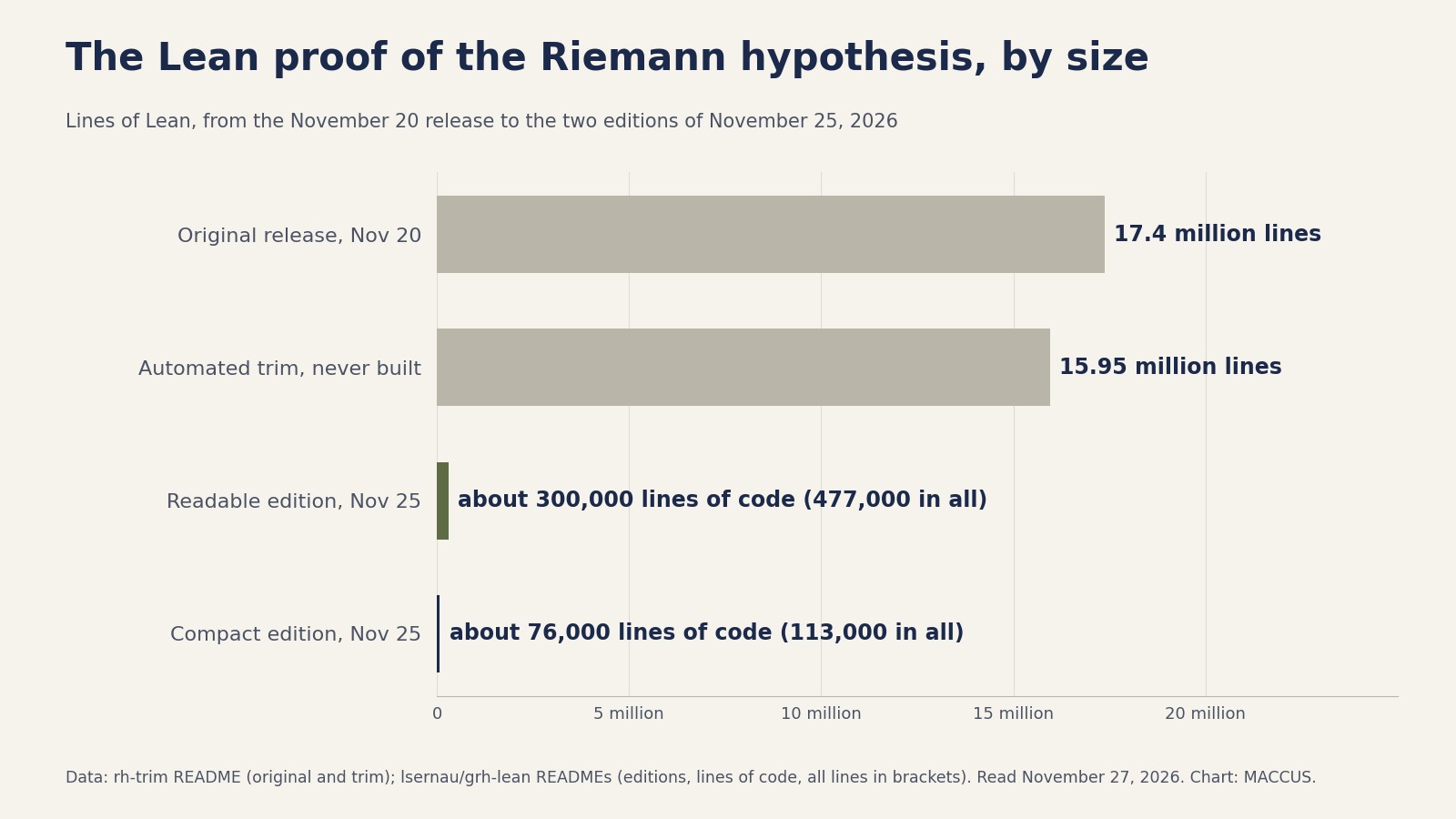
Even counting its comments and blank lines, the compact edition is more than 150 times shorter than the original as rh-trim counted it. Build time fell from about 21 hours on a large cloud machine, by rh-trim’s count, to “one to two hours on 12 cores with 24 GB of memory,” by the README’s.
Checked at Waterloo and MIT within a day
Rubinstein’s team started its check of the compact edition at 23:49 UTC on November 25, about three hours after the release. Its page notes that Claude Code, Anthropic’s coding agent, ran the checks on the university’s computers. All 794 modules (code files) compiled in under half an hour. Lean’s kernel, the small program that re-checks every step, accepted all of them.
A second tool, Comparator, run in its strictest mode, then confirmed that the code’s five theorems match the stated ones exactly. The check also put the proof through six separate kernels, and all six accepted it by 05:34 UTC on November 26.
Andrew Sutherland of MIT, who also ran his checks with Claude Code, reported the same verdict for both editions. His runs used Comparator’s sandbox, an isolated test mode, which the Waterloo computer cluster does not allow. The compact edition passed on two of his machines.
Rubinstein’s page says the theorem statements are identical to those of the original. Sutherland’s page adds that the new proof uses a later version of Mathlib, and that his team has not formally checked that the statements mean the same thing under both versions.
The Lean community switched to the new version
On November 20, Lean community members opened a repository to clean up Alpöge’s code, aiming at a version researchers could work with “without access to massive amounts of compute.” On November 25, the project replaced its main branch with one started from a copy of the readable edition.
The project’s README now reads: “This repo recently moved to a highly condensed version on November 25, 2026.” From November 20 to early November 27, the repository logged close to 9,000 pull requests (proposed changes), counting open, closed and merged ones. Maintainers merge approved small changes in batches, and the commits that assemble those batches list Claude Opus 5.5 as a co-author.
What is not yet shown
“The proof has passed machine checks only,” the lsernau/grh-lean README says. “No mathematician has read it through, and no paper comes with it.” The Waterloo page adds that the checks say nothing about whether the shorter proof is the clearest one.
The same page says the result holds only under two conditions. The Lean kernel must be sound, meaning it cannot accept a false step. Mathlib’s definitions of the zeta function and of Dirichlet L-functions must “mean what they are supposed to.”
The headline numbers also use different units: rh-trim counted every line of the original, while the new READMEs give lines of code. Counted in declarations, the definitions and theorems that checkers verify, the totals fell only about sevenfold. The checks of the compact edition accepted 204,583, against 1,468,414 accepted by rh-trim’s checkers for the original. Both totals include library material, which Sutherland’s MIT page puts at about 165,000 declarations from Mathlib and Lean’s own libraries on the compact side.
Anthropic has not announced the result. The lsernau/grh-lean repository sits on a personal account, although its license notice reads “Copyright 2026 Anthropic, PBC.” A thread on Hacker News, a tech forum, drew 545 points and called the repository “from Anthropic.” One commenter put the cut at “a 99.56% reduction”; another objected: “If this were ‘from Anthropic’ surely it would be hosted on an Anthropic account?”
New York University mathematician Maksym Radziwiłł criticized the original release in an email quoted by Quanta on November 20. His point was about Lean proofs in general. He wrote that with Lean, “if the symbols are right and follow the rules, then the symbols are a valid proof,” but “the object of mathematics as the rest of science is really the question ‘why?'”
What it means
The first objection to this proof was that nobody could read it. Five days of outside work verified the 17-million-line release, and rh-trim’s automated trim stopped at an unconfirmed 8%. Then Claude, steered by Anthropic colleagues, rewrote the proof, and independent mathematicians had it checked within a day.
So far, Claude, which produced the unreadable proof, is also the fastest route to a more readable one. That moves the bottleneck to human understanding. Whether the code is correct is the question the kernels answer, and several have now said yes, under the assumptions the Waterloo page lists.
The open question is whether a number theorist can follow the 300,000-line edition from its guide and explain why the argument works, the part Radziwiłł says matters. The AI math releases of the past week all now wait at that same step. They include Anthropic’s claimed VP vs VNP proof and the papers computer scientist Scott Aaronson reacted to on November 25.
The next things to watch are a first mathematician’s reading of the guide, a written paper from Alpöge or the Anthropic team, any statement from Anthropic, and how far the community repository shrinks the readable edition toward Mathlib’s own standards.
Sources
- GRH for Dirichlet L-functions, in Lean 4 (lsernau/grh-lean), GitHub, November 25, 2026
- rh-trim: Checking, mapping and shrinking the claimed Lean proof of the Riemann Hypothesis, GitHub, November 23, 2026
- riemann-hypothesis (leanprover-community), GitHub, November 26, 2026
- Short GRH Lean Check, Michael Rubinstein, University of Waterloo, November 26, 2026
- Alpöge/Claude proof of the Generalized Riemann Hypothesis, Michael Rubinstein, University of Waterloo, November 26, 2026
- Shorter Lean proof of RH and GRH for Dirichlet L-functions: verification files, Andrew Sutherland, MIT, November 26, 2026
- Transformation, Quanta Magazine, November 24, 2026
- remark, Levent Alpöge, November 20, 2026